
58 Japandi Bathroom Ideas To Create A Calm And Timeless Space
There is something quietly extraordinary about walking into a bathroom that simply asks nothing of you. No visual noise, no competing colors, no cluttered shelves demanding attention. Just space, warmth, and a deep sense of calm. That is the promise of Japandi design and nowhere does it feel more at home than in the bathroom.
Japandi is the design marriage between Japan and Scandinavia, two cultures that have spent centuries refining the art of living simply and purposefully. Japanese design brings wabi-sabi an appreciation for imperfection, natural materials, and quiet beauty. Scandinavian design contributes hygge a warm, cozy feeling of comfort and contentment. Together, they produce something greater than either achieves alone: spaces that are minimal but never cold, functional but never clinical, beautiful but never boastful.
Read: Stylish Bathroom Ideas for Every Home
The bathroom is the most personal room in a home. It is where you begin and end each day. Designing it with Japandi principles means choosing every tile, fixture, and towel with intention not to impress, but to restore. In this article,
we’ve gathered original Japandi bathroom ideas across carefully curated themes to help you design a bathroom that genuinely feels like a retreat. Whether you’re planning a full renovation or simply refreshing a few details, these ideas will guide you toward a space that is as calming to live in as it is beautiful to look at.
Embrace the Philosophy: What Japandi Really Means for a Bathroom
Before diving into specific ideas, it’s worth understanding what makes a bathroom truly Japandi because the style is a mindset as much as an aesthetic.
Read: Stunning Spring DIY Home Decor Ideas to Refresh Your Home
1. Start With Subtraction, Not Addition
The first rule of Japandi bathroom design is to remove before you add. Walk into your existing bathroom and ask: what can go? Cluttered countertops, mismatched accessories, shelves overloaded with products all of these work against the calm you’re trying to create. A Japandi bathroom begins in negative space. Empty surfaces, clean floors, and unobstructed sightlines form the canvas that everything else builds upon.

2. Honor Natural Materials Over Manufactured Ones
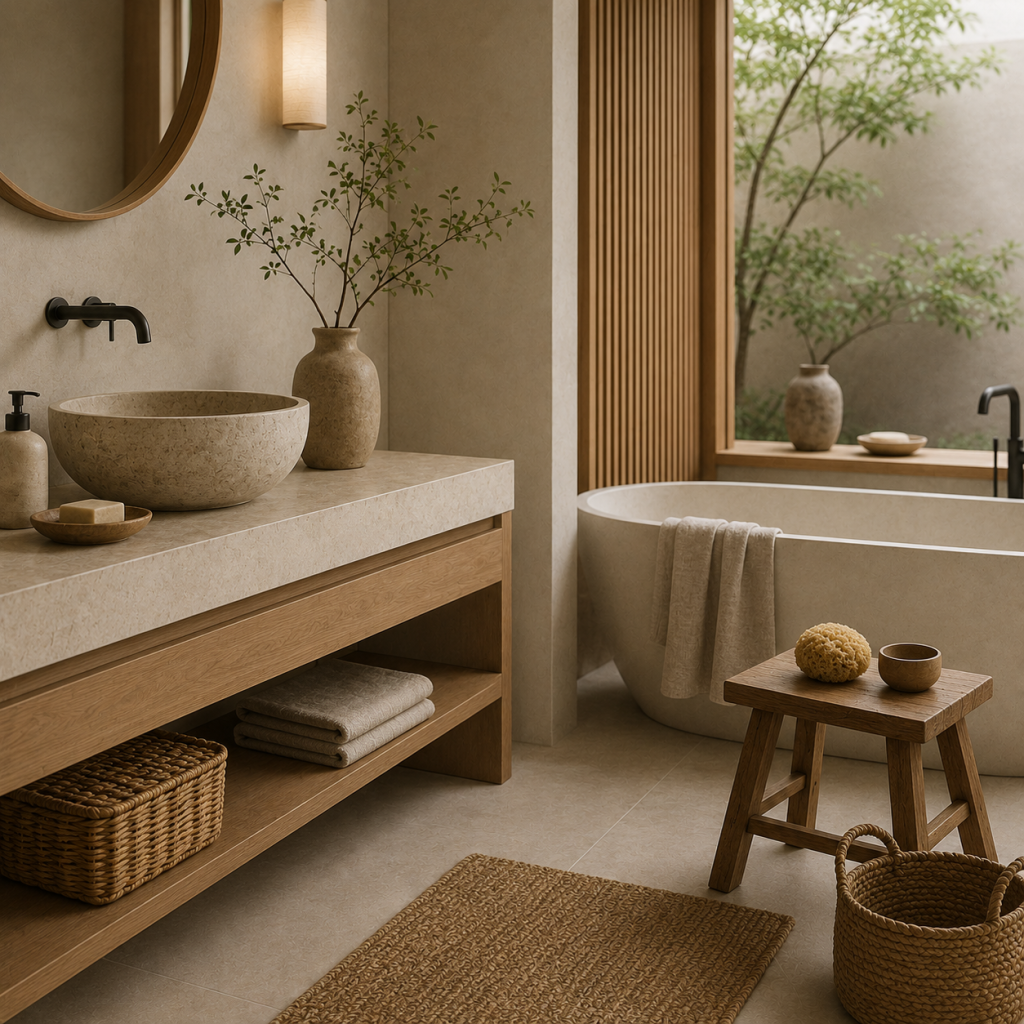
Japandi design has a deep reverence for materials that come from the earth. Stone, wood, linen, clay, and rattan all carry an organic irregularity that manufactured finishes cannot replicate. In a bathroom, this might mean a hand-thrown ceramic soap dish, a teak bath stool, a limestone countertop with gentle veining, or a woven storage basket instead of a plastic bin. These small choices accumulate into an atmosphere that feels grounded, authentic, and deeply calming.
3. Functionality Is Never an Afterthought
Unlike purely decorative design styles, Japandi demands that every element works. A beautiful floating vanity that lacks adequate storage will fail the Japandi test. A stunning stone floor that is painfully cold in winter is not truly comfortable living. Think about how you actually use your bathroom each day and design around those rituals then choose materials and forms that serve them beautifully.
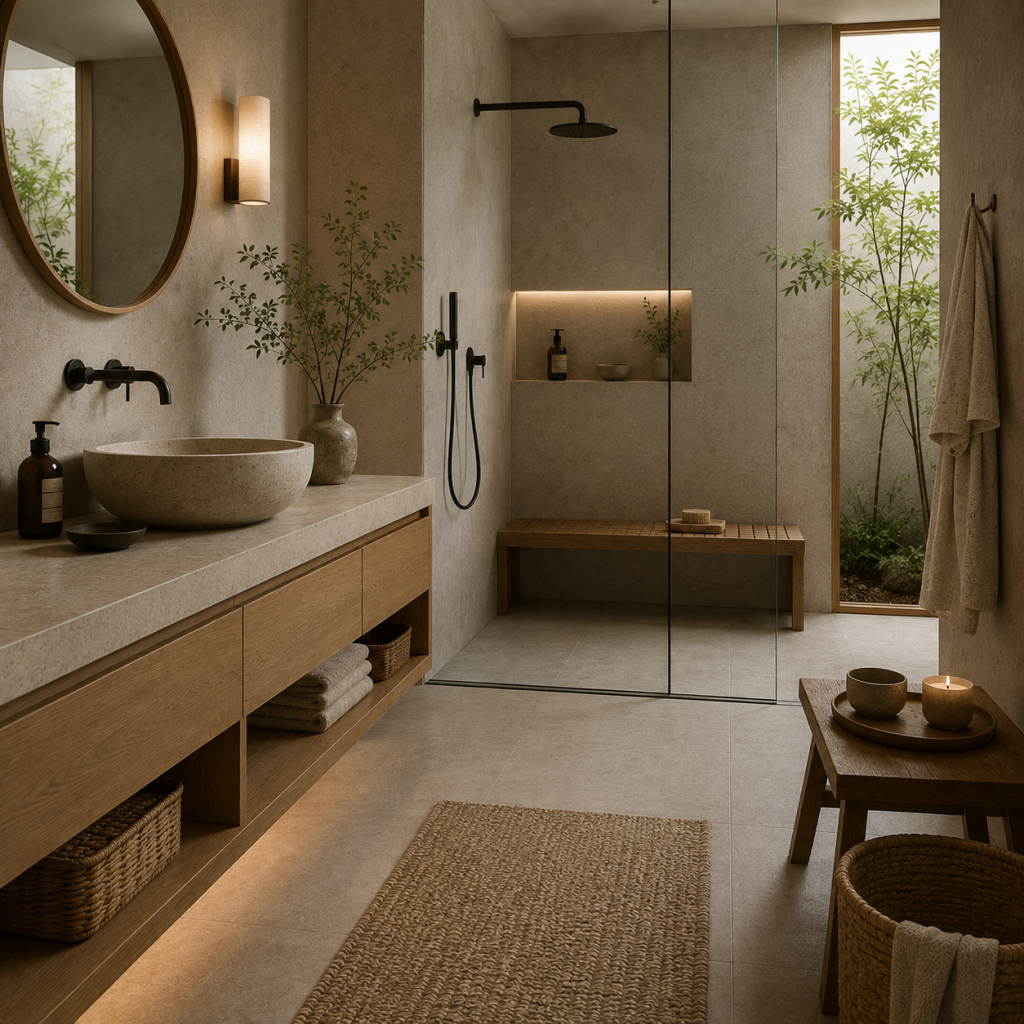
4. Imperfection Is Welcome
Japanese wabi-sabi philosophy celebrates the beauty of things that are weathered, irregular, or imperfect. This is liberating in bathroom design. You don’t need flawless white grout or perfectly matching accessories. A handmade ceramic with an uneven glaze, a linen towel with visible texture, a piece of driftwood repurposed as a shelf these “imperfections” are precisely what give a Japandi bathroom its soul.
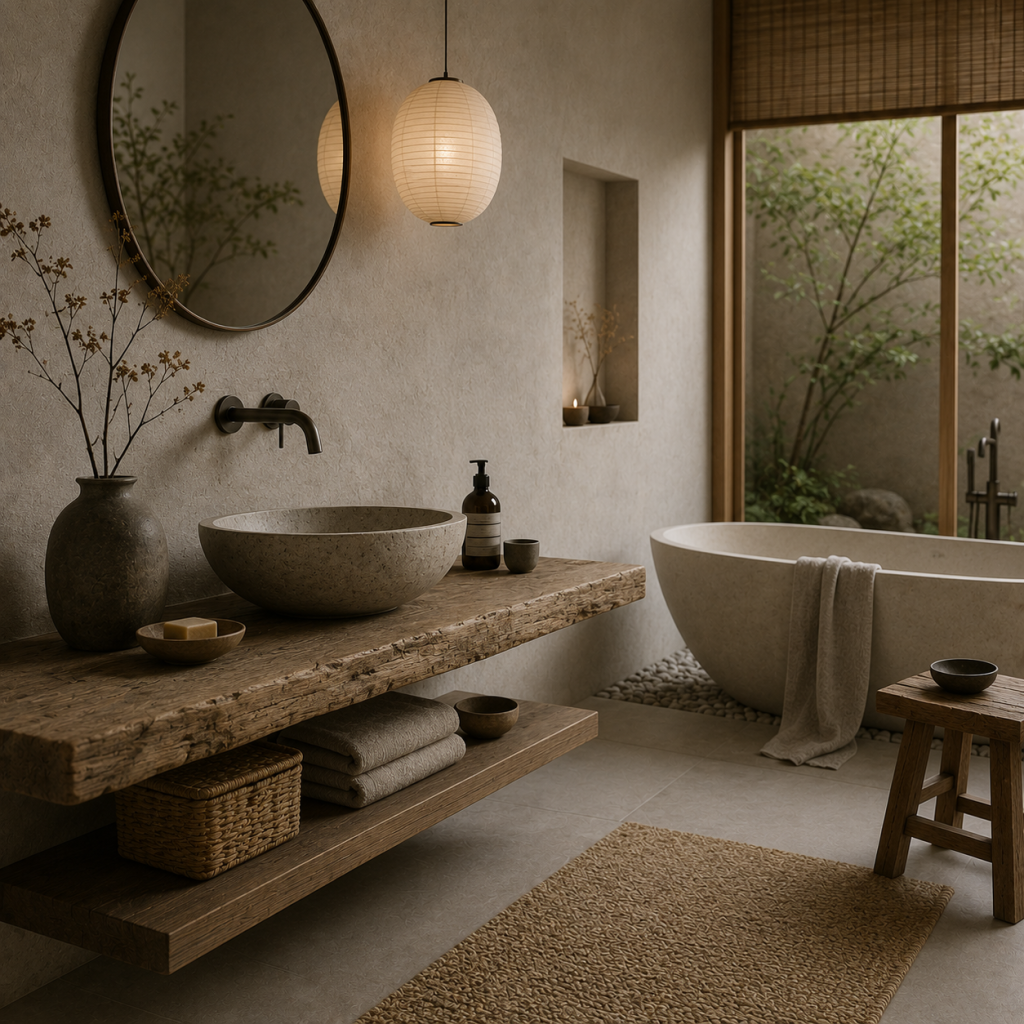
5. Design for Every Sense, Not Just Sight
The best Japandi bathrooms are designed to be experienced, not just photographed. Consider the sound of water echoing off stone walls. The warmth of heated tiles underfoot on a winter morning. The faint scent of eucalyptus or cedar from a natural diffuser. The soft weight of a thick linen towel. Engaging all the senses creates a truly restorative bathroom experience that no amount of Instagram-worthy styling alone can achieve.

Color Palette Ideas: Quiet Tones That Calm the Mind
Color in a Japandi bathroom is never loud or demanding. It whispers rather than shouts, suggesting mood rather than declaring it.
Read: Small Bedroom Organization Hacks
6. Warm White With Wheat and Sand Undertones
Pure, cool white can feel clinical in a bathroom. Instead, choose whites with warm undertones creamy white, aged linen, and soft chalk all introduce gentle warmth that makes the room feel welcoming rather than sterile. Layer these tones across wall tiles, cabinetry, and ceiling for a cohesive envelope of quiet light.
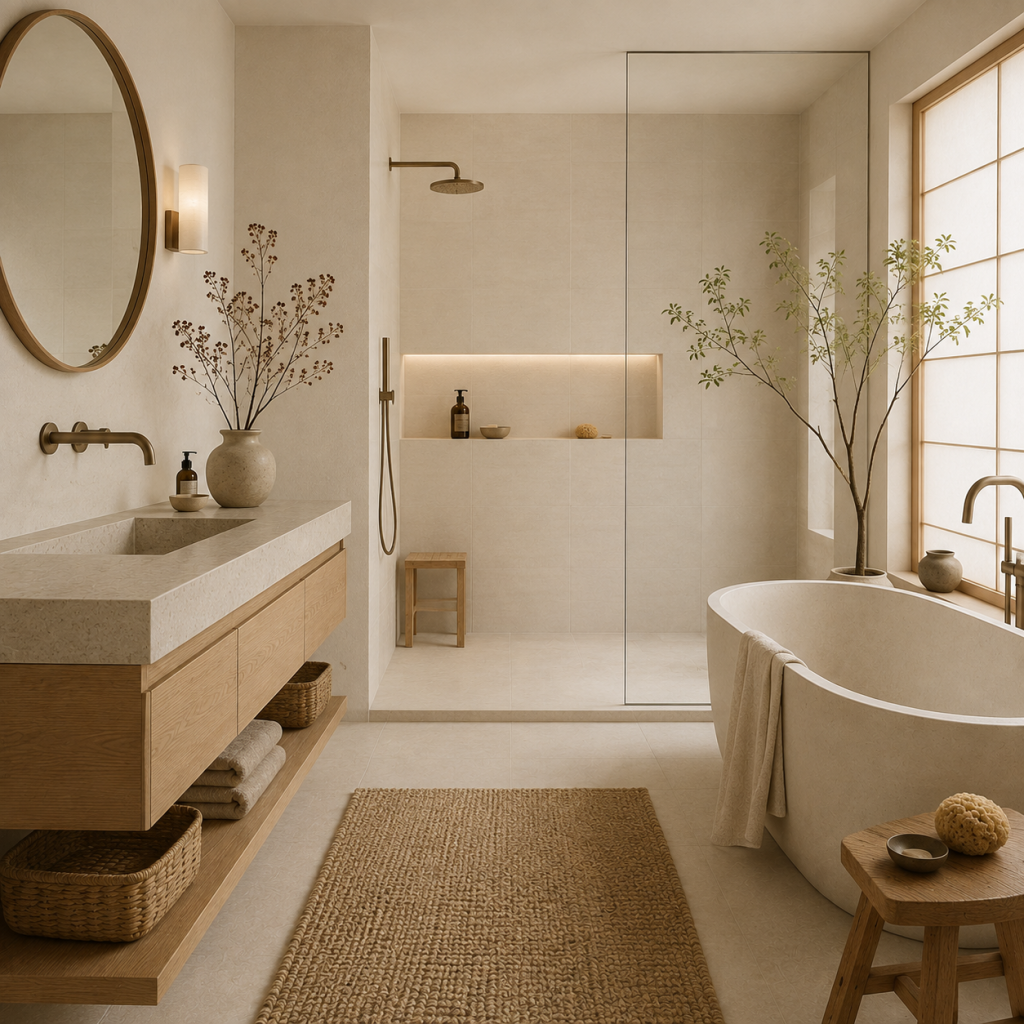
7. Sage Green as a Nature-Inspired Accent
Soft sage green is one of the most beautiful accent colors in Japandi bathrooms because it evokes moss, forest, and the Japanese concept of shinrin-yoku (forest bathing). Use it on a feature wall behind the vanity, in the grout between tiles, or through textiles like towels and a bath mat. Paired with natural wood and matte white, sage creates a bathroom that genuinely feels connected to the natural world.
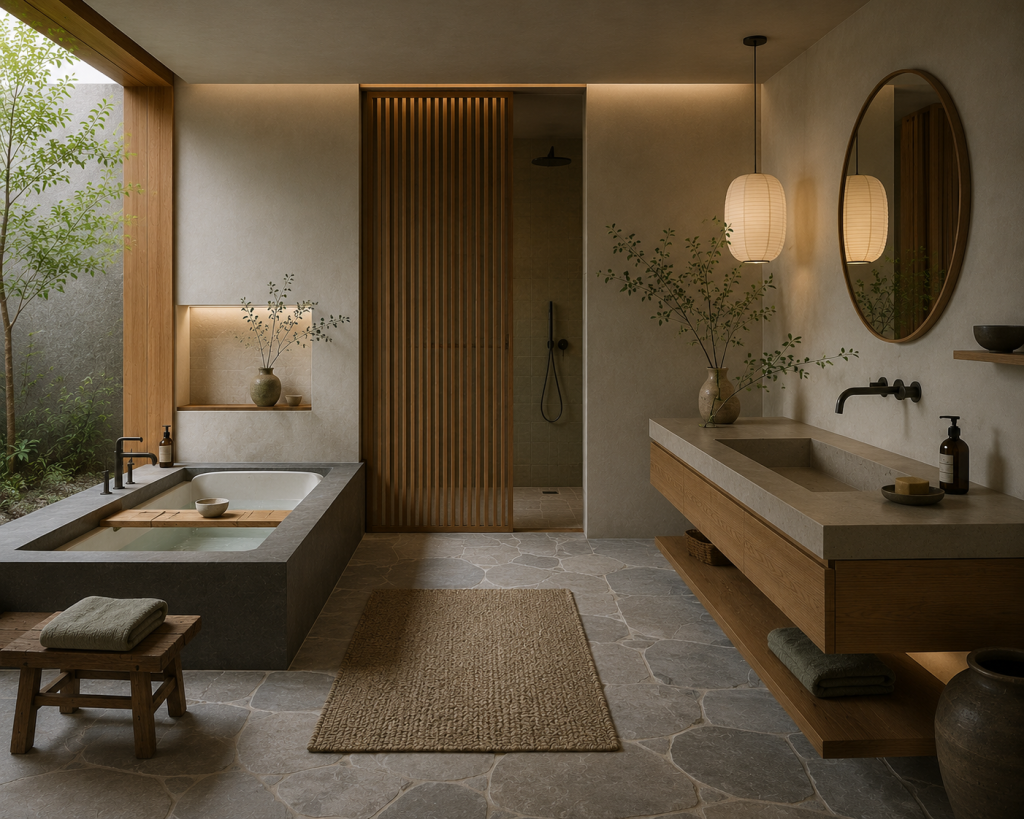
8. Charcoal and Warm Gray as Anchor Shades
Deeper tones have a role in Japandi design, but they must be handled carefully. Charcoal gray used on a single wall, as a ceiling accent, or through large-format floor tiles can ground the room without making it feel heavy. The key is pairing darker shades with plenty of warm white and natural wood so the overall mood remains light and restful.
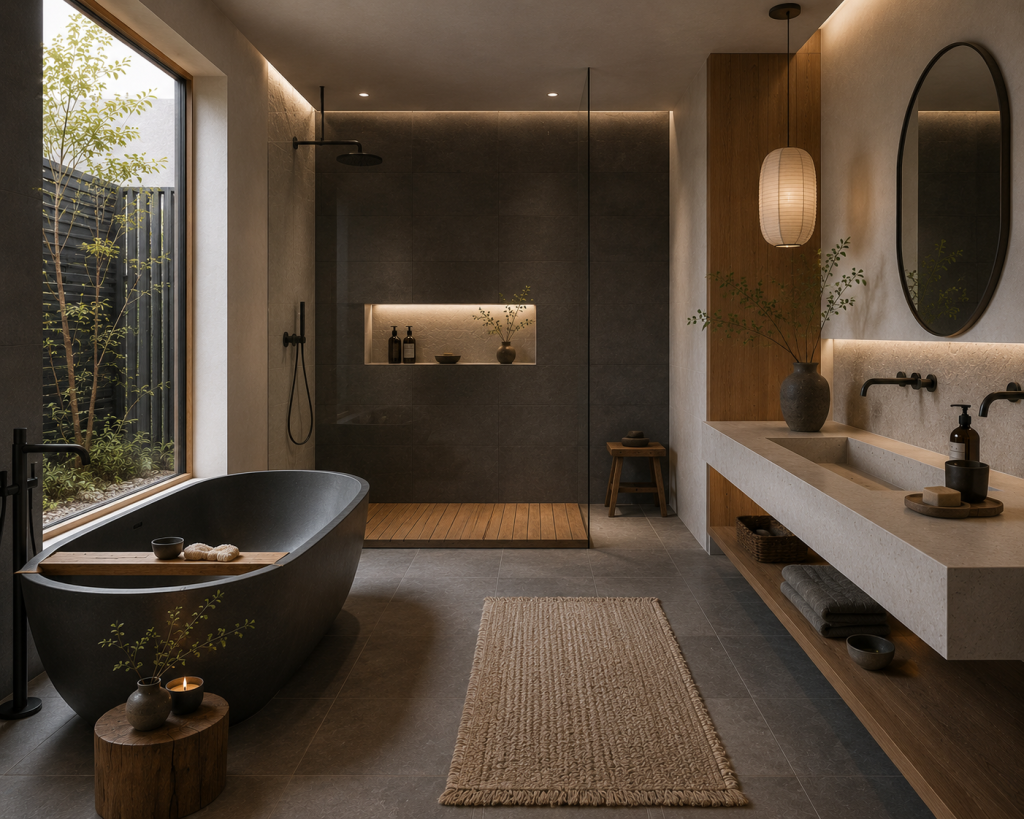
9. Terracotta and Clay as Earthy Warmth
Soft terracotta tones dusty, muted, and chalky rather than bright orange bring beautiful warmth to a Japandi bathroom. Consider terracotta-finish plaster on a single wall, clay-colored towels, or handmade ceramic accessories in burnt sienna. These earth tones pair beautifully with pale oak cabinetry and off-white tiles, creating a bathroom that feels both organic and refined.

10. Monochromatic Warmth Through Tonal Layering
Rather than introducing multiple distinct colors, consider building the entire bathroom palette from one color family in different shades and finishes. Start with a warm taupe tile, carry the tone into a slightly lighter painted wall, and deepen it through dark oak cabinetry. This tonal approach creates visual depth and sophistication without relying on contrast and the result is effortlessly calm.

Flooring Ideas: What You Stand On Sets the Tone
Flooring is one of the most tactile decisions in a bathroom. In a Japandi space, what you feel underfoot is just as important as what you see.
Read: Small Living Room Furniture Layout Idaes
11. Large-Format Stone-Look Porcelain With Minimal Grout
Nothing disrupts the visual calm of a Japandi bathroom more than a busy grid of small tiles and thick grout lines. Choose large-format porcelain tiles ideally 60×60cm or larger in a soft stone-inspired finish. Fewer grout lines mean a cleaner, more seamless floor that makes the room feel significantly larger.

12. Honed Limestone or Travertine for Authentic Texture
For those willing to invest in natural stone, honed limestone and travertine floors bring an extraordinary warmth and tactile richness to a Japandi bathroom. Unlike polished stone, honed finishes have a matte, softly textured surface that feels genuinely organic. Sealed properly, they are durable and practical while remaining visually spectacular.
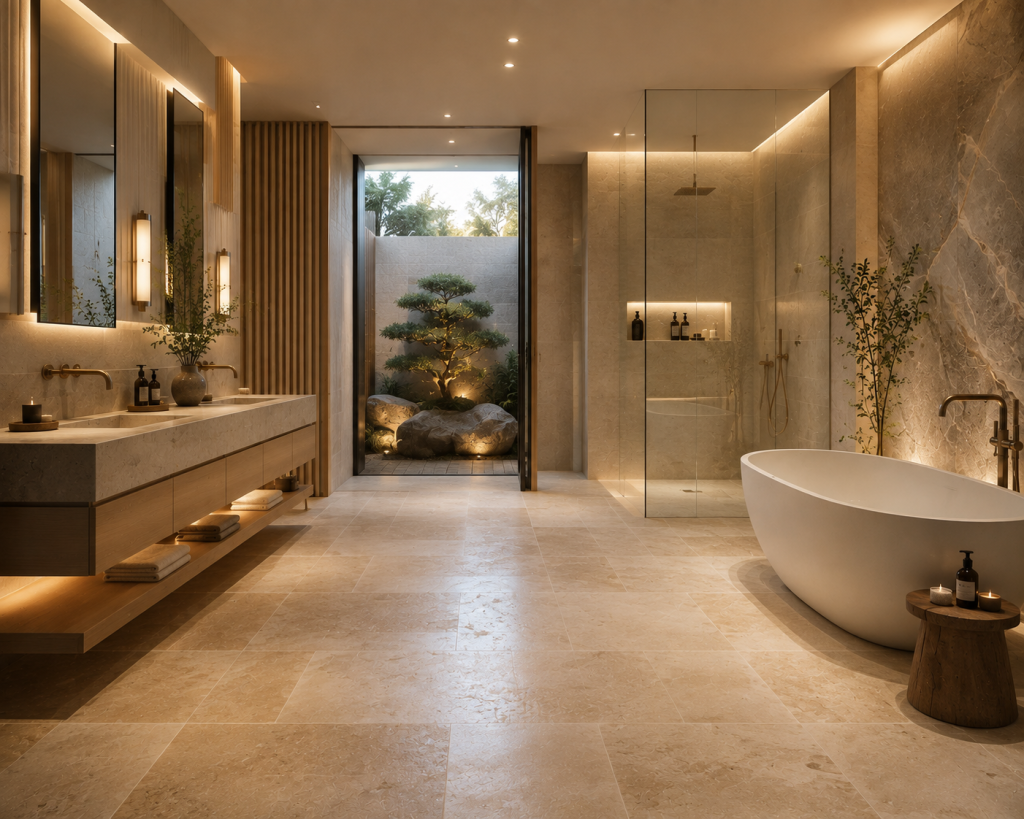
13. Pale Oak Wood Effect Tiles for Warmth Without Risk
The desire to introduce wood into a bathroom floor is understandable nothing is warmer underfoot but real wood can warp and swell in humid environments. High-quality wood-effect porcelain tiles solve this problem beautifully. Choose narrow planks in pale oak or ash tones, installed in a simple parallel pattern for a floor that reads as warm, natural, and quietly Scandinavian.
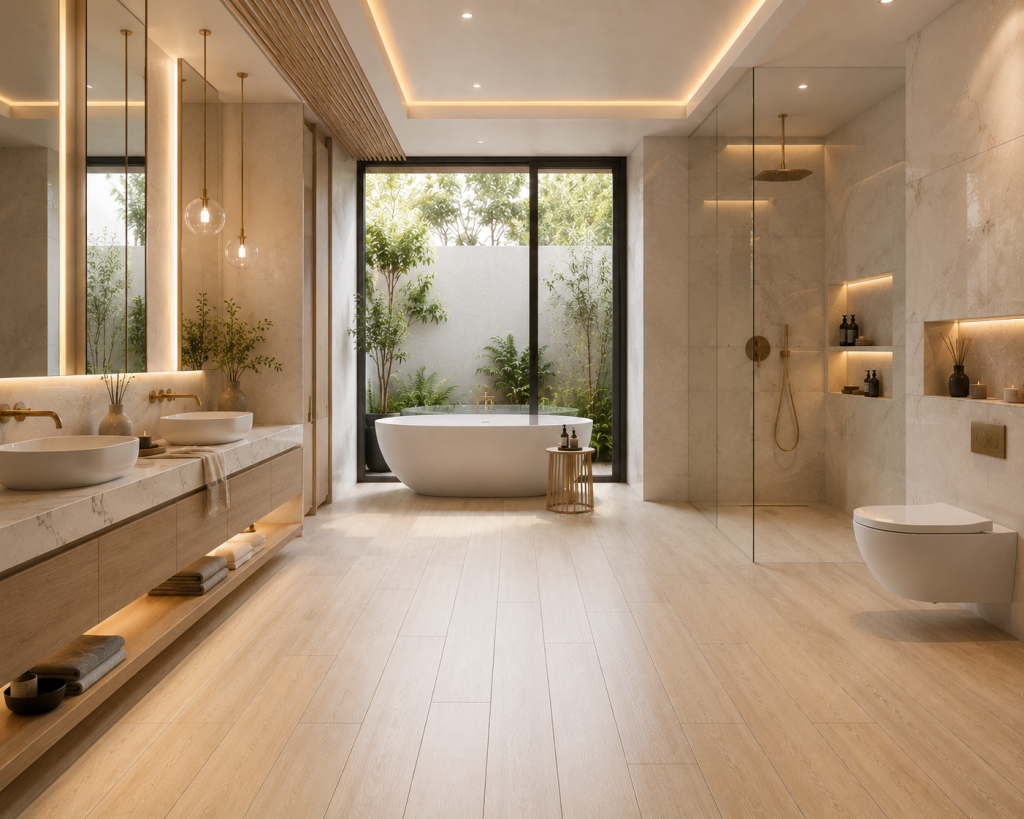
14. Microcement Floors for Seamless Contemporary Calm
Microcement is one of the most dramatic flooring choices available in a Japandi bathroom. Applied as a thin continuous coating over the entire floor and up the walls if desired it creates a completely seamless, joint-free surface that feels architectural and sculptural. In warm gray, sand, or taupe tones, a microcement floor is both visually calm and exceptionally practical.
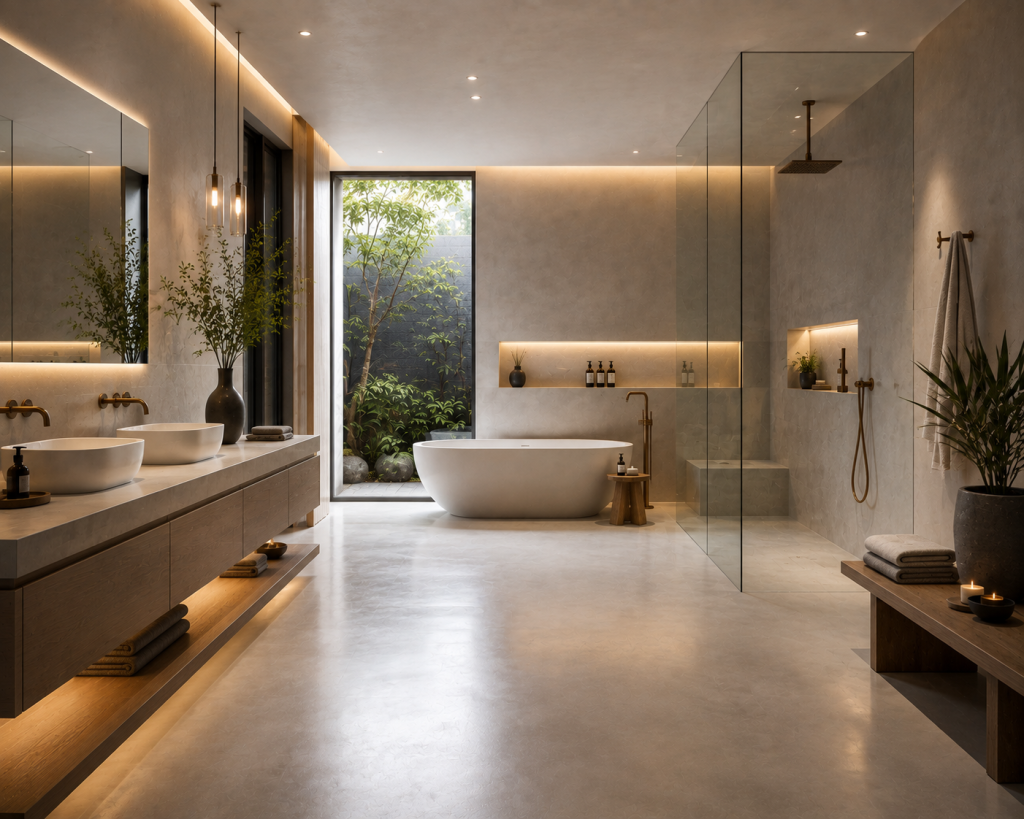
15. Underfloor Heating as a Non-Negotiable Comfort Element
A Japandi bathroom is designed for daily rituals, and stepping onto a cold floor at 6am is the opposite of restorative. Underfloor heating beneath any tile or stone floor transforms the ordinary act of getting out of the shower into something genuinely pleasant. It also eliminates the need for bulky radiators, keeping the walls clean and unobstructed.

Wall Treatment Ideas: Texture and Tone Without Decoration
Walls in a Japandi bathroom are the opportunity to introduce subtle texture, warmth, and depth without relying on art, patterns, or busy decoration.
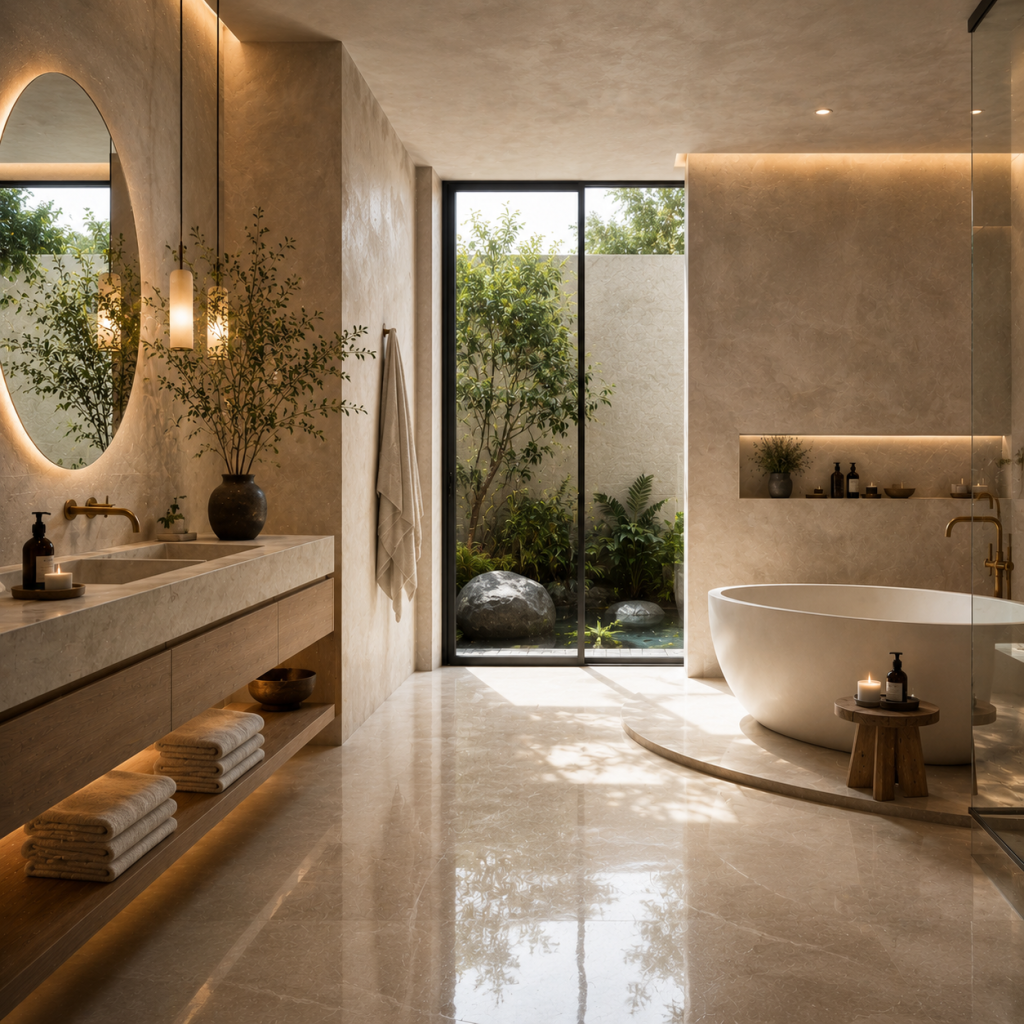
16. Limewash Plaster for Ancient, Living Texture
Limewash has been used on walls for thousands of years, and its enduring appeal is easy to understand. Applied in thin layers, it creates a softly mottled, cloudy surface that catches light differently at different times of day giving the wall an almost living quality. In pale stone, off-white, or warm gray, limewash walls bring depth and authenticity to a Japandi bathroom that painted walls simply cannot replicate.
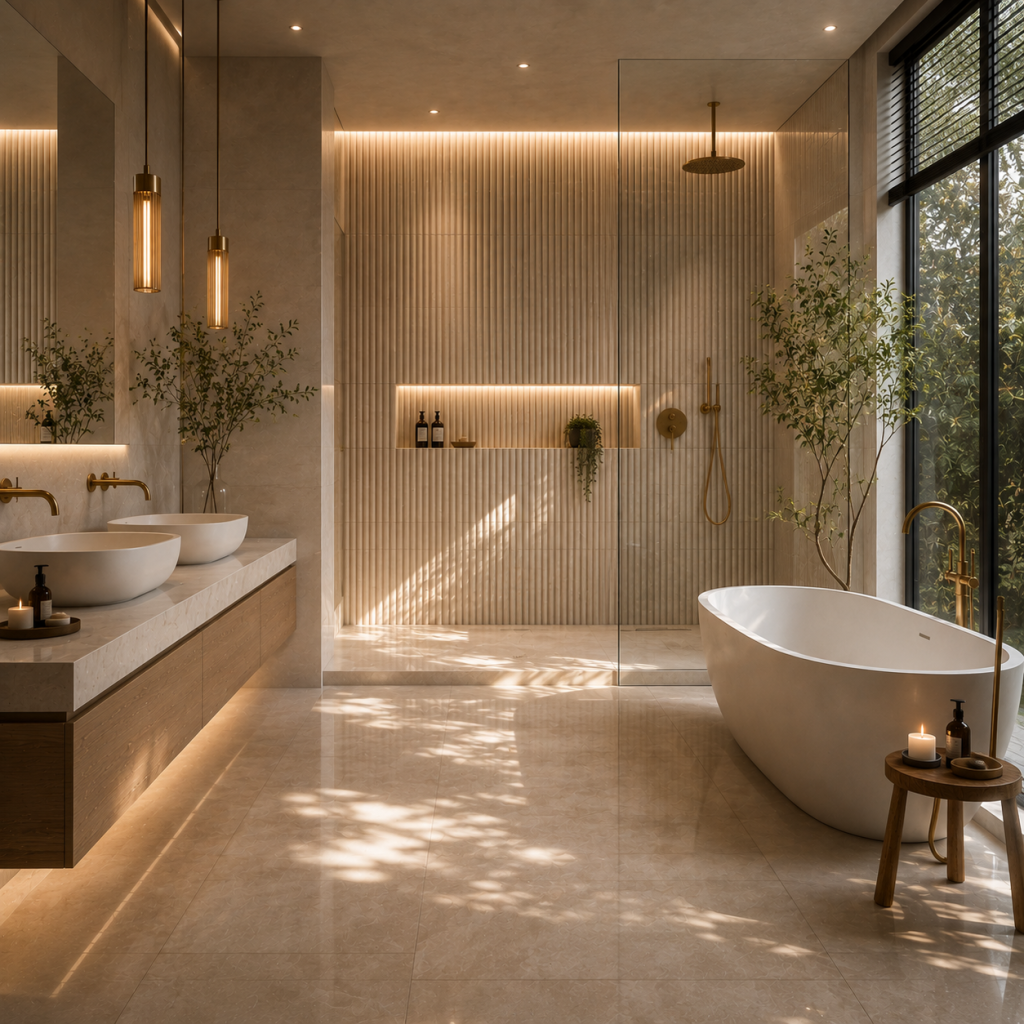
17. Vertical Fluted Tiles for Architectural Rhythm
Fluted or ribbed tile surfaces where each tile has shallow vertical grooves have become one of the defining material choices of contemporary Japandi bathrooms. They introduce beautiful texture and shadow play while remaining understated and elegant. Use them from floor to ceiling on a single wall as a feature, or wrap them around the entire shower enclosure for an immersive tactile experience.
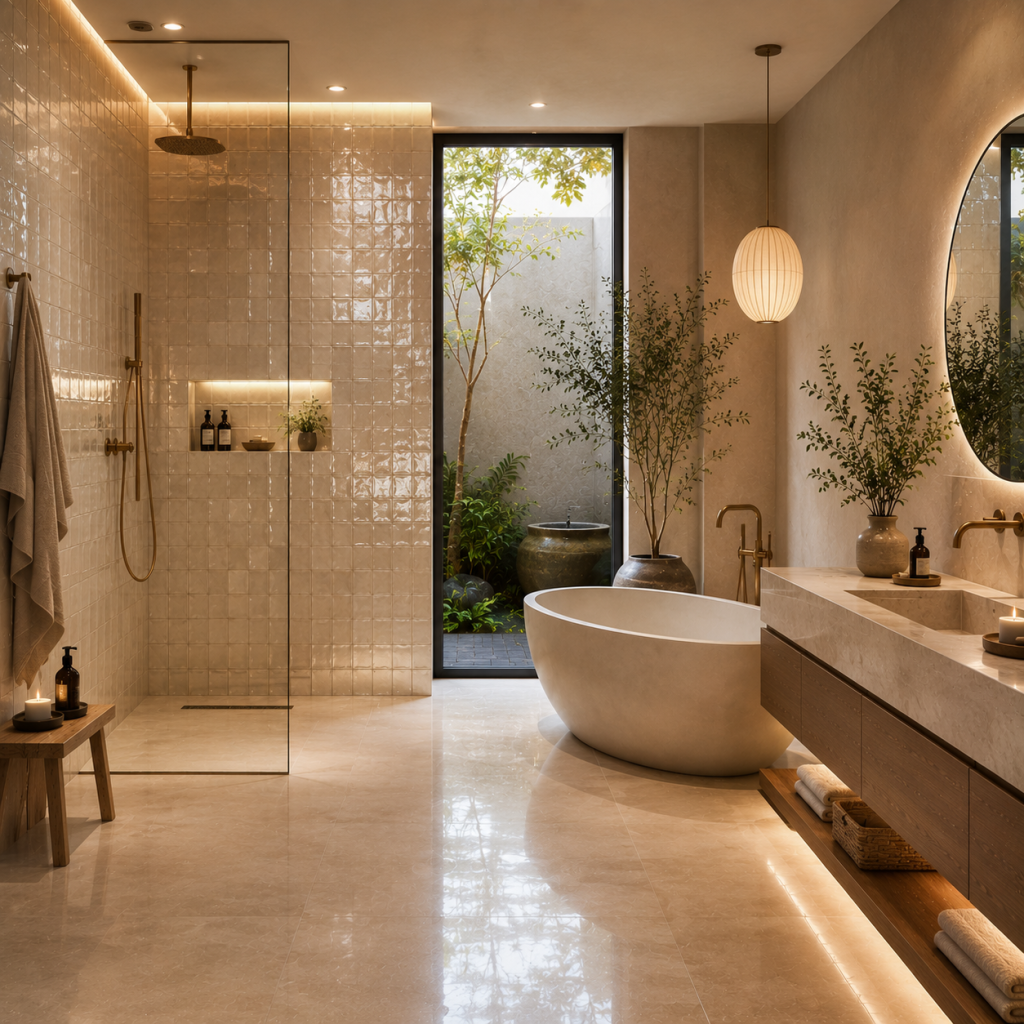
18. Zellige-Inspired Handmade Tiles for Warm Irregularity
Zellige tiles, originating from Moroccan craft tradition, have a handmade quality that aligns beautifully with Japandi’s appreciation for imperfection. Each tile has a slightly different surface, color variation, and gloss level. In soft whites, creamy ivories, or pale sage greens, a wall of zellige tiles catches light in endlessly varied ways creating a surface that is simultaneously subtle and captivating.
19 .Bare Concrete or Microcement Feature Walls
A single wall treated in microcement or polished concrete creates a dramatic yet restrained focal point in a Japandi bathroom. The industrial material takes on unexpected warmth in sandy, taupe, or warm gray tones, and its seamless surface reads as calm rather than stark when surrounded by natural wood and soft lighting. This is an excellent choice for the shower enclosure wall or the wall behind the vanity.
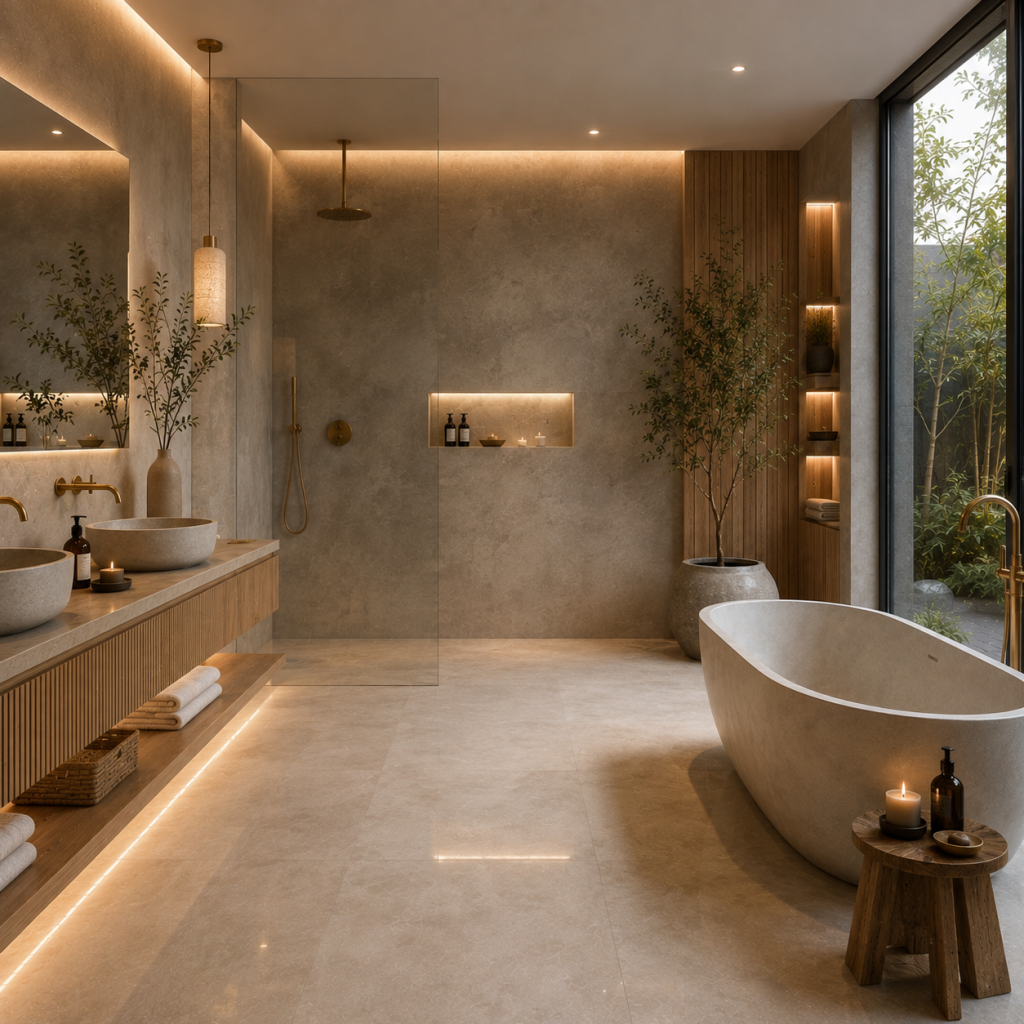
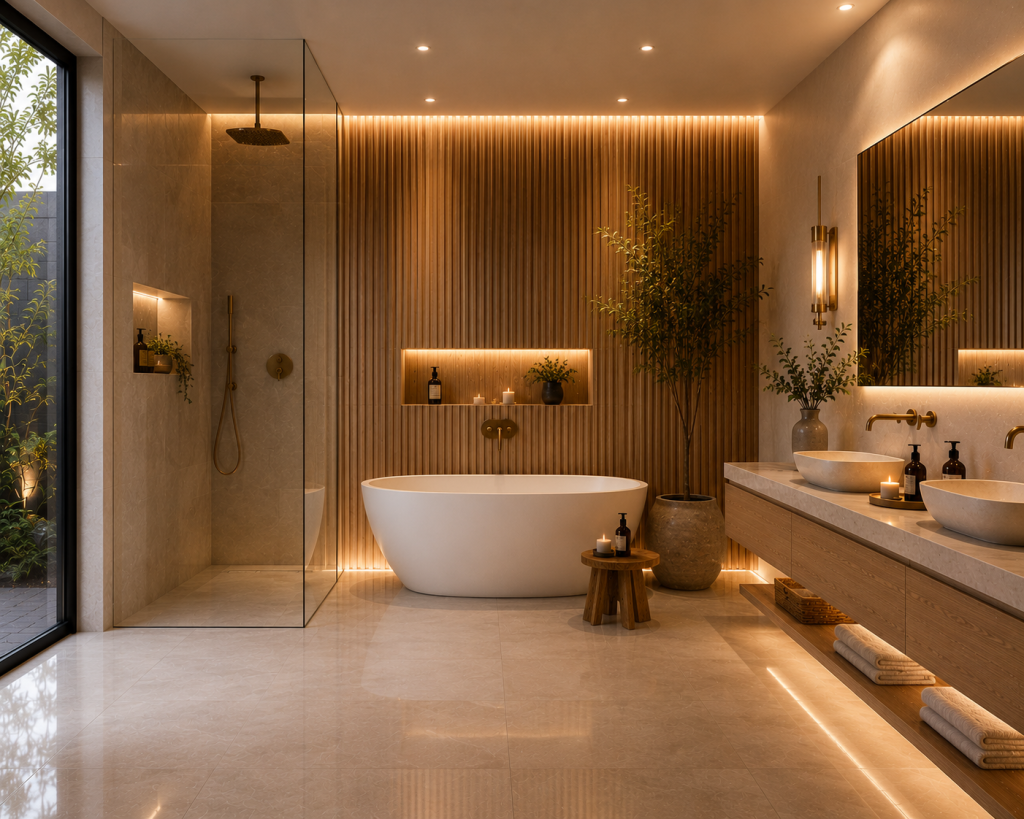
20. Slatted Timber Paneling for Warmth and Rhythm
Vertical timber slats bring a deeply Scandinavian warmth to bathroom walls while echoing the geometric simplicity of Japanese architecture. Used on a single wall behind the bathtub or as wainscoting in the lower half of the room, moisture-resistant timber panels introduce beautiful grain, warmth, and rhythm. Pair with concealed LED strips running behind the slats for a softly glowing accent wall that is genuinely stunning.
Vanity and Storage Ideas: Organized Beauty
The vanity is the workhorse of the bathroom the place where most daily rituals happen. In a Japandi bathroom, it must be both beautiful and supremely functional.
Read: Summer Home Decor Ideas to Refresh Your Space Easily
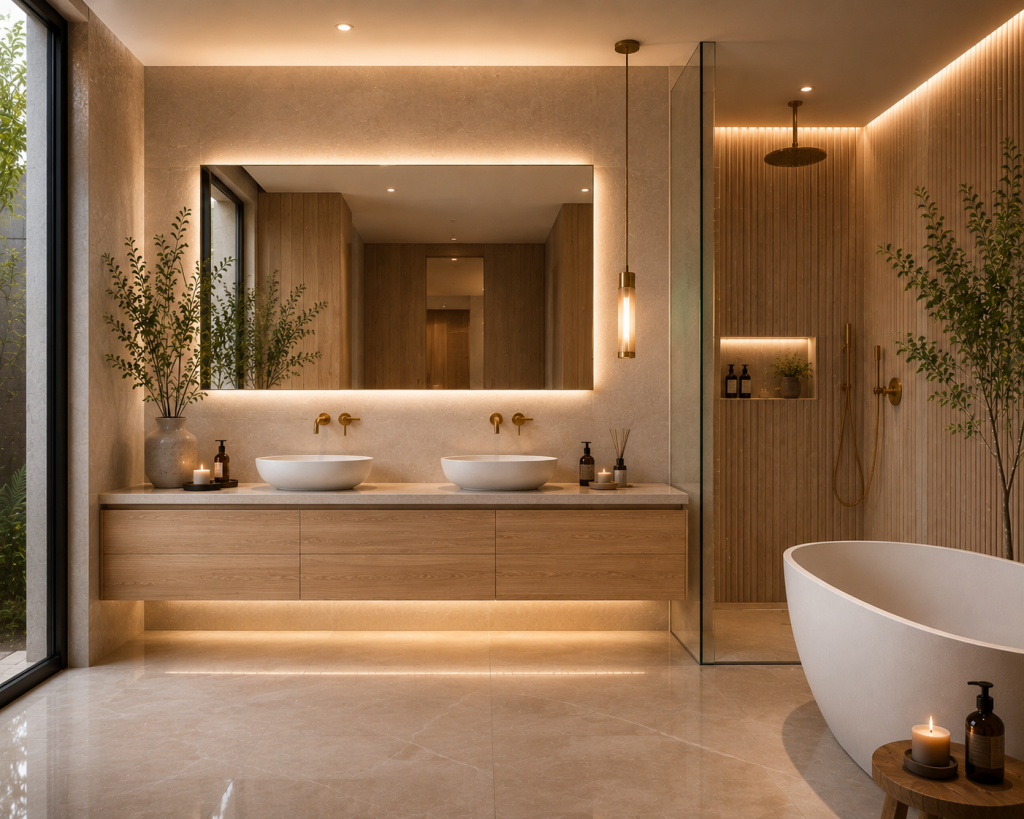
21. A Floating Vanity With Grain-Matched Timber Fronts
Floating vanities are the gold standard in Japandi bathrooms because they create the visual impression of an unobstructed floor. For a truly elevated result, choose cabinetry fronts in grain-matched timber veneer where the wood grain flows continuously across all drawer and door fronts. This creates a seamless, almost sculptural appearance rather than the look of individual cabinet doors.
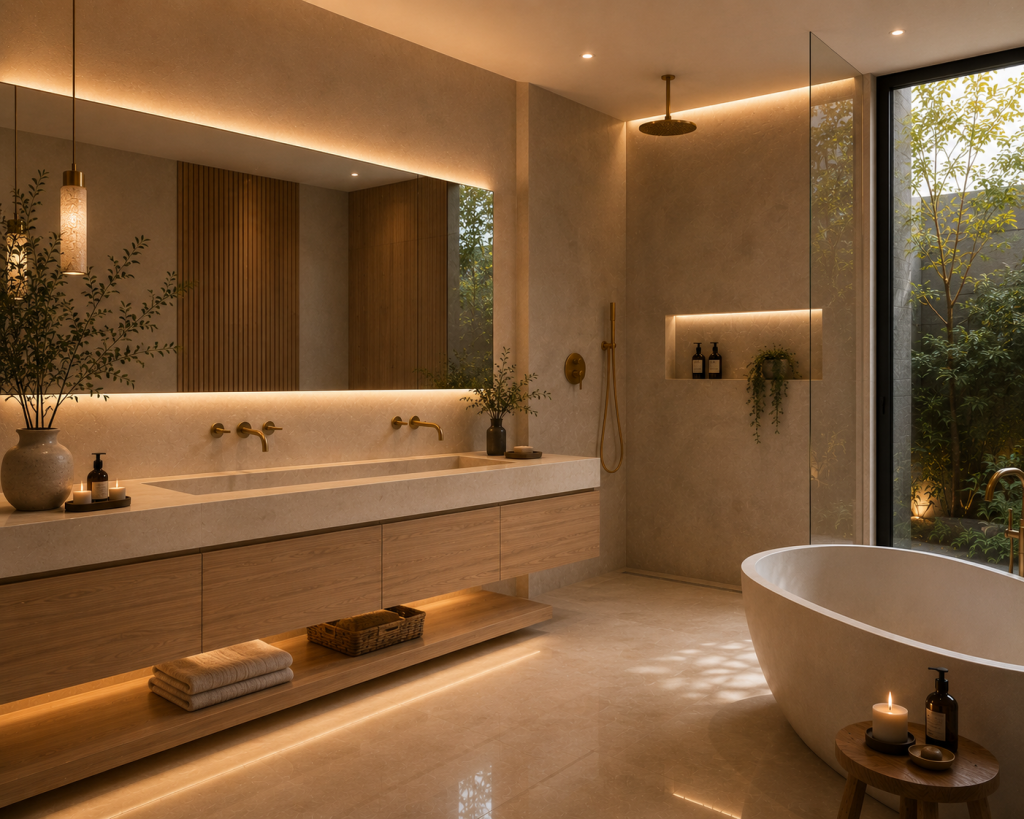
22. Integrated Concrete or Stone Basins That Form Part of the Countertop
Rather than a sink that sits on or inside the countertop as a separate object, consider an integrated basin where the sink and countertop are formed from a single continuous material concrete, stone, or solid surface. The result is a vanity with no visible joint, no edge to collect grime, and a visual simplicity that is genuinely elegant.
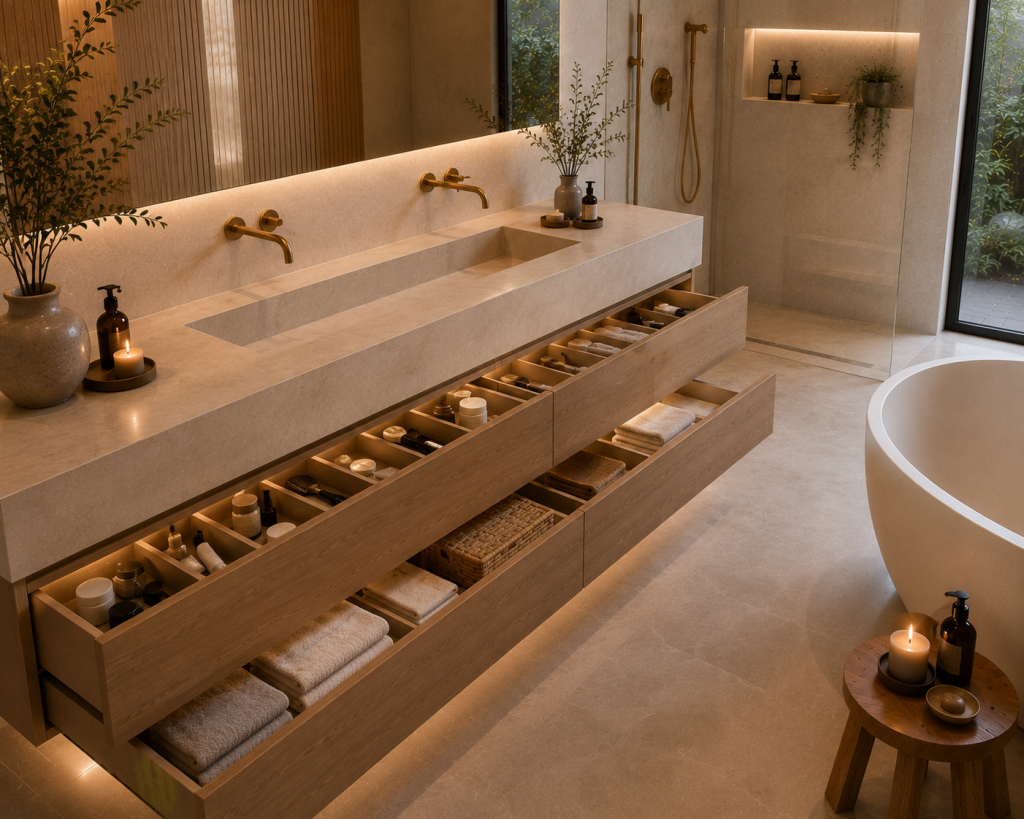
23. Deep Drawer Storage With Custom Organizer Inserts
The most important storage principle in a Japandi bathroom is that everything used daily should have a specific, permanent home inside a drawer. Custom-fitted drawer organizers with compartments sized precisely for your toothbrush, skincare products, and makeup make it possible to keep every surface in the room completely clear. A cleared surface is a calmed mind.
24. A Recessed Medicine Cabinet Concealed Behind a Mirror
One of the most space-efficient and aesthetically clean storage solutions in a small Japandi bathroom is a full-width mirror that conceals a recessed medicine cabinet behind it. From the outside, it simply reads as a large, frameless mirror contributing to the sense of openness. Behind it, a surprisingly deep cabinet stores everything from medications to skincare to spare razors, completely out of sight.
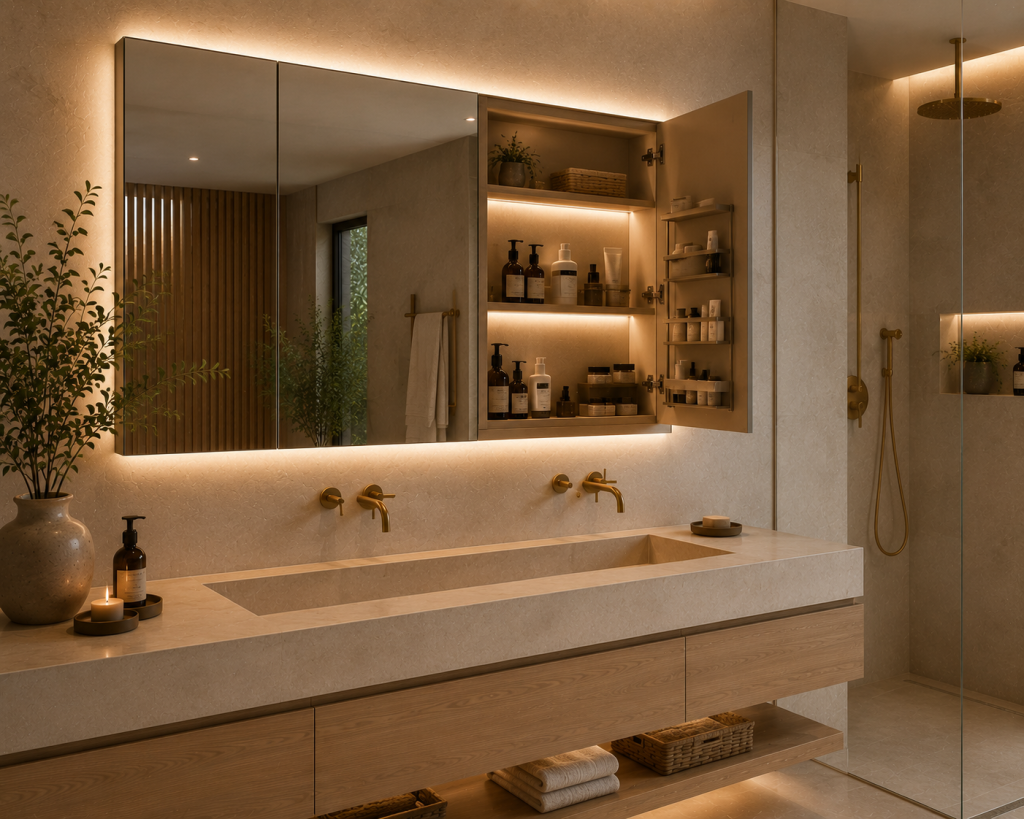
25. Open Shelving as Curated Display, Not General Storage
Open shelving in a Japandi bathroom works only if it is treated as curated display rather than general storage. Limit each shelf to three or four carefully chosen objects: a neatly folded towel, a small ceramic vase with a single stem, a linen drawstring pouch, a candle. The discipline of curation keeps the shelves feeling intentional rather than cluttered.
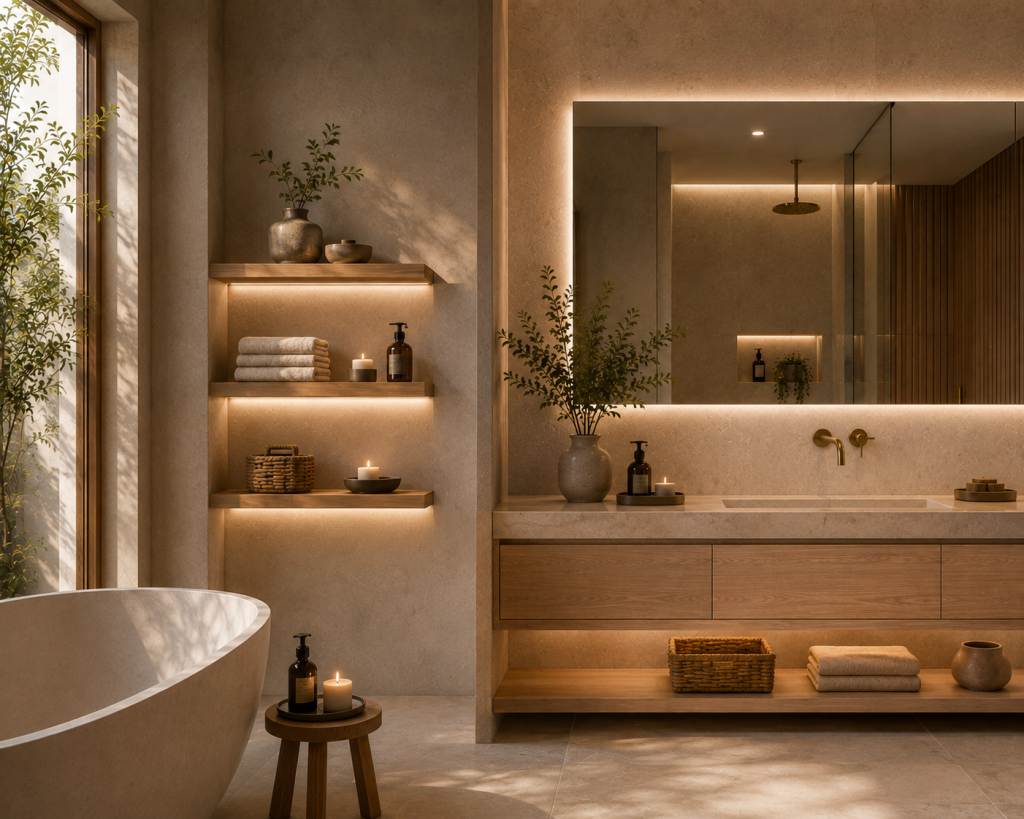
26. A Tall, Slim Storage Tower for Vertical Efficiency
In bathrooms where wall space is limited, a tall, slim storage column floor to ceiling, perhaps 30cm wide makes brilliant use of vertical space without occupying significant floor area. Fitted with adjustable shelves behind simple push-to-open doors, it can hold towels, toiletries, cleaning products, and spare supplies while remaining completely invisible when closed.
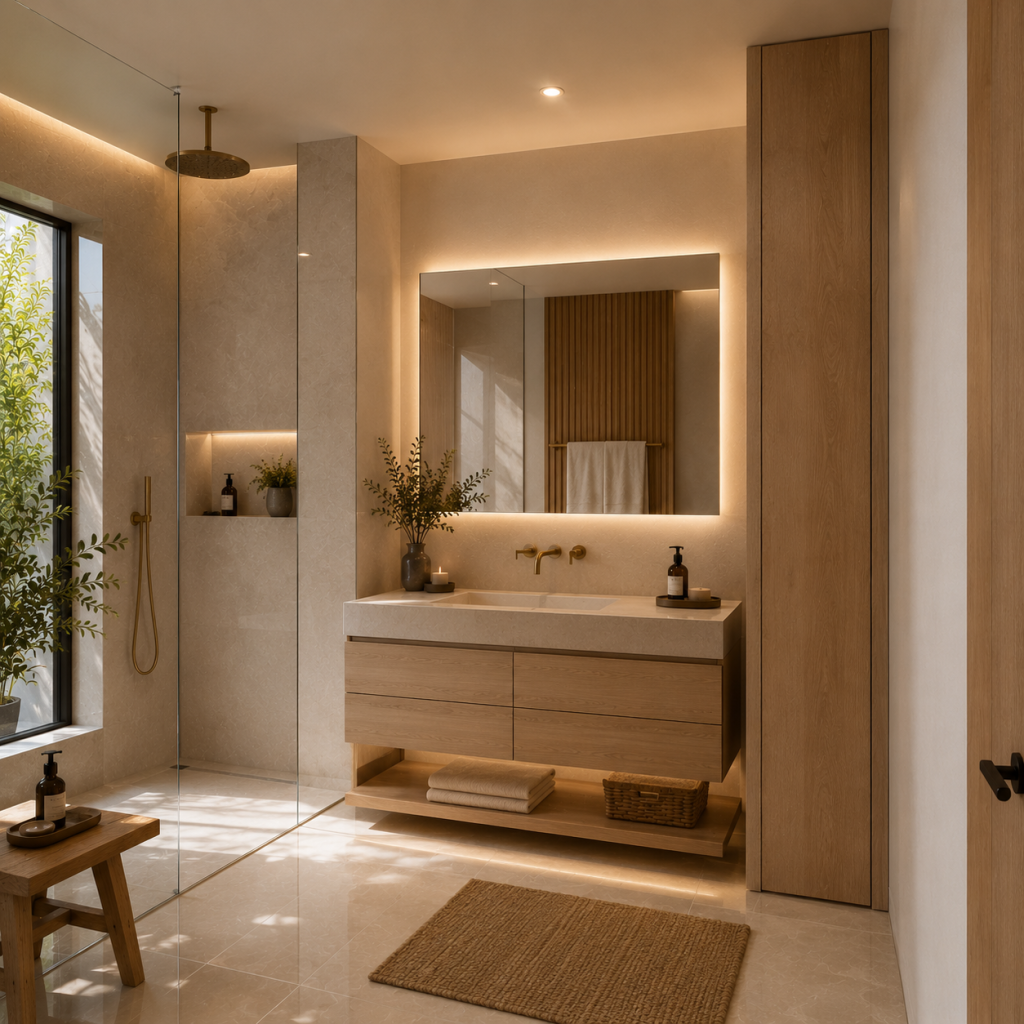
Shower Ideas: The Ritual Space
The shower is, for many people, the most important moment of their bathroom experience. Japandi shower design makes it feel like a genuine ritual rather than a hurried necessity.
Read: Bedroom Wall Decor Ideas DIY Easy (Creative, Budget-Friendly & Aesthetic)
27. A Wet Room With No Shower Tray or Enclosure
The most radical and most beautifully minimal shower option is a fully tanked wet room where a section of the bathroom floor is simply graded to drain and the entire space becomes the shower area. No tray, no screen, no enclosure. Just water, steam, and space. The visual openness this creates is extraordinary, and continuous tiling across the floor and shower area makes the room feel seamless and expansive.
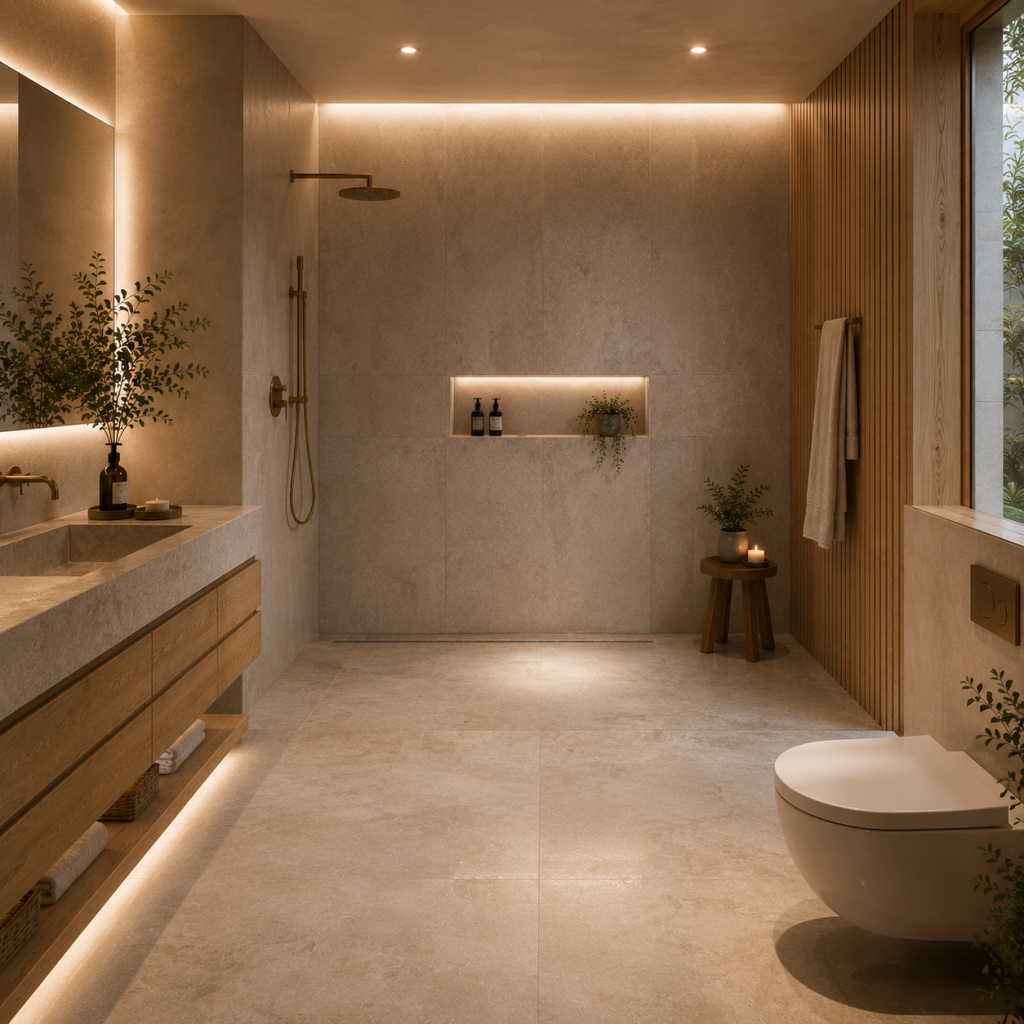
28. A Ceiling-Mounted Rainfall Showerhead as the Centerpiece
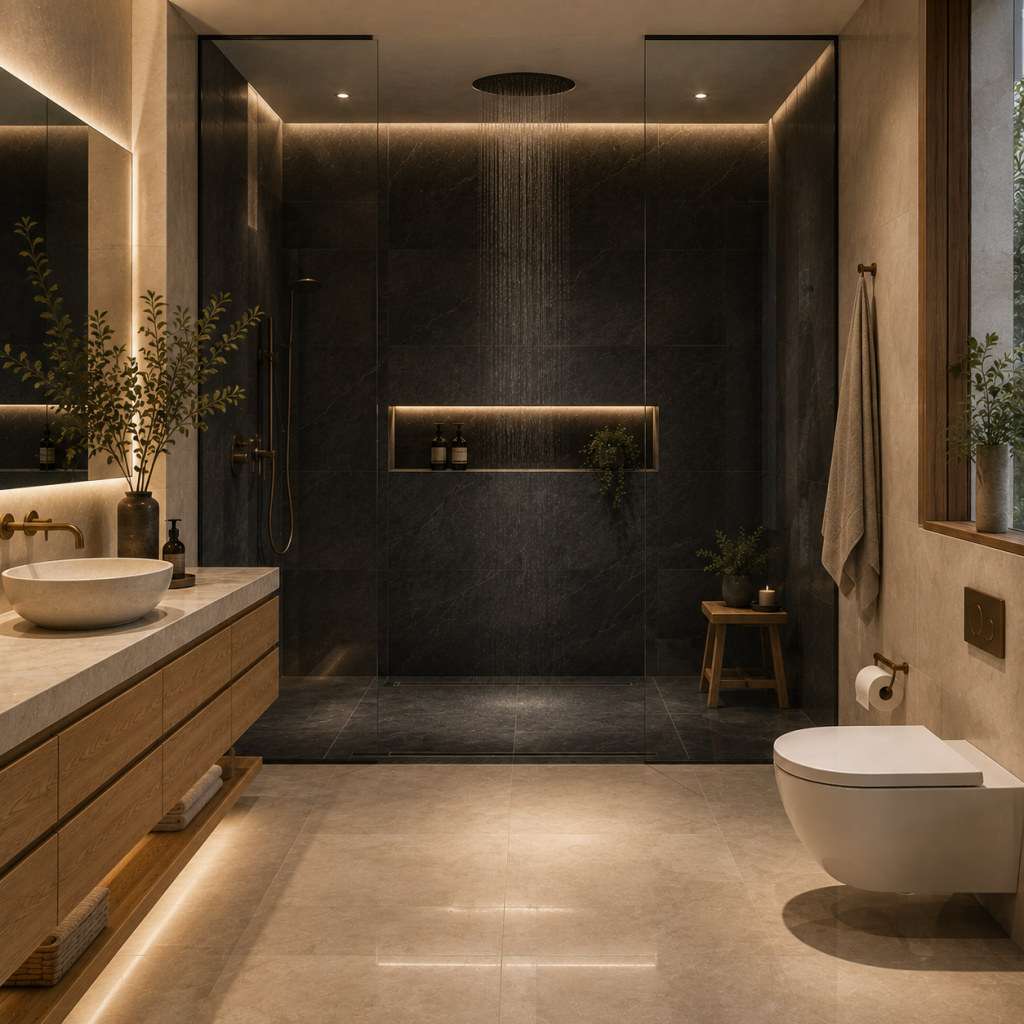
A large overhead rainfall showerhead mounted flush into the ceiling rather than protruding on a visible arm transforms showering from a functional act into a genuinely immersive experience. The sensation of water falling vertically from above, like rain, engages the body and the mind differently to a wall-mounted shower. Choose a circular head in matte black or brushed nickel to keep the fixture minimal and refined.
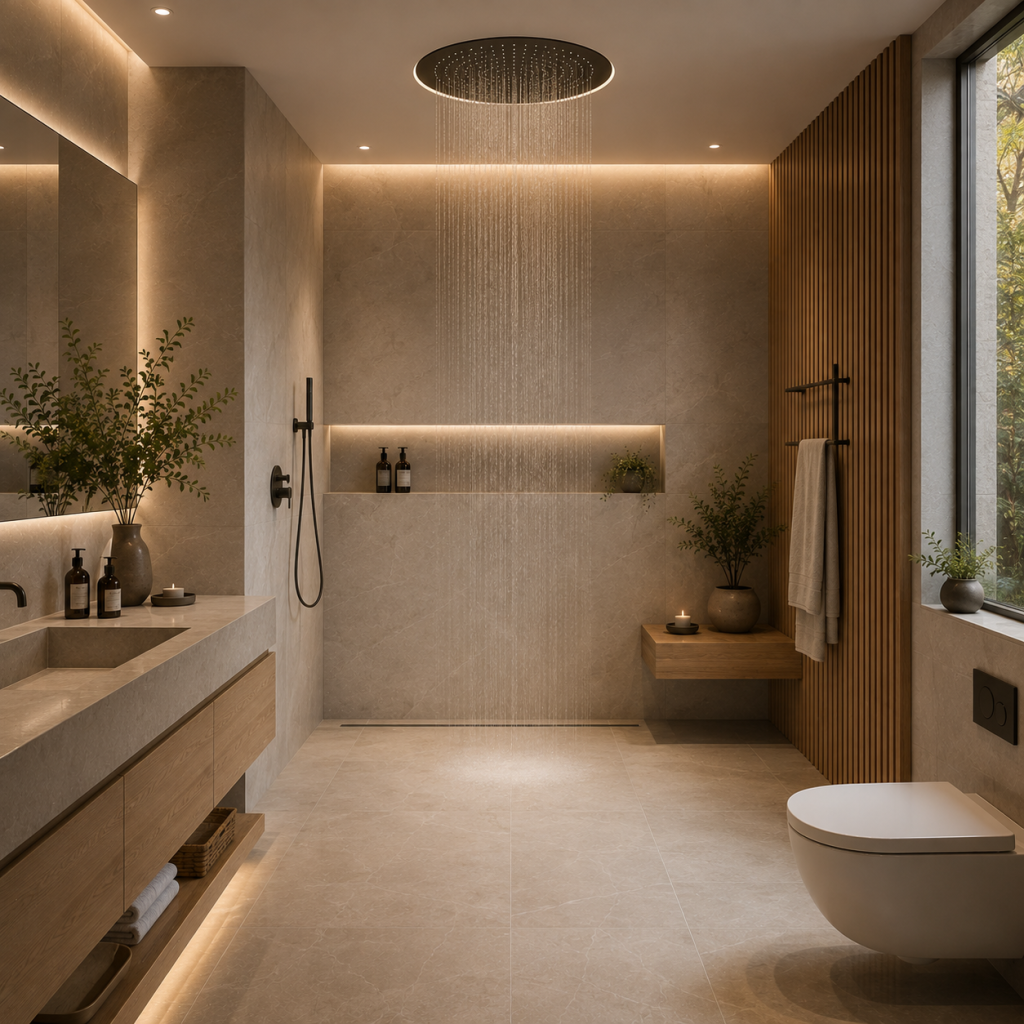
29. A Built-In Teak or Stone Shower Bench
A built-in shower bench is one of those elements that seems like a luxury until you have one, after which it becomes indispensable. In a Japandi shower, use a stone slab or a solid teak bench built into the corner or recessed into the wall. It provides somewhere to sit while washing hair, to rest a foot while shaving, or simply to pause and let warm water fall. It is comfort and calm made architectural.
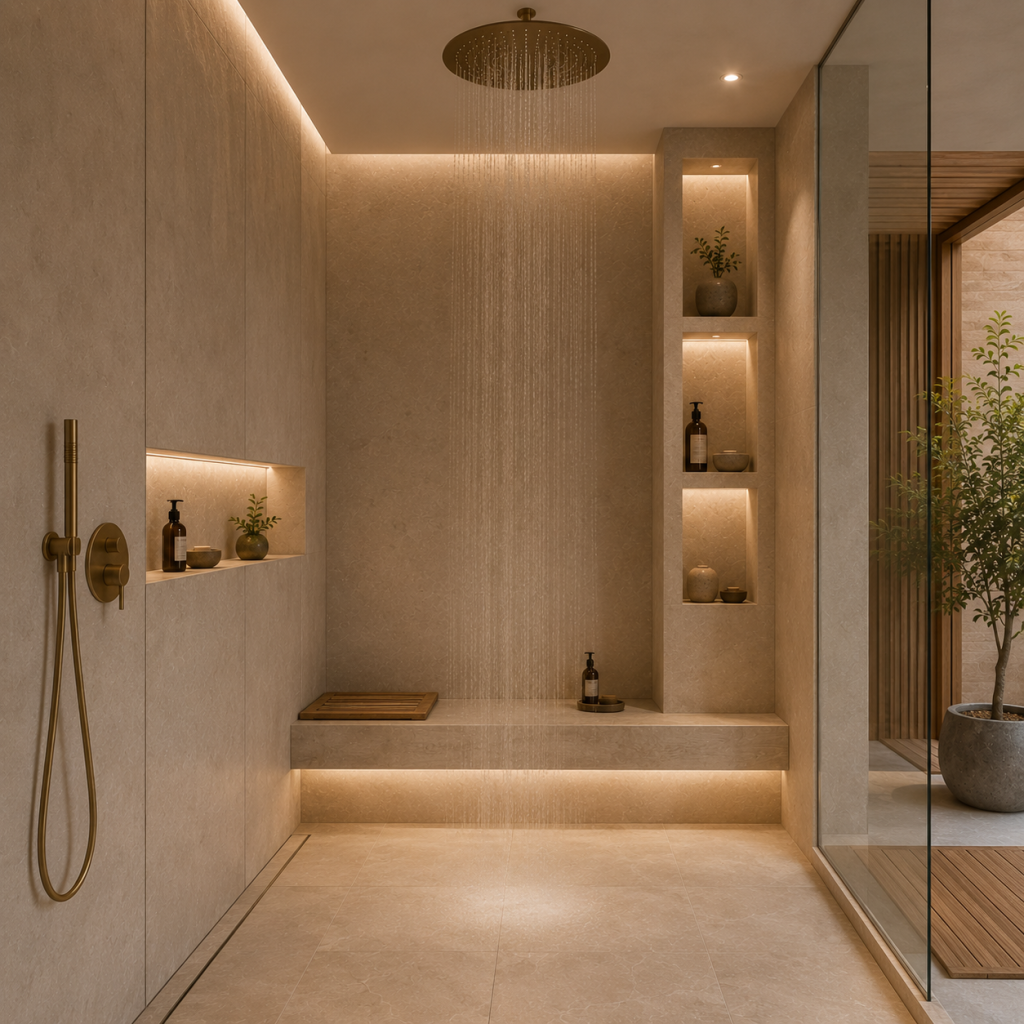
30. Recessed Wall Niches Instead of Shower Caddies
Plastic shower caddies and hanging organizers are the enemies of a calm, Japandi bathroom. Replace them entirely with recessed wall niches shallow alcoves cut into the shower wall and tiled to match. A niche at shoulder height holds shampoo and conditioner; a lower niche holds body wash and a razor. Everything is organized, accessible, and completely flush with the wall.
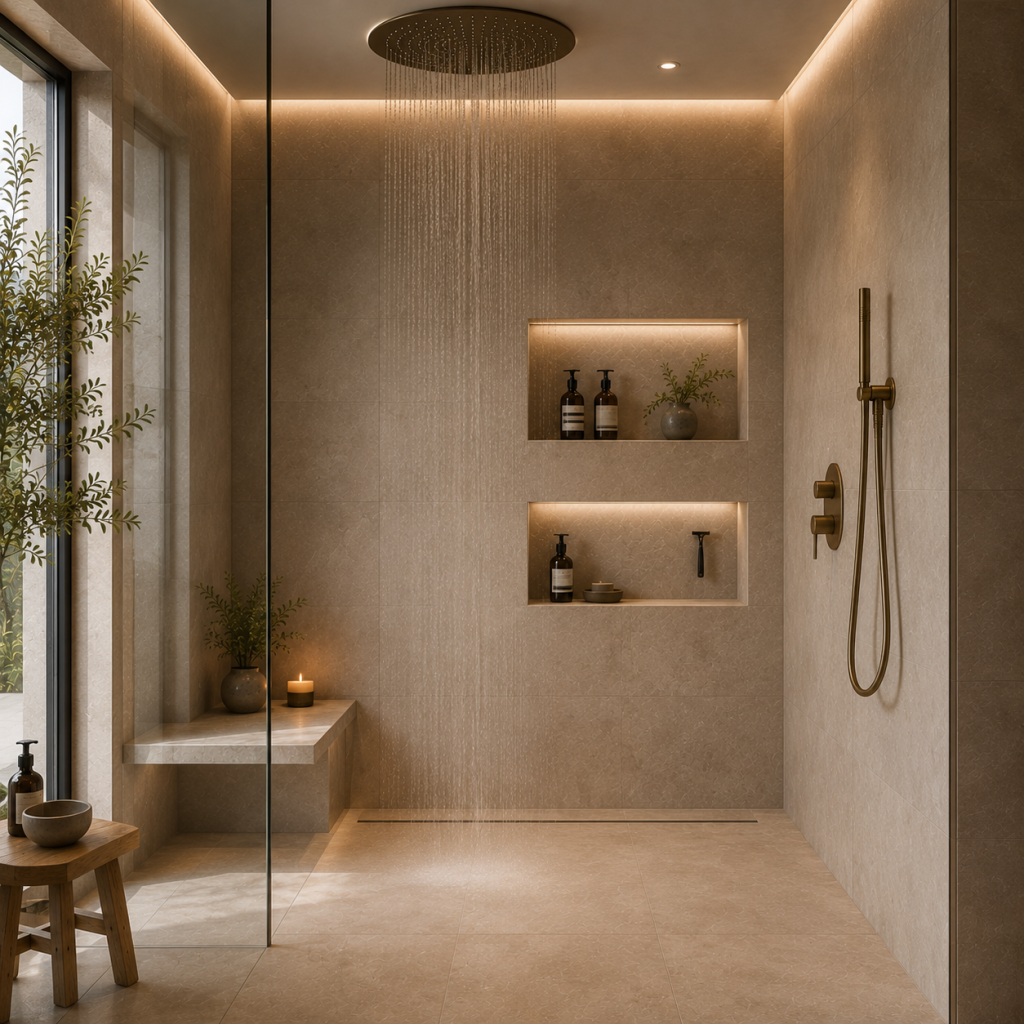
31. A Frameless Glass Shower Screen That Almost Disappears
Where a complete wet room is not possible, a single frameless glass panel with no frame, no door, and no aluminium profile is the next most minimal option. It provides effective water protection while remaining almost invisible, allowing the eye to travel continuously through the shower space to the tiled wall behind. Pair with a linear drain running the full width of the shower for a perfectly clean floor line.
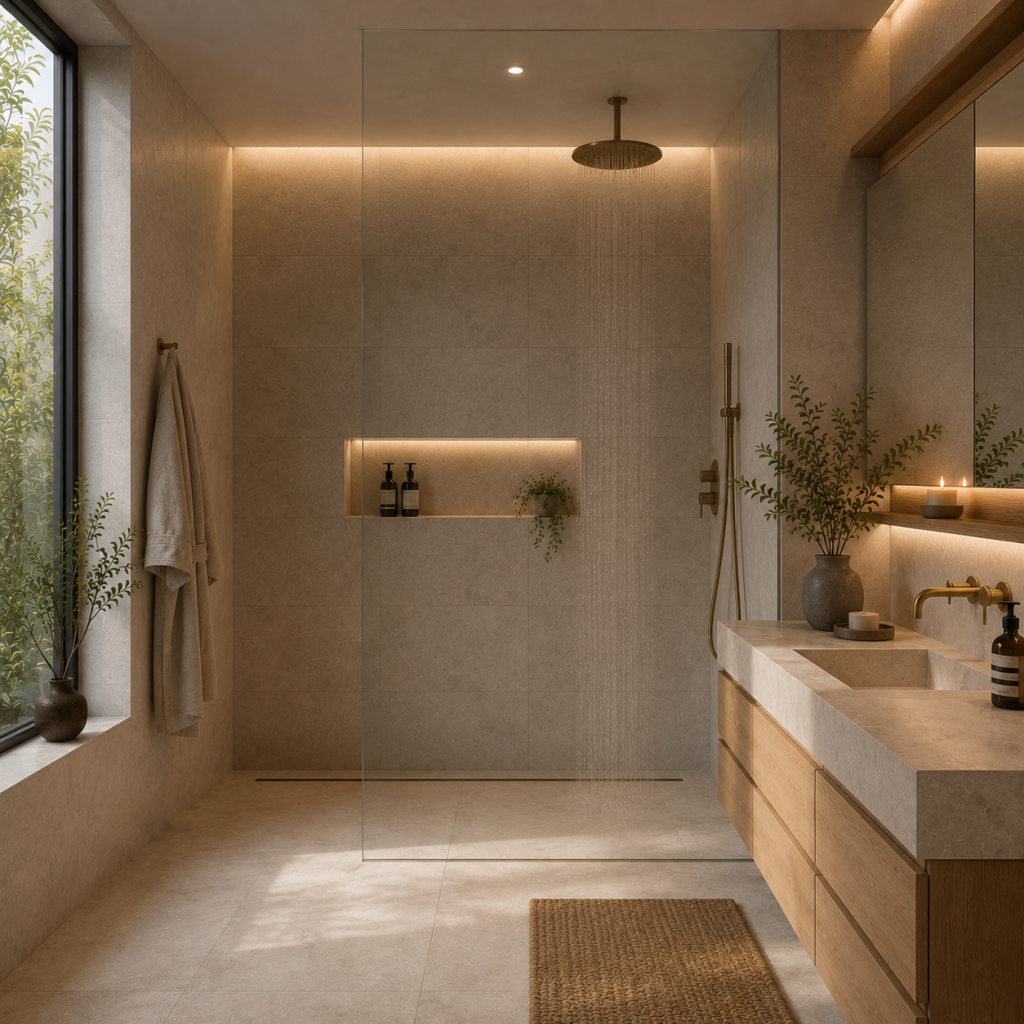
32. Contrasting Dark Tile Inside the Shower for Dramatic Depth
While the main bathroom palette may be soft and light, introducing a deeper tile inside the shower enclosure charcoal slate, dark marble, or matte black stone creates a sense of depth and drama that enhances the feeling of immersion. Stepping into a darker shower is psychologically like stepping into a cave or a forest: enclosed, quiet, and restorative. The contrast with the lighter main bathroom makes both spaces feel more intentional.
Bathtub Ideas: The Art of Slow Living
A freestanding bathtub in a Japandi bathroom is more than a vessel for washing it is an invitation to slow down, to be still, and to give time to yourself.
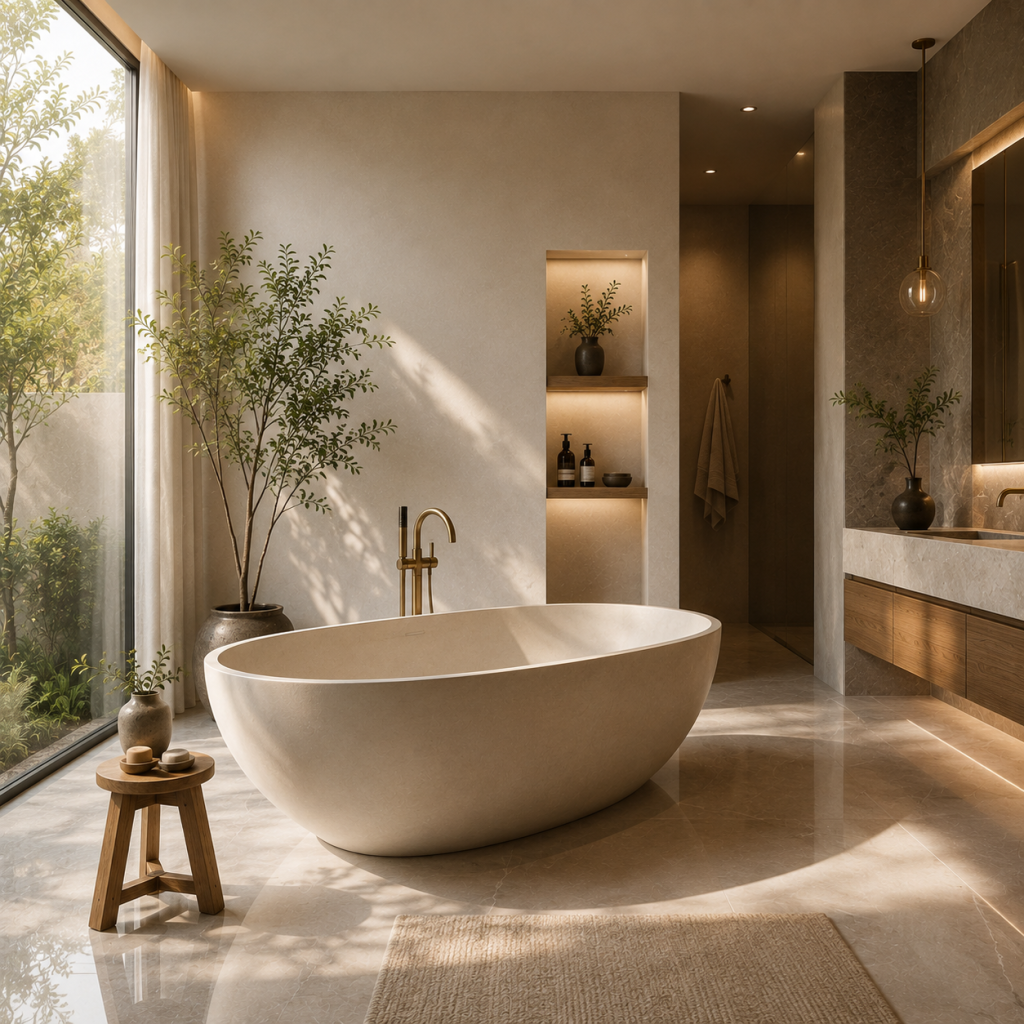
33. An Oval Soaking Tub With a Matte Stone Finish
The form of a bathtub carries its own language. Oval tubs with soft, continuous curves speak of comfort and surrender. Choose a deep soaking tub in a matte stone or powder-coated finish soft white, dove gray, or warm sand and position it where natural light can fall across its surface during the day. The visual simplicity of a beautiful, standalone tub requires no additional decoration to justify its presence.
34. A Japanese-Style Ofuro Deep Soaking Tub
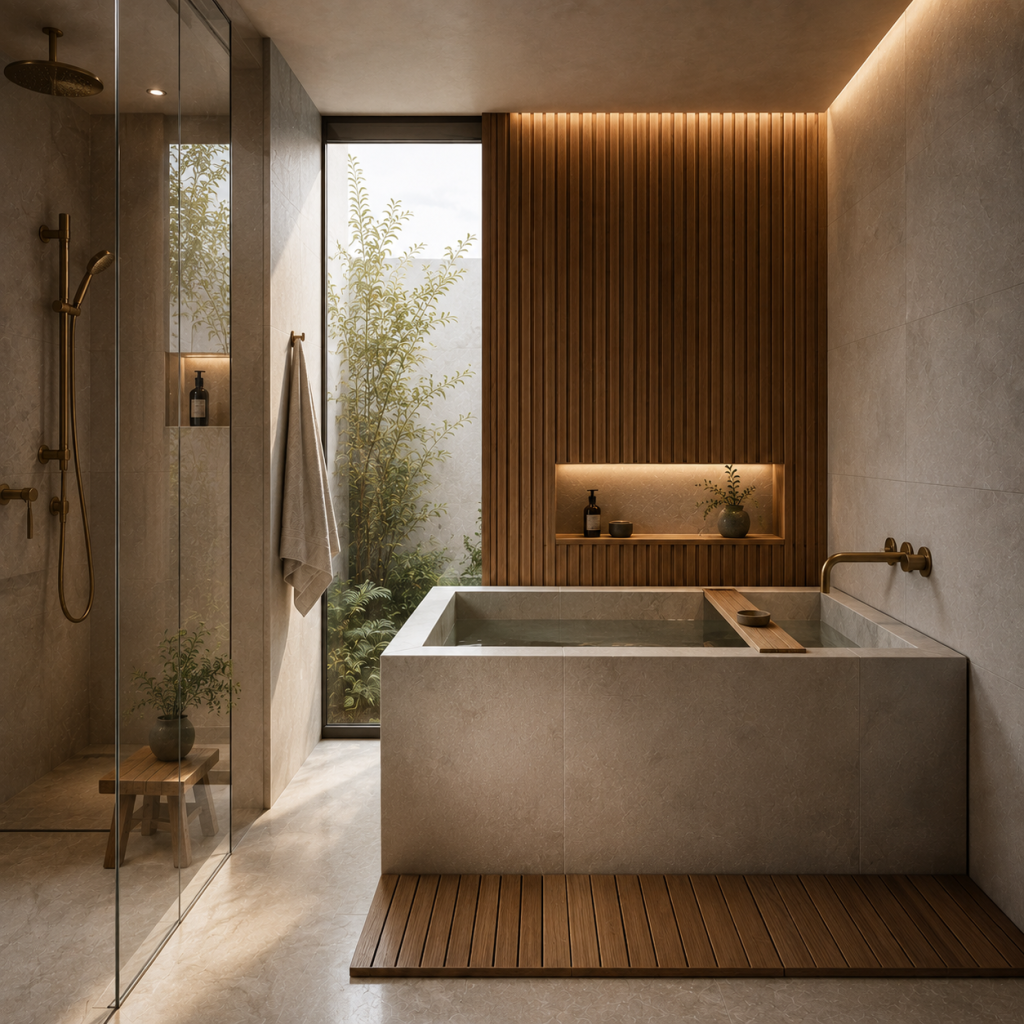
The Japanese ofuro tradition centers on a deep, compact soaking tub designed for full-body immersion rather than reclined bathing. An ofuro tub is shorter but much deeper than a Western bathtub, allowing you to sit upright with water reaching the shoulders. This posture sitting tall, immersed, still is fundamentally different from lying in a shallow Western tub, and far more restorative. Many contemporary bathroom designers now offer ofuro-inspired soaking tubs in stone, wood, and solid surface materials.
35. A Tub Positioned in Front of a Floor-to-Ceiling Window
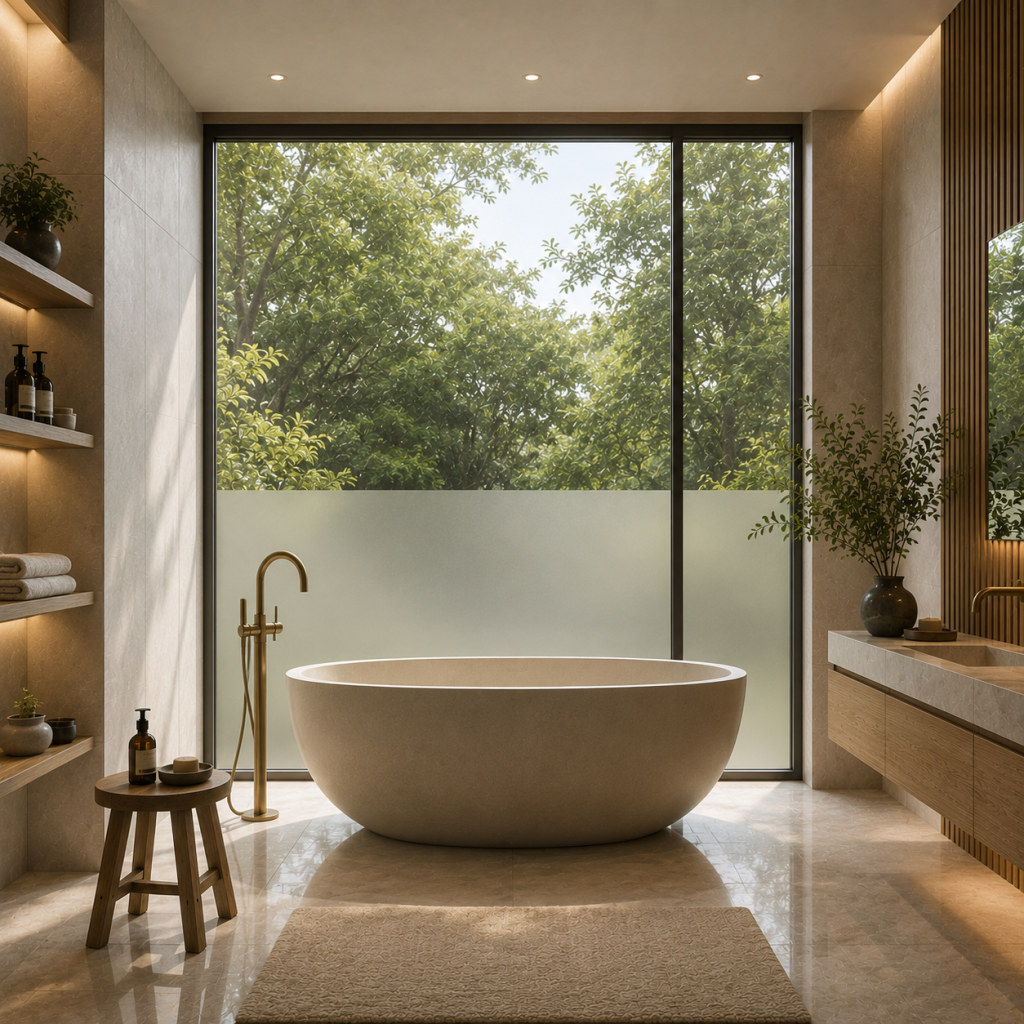
If privacy allows, positioning a freestanding bathtub directly in front of a large window ideally floor-to-ceiling creates one of the most spectacular experiences in domestic design. Bathing with a view of trees, sky, or garden connects the interior ritual to the exterior world in a way that is profoundly calming. Use frosted glass in the lower section to maintain privacy while allowing diffused daylight to fill the space.
36. A Built-In Tub With a Stone Surround for a More Permanent Feel
Where a freestanding tub feels too imposing or impractical, a built-in tub with a continuous stone surround offers an equally beautiful alternative. The tub becomes flush with a surrounding platform of limestone, marble, or concrete, creating a bathing area that feels architectural as if it grew from the floor. Add a built-in ledge at the end for bath essentials and a single stem of eucalyptus for a touch of living texture.
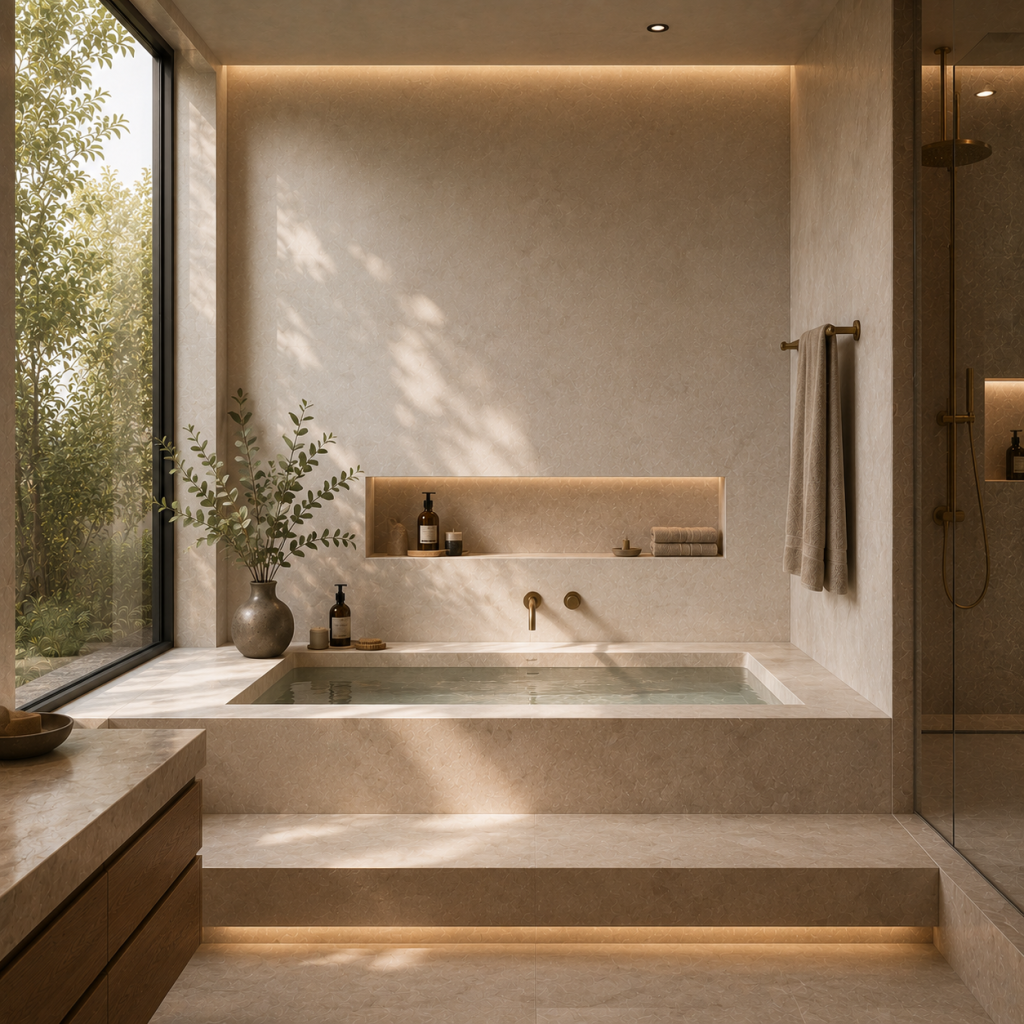
37. Placing the Tub on a Raised Timber Platform
Elevating a freestanding tub on a low timber platform just one or two steps immediately transforms it into the focal point of the room. The platform defines the bathing zone without using walls or partitions, creates a ceremonial sense of arrival, and allows concealed lighting beneath the timber edge for a softly glowing base. This is Japandi design at its most dramatic and intentional.
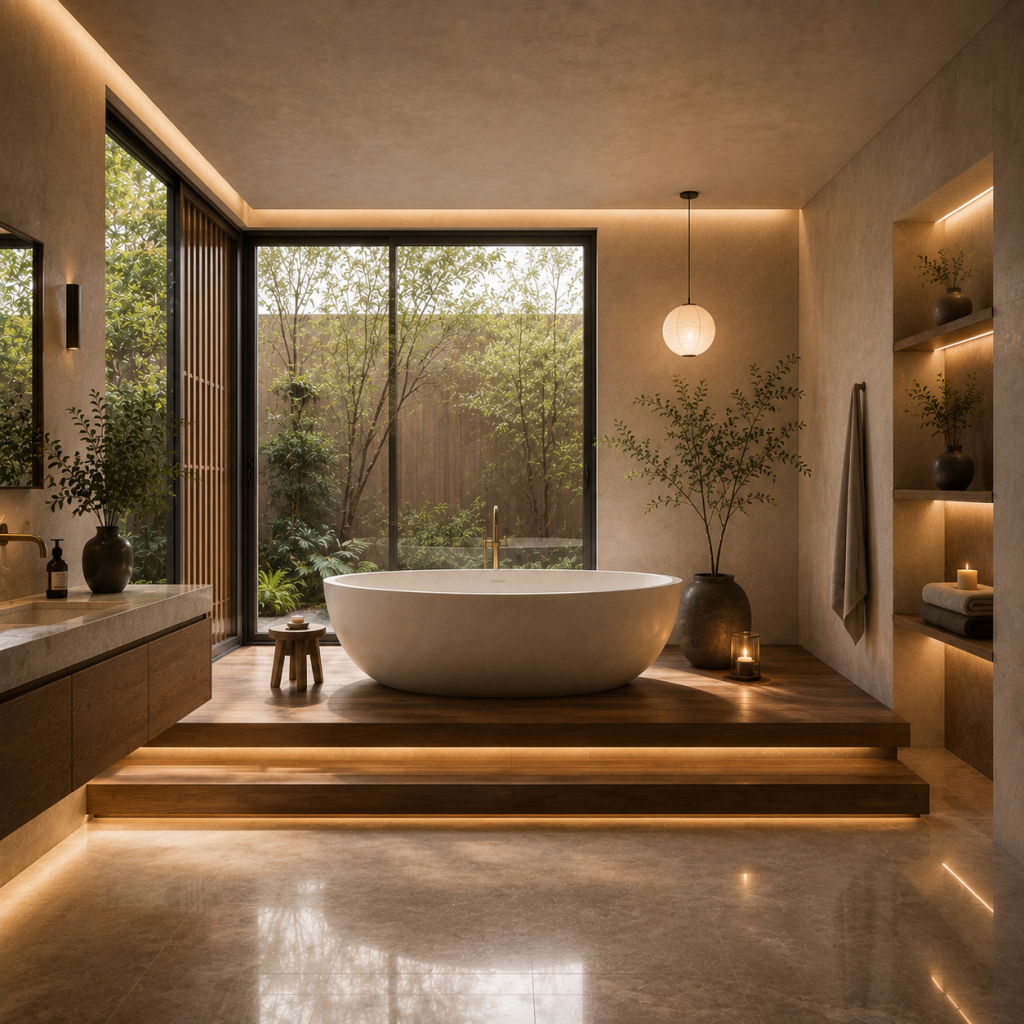
Lighting Ideas: The Most Underestimated Element
Lighting is the single most powerful tool for creating atmosphere in a Japandi bathroom, yet it is routinely underinvested in. The difference between beautiful lighting and harsh overhead fluorescents is the difference between a retreat and a doctor’s office.
Read: Backyard Lighting Aesthetics For Stylish & Magical Outdoor Spaces
38. Warm White Bulbs as a Foundational Rule
This sounds simple, but it makes an enormous difference. The color temperature of light measured in Kelvins dramatically affects how a room feels. Cool white light (above 4000K) feels energizing and clinical. Warm white light (2700K–3000K) feels intimate, cozy, and flattering. Every single light source in a Japandi bathroom should be warm white. No exceptions.
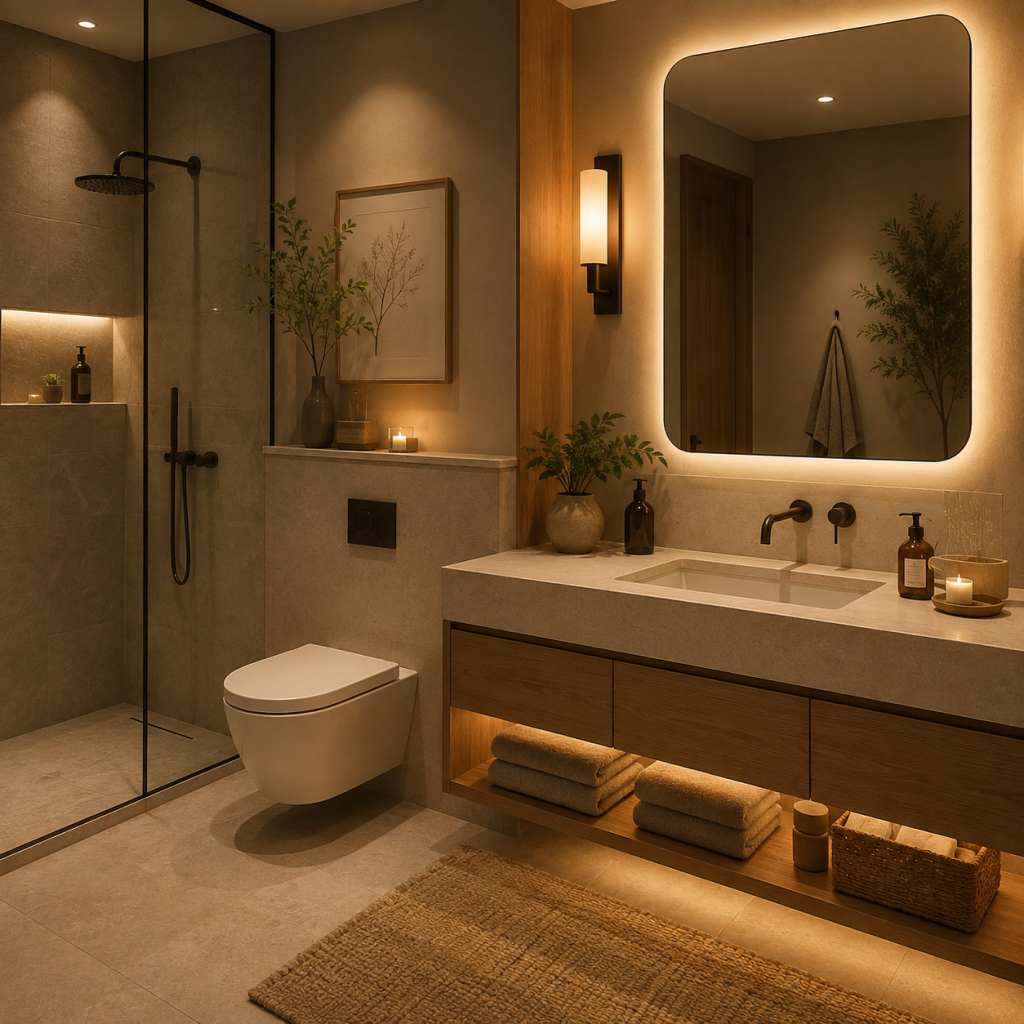
39. Concealed LED Strip Lighting Beneath the Floating Vanity
A strip of warm LED lighting running the underside of a floating vanity casts a soft glow across the floor that reads as almost magical in its subtlety. The vanity appears to hover above a cushion of light. This technique also serves the practical purpose of providing gentle orientation lighting during the night without requiring the overhead lights to be switched on.
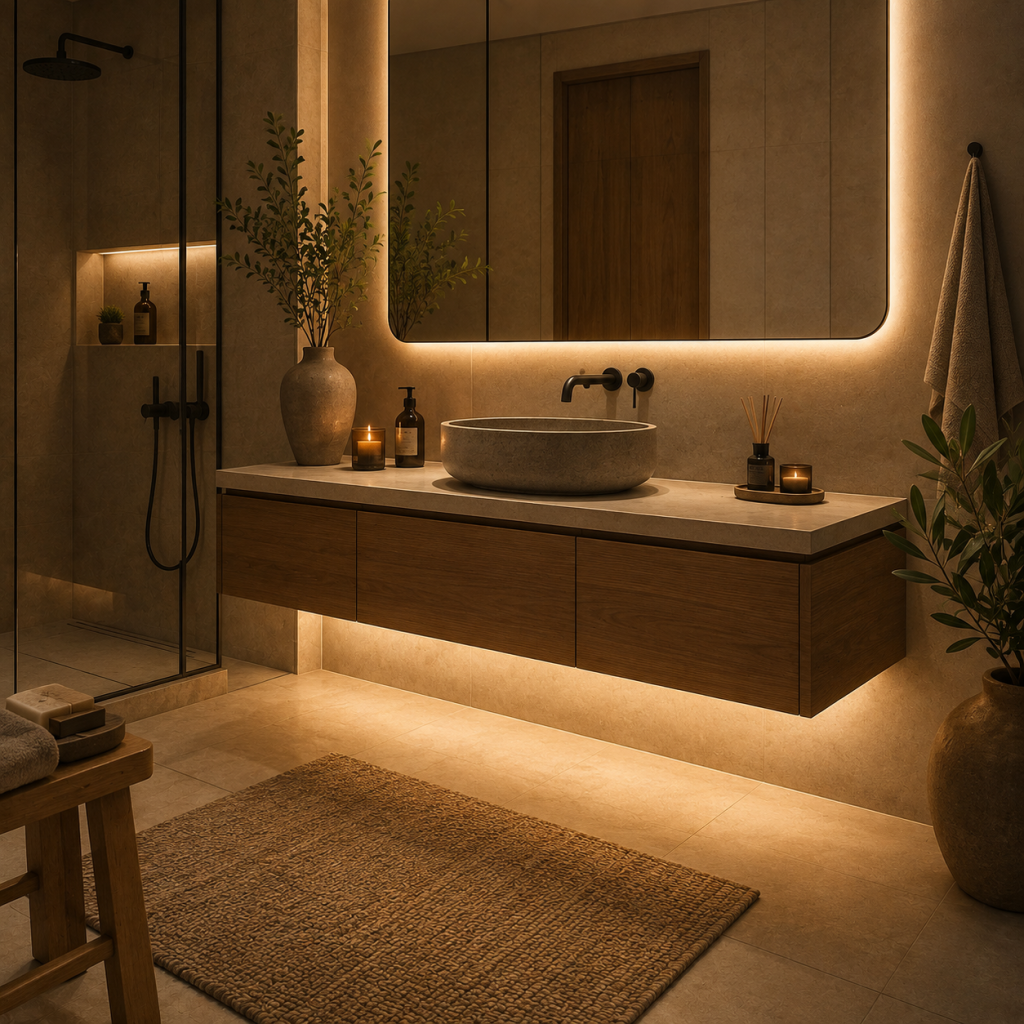
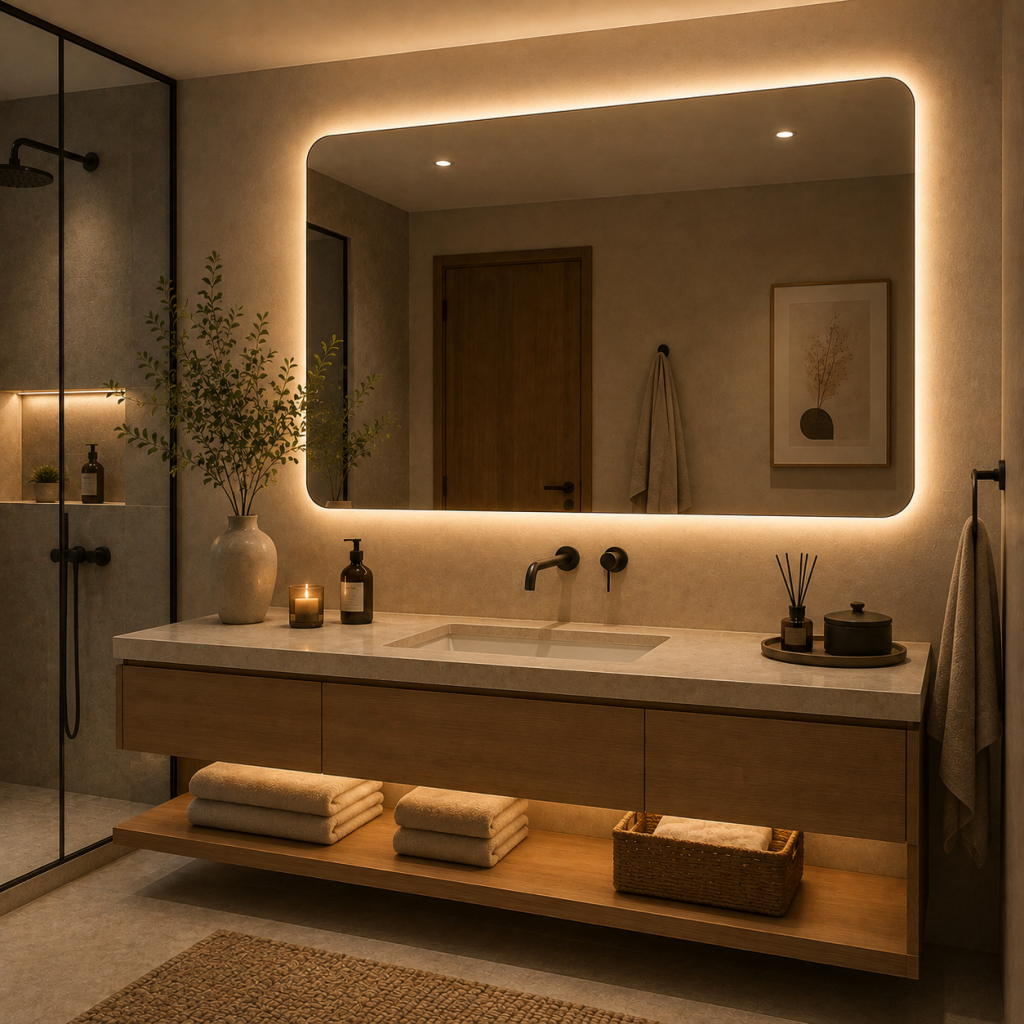
40. Backlit Mirror Panels for Flattering Task Lighting
A large mirror with a concealed LED strip running around its perimeter so the light appears to emanate from behind the mirror itself provides the most flattering and practical task lighting in a bathroom. The light source is diffused and directional, eliminating the harsh shadows that downlights create on the face. It is the closest approximation to natural daylight for applying makeup or skincare.
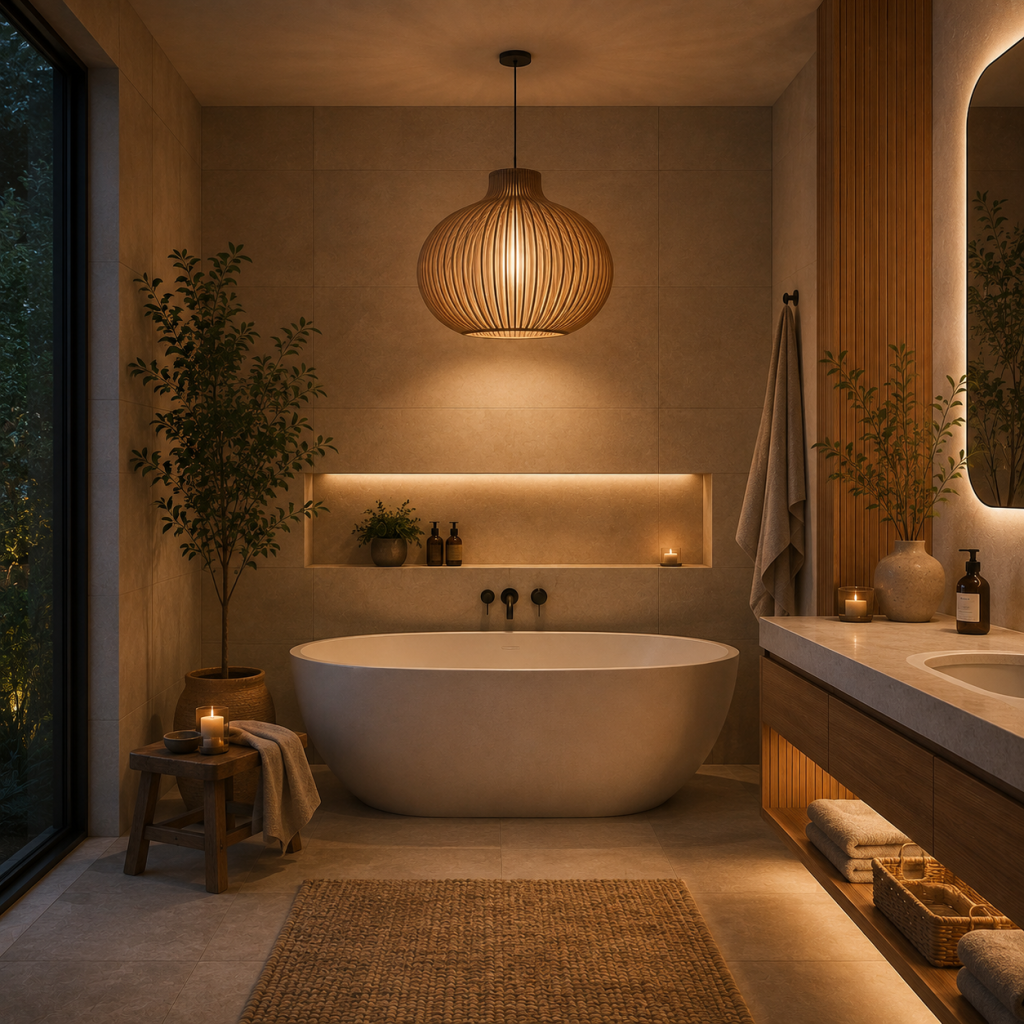
41. A Statement Pendant Above the Bathtub
A single handcrafted pendant perhaps in washi paper, blown glass, or rattan hanging above the bathtub brings a sculptural element to the room while providing a soft, localized pool of light over the bathing area. It also draws the eye upward, making the ceiling feel higher and the room more spacious. Choose a pendant that is beautiful when unlit as well as when it is on.
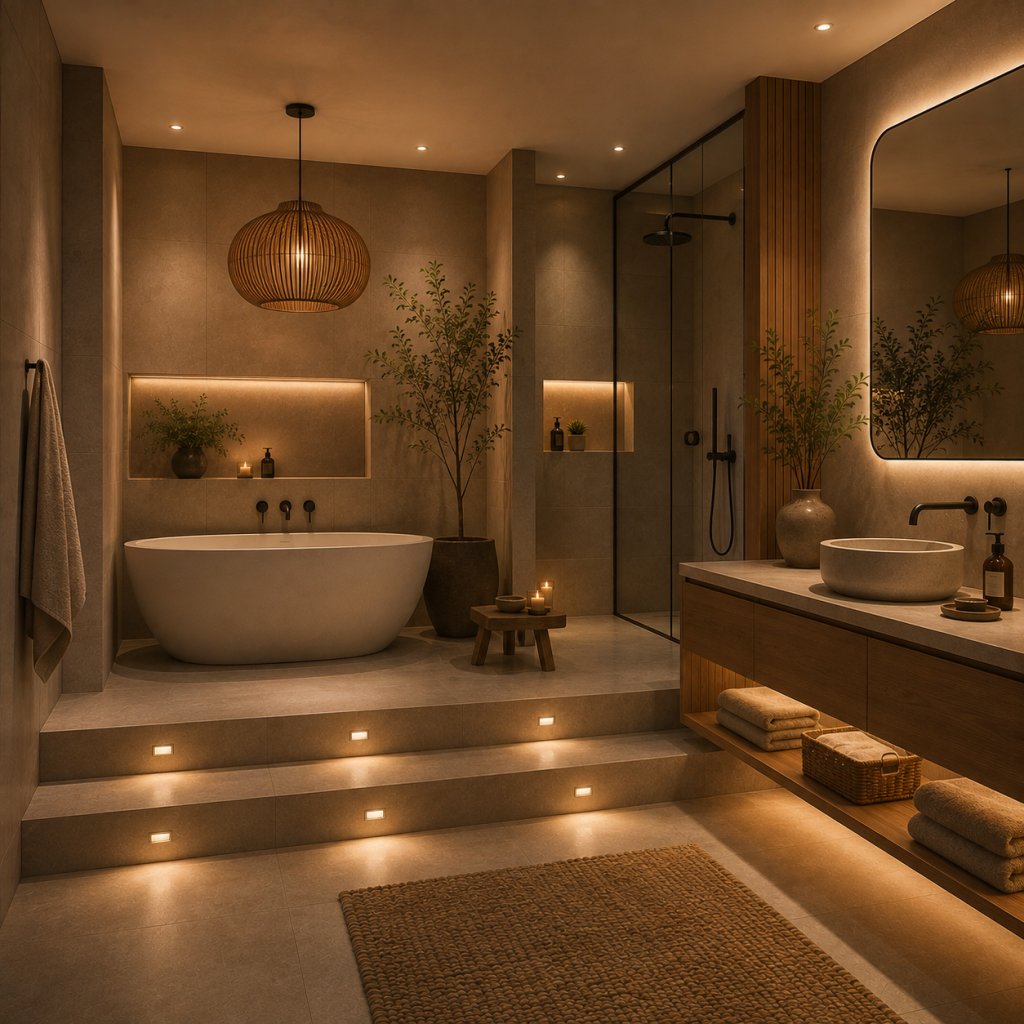
42. Recessed Step Lighting for Layered Atmosphere
If your bathroom includes a raised platform around a built-in tub or a step into a shower area, integrating recessed LED lighting into the step risers creates a beautifully layered effect. These low-level lights provide practical safety guidance while contributing to an atmospheric, hotel-inspired glow that makes the bathroom feel genuinely luxurious.
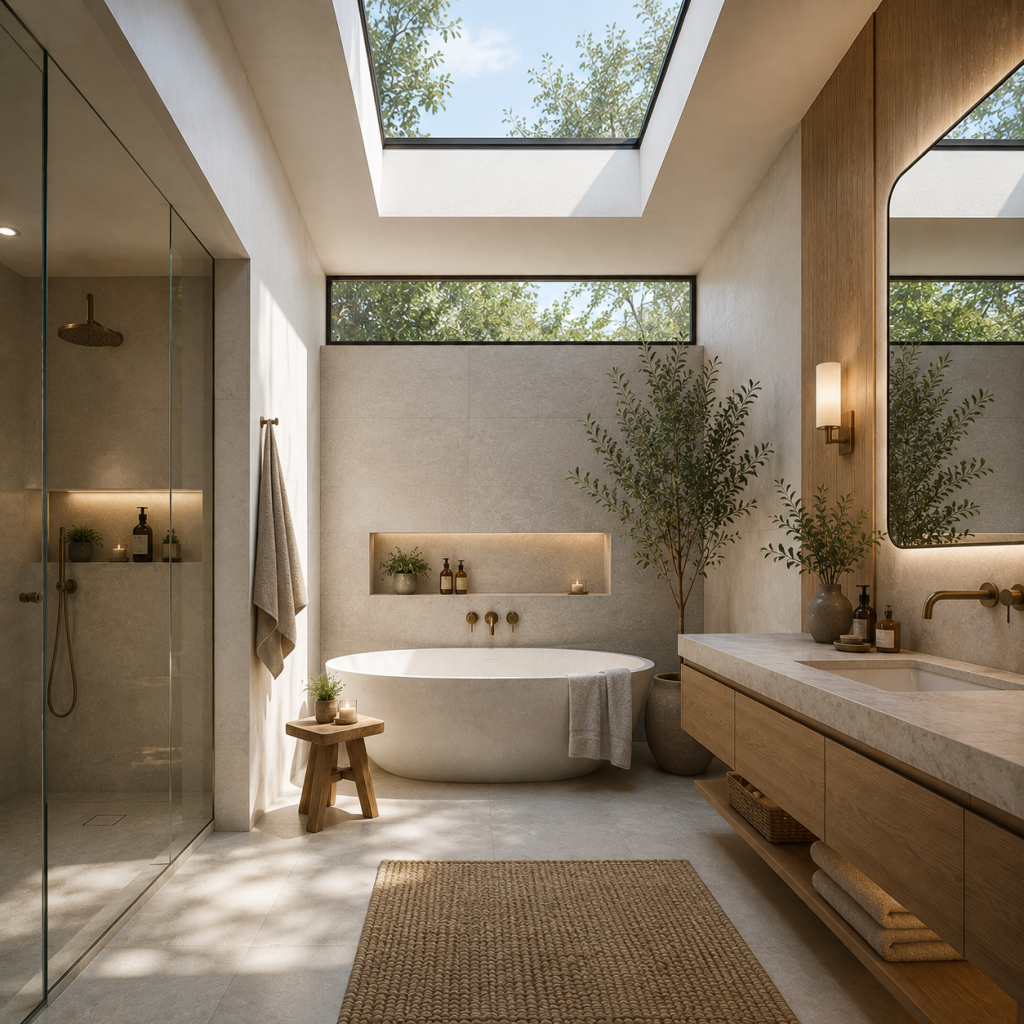
43. Maximizing Natural Daylight Through Skylights or Clerestory Windows
No artificial lighting, however beautifully designed, can replicate the quality of natural daylight falling on stone or wood surfaces. Where possible especially in ground-floor or extension bathrooms installing a skylight above the shower or bathtub zone transforms the experience of using those spaces. Daylight changes throughout the day, creating shifting patterns that make the bathroom feel alive and connected to the world outside.
Nature and Living Elements: Bringing the Outside In
Japandi design has a deep respect for the natural world, and a truly successful bathroom in this style will find ways to incorporate living, organic elements alongside its materials and fixtures.
Read: Easy Home Cleaning Ideas That Actually Work: A Real Person’s Guide
44. A Single Large Plant in a Matte Ceramic Pot
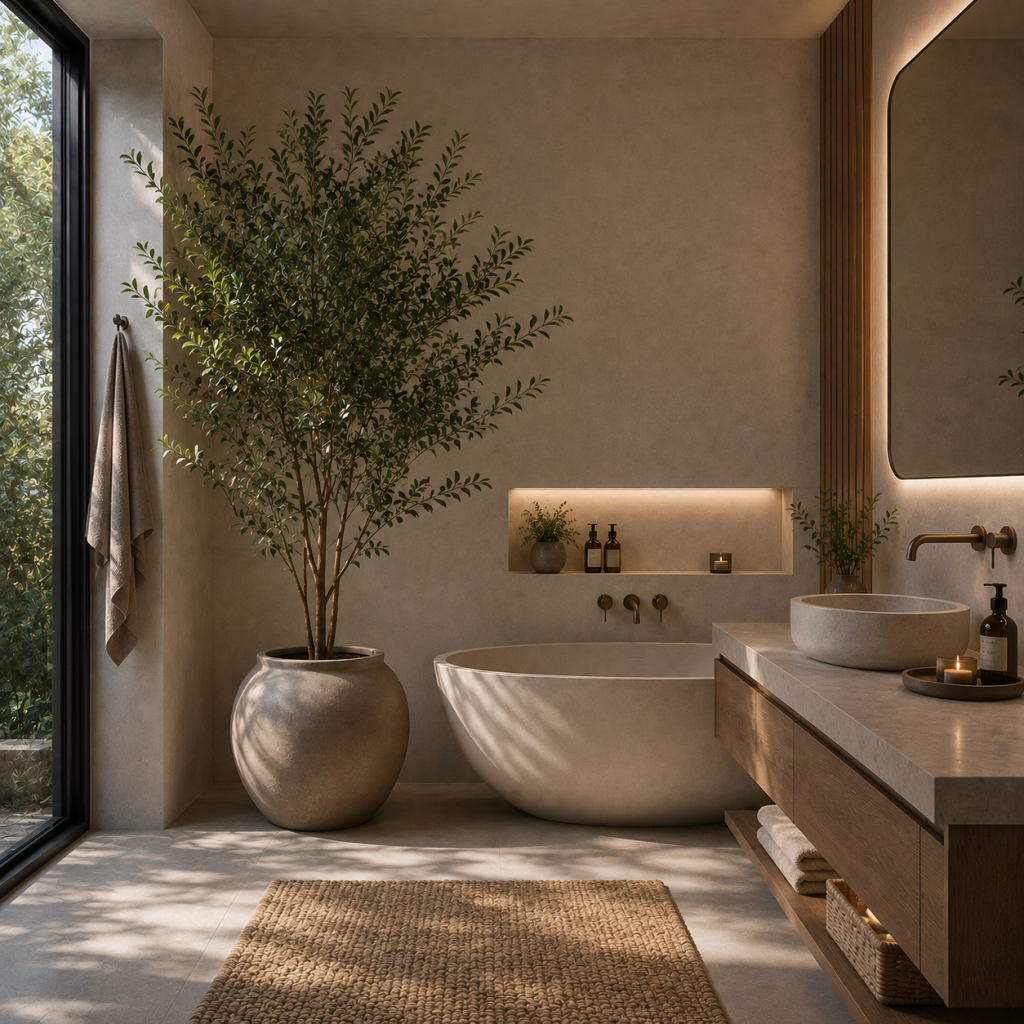
Resist the temptation to fill the bathroom with multiple plants and instead choose one a large, architectural specimen like a fig tree, a bird of paradise, or a tall snake plant in a generous, simply shaped ceramic pot. One beautiful plant, thoughtfully positioned, creates far more visual impact than a collection of small pots competing for attention on the windowsill.
45. Hanging Eucalyptus in the Shower
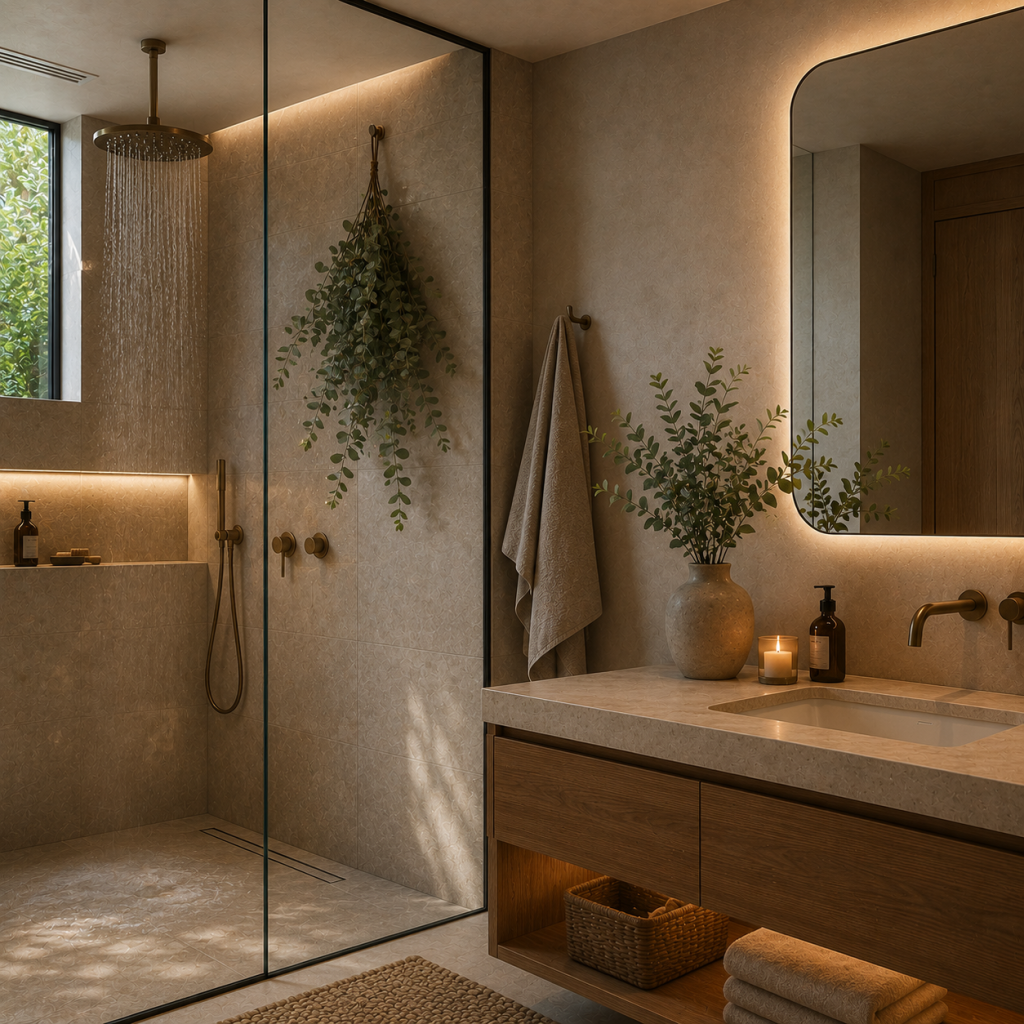
This is one of the simplest and most sensory additions to a Japandi bathroom. A bundle of fresh eucalyptus branches, tied and hung from the showerhead, releases its aromatic oils in the steam creating a natural, spa-like fragrance that transforms every shower into something genuinely restorative. Replace the bundle every week or two, and the ritual of renewal becomes its own small ceremony.
46. A Pebble or River Stone Feature Strip in the Shower Floor
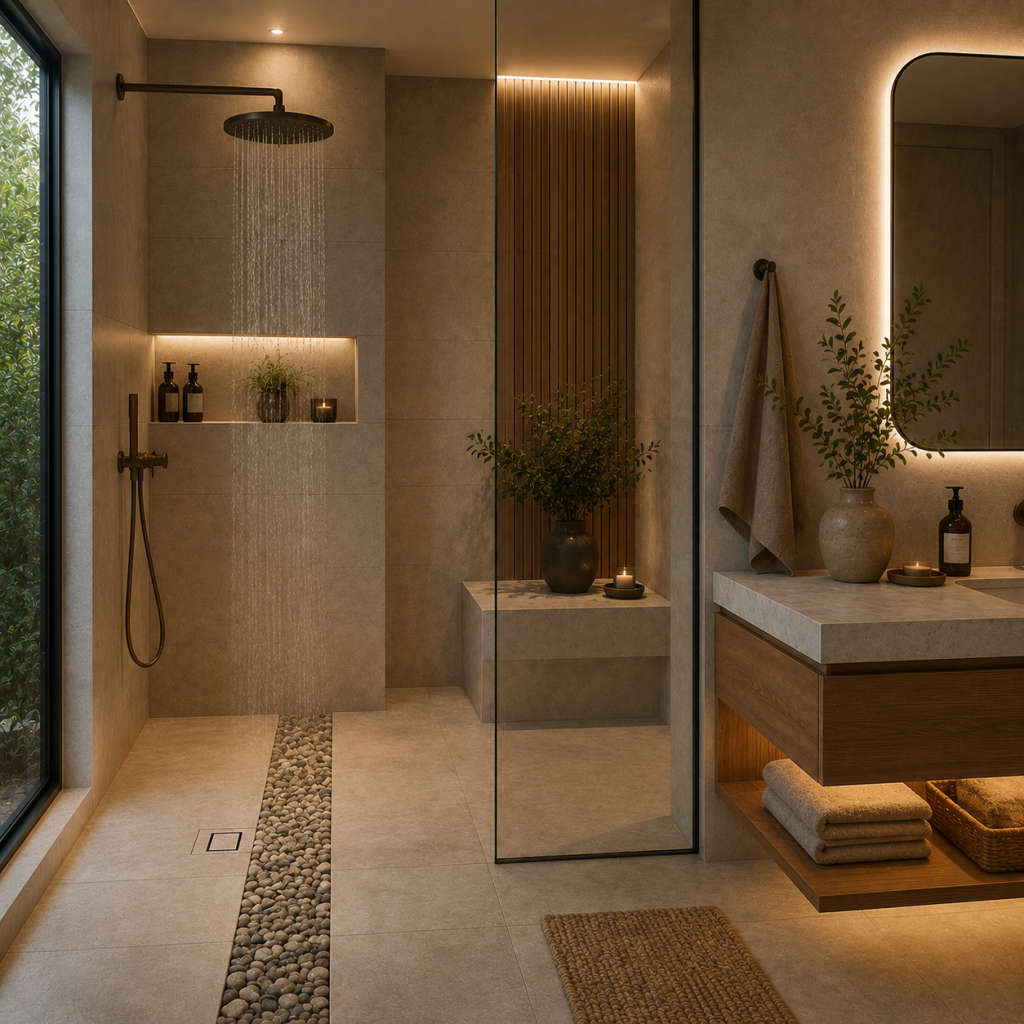
A narrow strip of smooth, rounded river pebbles set into the shower floor particularly beneath the showerhead creates a reflexology-inspired surface that is both beautiful and physically stimulating. The contrast between the smooth large tile and the organic pebble strip introduces natural texture while grounding the shower in a deeply Japanese aesthetic. Walking barefoot on river stones is one of the most primal and pleasurable sensations available in a domestic setting.
47. A Small Indoor Moss Wall or Preserved Moss Panel
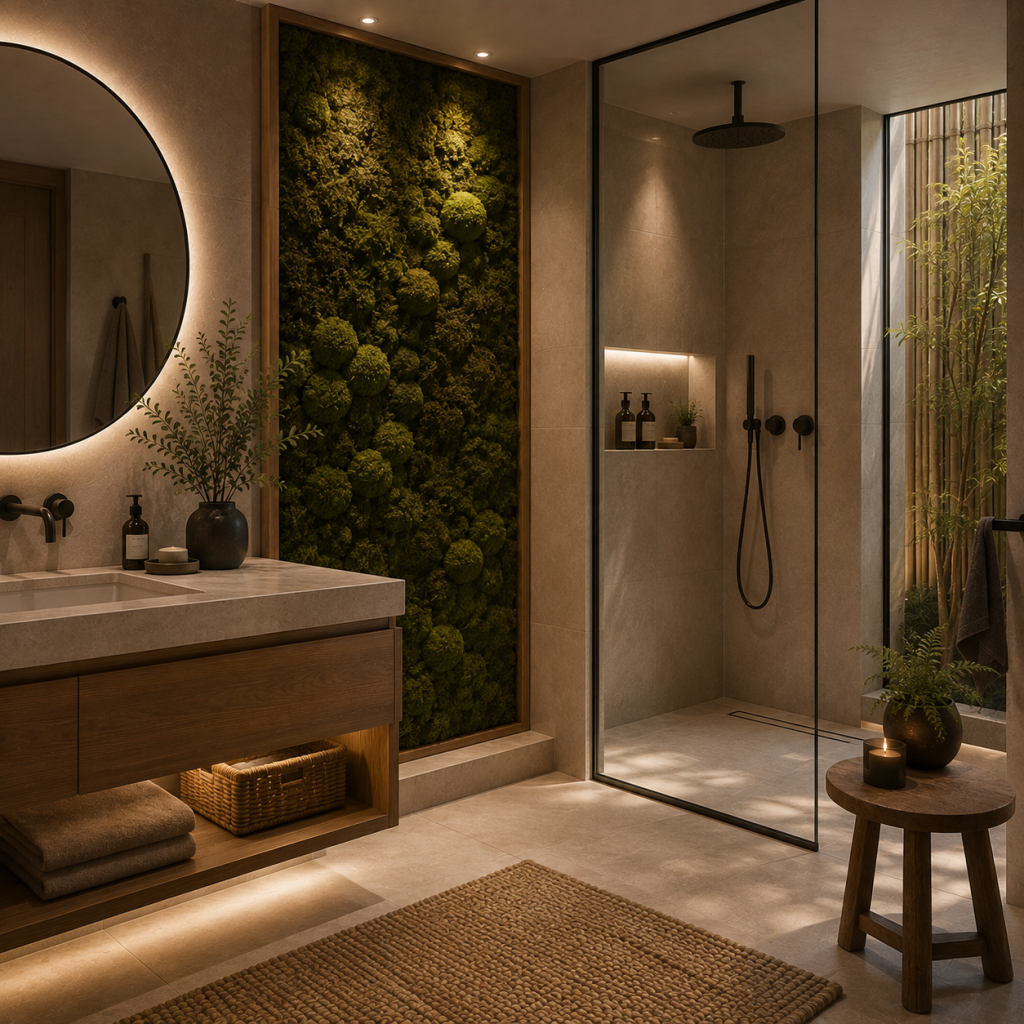
For bathrooms with sufficient humidity, a small panel of preserved moss naturally green, soft-textured, and requiring no maintenance on an interior wall creates a living artwork that is entirely at home in a Japandi aesthetic. Preserved moss panels require no watering or light, making them practical as well as beautiful. They introduce the color, texture, and energy of a forest floor into a space that would otherwise be entirely made of hard materials.
48. Using Natural Wood Accessories Consistently
Resist the mix of chrome, plastic, and ceramic accessories that accumulates in most bathrooms over time. Instead, establish a consistent material language for accessories: a teak soap dish, a wooden bath tray that spans the tub, a bamboo or walnut toothbrush holder, a cedar diffuser block. When all bathroom accessories share the same warm, natural material, the room achieves a cohesion and calm that is immediately perceptible.
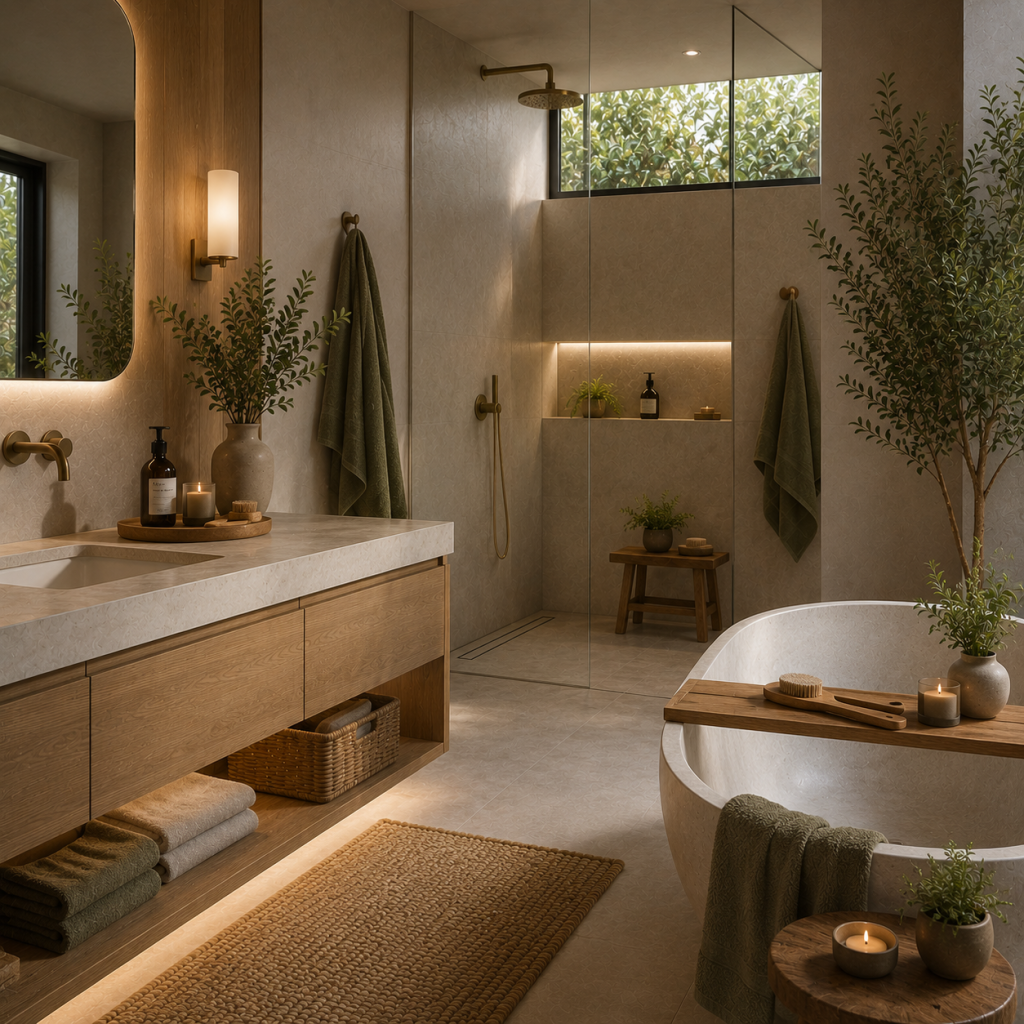
The Final Details: What Separates Good From Exceptional
Japandi bathroom design is a discipline of details. The large decisions flooring, fixtures, cabinetry establish the structure. But it is the smaller, seemingly minor decisions that determine whether the bathroom truly feels alive.
49.Towels That Function as Textiles, Not Just Utilities
In a Japandi bathroom, towels are part of the visual composition. Choose thick, waffle-weave or linen-cotton blend towels in soft, coordinated neutral tones oatmeal, stone, sage, or warm white. Fold them deliberately and display them on a simple rail or open shelf where they become part of the room rather than objects hidden away.
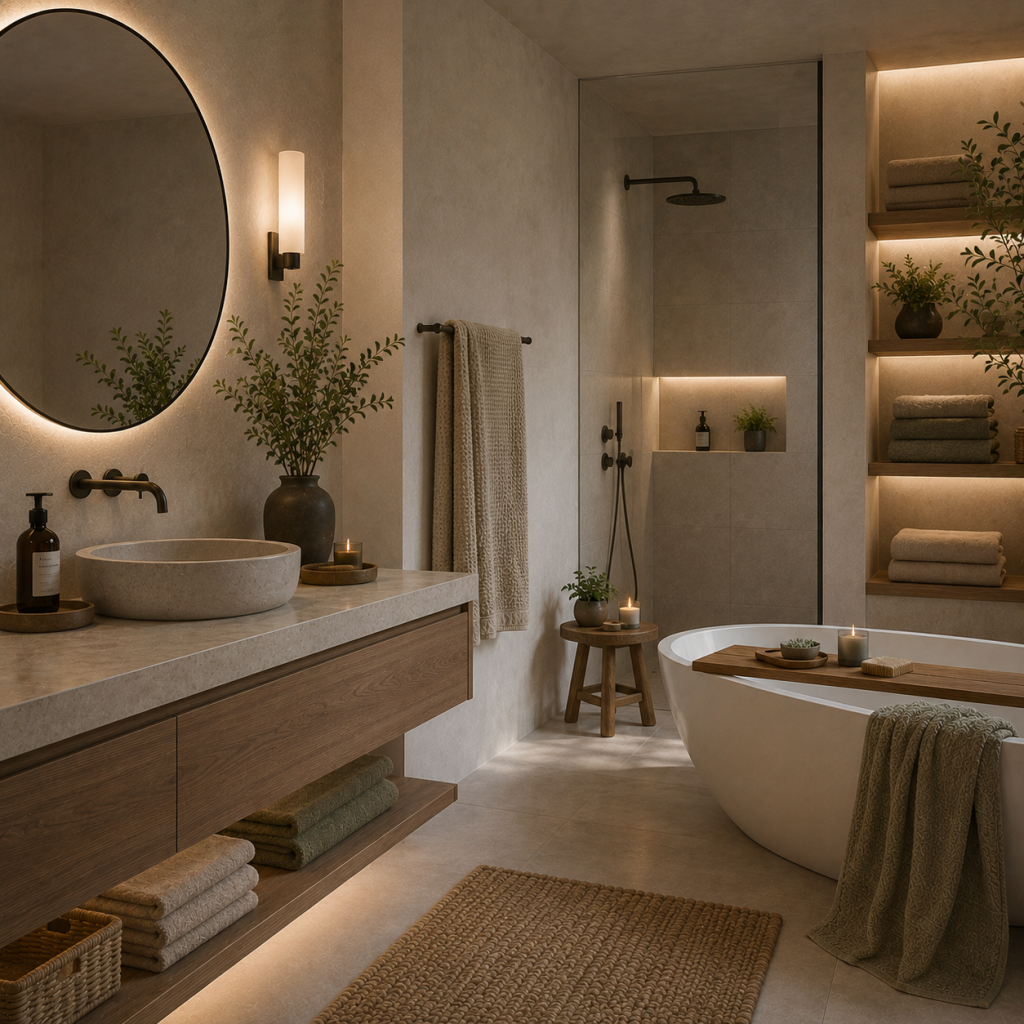
50. Matte Hardware, Always
Shiny chrome hardware taps, towel rails, toilet roll holders introduces a hard, reflective quality that works against the soft, matte aesthetic of a Japandi bathroom. Switch every metal finish to matte black, brushed nickel, or warm bronze. The non-reflective surfaces integrate quietly into the room rather than catching the eye and demanding attention.
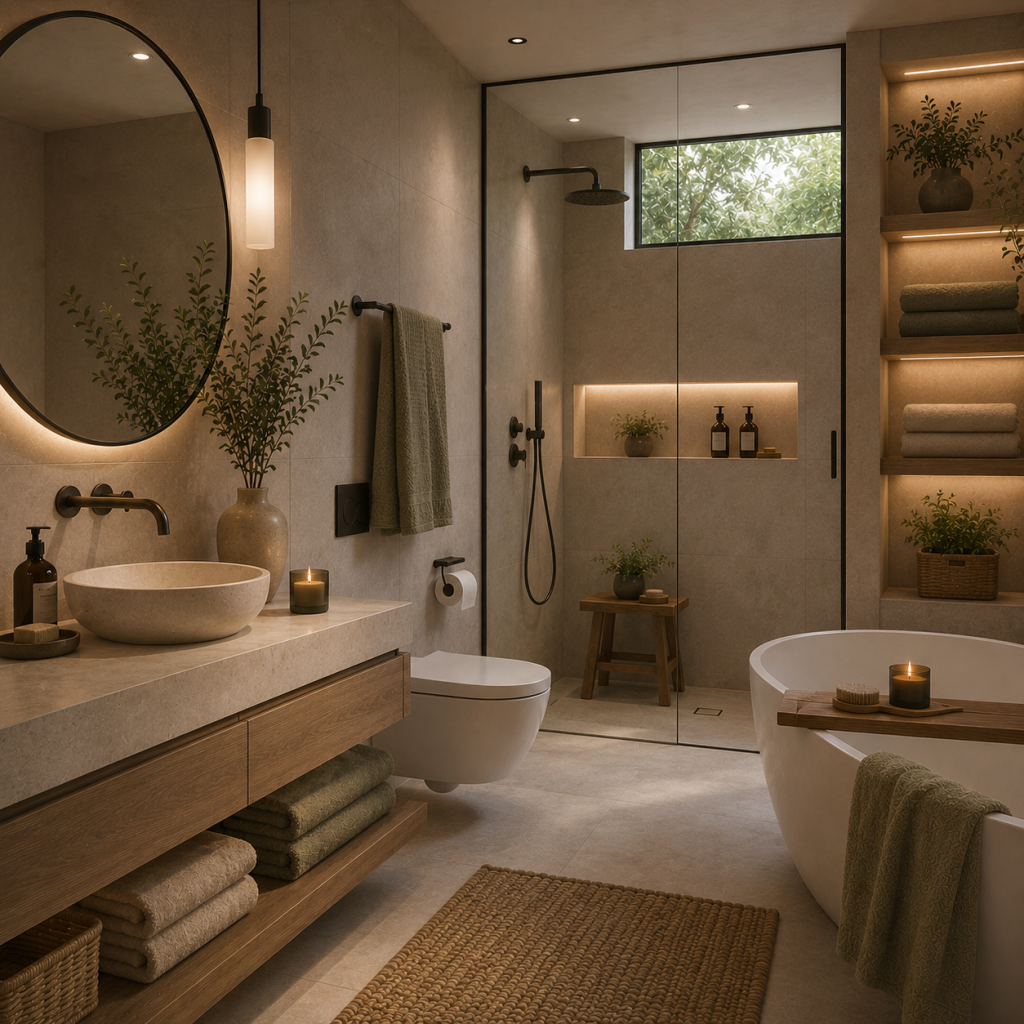
51. A Hand-Thrown Ceramic Soap Dish as a Small Ceremony
The soap dish is one of the smallest objects in a bathroom, but in a Japandi space, even the smallest object is chosen with care. A hand-thrown ceramic dish perhaps with an irregular rim and a softly variegated glaze introduces the philosophy of wabi-sabi in the most accessible and affordable way. It is a daily reminder that beauty does not require perfection.
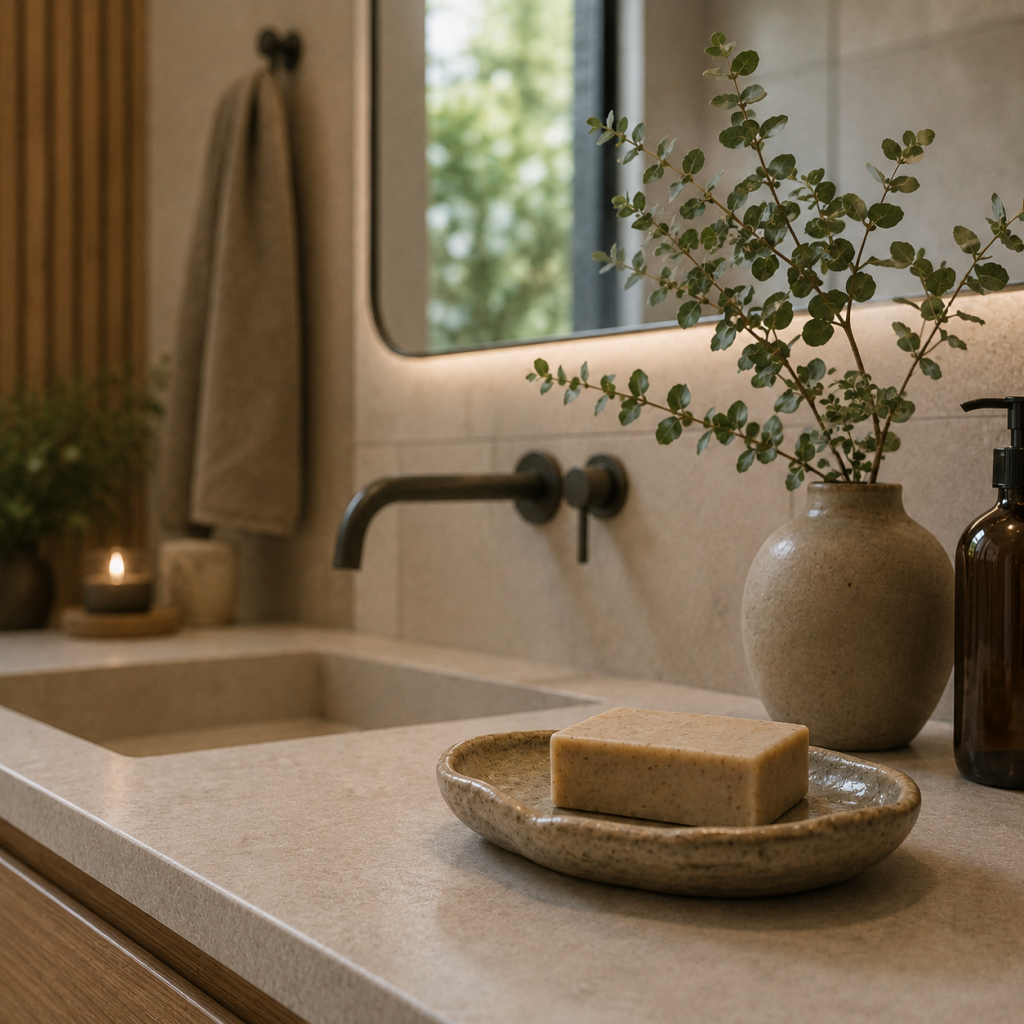
52. Decluttering Products Into Refillable Dispensers
Commercial product packaging with its bright labels, various sizes, and competing graphic designs is one of the greatest sources of visual noise in a bathroom. Decant shampoo, conditioner, body wash, and hand soap into matching matte or glass refillable dispensers. This single change, more than almost any other, makes a bathroom feel immediately more intentional and calm.
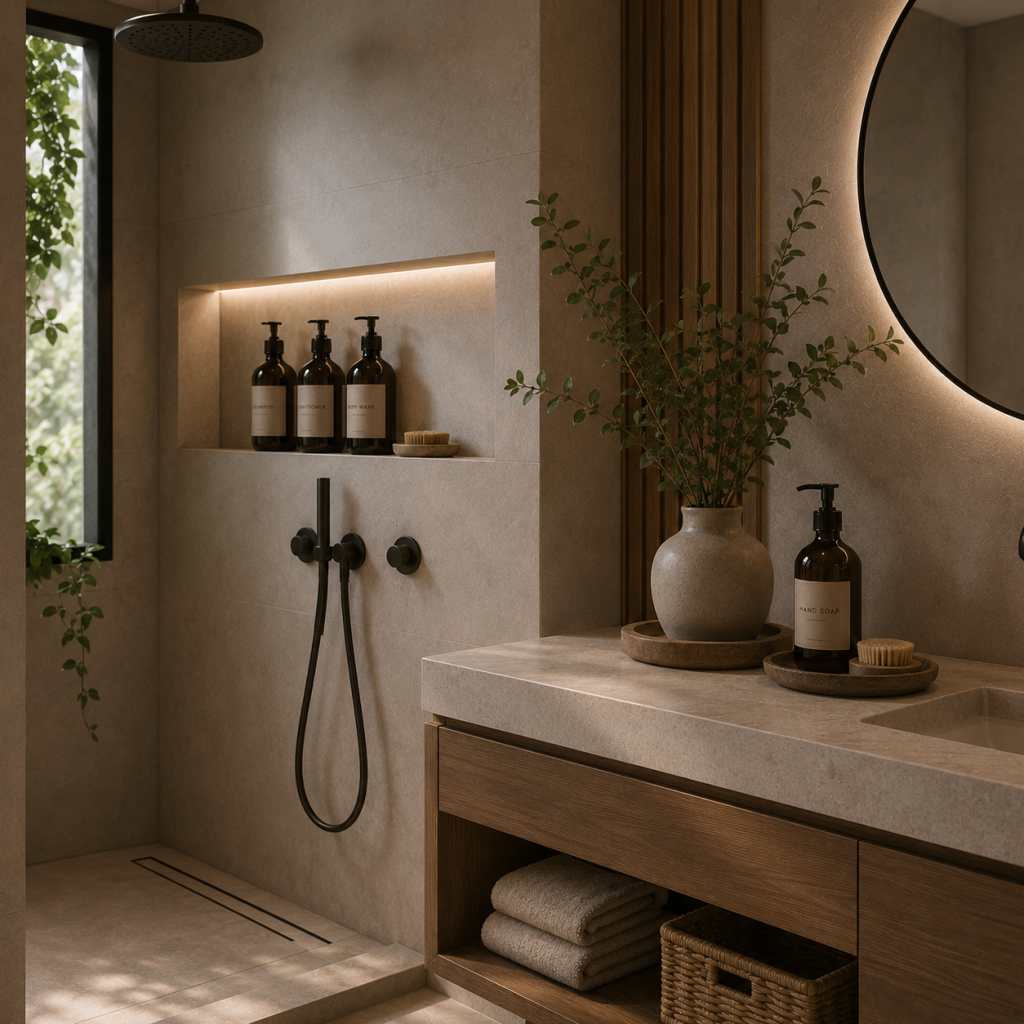
53. A Bath Tray That Serves as a Ritual Object
A beautifully designed bath tray spanning the width of the tub, holding a small candle, a book, a glass of water, and perhaps a single bloom transforms the act of bathing into a ceremony. In a Japandi bathroom, ritual matters. Choose a tray in solid teak or pale oak, simple in form, perfectly proportioned to the tub.
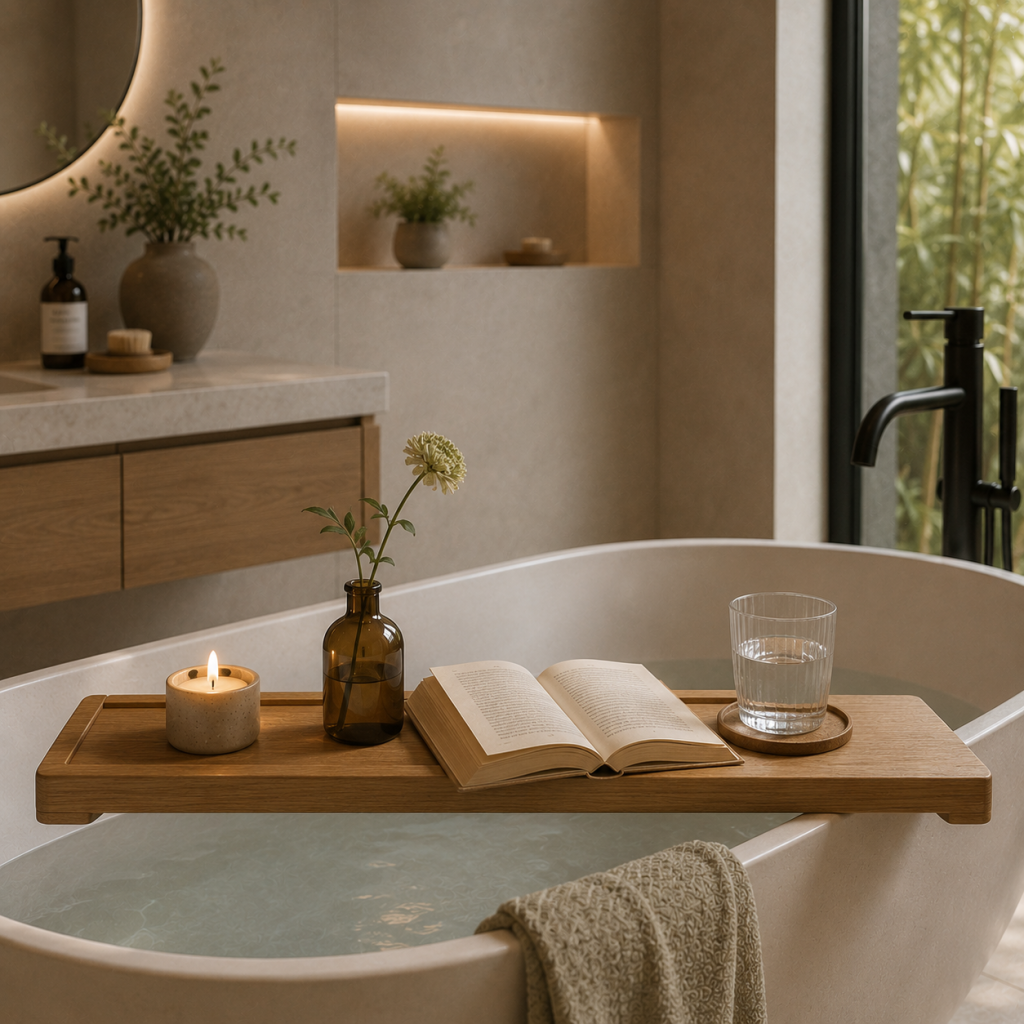
54. A Simple, Unscented Beeswax or Soy Candle
A single candle, lit while bathing in the evening, changes the entire atmosphere of a bathroom. In a Japandi space, choose an unscented or very lightly scented beeswax or soy candle in a matte ceramic holder. The living flame, the soft golden light, the quiet these elements invite stillness in a way that no light switch can.
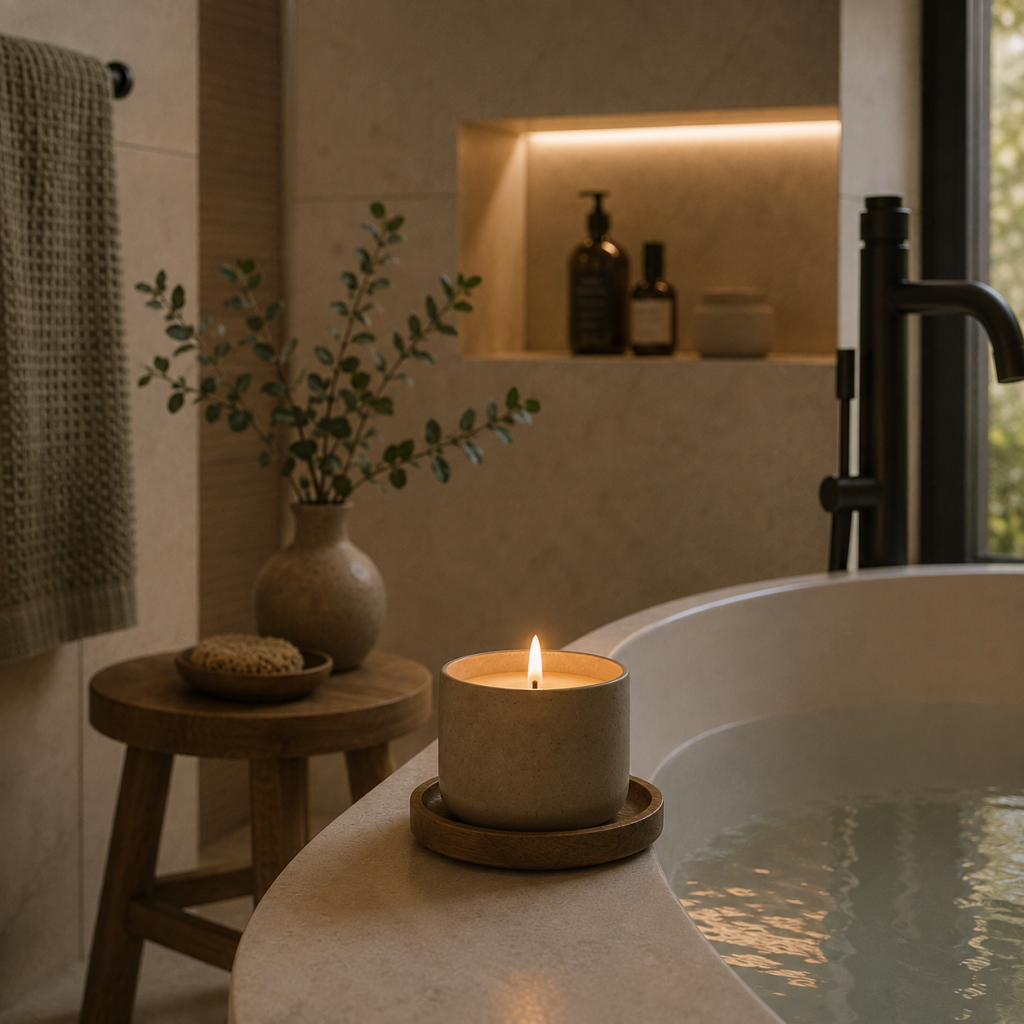
55. Scent as an Invisible Layer of the Design
The most memorable spaces have a consistent, subtle scent that becomes part of their identity. For a Japandi bathroom, consider cedarwood, hinoki cypress, sandalwood, or fresh green tea scents that evoke forests, stone, and clean air. A simple wooden diffuser with essential oils, or a few drops of hinoki oil on the shower floor before stepping in, establishes a sensory signature that makes the bathroom feel distinctly yours.
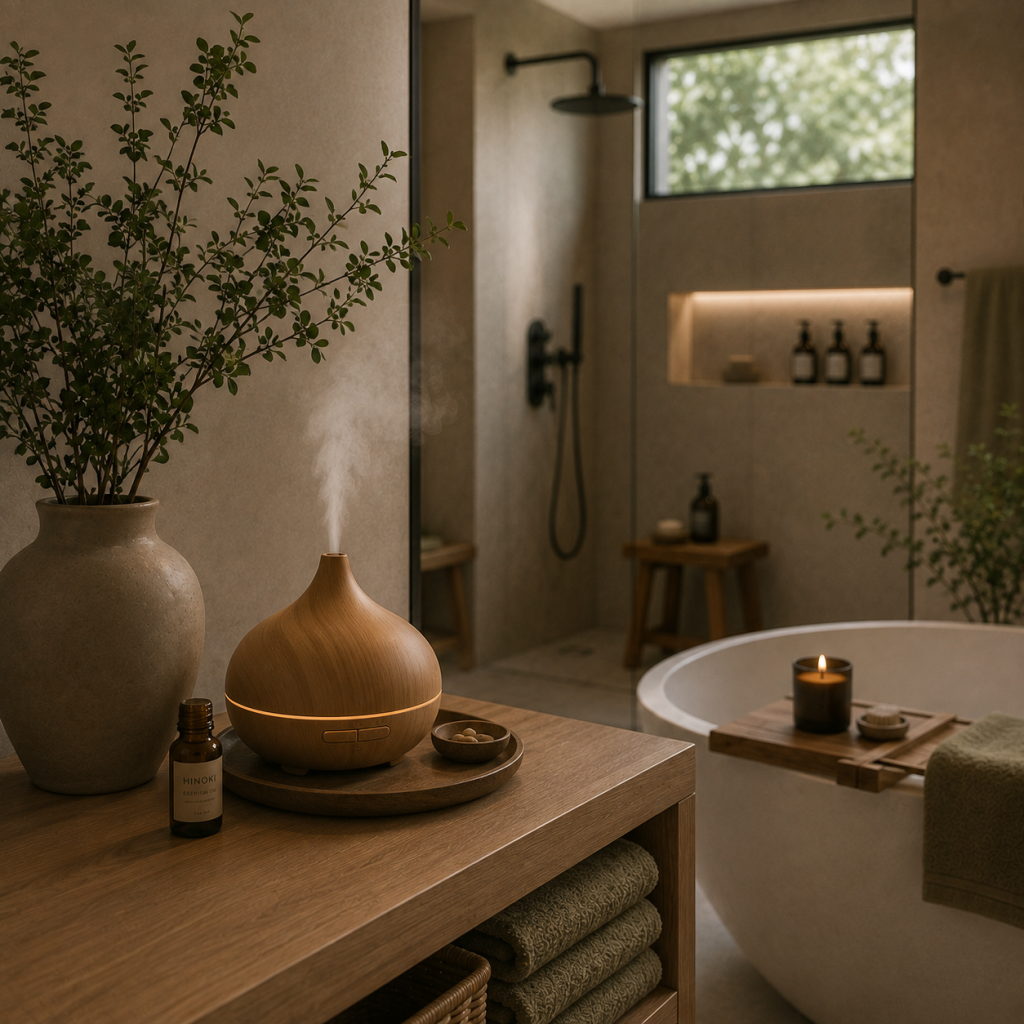
56. Art That Is Earned, Not Decorative
Most bathrooms have no art. Some have art that is merely decorative. A Japandi bathroom, if it has art at all, displays it sparingly and with purpose perhaps a single framed piece of Japanese calligraphy, a small woodblock print by a living artist, or a carefully selected piece of ceramic work displayed on a shelf. The art should feel earned by the space, not hung to fill silence.
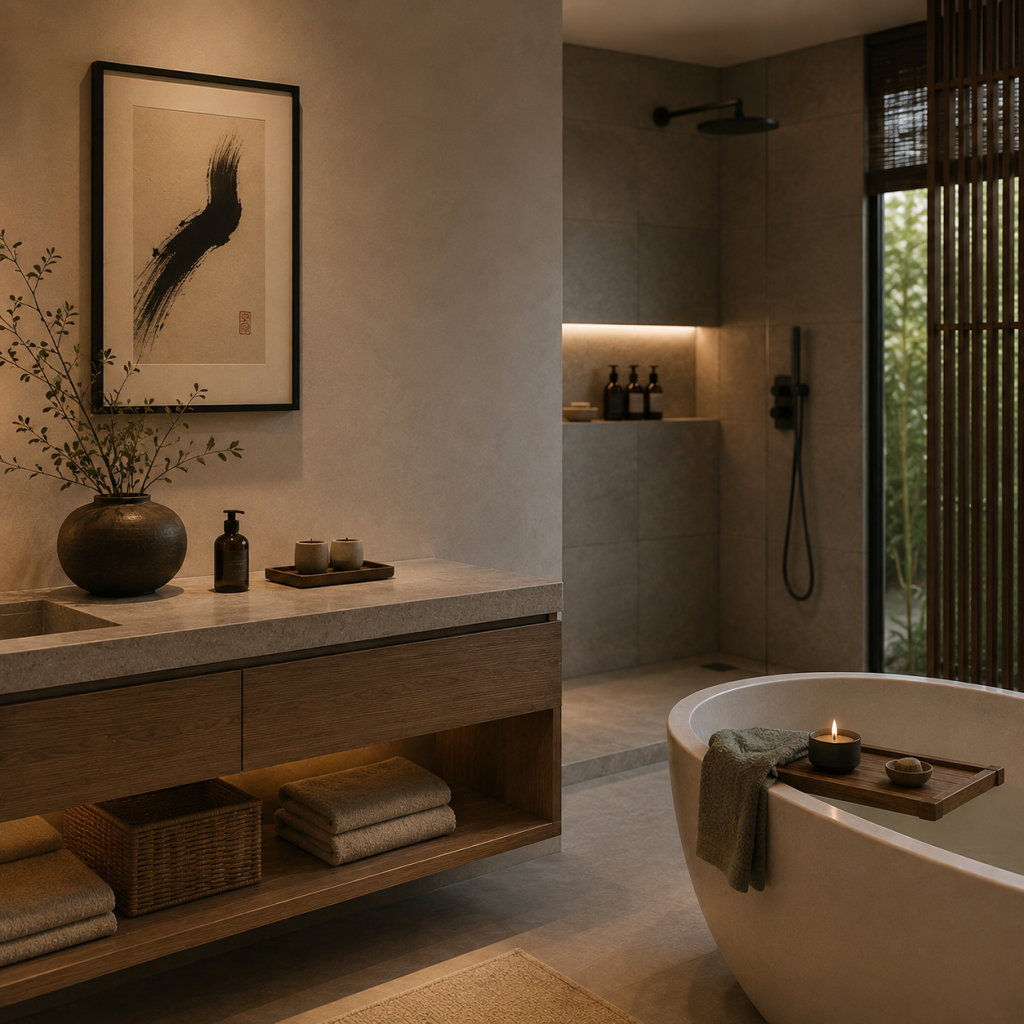
57. Music or Silence as a Considered Choice
Sound is part of the bathroom experience. Consider built-in speakers, carefully positioned, that allow music, nature sounds, or ambient audio to fill the space at a comfortable level. Or choose silence and design the room with materials that absorb rather than reflect sound, making the quiet feel rich rather than empty. Both are valid Japandi choices. What matters is that the sound environment is chosen deliberately.
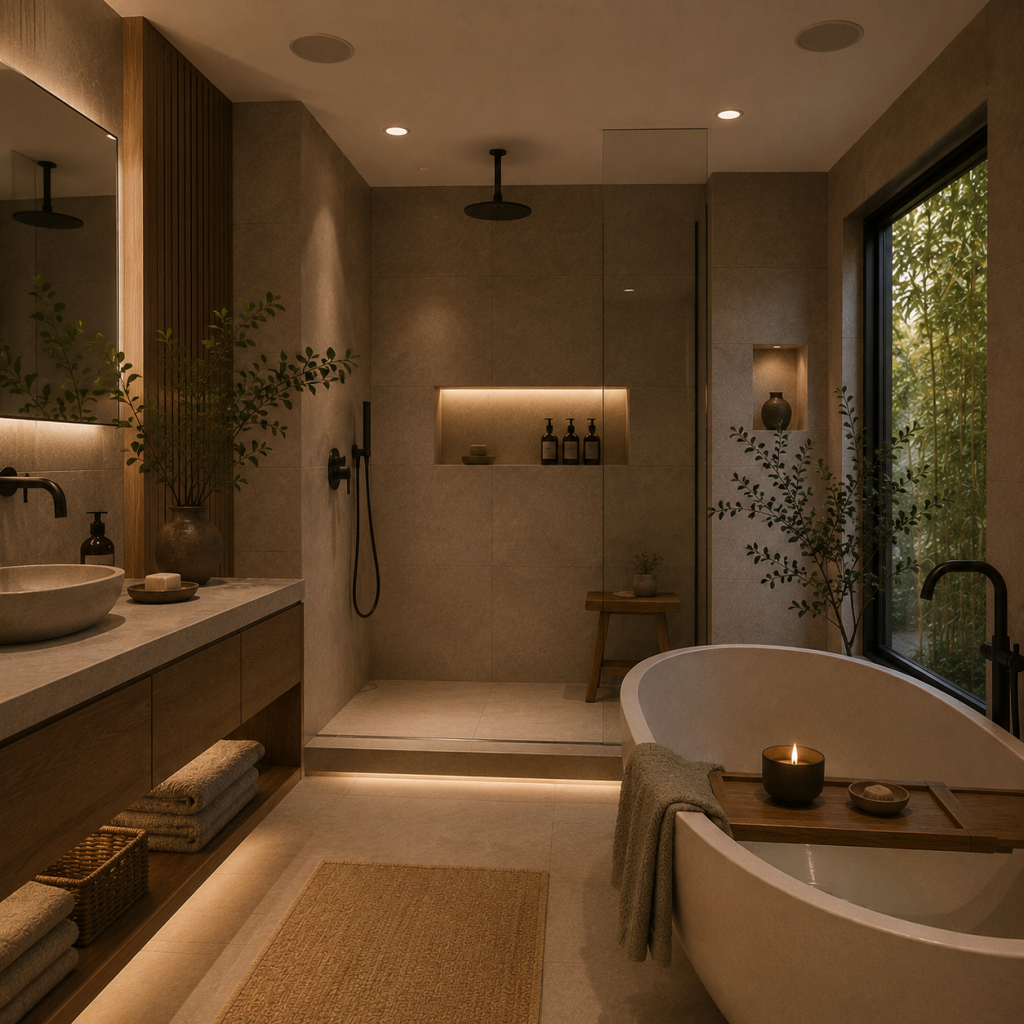
58. A Morning Ritual That Honors the Space
The final Japandi bathroom idea is not a material choice at all it is a practice. Design a simple morning ritual that makes deliberate use of the space you have created. Perhaps it is three minutes of stillness after the shower, standing in warm light. Perhaps it is the careful application of a few skincare products with a tea towel folded on the counter. Whatever it is, the ritual completes the design because a Japandi bathroom is not finished when the tiles are laid. It is finished when someone begins to live in it slowly.
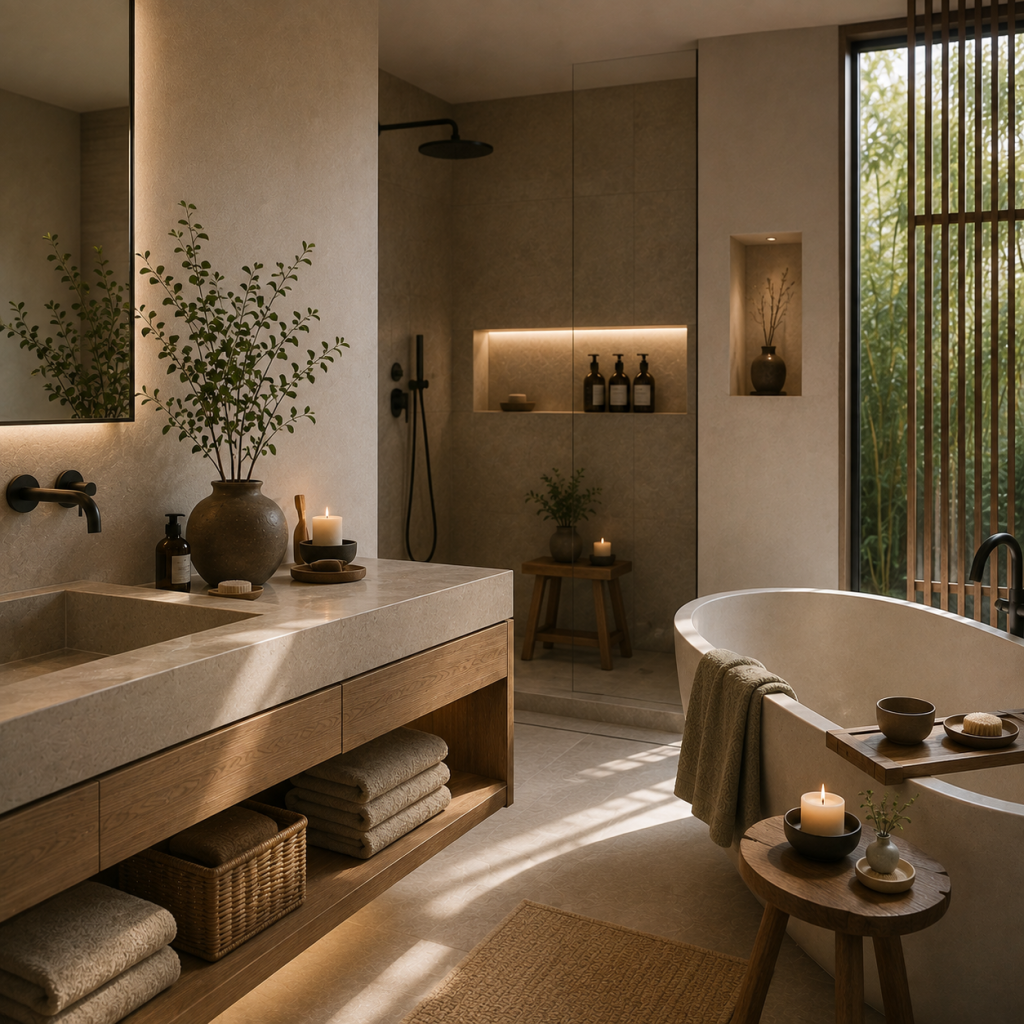
A Japandi bathroom is not a style you simply install it is a philosophy you choose to live by. At its heart, it asks a deceptively simple question: what is truly necessary? What materials feel honest? What forms serve us best? What removes noise from daily life rather than adding to it?
The ideas in this article span everything from the broad strokes of color palette and flooring to the quiet details of ceramic soap dishes and morning rituals. Some will resonate immediately; others may feel aspirational. The best approach is not to try to implement everything at once, but to begin with the elements that would most meaningfully change your daily experience and let the rest follow.
A bathroom designed in the Japandi spirit will not photograph as dramatically as a maximalist interior, and it will not announce itself the moment you walk through the door. What it will do is something more valuable: it will make you feel better, every single day, without you quite knowing why. That quiet, steady, reliable calm is the most honest definition of timeless design and it is entirely within your reach.
Start simply. Remove before you add. Choose materials that feel true. And give your bathroom the dignity of intention.