11 Modern Tech-Zone Bedroom Ideas That Make Your Room Smarter and Calmer
Introduction
A modern tech-zone bedroom starts with one question: what should the technology in your bedroom actually do for you? The honest answer is usually small — wake you gently, charge your phone, dim the lights at night, play music, and let you watch a show or play a game without the room looking like an electronics store. Everything else is noise, and noise is the opposite of what a bedroom is for.
The eleven ideas below treat technology as infrastructure, not decoration. Smart lighting replaces the harsh overhead bulb. Charging moves off the floor and into the nightstand. Cables run behind furniture instead of across it. A TV or gaming setup gets one clean zone instead of spreading across the whole room. And sleep tech — a smart alarm, a white-noise machine, a thermostat schedule — works while you sleep so you do not have to think about it at all. If you are starting from a plain bedroom and want the decor side first, our boho bedroom decor ideas and new year bedroom decor ideas guides cover the soft layers; this guide covers the wires, the glow, and the quiet.
One more principle before the ideas: buy for the room you have, not the showroom. A small bedroom needs one smart speaker, not three, and one charging spot per person, not a charging station for a family of five. A rented bedroom needs plug-in solutions — smart bulbs, a charging pad, a cable tray — not in-wall wiring you cannot take with you. And every piece of bedroom tech should pass a simple test: if it broke tomorrow, would the room still work? The lights should still turn on from the wall switch, the alarm clock should still ring, and the curtains should still close by hand. Smart is a bonus, not a dependency, and the best tech-zone bedroom is the one that stays comfortable even when the Wi-Fi goes down.
1. Smart Lighting That Follows Your Day
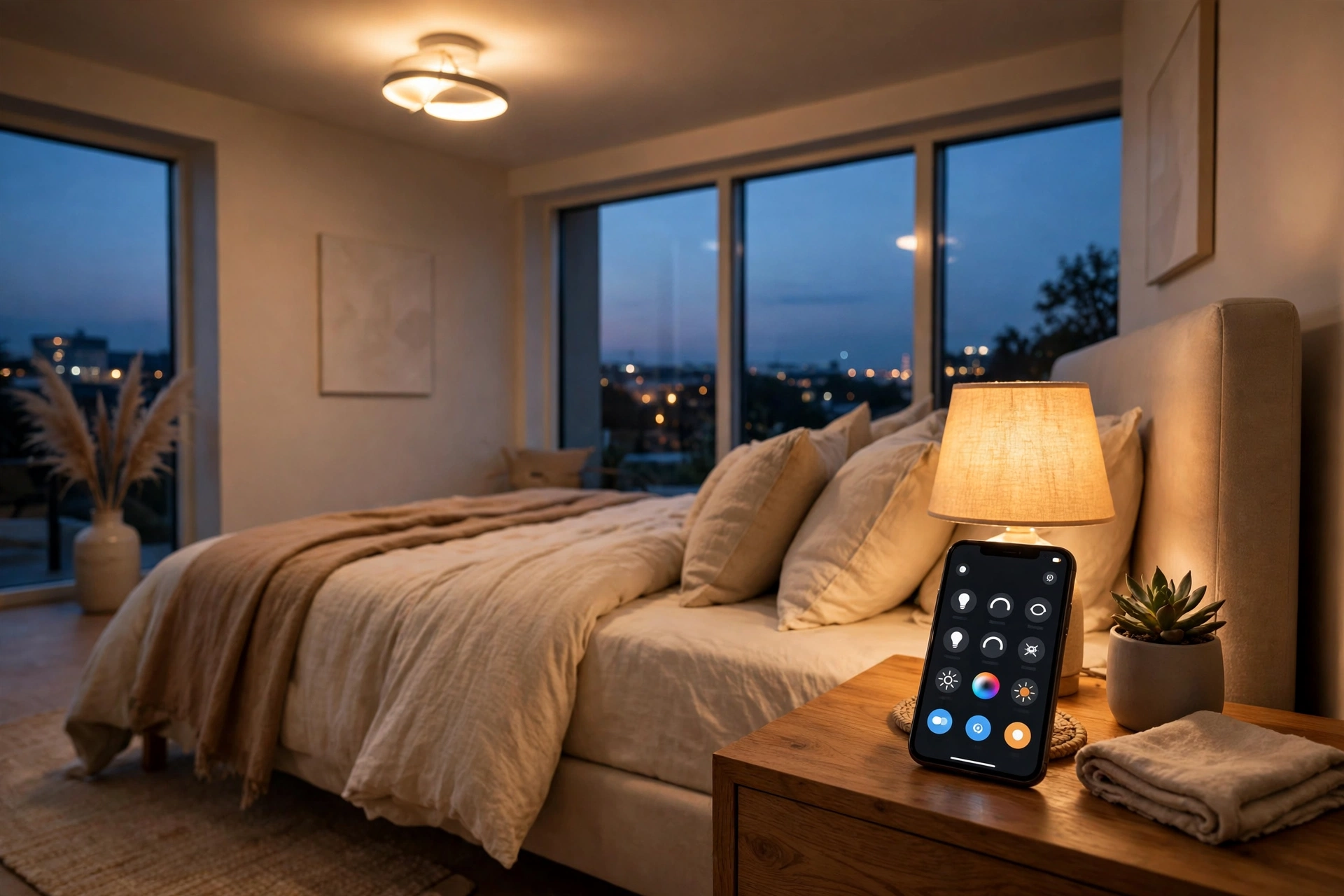
Smart bulbs are the single easiest tech upgrade in a bedroom, and they change the room more than any lamp ever will. Set a warm, dim scene for the evening, a bright white scene for getting dressed in the morning, and a slow sunrise fade for your alarm — the lights do the work of a dimmer switch, a bedside lamp, and a wake-up light all at once, and you never have to get out of bed to change them.
Start with two or three smart bulbs in the fixtures you already own, plus one smart plug for a lamp you love. Group them in the app as one room so a single voice command — “good night” — turns everything off. Keep the color temperature warm after sunset, around 2200K to 2700K, because cool blue-white light late at night fights your sleep. The goal is a room that gets darker and warmer as the evening goes on, on its own, without you thinking about it.
If you share the bedroom, set up a second scene for your partner — one side of the room dim while the other reads, for example — and use a small wireless remote or a bedside button instead of the phone app, so nobody has to unlock a phone at midnight. LED strip lights behind the headboard or under the bed frame add a soft glow for getting up at night without waking anyone; set them to the dimmest warm setting and a motion sensor so they only come on when a foot hits the floor. The whole point is that the lighting adapts to you, not the other way around.
2. A Wireless Charging Nightstand
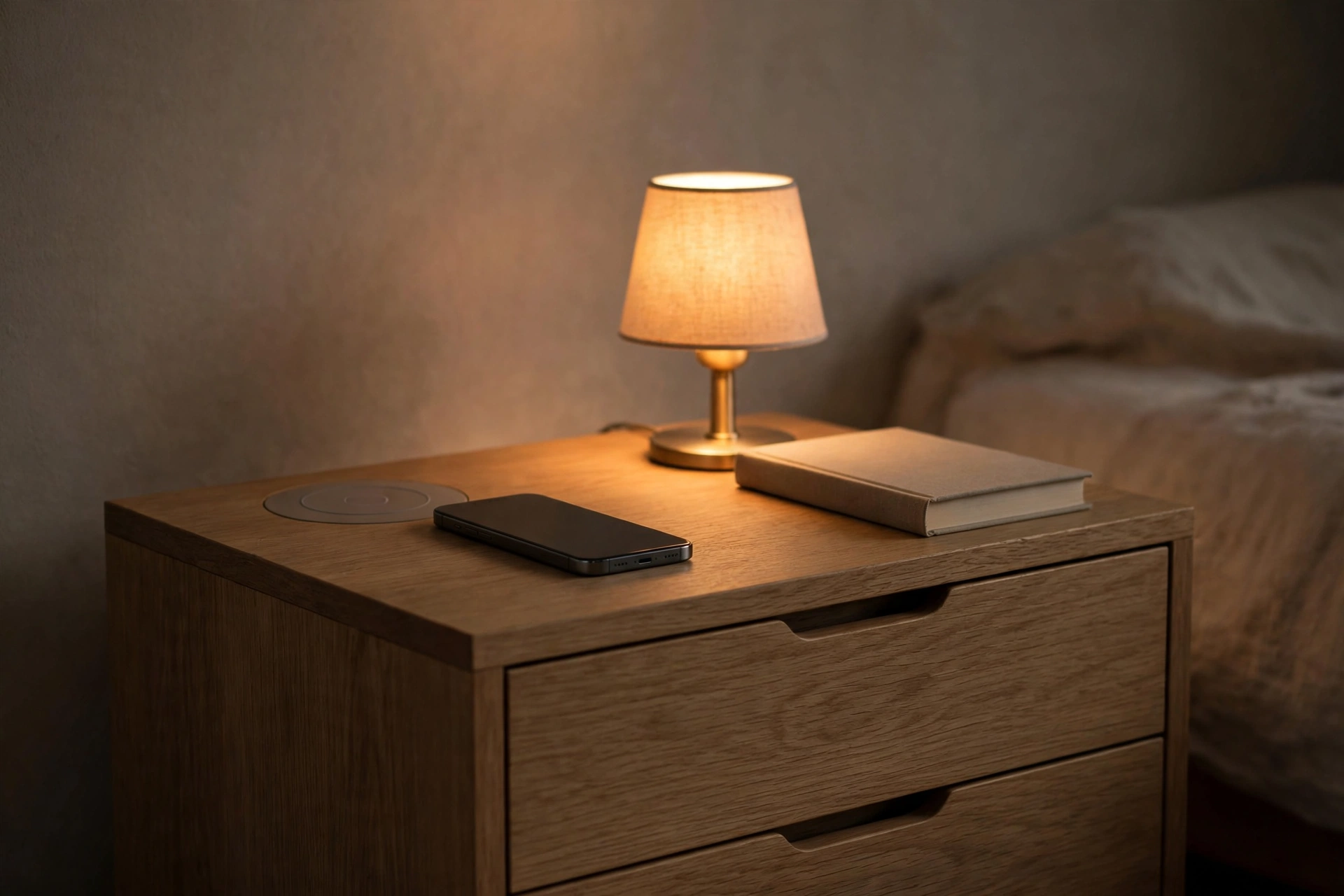
The nightstand is where bedroom clutter is born: a phone cable, a watch cable, an earbuds case, and a lamp all fighting for the same six inches of wood. A wireless charging nightstand ends that fight. Choose a nightstand with a built-in charging pad on top, or add a slim charging pad under a thin wood or stone top — your phone charges just by being set down, and the cable disappears entirely.
Keep the top of the nightstand to three things: the charging spot, a small lamp, and one personal item, like a book or a glass of water. Everything else — the watch charger, the extra cables, the power strip — lives in the drawer, plugged into a small power strip mounted inside it. If your bedroom storage needs a bigger reset first, our new year bedroom organization ideas guide shows how to clear the surfaces before the tech goes in.
3. One Clean TV Zone — Never a TV on Every Wall
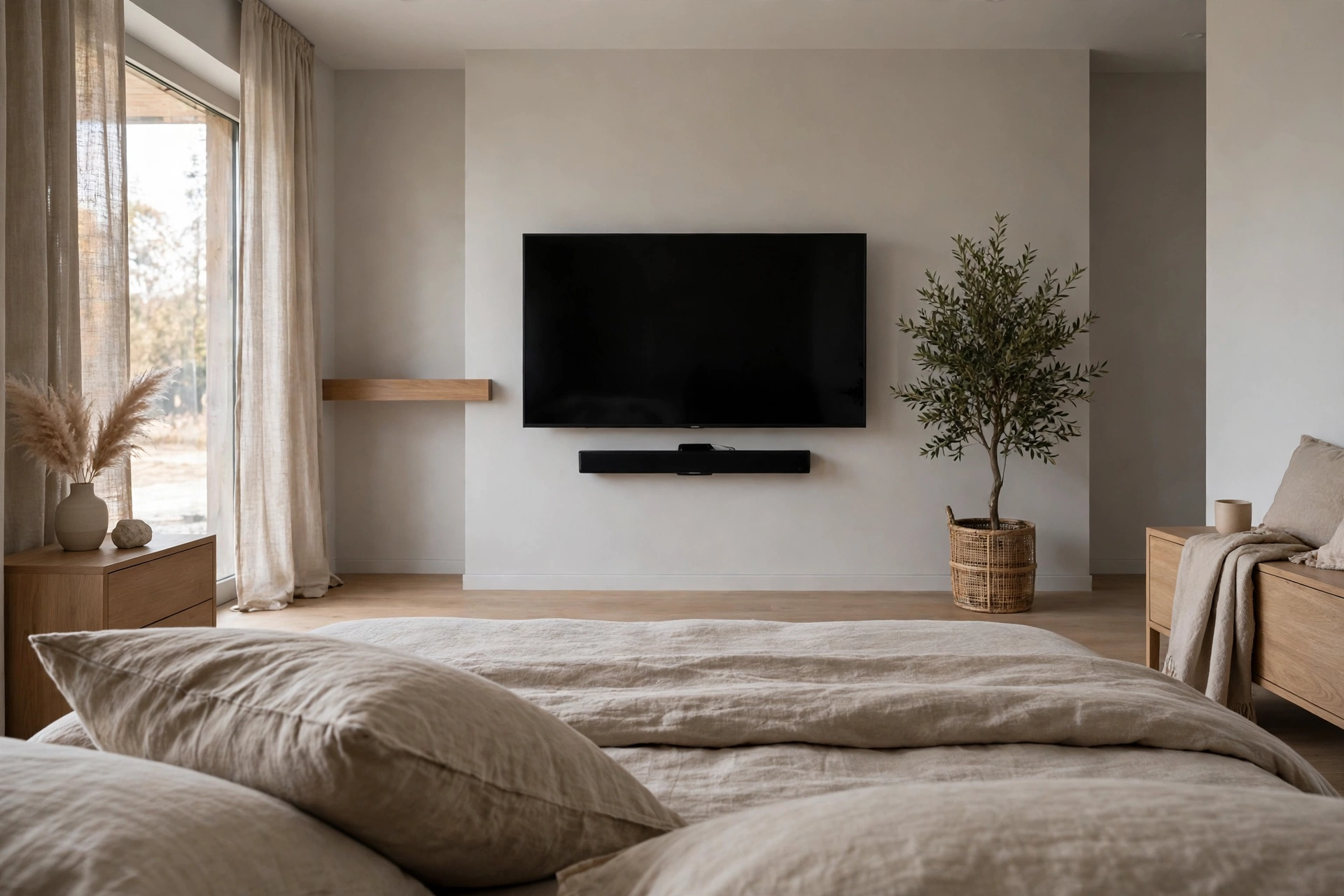
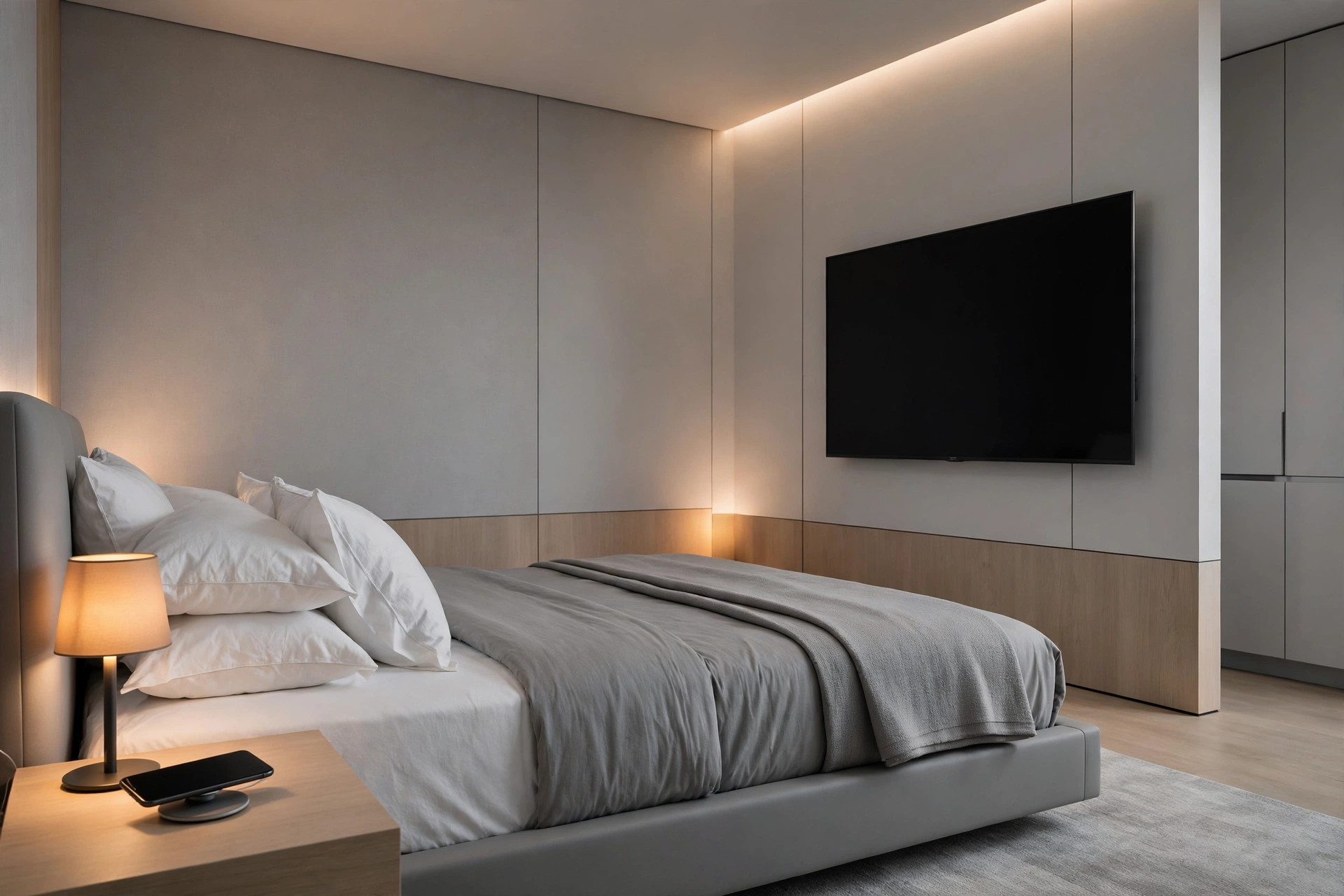
A bedroom TV works best when it has exactly one home and one job. Mount it on the wall opposite the bed at eye level while you are lying down — usually lower than you expect, around 42 to 48 inches from the floor to the center of the screen — and run the power and HDMI cables through the wall or inside a slim paintable cable channel so nothing dangles. A single soundbar underneath the screen replaces a shelf of speakers.
The rest of the room stays TV-free on purpose. No second screen on the dresser, no tablet propped on the pillow. When the TV is off, it should read as a dark, quiet panel on the wall, not the center of the room — a simple frame-style TV or a plain black screen both work. Set a sleep timer in the TV settings so it turns itself off, and keep the remote in one spot, like a small tray on the nightstand, so the bed never becomes a remote-control hunt.
4. A Compact Gaming Corner That Hides in Plain Sight
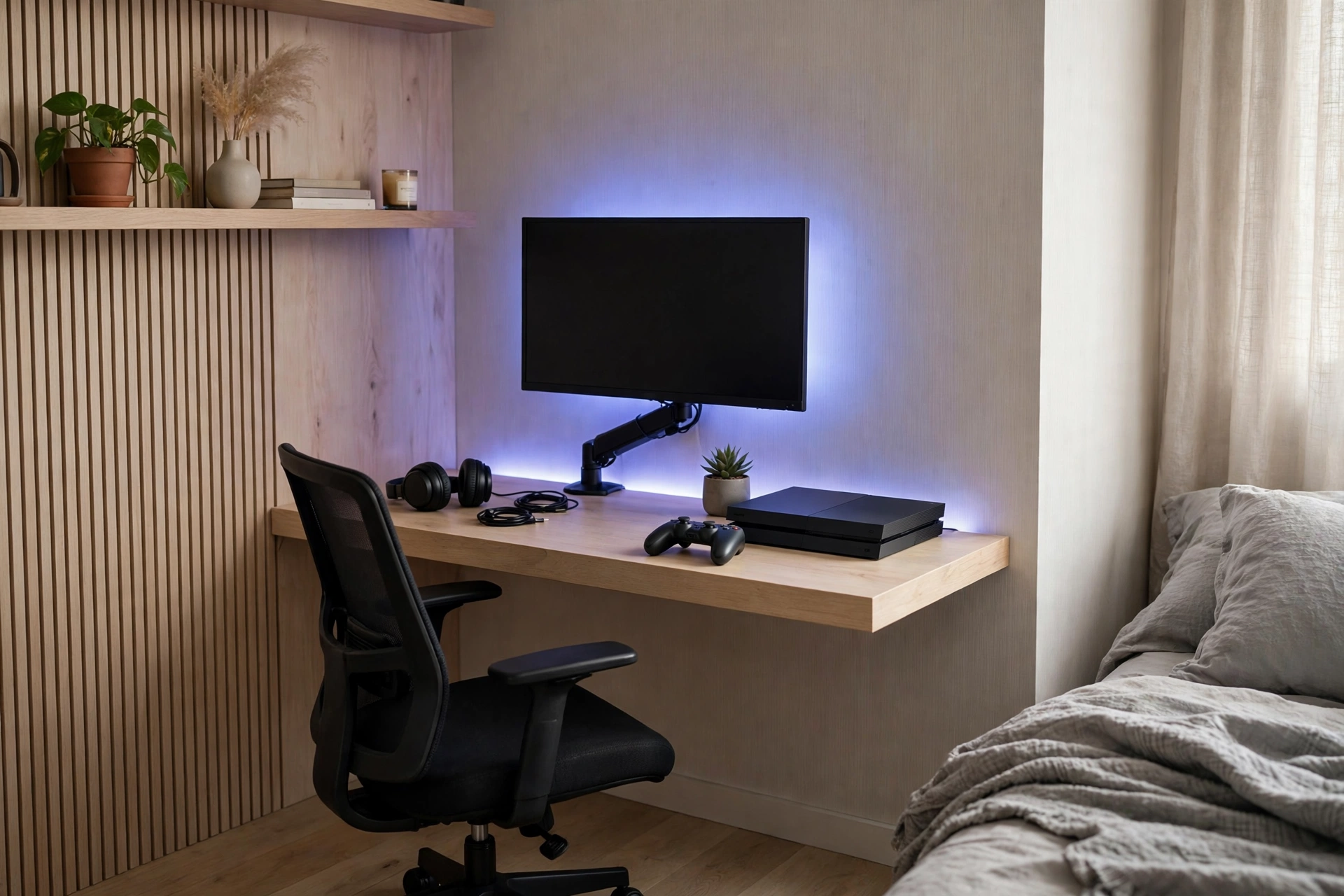
A bedroom gaming setup does not need a whole desk wall — it needs one honest corner. A small floating desk or a narrow console table against one wall, a comfortable chair that slides fully under it, and a monitor arm that lets the screen fold flat against the wall when you are done will hold a console or a laptop, a controller, and a headset without taking over the room.
Cable management is what makes this corner look grown-up instead of messy. A cable tray under the desk holds the power strip, and one braided sleeve carries the monitor, console, and charger cables together to the wall outlet. Add a small LED light strip behind the monitor for bias lighting — it softens the screen glare and makes late-night sessions easier on your eyes. When friends ask where the gaming setup is, the answer should be “that corner,” not “the whole bedroom.”
5. Cable Management You Never Have to Think About Again
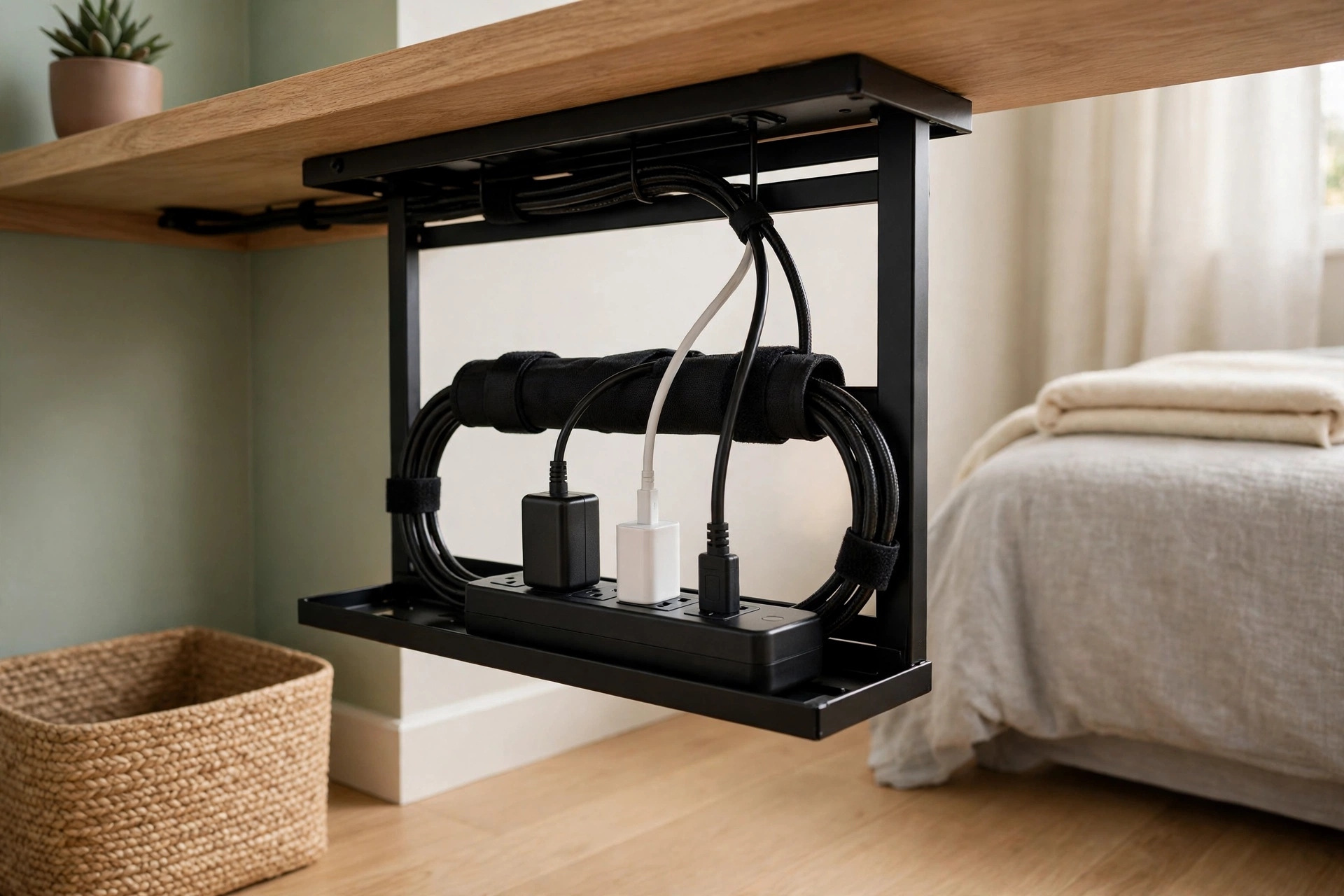
Cables are the fastest way to make a smart bedroom look dumb. The fix is boring and permanent, which is exactly why it works: one power strip per zone, mounted out of sight, with every cable labeled and bundled. Behind the bed, a cable tray or a fabric sleeve carries the lamp, charger, and alarm cables together down to a single outlet. Behind the TV, an in-wall kit or a paintable channel does the same job.
Do the cable audit in one sitting. Unplug everything, throw away the chargers for devices you no longer own, and replace the three random cables with one short cable of the right length for each device. Short cables are the secret — a 3-foot cable from nightstand to outlet never tangles, while a 6-foot one always does. When the job is done, you should be able to see every device in the room and not one cable.
6. A Smart Speaker as the Bedroom’s Control Center
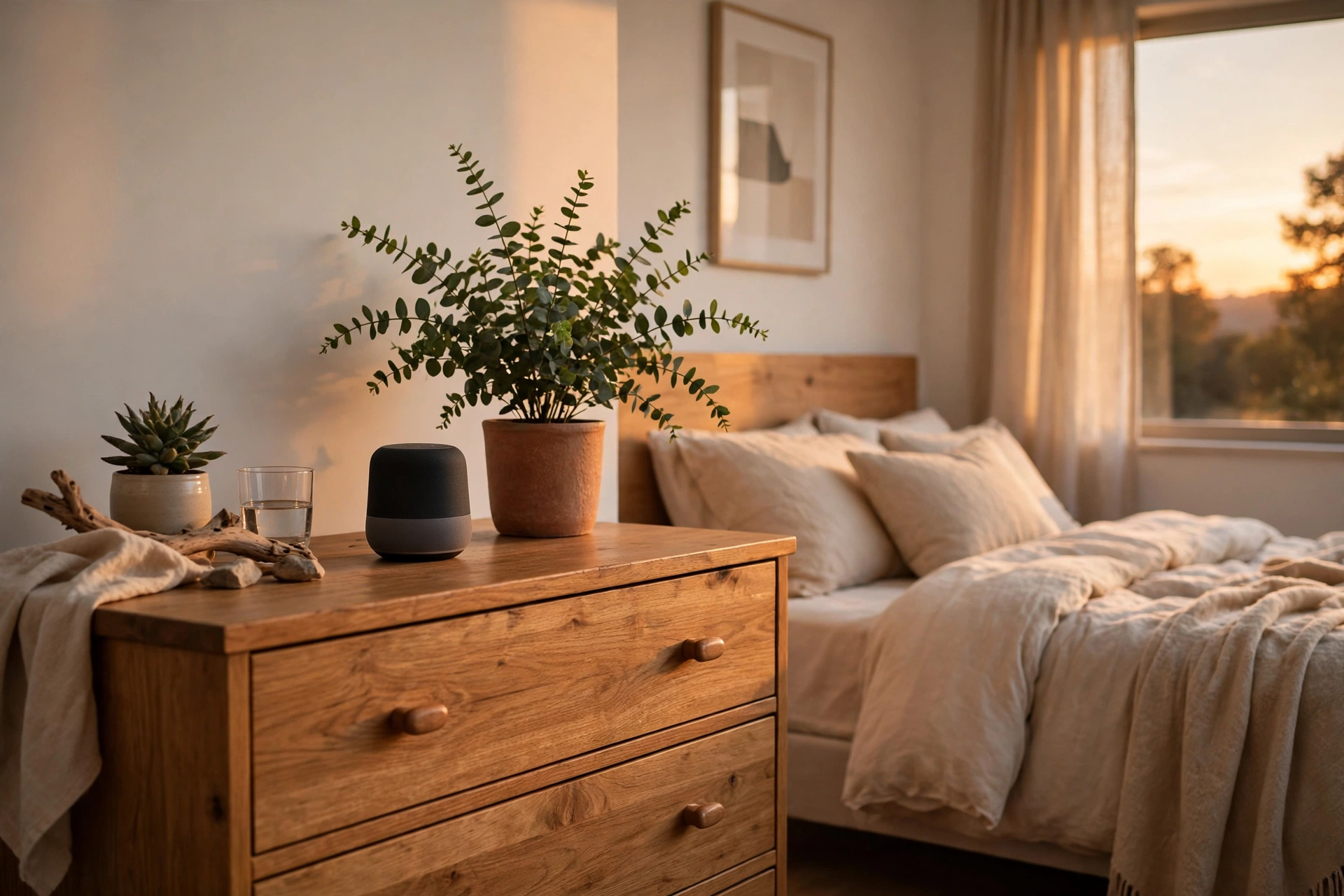
One smart speaker on the nightstand or dresser can replace an alarm clock, a radio, a white-noise machine, and a light switch. Ask it to set the alarm, play rain sounds, dim the lights, read tomorrow’s weather, and turn the TV off — all without reaching for a phone, which is the whole point: the less you touch a glowing screen at night, the better you sleep.
Place the speaker where you can talk to it from bed without shouting, and set up two routines. A “good night” routine dims the lights, locks the smart lock if you have one, and starts white noise. A “good morning” routine slowly raises the lights, reads the weather, and starts your news or music. Keep the speaker’s volume low and its display dim at night — most smart speakers have a night mode for exactly this — so the control center never becomes the thing keeping you awake.
7. Sleep Tech That Actually Helps You Sleep
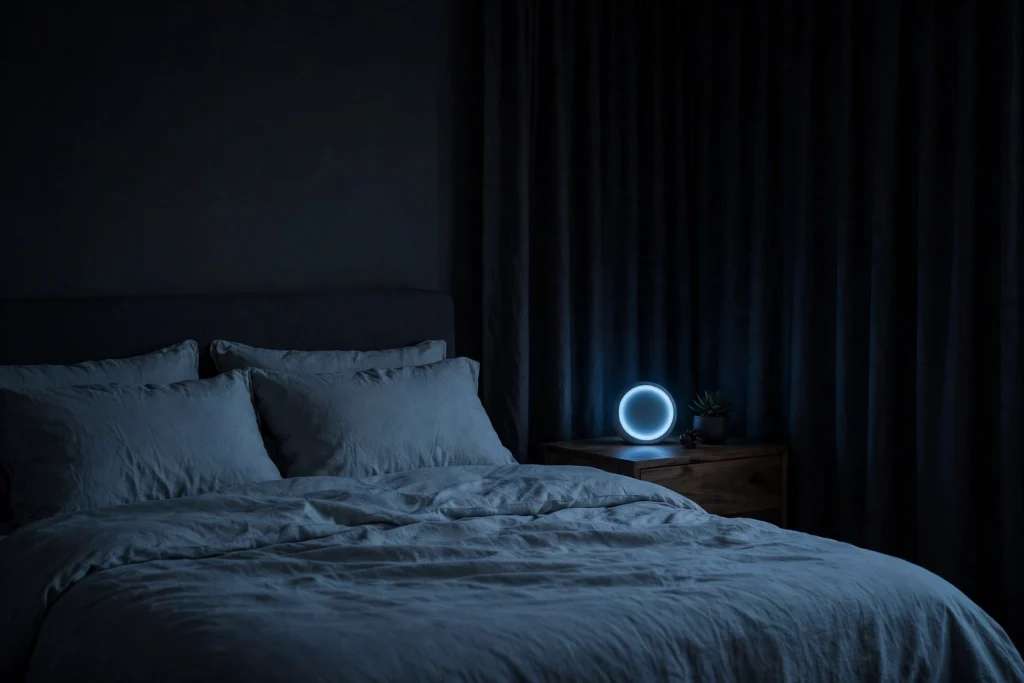
Sleep tech earns its place in a tech-zone bedroom only if it makes sleep better, not just more measured. A smart alarm that wakes you during light sleep with a gentle sound and a slow light fade beats a blaring buzzer every time. A white-noise machine — or the same smart speaker from idea 6 — masks street noise and a partner’s snoring without earbuds. A smart thermostat schedule that drops the room to 65 to 68 degrees Fahrenheit an hour before bed does more for deep sleep than any gadget on the nightstand.
Skip the gadgets that add anxiety. A sleep tracker is useful for a week of learning your patterns, but checking a sleep score every morning and worrying about it is the opposite of rest. Pick one or two sleep tools, use them for a month, and keep only the ones you would miss. The best sleep tech is the kind you forget is there — the room is cool, the light is warm and low, the noise is steady, and you are asleep.
A fan or a small air purifier with a quiet sleep mode earns a place here too, especially in a warm climate or a dusty room: steady airflow and clean air help you fall asleep faster, and the low hum doubles as white noise. Keep the device on the floor away from the bed, not on the nightstand where its lights and buttons glow in your face, and run it on a timer so it slows down in the middle of the night instead of running at full speed until morning.
8. Hidden Tech: Furniture That Swallows the Gadgets
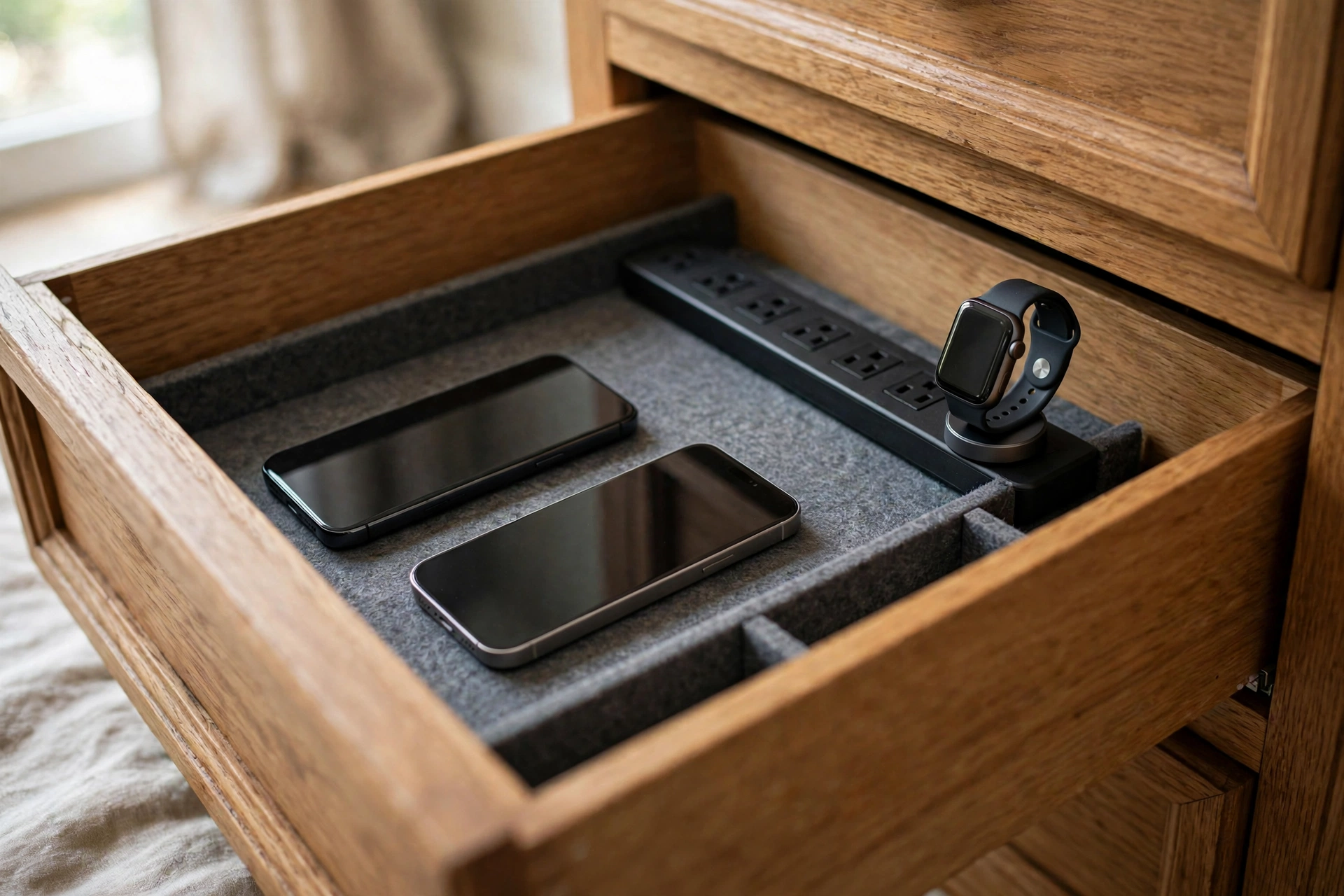
The difference between a tech bedroom and a gadget store is hiding. A TV lift inside a footboard cabinet, a projector that drops from the ceiling, a charging drawer in the dresser, a soundbar built into a shelf — each one keeps the technology available and invisible at the same time. You do not need all of them; one hidden-tech piece is enough to change how the room feels.
The easiest version is the charging drawer. Mount a small power strip inside a dresser or nightstand drawer, drill one small hole in the back for the strip’s own cord, and charge phones, watches, and earbuds inside the closed drawer overnight. The bedroom looks like a bedroom again in the morning, and every device is full. If you are short on drawer space, our small room storage bedroom design ideas guide shows where a charging drawer fits in a tight layout.
9. A Reading and Work Nook With the Right Light and Power
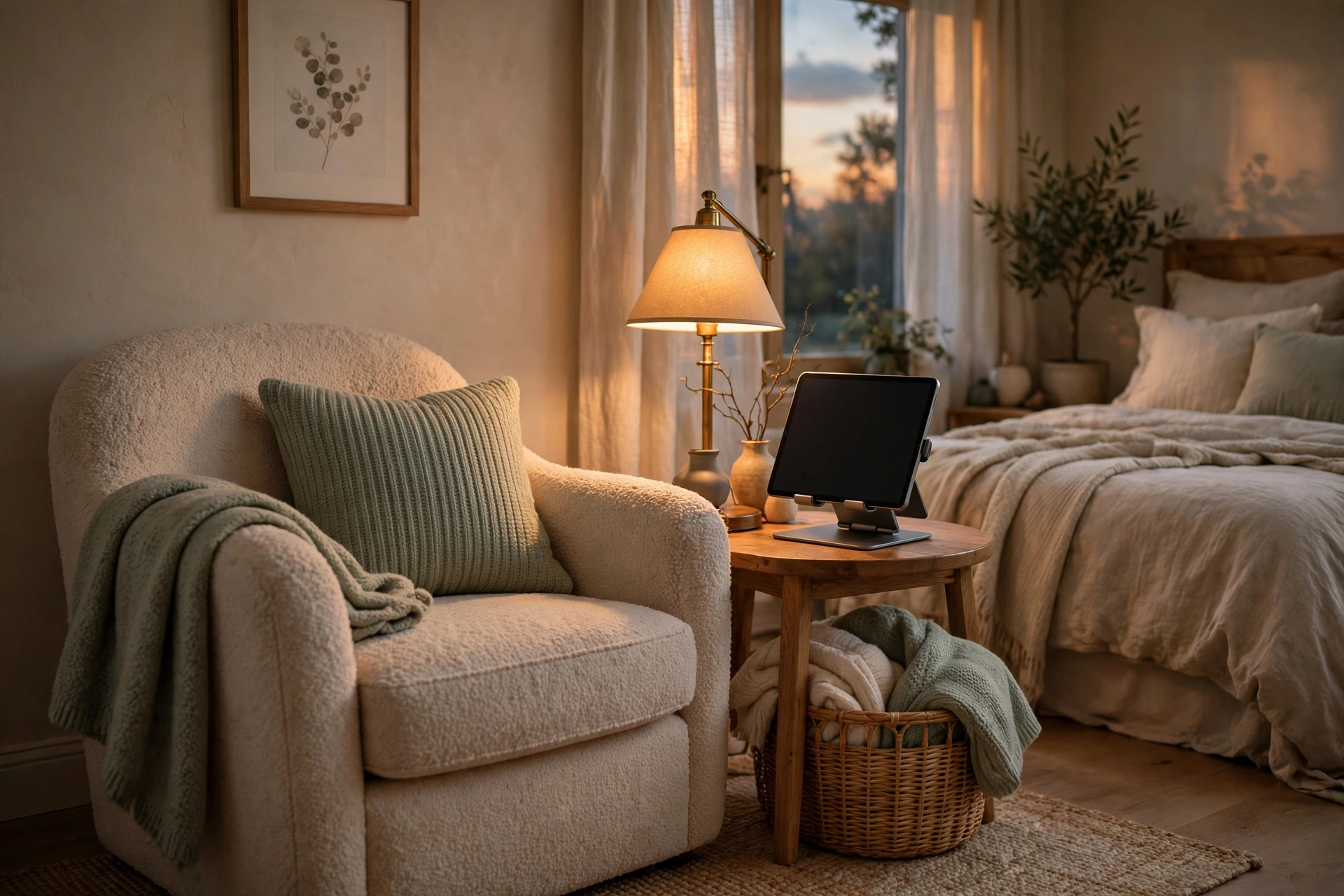
Every tech-zone bedroom needs one spot that is not the bed — a chair, a small side table, and a light you can actually read by. A warm task lamp with adjustable brightness, a USB outlet built into the side table or a floor outlet nearby, and a small shelf for a tablet or e-reader turn a corner into a reading nook that does not steal the bed’s job as a sleep space.
Keep the nook’s power simple: one outlet, one short cable, one device at a time. A tablet stand on the side table holds an e-reader at eye level, and a small basket underneath holds the charger when it is not in use. This is also the right place for a laptop if you sometimes work from the bedroom — a laptop lives in the nook, never in the bed, because the bed stays a sleep-only zone and your brain learns the difference fast.
10. Smart Blinds and Blackout Curtains for Real Darkness
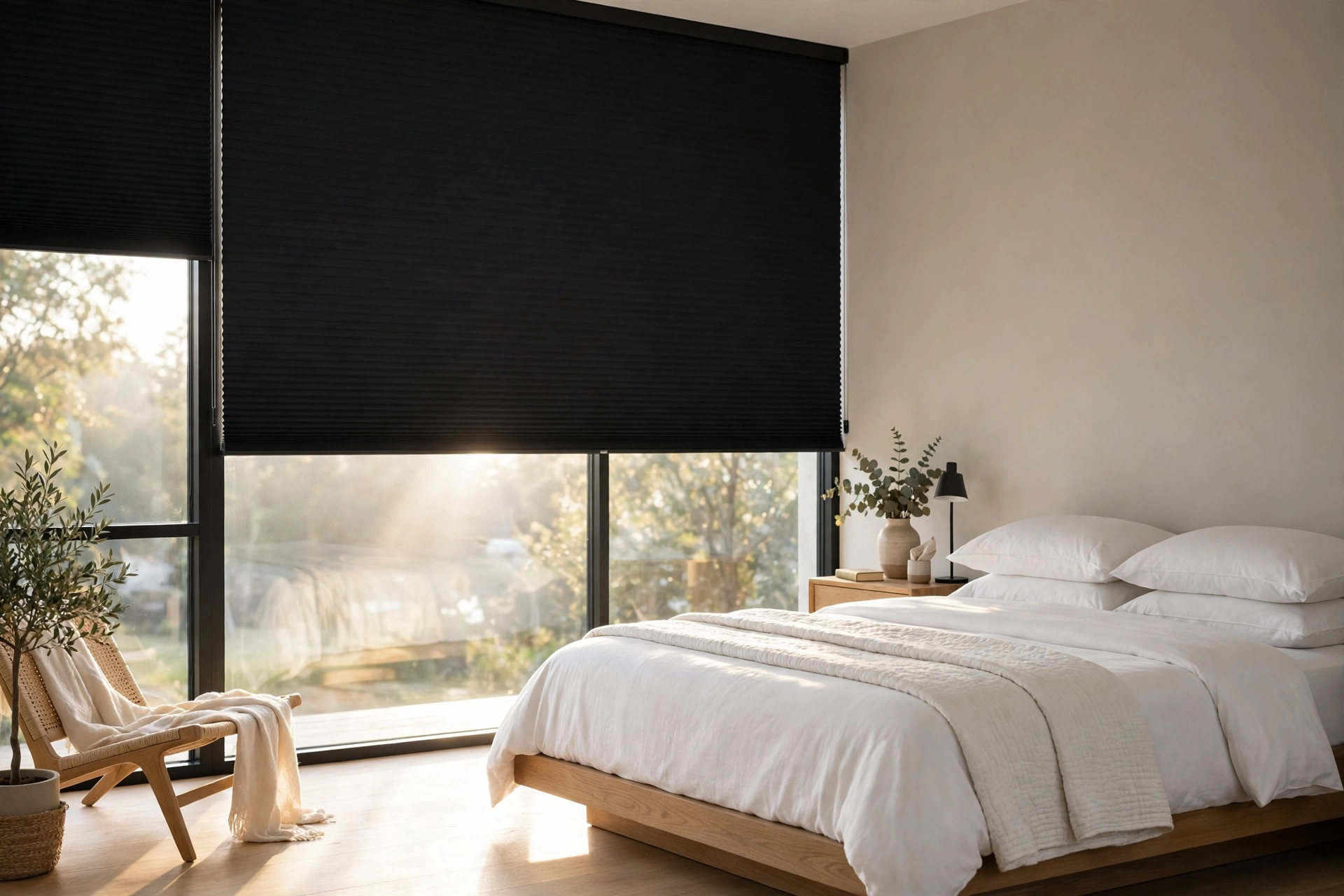
Light is the most underrated bedroom technology. Smart blinds or motorized blackout curtains close on a schedule — down at sunset, up with your alarm — and give you real darkness at night without a daily tug on a cord. Pair them with blackout lining and the room goes properly dark, which is the single biggest upgrade for sleep quality in a bright city bedroom or a room facing a streetlight.
If motorized blinds are out of budget, a smart plug on a simple curtain motor or even a well-fitted blackout curtain on a wraparound rod gets you most of the way there. The rule is the same either way: the bedroom should be dark when you sleep and bright when you wake, without you having to remember to do it. Set the schedule once, in the app, and let the room handle the rest — and if you want the room to look good in daylight too, our bedroom wall decor ideas guide pairs wall art with the window wall without blocking the light.
11. A Phone-Free Wind-Down Dock by the Door
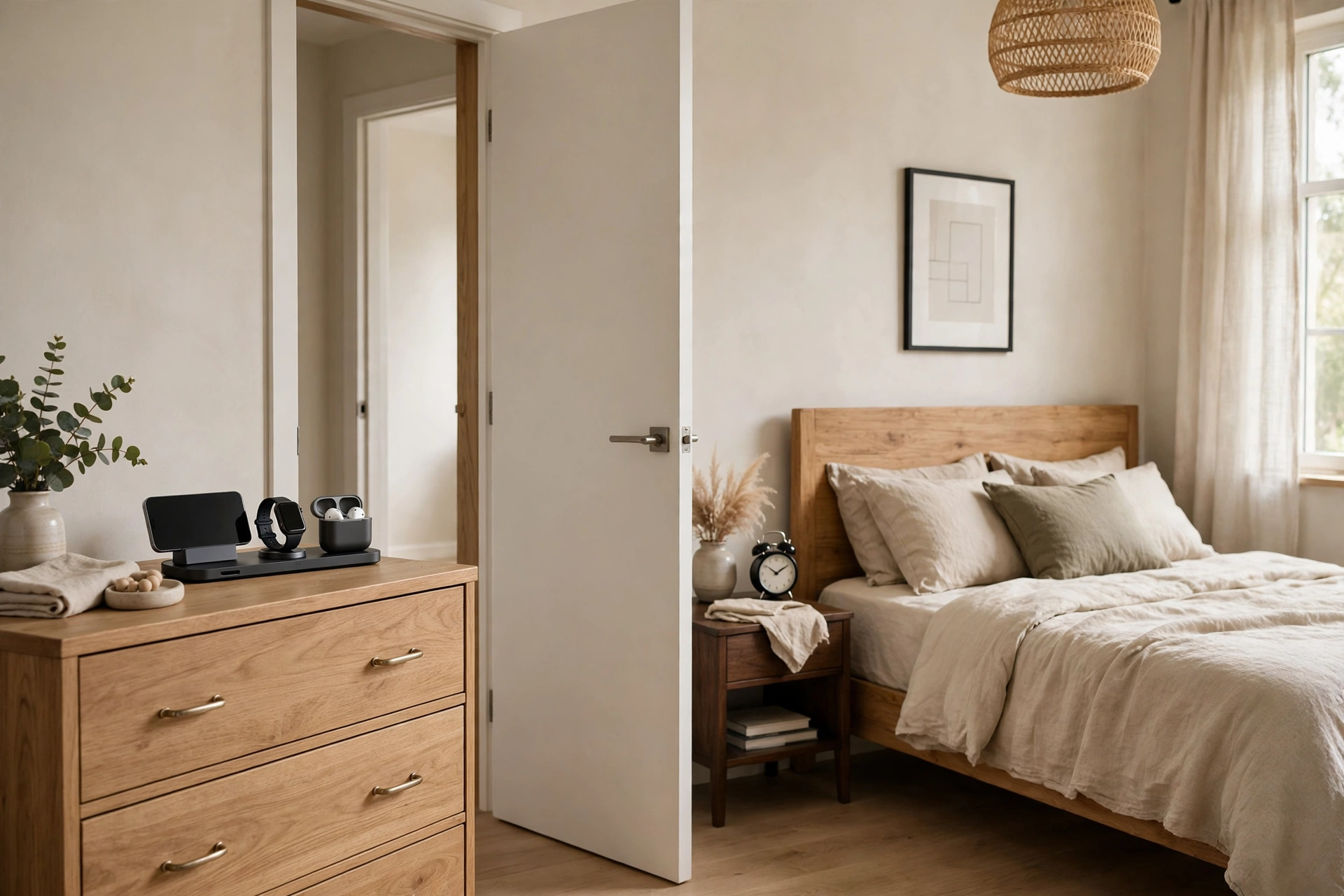
The last idea is the simplest and the most powerful: a place for the phone that is not the bed. A small dock, tray, or charging station by the bedroom door — or on the dresser across the room — holds the phone, watch, and earbuds overnight, charging, while you sleep without a screen within arm’s reach. An old-fashioned alarm clock on the nightstand takes over the one job the phone used to do.
This one change fixes three problems at once: no more scrolling in bed, no more blue light at midnight, and no more reaching for the phone at 3 a.m. to check the time. Put the dock somewhere you pass on the way in, make it the only charging spot in the room, and give it a week. Most people who try a phone-free bed never go back — and the bedroom finally feels like a bedroom again, smart tech and all. For a kids’ room version of the same idea, our kids bedroom ideas guide shows device zones that work for younger sleepers too.
Frequently Asked Questions
What is a tech-zone bedroom?
A tech-zone bedroom is a bedroom where technology has one defined place and one job — smart lighting, charging, a TV or gaming corner, and sleep tech — instead of gadgets spread across every surface. The technology is planned, hidden where possible, and set up so the room still feels calm and sleep-friendly. That is the whole point of these modern tech-zone bedroom ideas: every device earns its place before it earns a spot in the room.
How much does a smart bedroom cost to set up?
A basic setup costs very little: two or three smart bulbs and a smart plug run under $100, and a wireless charging pad and cable tray add another $50 or so. A wall-mounted TV, a motorized blind, or a hidden charging drawer costs more, but none of them is required — start with lighting and charging, then add one upgrade at a time. That one-at-a-time rule is what keeps these modern tech-zone bedroom ideas calm instead of cluttered.
Is a TV in the bedroom bad for sleep?
A TV is not automatically bad for sleep, but how you use it matters. Keep the screen dim and warm in the evening, set a sleep timer so it turns off by itself, and stop watching at least 30 minutes before you want to sleep. The bigger risk is a TV with no off switch in your routine — the timer and the routine fix that. For more on how screens affect sleep, see the Sleep Foundation’s guide to technology in the bedroom — these modern tech-zone bedroom ideas follow the same rule: the TV switches off before you do.
Where should I put the charging station in a bedroom?
Put the main charging spot where devices charge overnight without being in the bed — a nightstand charging pad, a drawer with a power strip, or a dock by the door all work. Keep one charging spot per person, keep the cables short and hidden, and never charge a phone under a pillow, which traps heat. That is the idea behind these modern tech-zone bedroom ideas: charge overnight, out of the bed, and out of sight.
Can I make a tech bedroom without Wi-Fi or a smart home hub?
Yes. A wireless charging pad, a cable tray, a wall-mounted TV, blackout curtains, and a white-noise machine need no Wi-Fi at all. Smart bulbs and speakers need Wi-Fi, but the core of a tech-zone bedroom — one clean TV zone, hidden cables, and one charging spot — works with ordinary power outlets and a little planning. No Wi-Fi, no problem: these modern tech-zone bedroom ideas work either way, because a good layout beats a good app.
Related Reading
- Boho Bedroom Decor Ideas
- New Year Bedroom Decor Ideas
- New Year Bedroom Organization Ideas
- Small Room Storage Bedroom Design Ideas
- Bedroom Wall Decor Ideas
- Kids Bedroom Ideas
Conclusion
A modern tech-zone bedroom is not about owning more gadgets — it is about giving the ones you already own a proper home. Smart lighting that follows your day, a nightstand that charges without a cable, one clean TV zone, a gaming corner that folds away, and a phone dock by the door add up to a room that is easier to live in and easier to sleep in. Start with the lighting and the charging, hide one cable today, and let the room get smarter one quiet upgrade at a time. Put together, these modern tech-zone bedroom ideas turn a gadget-filled room into a calm one — without giving up a single thing you actually use.
And remember the test from the start: walk into the room at night, lights low, phone on its dock, and ask whether the room feels calmer than it did before the tech arrived. If the answer is yes, the tech-zone is working. If the room feels busier — more glow, more hum, more things demanding attention — take one thing out. A tech-zone bedroom earns its name not by how much technology it holds, but by how little of it you notice. That is the real test of these modern tech-zone bedroom ideas: the best tech in the room is the tech you barely notice.