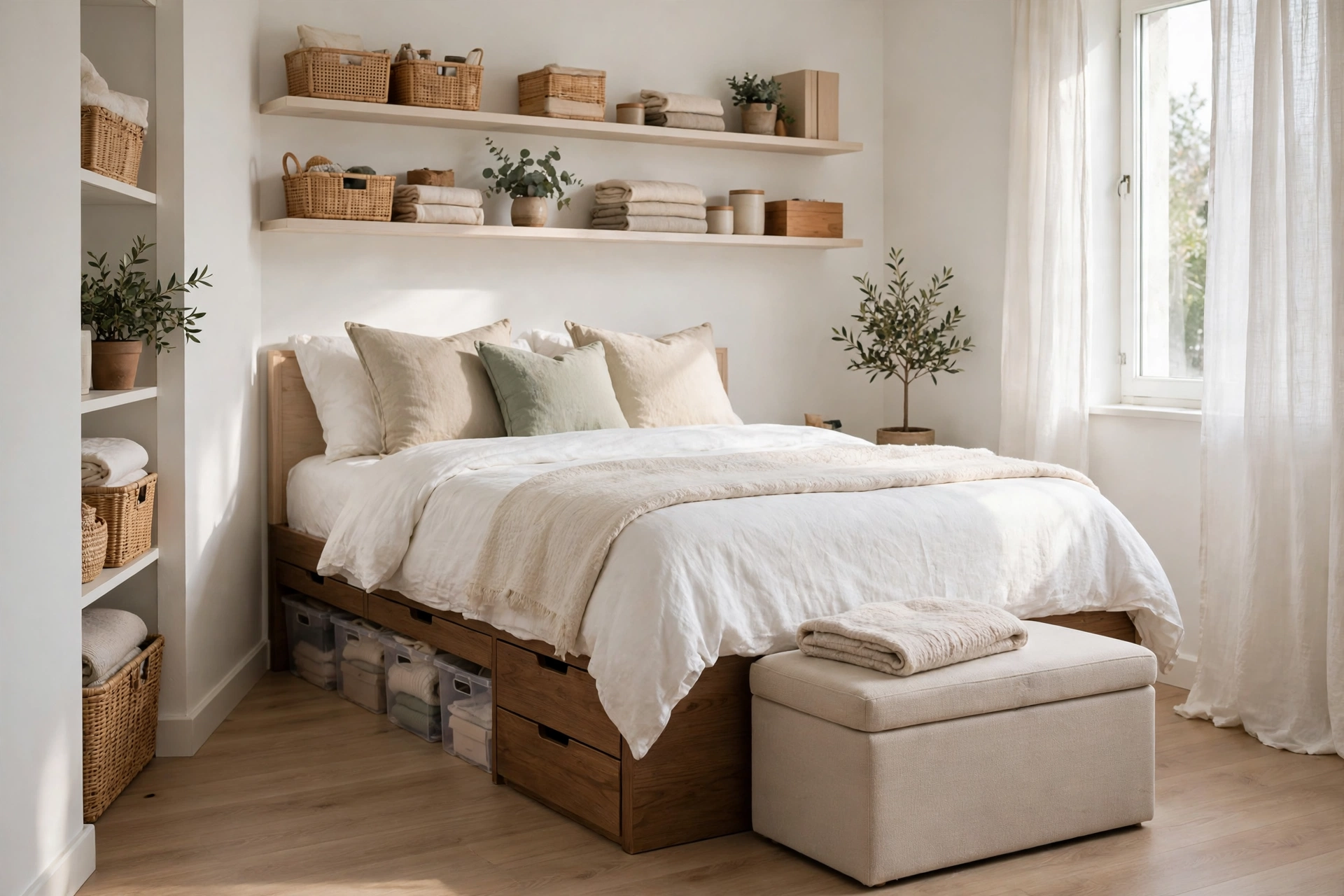
43 Small Room Smart Storage Bedroom Design Ideas That Actually Work
A small bedroom does not have to feel cramped, cluttered or impossible to keep tidy. With the right small room storage bedroom design ideas, even the tiniest room can hold your clothes, shoes, books and bedding — and still leave space to breathe. The secret is not owning less, although that helps. It is making every inch work harder: the space under the bed, the wall above the headboard, the back of the door and the forgotten corners all count as storage, once you design them that way.
This guide covers 43 practical, space-saving storage and design ideas for small bedrooms, from storage beds and vertical shelving to hidden compartments and multi-functional furniture. Every idea is written for real American bedrooms — apartments, guest rooms, kids’ rooms and older homes with small closets — using US sizes and stores you can actually shop at. A bedroom is the most personal room in the home, so each idea is designed to keep it calm and comfortable, not just organized. Work through the list, pick the ideas that fit your room, and start with the one that solves your biggest frustration first.
1. Under-Bed Rolling Storage Drawers
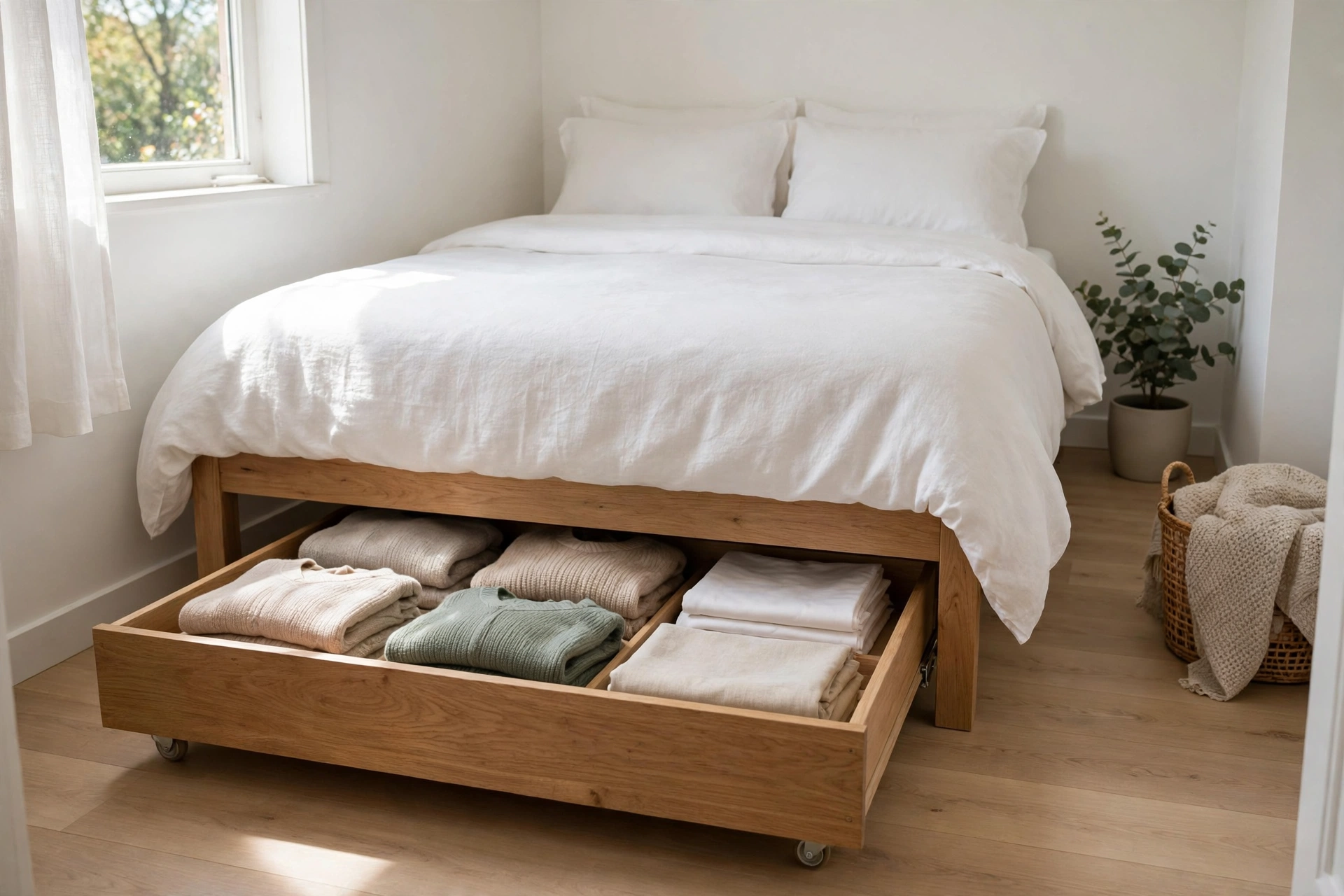
The space under your bed is the largest unused storage zone in most small bedrooms, and rolling drawers turn it into a proper drawer bank. Low, flat drawers on wheels slide out smoothly, so you can reach off-season clothes, extra bedding or shoes without dragging heavy bins across the floor. Choose drawers that are no taller than your bed’s clearance — measure first, because most standard frames leave six to eight inches — and pick ones with handles that sit flush so they do not catch on the rug.
Rolling drawers work best when each one has a single job, such as one for winter sweaters, one for spare sheets and one for shoes. Label the front edge with a small tag so you never have to pull out three drawers to find one thing. Wooden drawers look neater than plastic bins in a bedroom, but sturdy fabric drawers with a rigid frame are a good budget option. Either way, keep the contents light enough that the drawers roll easily, and vacuum under the bed once a month so dust does not build up around them.
2. A Storage Bed With Hydraulic Lift
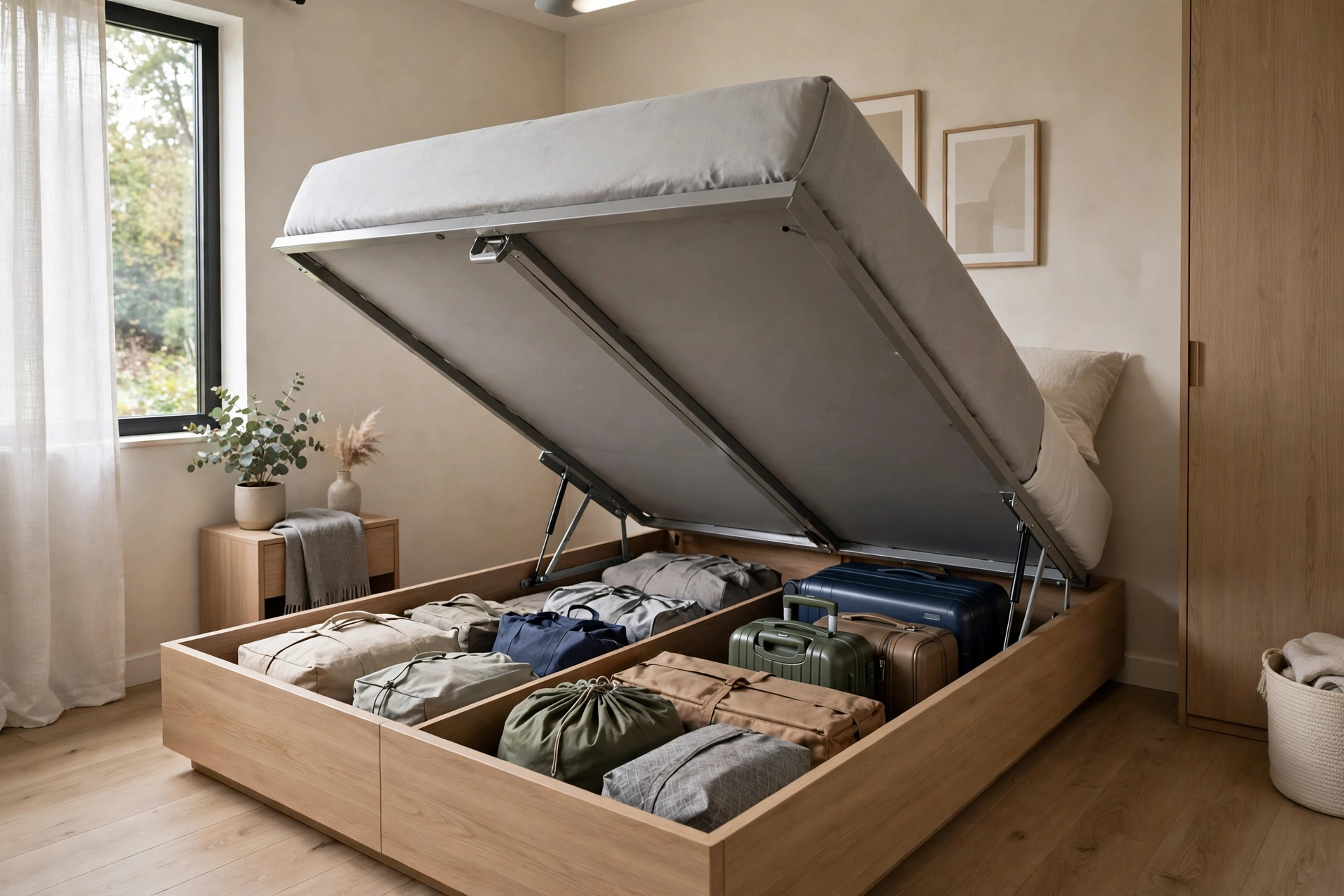
A storage bed with a hydraulic lift turns the entire footprint of your mattress into one giant storage compartment, which is the single biggest storage win a small bedroom can offer. You lift the mattress platform on gas struts — no heavy lifting, no wrestling with drawers — and the whole base opens up for bulky items like suitcases, winter coats, extra pillows and keepsake boxes. It is the closest thing to adding a closet without building one.
Before you buy, check the lift mechanism in person if you can, because cheap struts sag or slam over time. A good lift bed opens with one hand and stays open on its own while you load it. Keep heavy items at the bottom and things you reach for often near the top edge, and use fabric storage bags inside so nothing slides around. Pair the bed with a simple, light-colored headboard and plain bedding so the large bed frame does not visually dominate the room.
3. Floating Shelves Above the Headboard
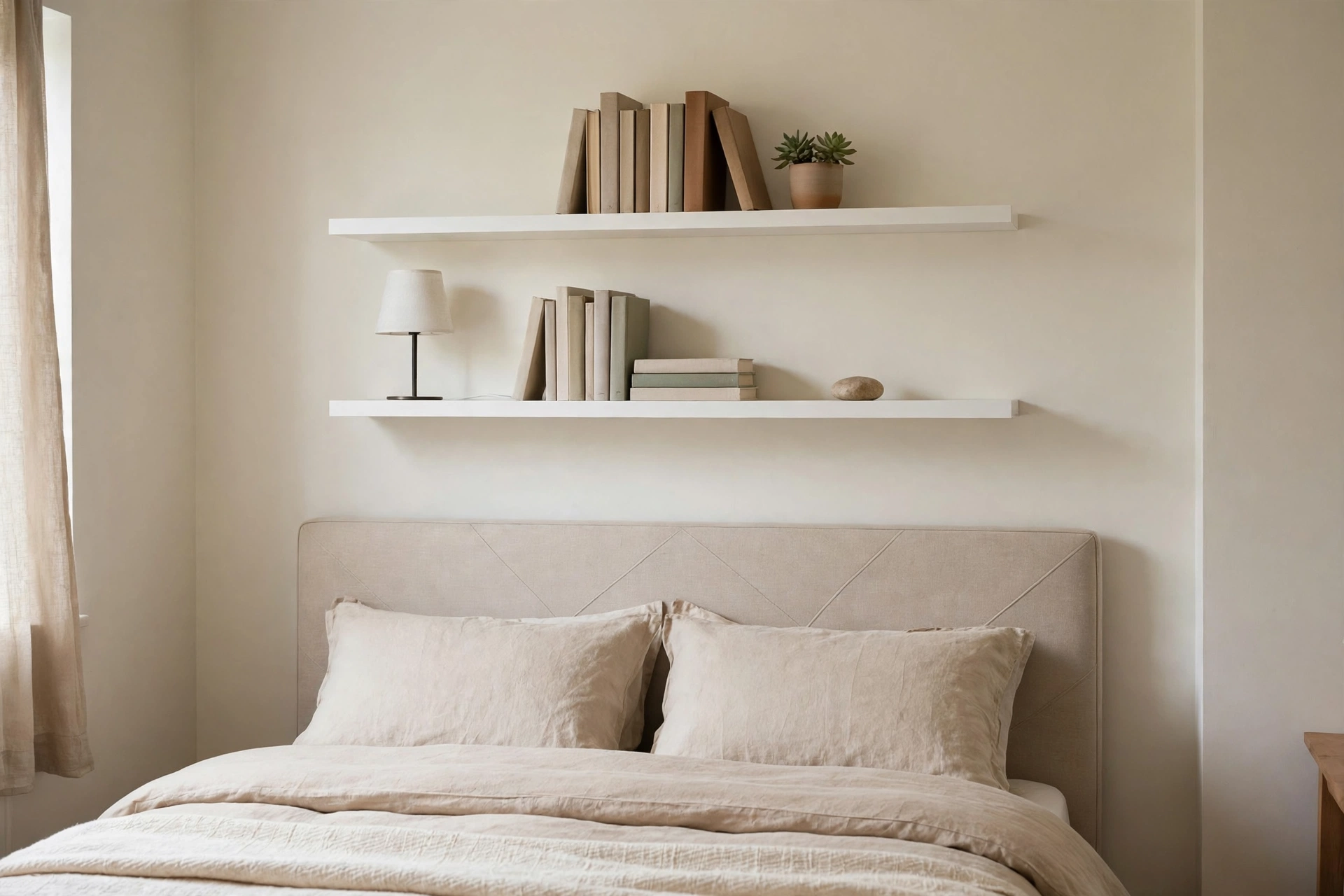
Floating shelves above the headboard use wall space that is almost always empty, and they keep books, plants and bedtime essentials within arm’s reach without taking up a single inch of floor. Two or three slim shelves in a row create a tidy display that doubles as storage, and because they float, the wall below stays open and the room feels lighter than it would with a tall bookcase. Mount them at a height you can reach from the bed but high enough that you will not bump your head sitting up.
Keep the shelves shallow — eight to ten inches deep is plenty — and style them with a mix of useful and decorative items, such as a small lamp, a few favorite books and a framed photo. Leave some breathing room on each shelf rather than filling every inch, because a crowded shelf above your head feels heavy. Use proper wall anchors rated for the weight, especially on drywall, and check that the shelves are level before you load them.
4. A Slim Nightstand With Hidden Drawers
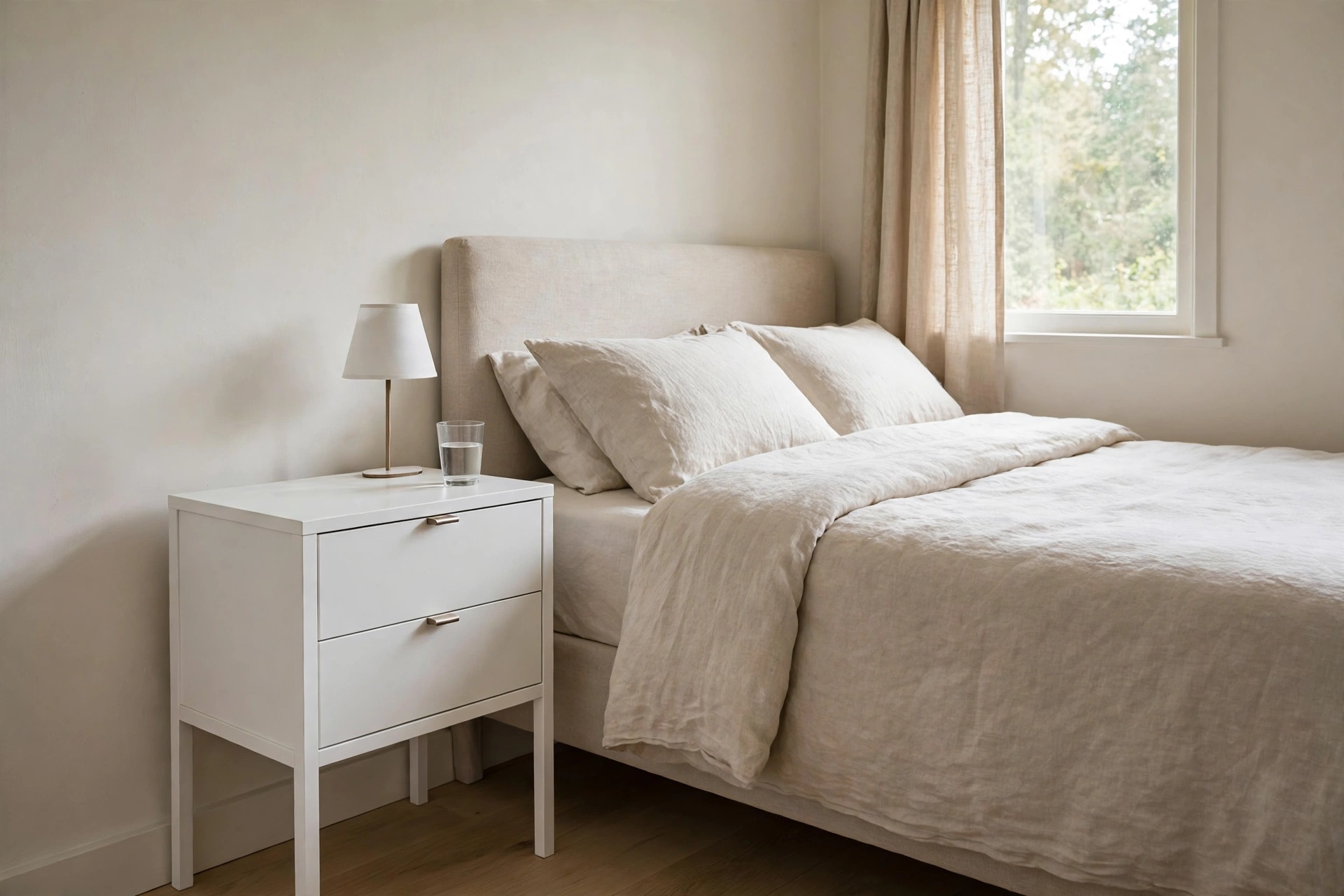
A slim nightstand with hidden drawers gives you bedside storage without the bulk of a traditional nightstand, which matters when the gap between the bed and the wall is only a foot or two wide. Look for a nightstand no wider than 14 to 16 inches with at least two drawers: one shallow drawer for glasses, lip balm and a phone charger, and one deeper drawer for a book, journal or medication. A hidden compartment or a push-to-open drawer front keeps the look clean.
The top surface should hold only a lamp and a glass of water — everything else lives inside the drawers. If your nightstand has open shelving instead, use a small basket on the shelf to corral the clutter so it reads as one tidy object rather than a pile. Choose a nightstand in the same finish as your bed frame so the two pieces read as one unit, which makes a small room feel more intentional and less crowded.
5. Wall-Mounted Bedside Shelves Instead of Nightstands
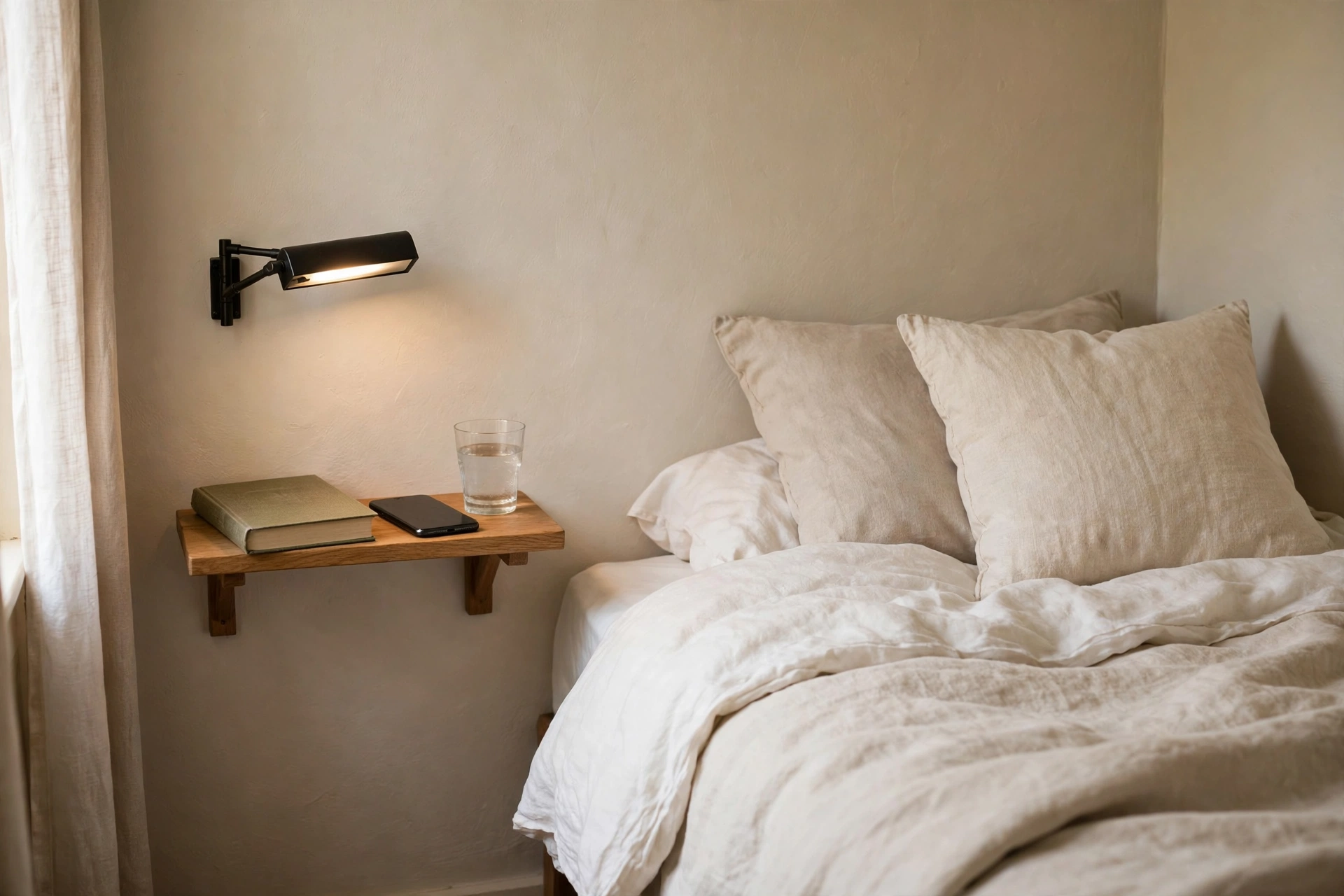
When there is genuinely no floor space for a nightstand, wall-mounted bedside shelves are the answer. A small floating shelf or a wall-mounted cubby at mattress height holds your phone, book and water glass, and the floor underneath stays completely clear — which makes the room feel bigger and makes vacuuming easy. This is one of the best small room storage bedroom design ideas for rooms where the bed touches the wall on both sides.
Mount the shelf so its top sits one or two inches above the mattress, so you can reach items without sitting up. Add a small wall-mounted reading light above it and a cable clip on the shelf edge to keep the charging cord from sliding behind the bed. A shelf with a small lip or raised edge stops items from being knocked off in the night. If you share the bed, mount one on each side for symmetry.
6. A Storage Ottoman at the Foot of the Bed
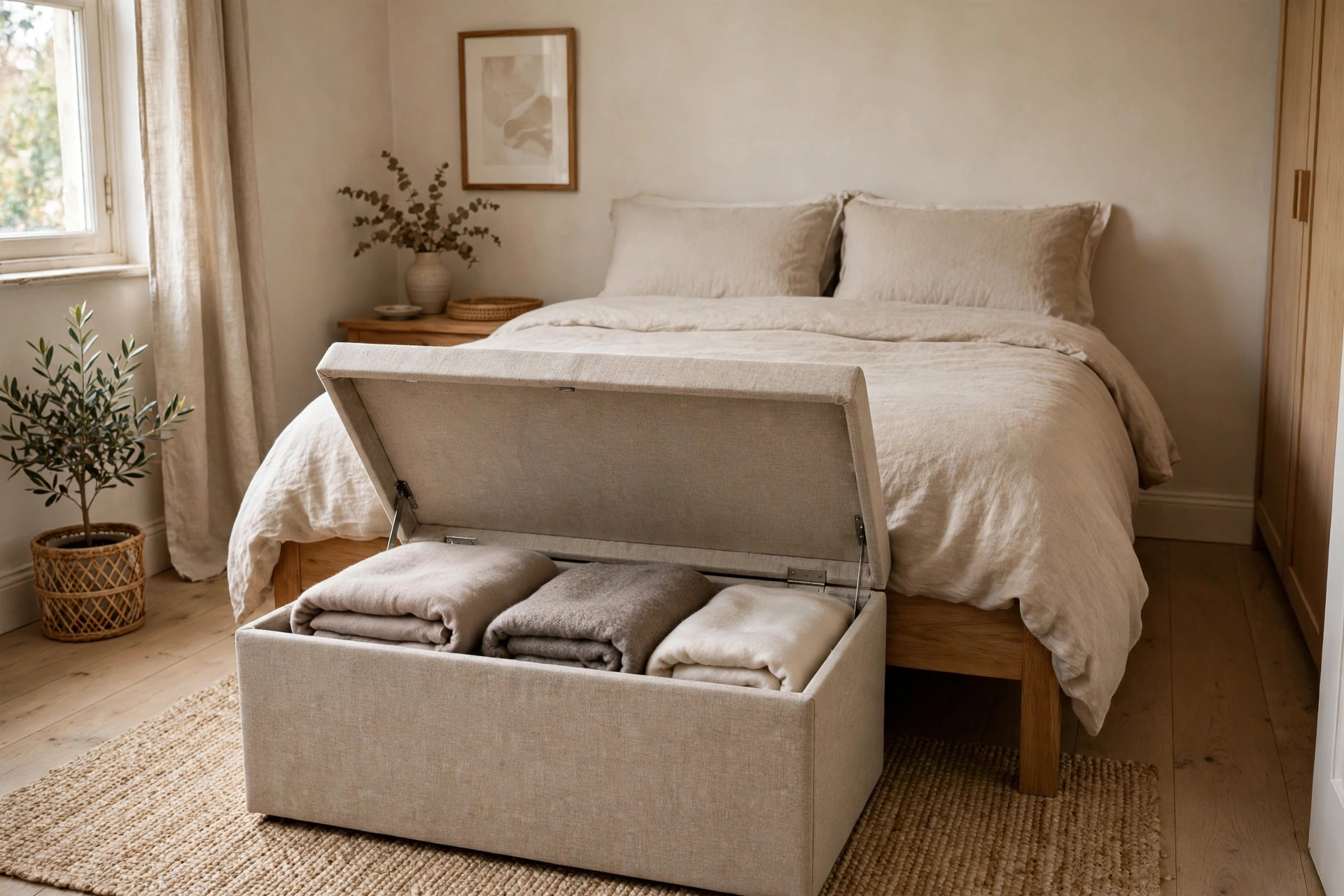
A storage ottoman at the foot of the bed is three pieces of furniture in one: a seat for putting on shoes, a surface for laying out tomorrow’s clothes, and a hidden storage box for blankets, extra pillows or off-season clothes. Choose one that is about two-thirds the width of your bed so it looks proportional, and pick a firm top that can hold weight without sagging. A hinged lid that stays open while you load it is much easier to use than a loose cushion top.
Keep the ottoman’s contents to things you use weekly, not deep storage, so you open it often enough to remember what is inside. Throw blankets and spare pillowcases are ideal. A fabric ottoman in a neutral color softens the room, while a faux-leather one wipes clean easily and looks more structured. If floor space is very tight, choose a narrow bench-style ottoman rather than a deep square one, and leave at least 18 inches of walking space in front of it.
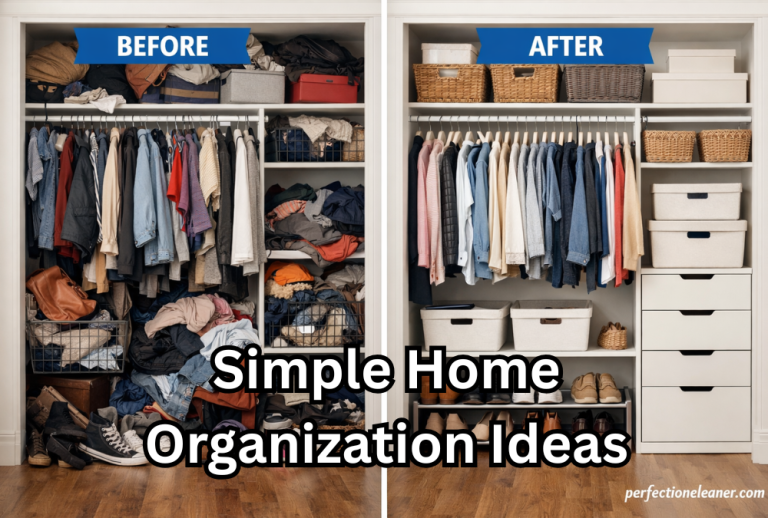
7. Vertical Closet Shelving That Reaches the Ceiling
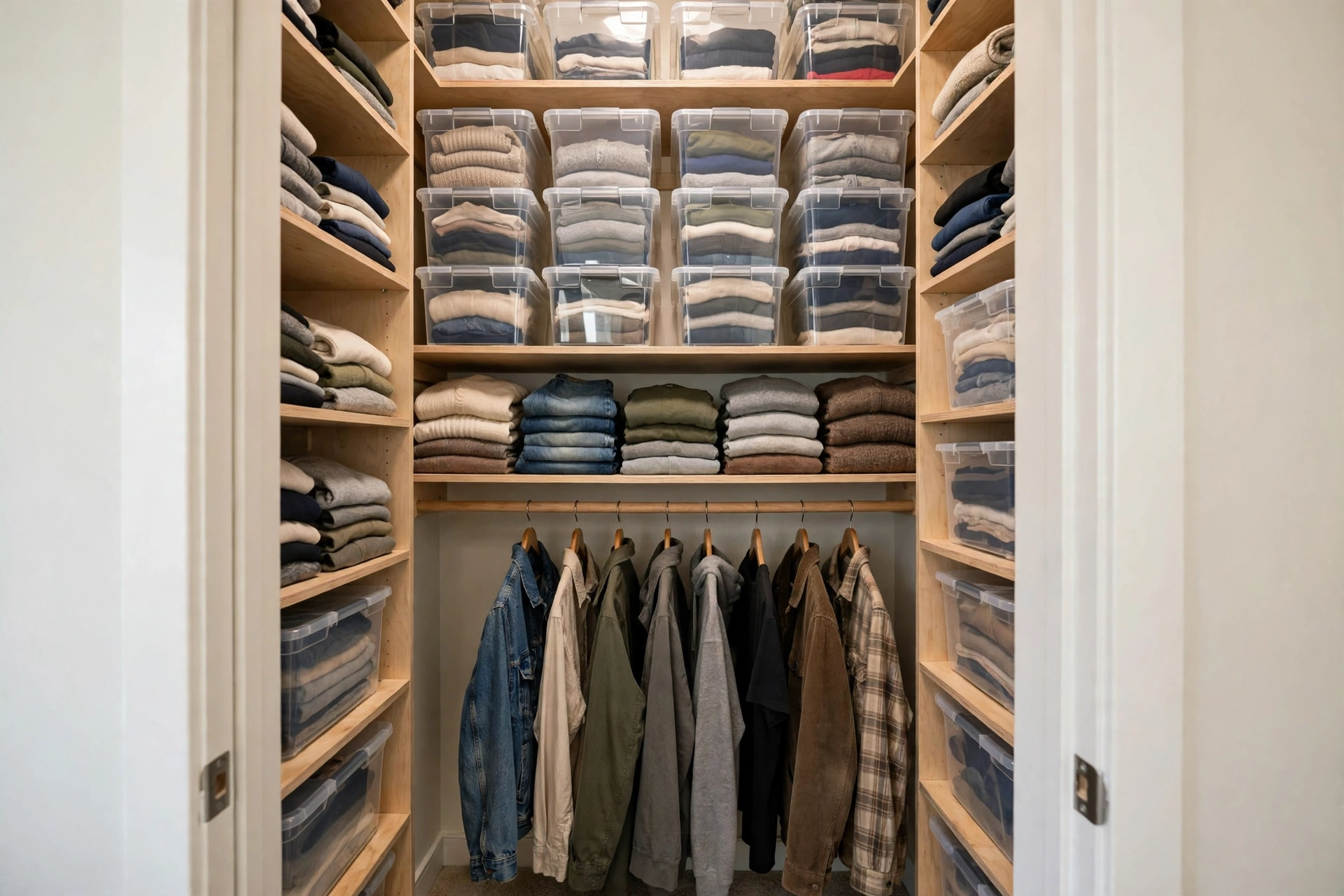
Most closets waste the top two feet of space, and vertical shelving that reaches the ceiling reclaims it. A tall shelf tower or a stack of adjustable shelves inside the closet holds folded clothes, bags and bins up to the ceiling, while the hanging rod below stays free for everyday clothes. This is one of the highest-impact small room storage bedroom design ideas because it adds storage without taking any floor space at all.
Use the topmost shelf for things you need only a few times a year, such as holiday clothes or luggage, and keep everyday items at eye level. If your closet itself needs a full overhaul, our Small Closet Organization Ideas guide covers closet-only systems in detail. Clear bins with labels work well up high because you can see what is inside from below. A small step stool kept in the closet makes the top shelf genuinely usable rather than a place where things go to be forgotten. Measure your closet’s height and depth before buying a shelf unit, and leave a few inches of clearance so folded clothes do not brush the ceiling.
8. Over-the-Door Organizers on the Bedroom Door
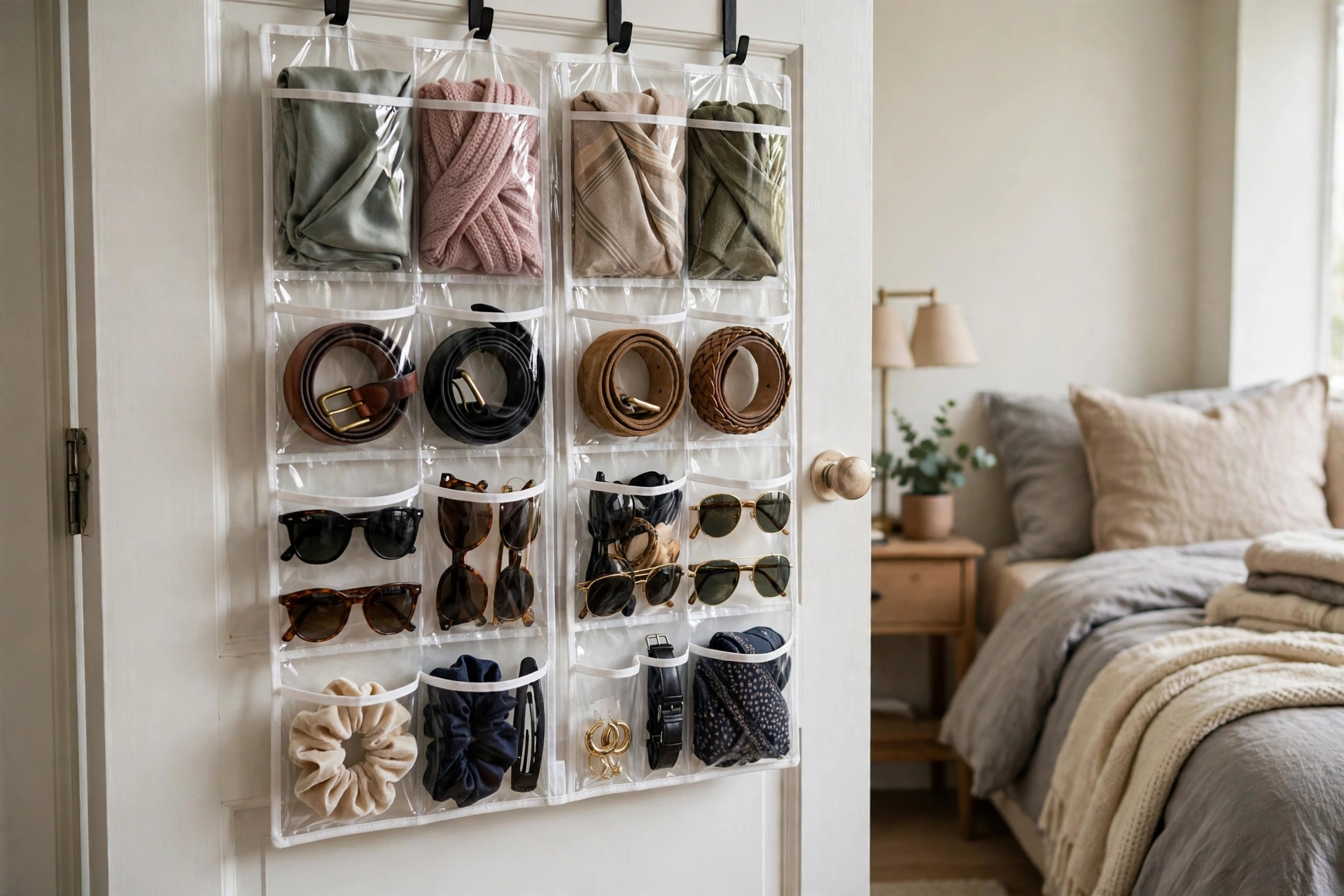
The back of the bedroom door is free storage that most people ignore, and an over-the-door organizer turns it into a full storage wall without a single screw. Clear-pocket organizers hold scarves, belts, socks, chargers, sunglasses and small accessories, while sturdier hook racks hold robes, bags and tomorrow’s outfit. Because the organizer hangs on hooks over the door, it works in rentals where you cannot drill into walls.
Choose an organizer that matches what you actually lose track of: deep pockets for shoes and accessories, or flat pockets for papers and small items. Hang it on the inside of the bedroom door so the pockets face the room, and keep the heaviest items in the lowest pockets so the door still closes smoothly. Check the door clearance first — thick organizers can stop a door from closing in older homes with tight frames — and use slim hooks that do not scratch the door’s finish.
9. A Murphy Bed With Built-In Storage
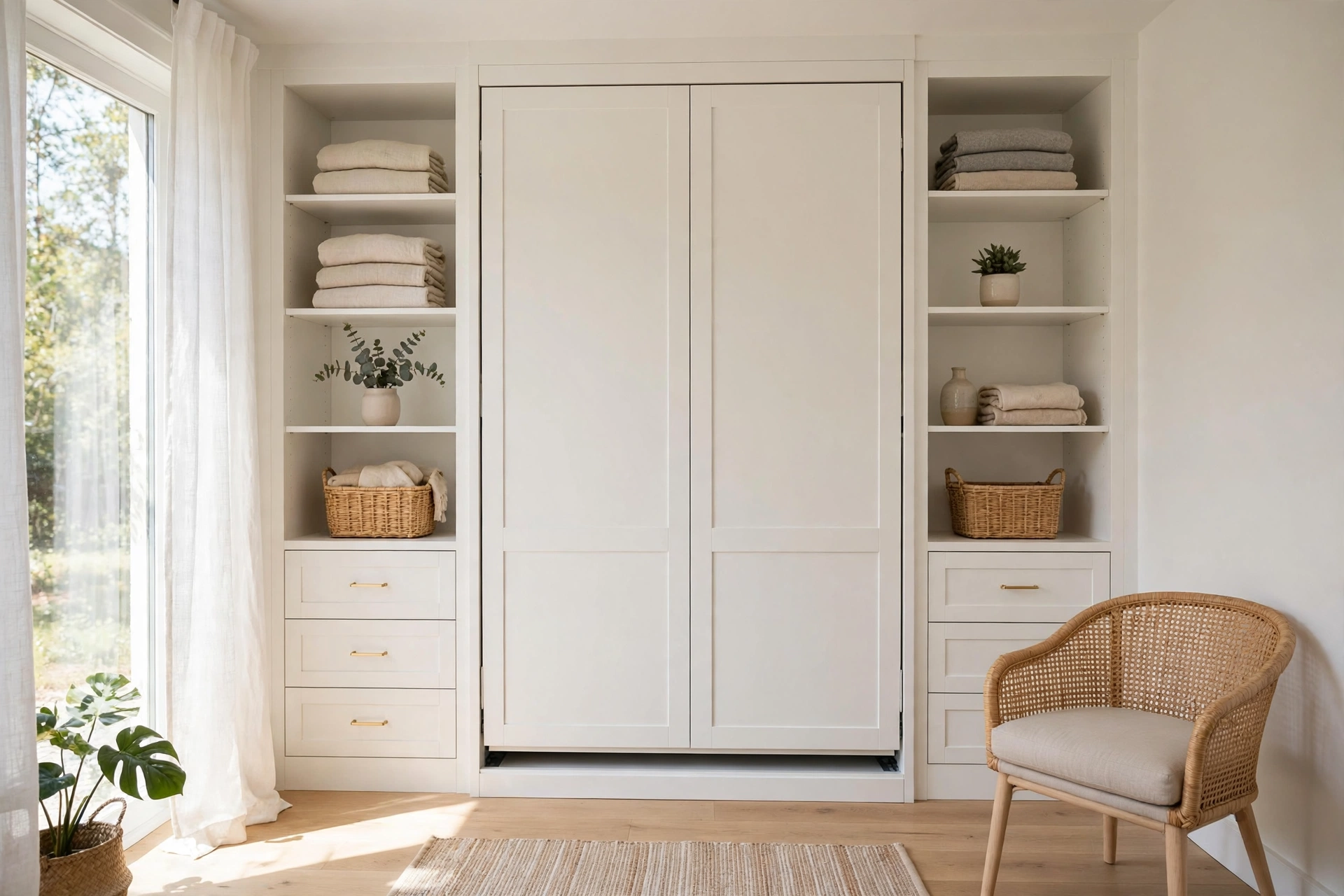
A Murphy bed, also called a wall bed, folds up into a cabinet during the day and frees the entire floor of a small bedroom for living, working or exercise. Modern Murphy beds come with built-in storage — shelves, drawers and even a fold-down desk on the cabinet front — so the wall unit works as a wardrobe and a workspace when the bed is folded away. It is the most dramatic space-saving move on this list, and it suits guest rooms and studio apartments best.
A Murphy bed is a real installation, not a quick purchase, so measure carefully and check that the wall can support the mechanism. Quality hardware matters more than the cabinet finish: the bed should fold up and down smoothly with one hand, and lock securely in both positions. Keep the bedding simple — a fitted sheet, a light duvet and one pillow — so folding the bed stays quick. Pair it with a small side table that can move out of the way when the bed comes down.
10. Under-Bed Vacuum-Sealed Seasonal Bins
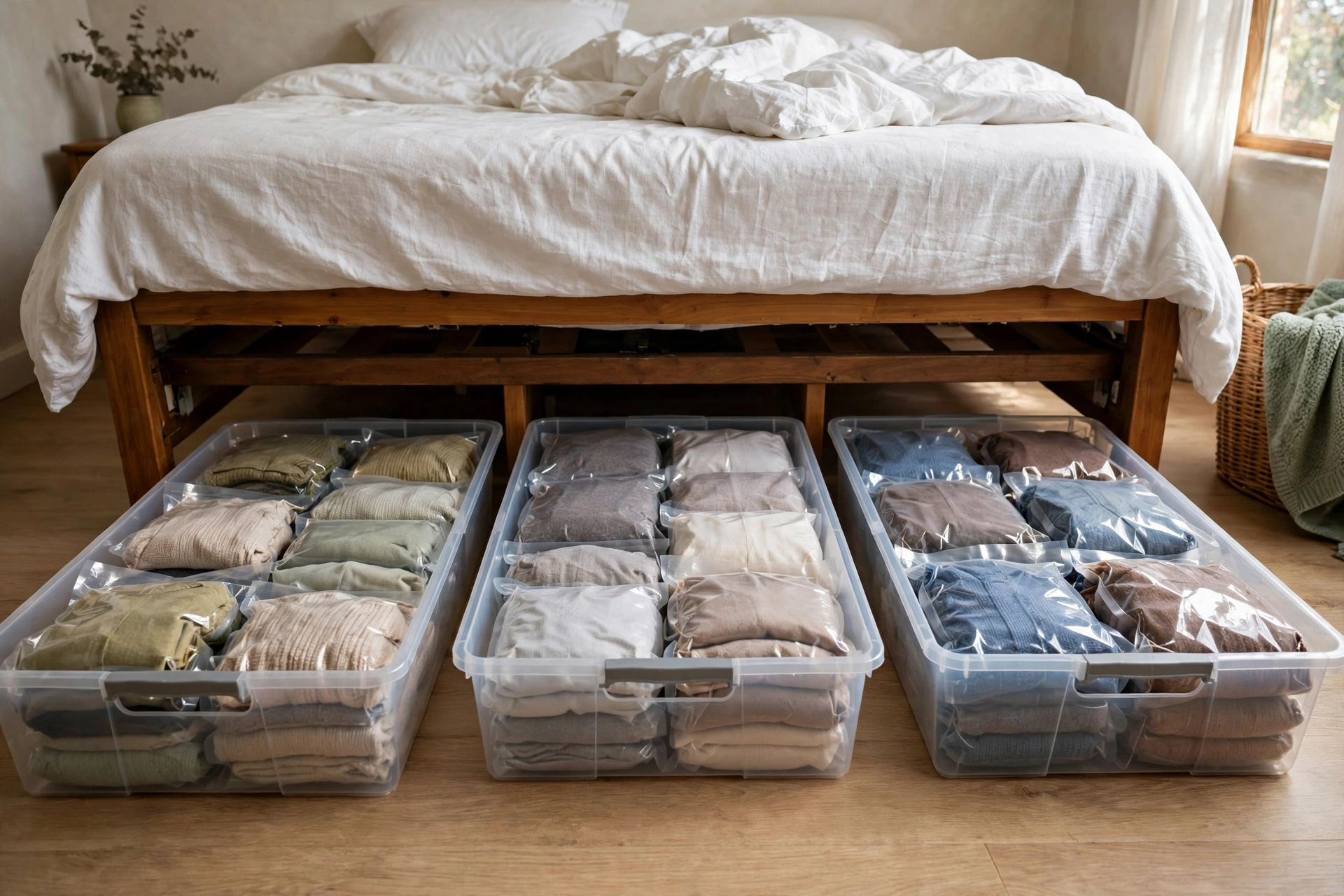
Vacuum-sealed bags shrink bulky seasonal clothes and bedding to a fraction of their size, and flat bins under the bed are the perfect place to store them. A winter coat that fills a whole shelf compresses to the thickness of a book, which means a single under-bed bin can hold an entire season’s wardrobe swap. Use rigid, low-profile bins with lids so the compressed bags stay protected from dust and the bins slide out easily.
Label each bin by season and contents — “Winter Sweaters” or “Summer Bedding” — and do the swap twice a year, in spring and fall, so the system stays honest. Keep one small bag of the current season’s extras in the same bin for quick access. Vacuum bags work best with soft items like clothes, blankets and pillows; do not use them for leather, down-filled items you use daily, or anything with sharp fasteners that could puncture the seal.
11. A Window Seat With Hidden Storage
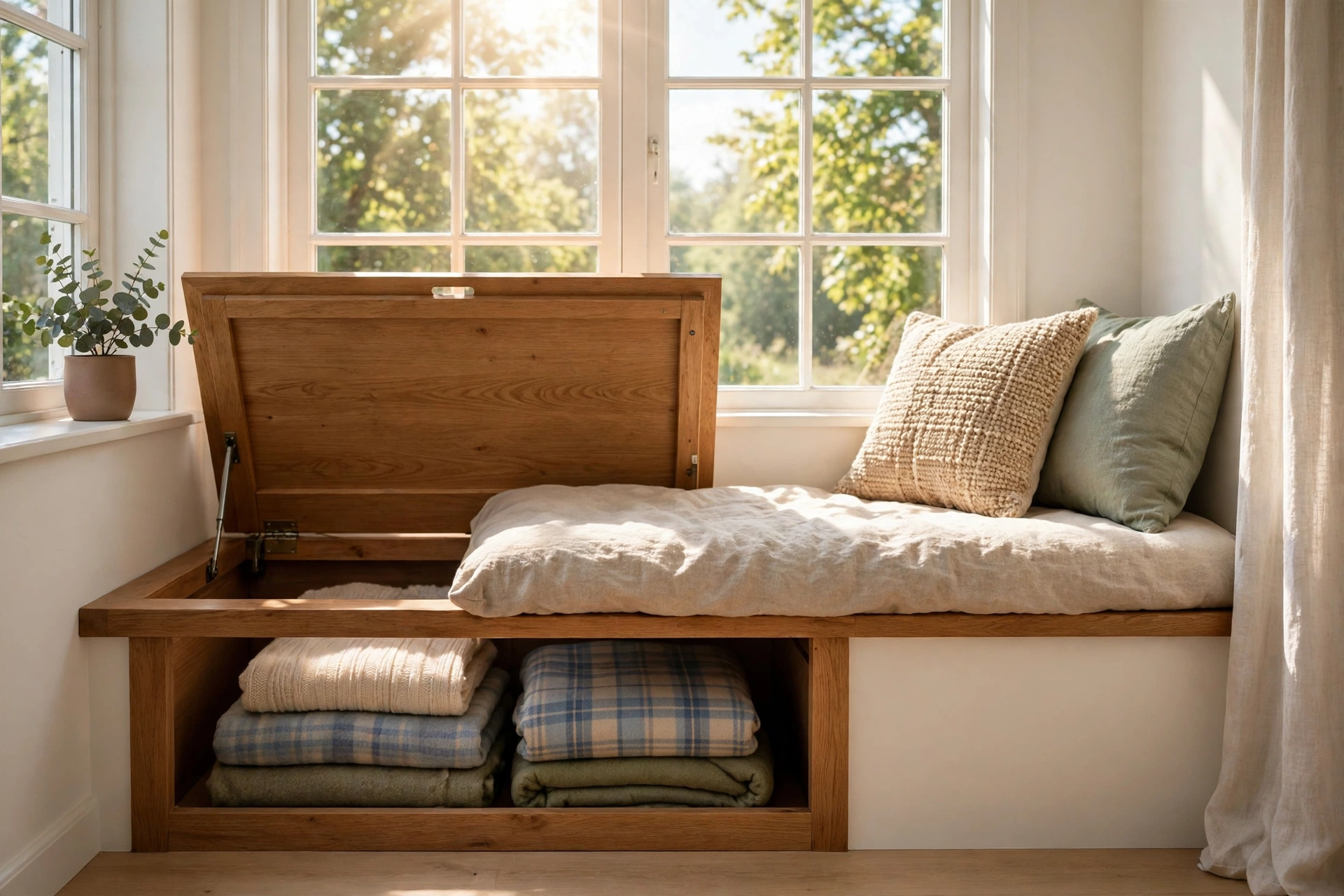
A window seat with hidden storage turns a sunny window nook into a reading spot and a storage bench at the same time. The seat lifts or pulls out to reveal space for books, blankets, board games or off-season clothes, and the cushion on top makes it the coziest seat in the room. If your bedroom has a wide windowsill or a bay window, a custom or ready-made window seat can be built to fit exactly.
Keep the seat cushion in a washable, durable fabric, because a window seat gets daily use and direct sunlight. Store heavier items at the bottom and lighter things on top, and add a small shelf or a wall-mounted light nearby so the seat works as a reading nook in the evening. If a built-in seat is too big a project, a low storage bench placed under the window gives you most of the same benefit for far less cost and effort.
12. Corner Shelving for Dead Space
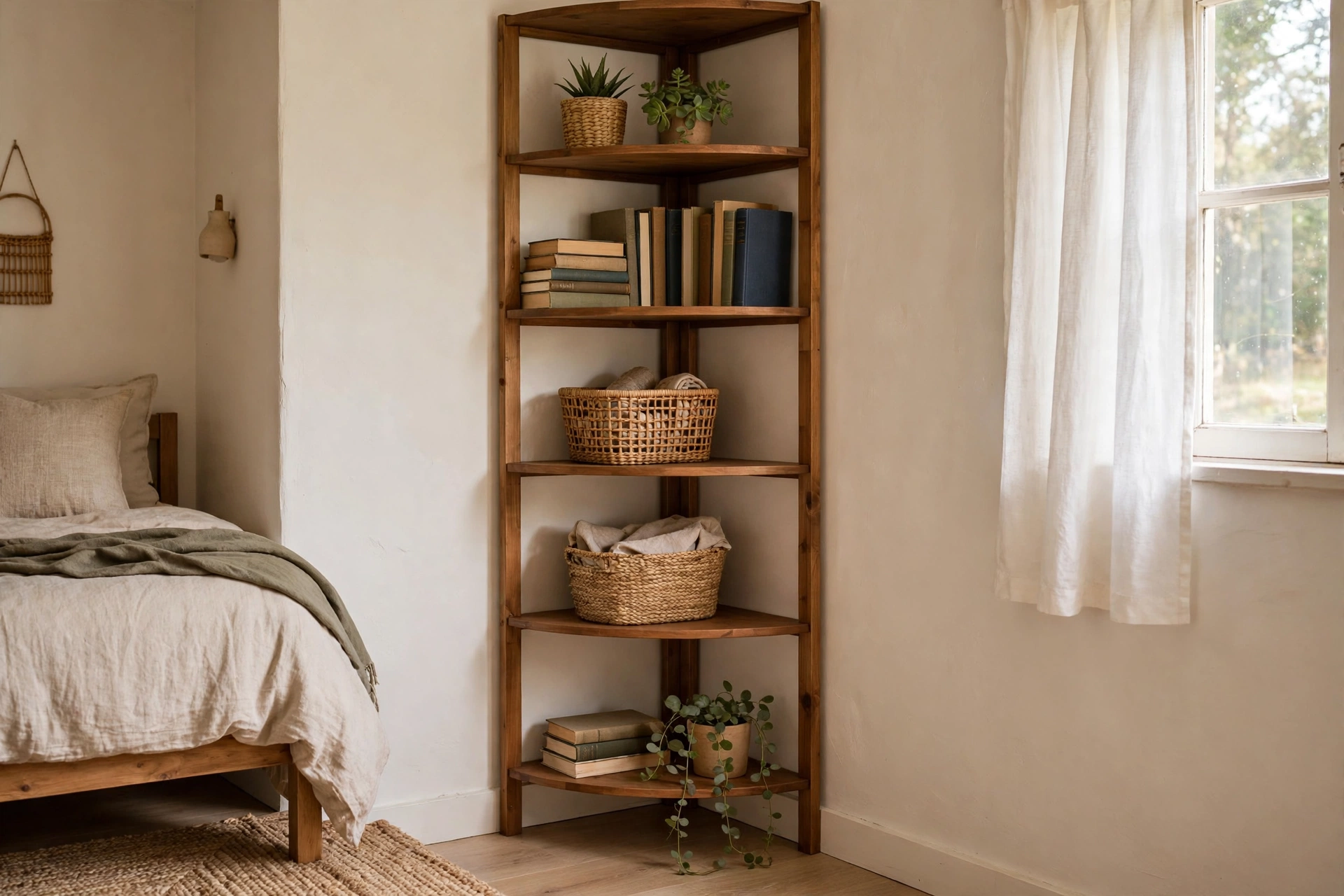
Corners are the most wasted space in a small bedroom, and corner shelving turns dead space into display and storage. A tall corner shelf unit fits where no rectangular furniture can, holding books, plants, baskets and folded clothes without blocking a walkway. Floating corner shelves work the same way on the wall, giving you two walls of storage in the footprint of one.
Use the lowest shelves for things you reach for daily and the highest shelves for display items and rarely used storage. Baskets on the shelves hide clutter and keep the corner looking tidy, while open shelves with a few books and a plant keep it feeling light. Measure the corner carefully — baseboards and uneven walls can throw off the fit — and choose a unit that is narrower than you think you need, because a corner shelf that sticks out too far becomes an obstacle.
13. A Ladder Shelf in a Narrow Corner
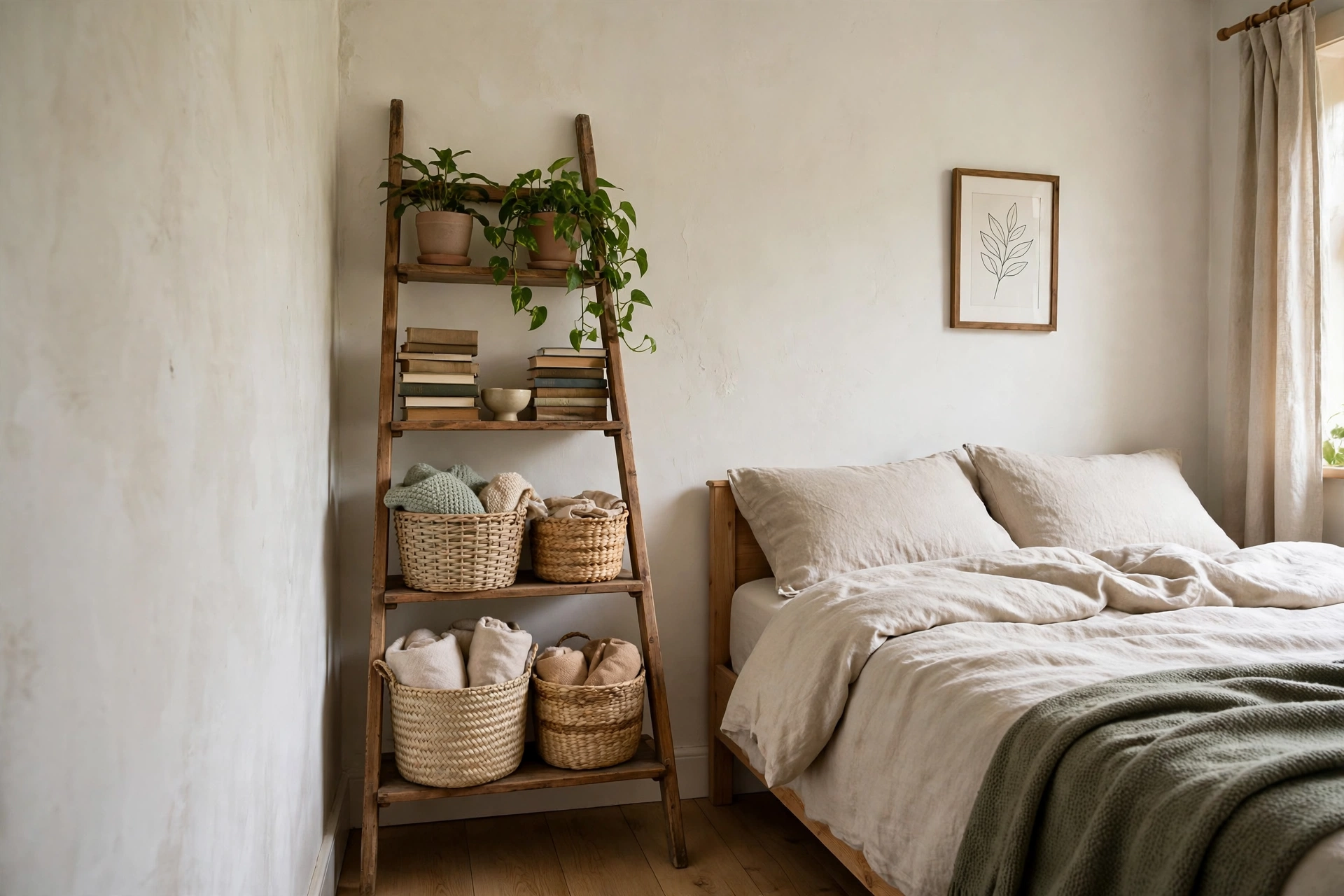
A ladder shelf leans against the wall and takes up almost no floor space, which makes it ideal for the narrow gap beside a dresser or between the bed and the wall. The shelves get deeper toward the bottom, so the base holds baskets and folded clothes while the top holds a plant or a framed photo. Because it leans rather than standing on four legs, it feels lighter than a bookcase and suits small rooms.
Anchor the top of the ladder shelf to the wall with a furniture strap, especially if children use the room, because leaning shelves can tip. Use the bottom shelf for a storage basket that hides the messiest items, and keep the middle shelves for books and daily essentials. A ladder shelf in a light wood or white finish blends into the wall and keeps the room feeling open, while a dark finish can anchor the corner visually.
14. Pegboard Wall for Accessories and Jewelry
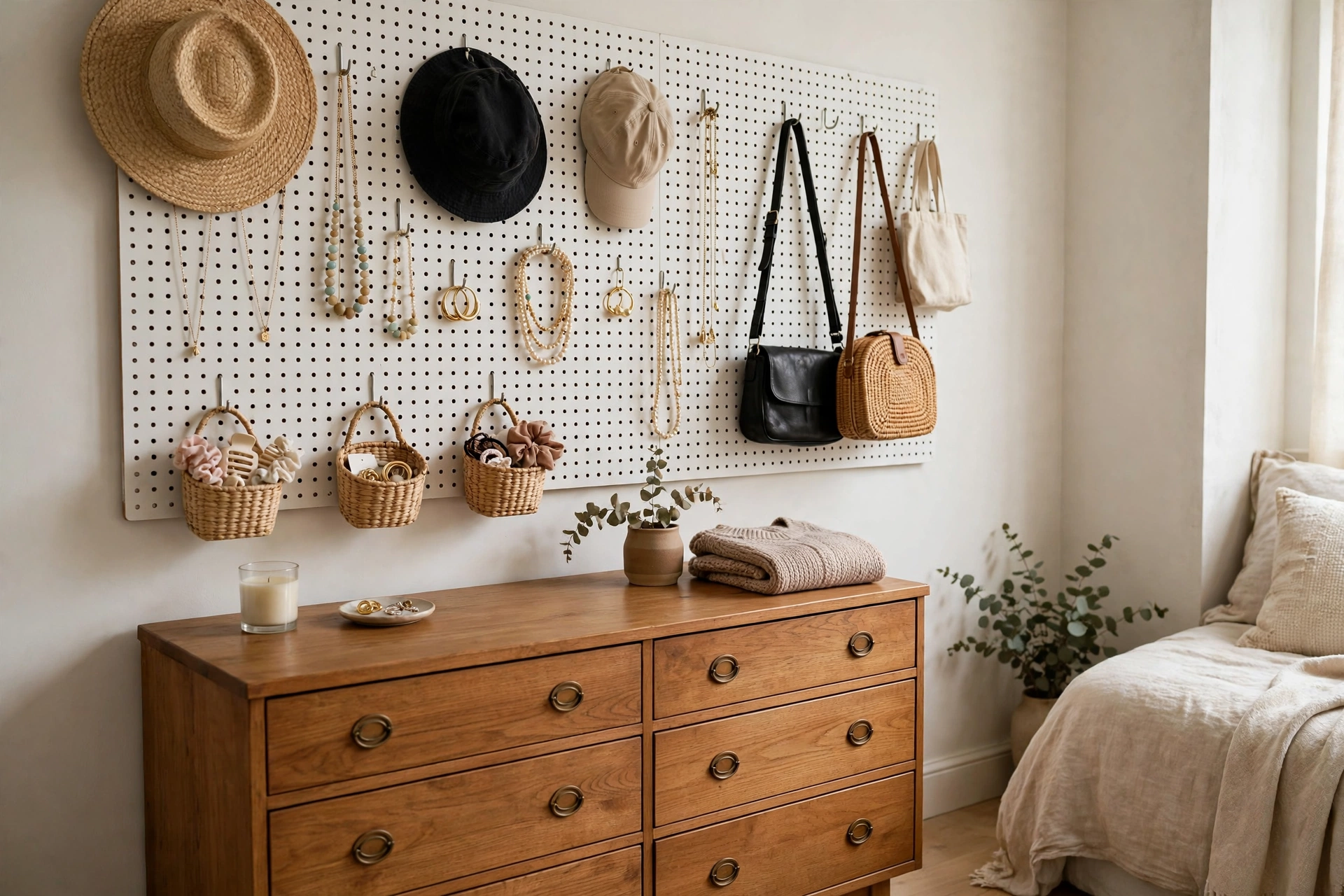
A pegboard wall turns a blank stretch of bedroom wall into flexible, changeable storage for jewelry, hats, scarves, bags and small accessories. Hooks, baskets and small shelves move around the pegboard as your needs change, so the same wall can hold necklaces one month and handbags the next. It keeps accessories visible, which means you actually wear them instead of forgetting them in a drawer.
Mount the pegboard at eye level near the dresser or mirror, and use a mix of short hooks for necklaces, small baskets for sunglasses and a shelf for perfume bottles. Paint the pegboard the same color as the wall for a subtle look, or a soft accent color to make it a feature. Keep the arrangement loose and airy — a pegboard crammed edge to edge looks cluttered — and leave a few empty pegs so you have room to add new pieces.
15. A Multi-Functional Dresser as a Room Divider
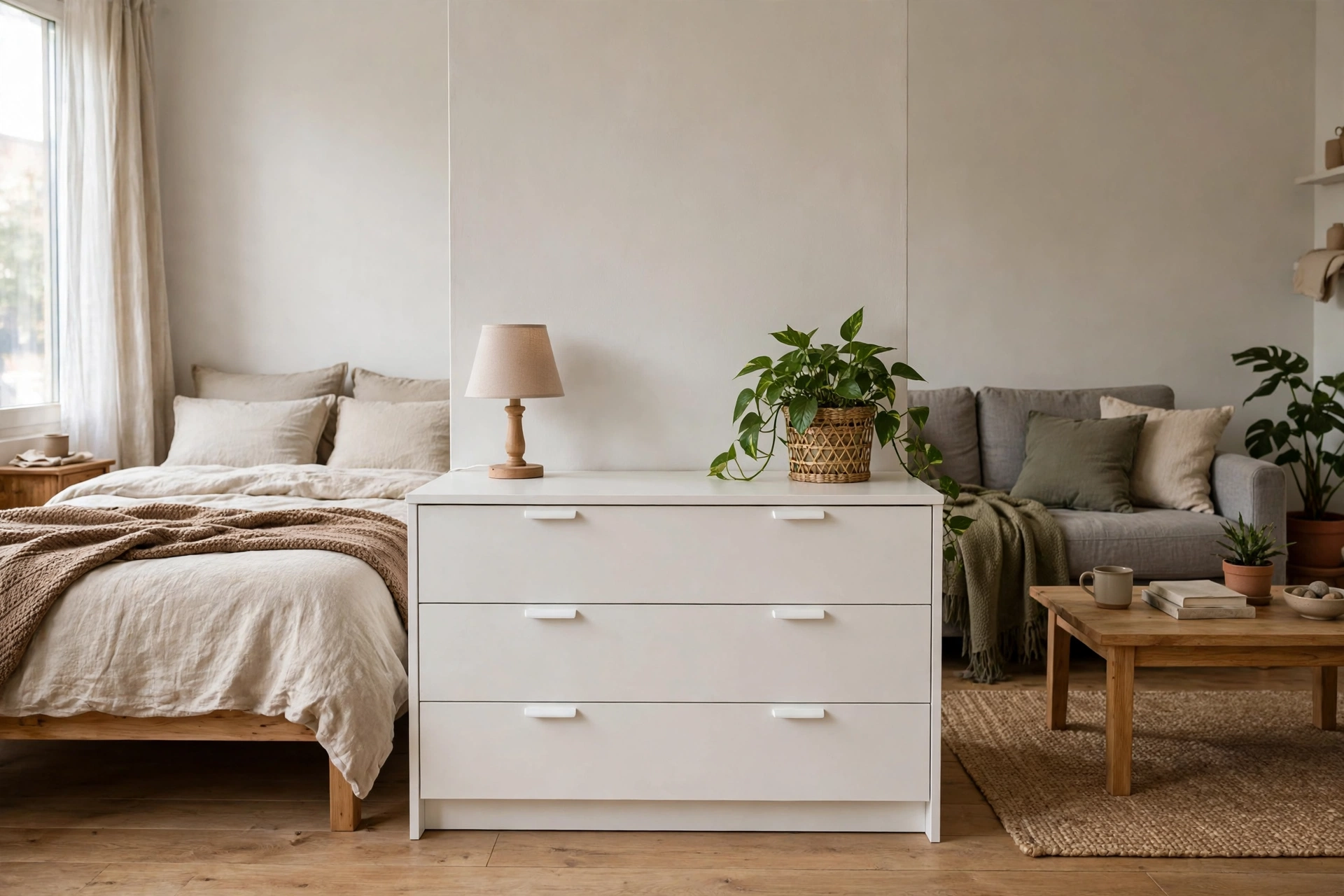
In a studio apartment or a shared bedroom, a low dresser can work as a room divider that also stores clothes. Place a wide, low dresser perpendicular to the wall to create a visual boundary between the sleeping area and the rest of the room, and you gain six drawers of storage plus a surface that doubles as a display shelf or a TV stand. The divider effect makes a single room feel like two distinct zones.
Choose a dresser that is no taller than 36 inches so it divides the space without blocking light or making the room feel closed in. Keep the top styled simply — a lamp, a small plant and a tray — so the surface does not become a dumping ground. A dresser with a light finish keeps the divided space feeling open, and adding a mirror or artwork above it anchors the piece visually.
16. Hanging Shoe Storage Behind the Door
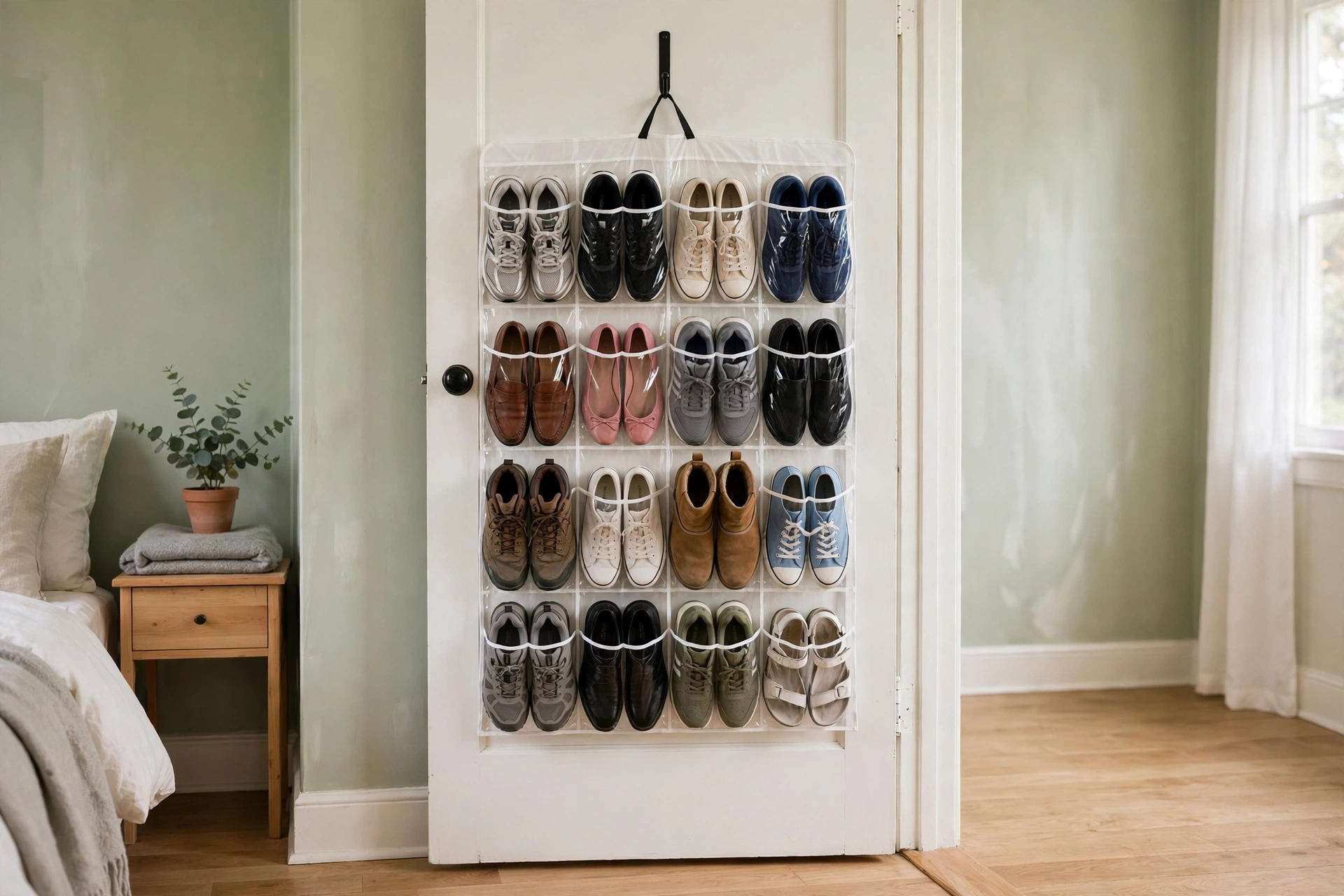
Shoes are one of the biggest clutter sources in a small bedroom, and hanging shoe storage behind the door keeps every pair visible and off the floor. A hanging organizer with clear pockets holds flats, sneakers and sandals, while a slim over-the-door rack holds heels and boots upright. Either option uses the door you already have, so it costs no floor space at all.
Sort shoes by how often you wear them — daily pairs at eye level, occasional pairs at the bottom — and keep no more than one pair per pocket so the organizer does not bulge and stop the door from closing. Clean shoes before storing them, because dirt in a fabric pocket spreads to everything else. If the door organizer fills up, it is a signal to donate the pairs you have not worn in a year rather than buying a second organizer.
17. Bedside Caddy for Books and Chargers
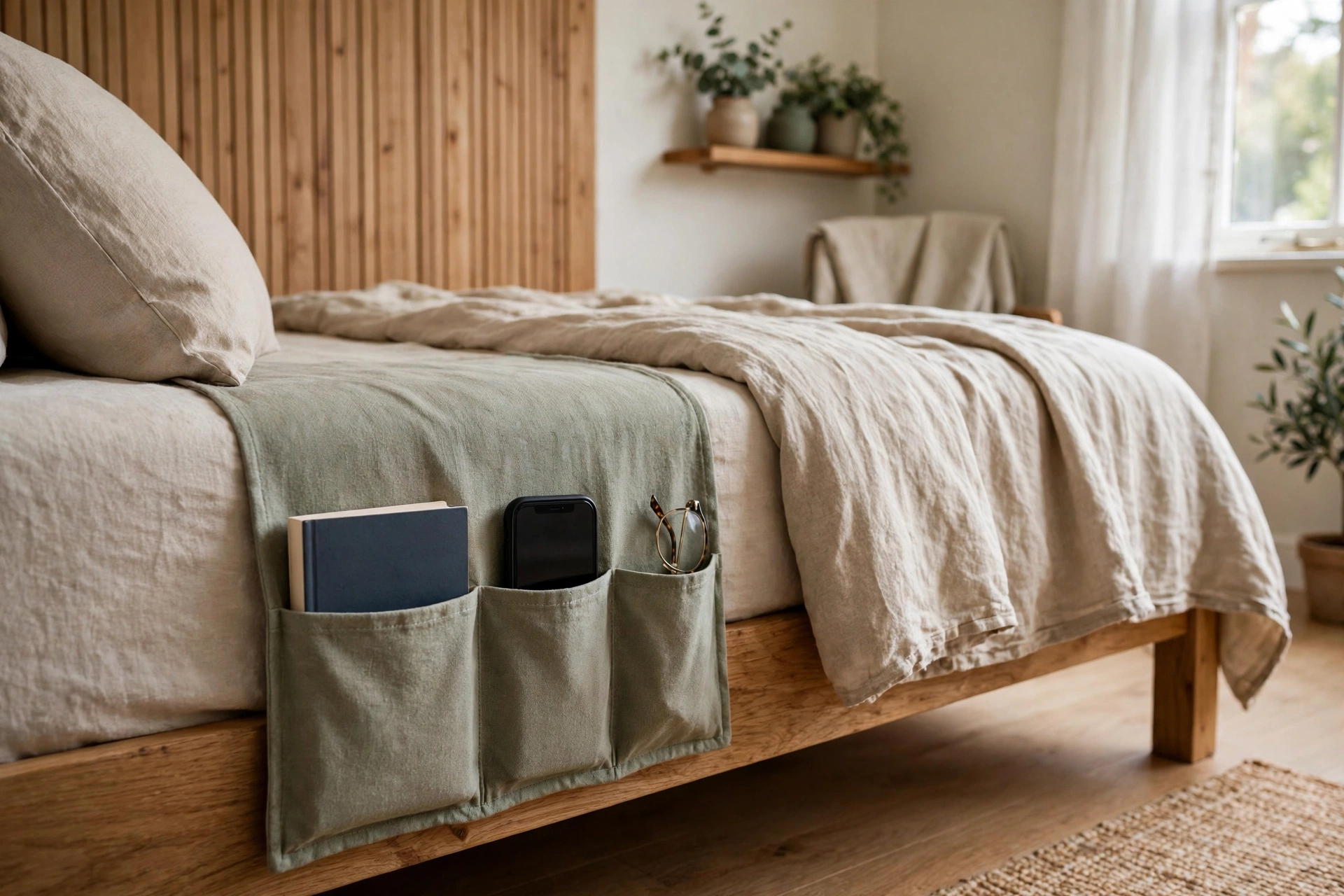
A bedside caddy is a small fabric or leather pocket that hangs over the side of the mattress, holding your book, phone, charger, glasses and remote without needing a nightstand at all. It is the simplest bedside storage idea on this list — it costs little, installs in seconds and works in rooms where the bed is pushed against the wall. The caddy keeps essentials within reach but out of sight, so the bed looks tidy.
Choose a caddy with at least three pockets of different sizes: a large pocket for a book or tablet, a medium pocket for your phone, and a slim pocket for glasses or a pen. Make sure the caddy’s flap tucks firmly under the mattress so it does not slide off when you pull something out. A caddy in a color that matches your bedding blends in, while a contrasting leather caddy adds a deliberate design detail.
18. A Fold-Down Wall Desk That Disappears
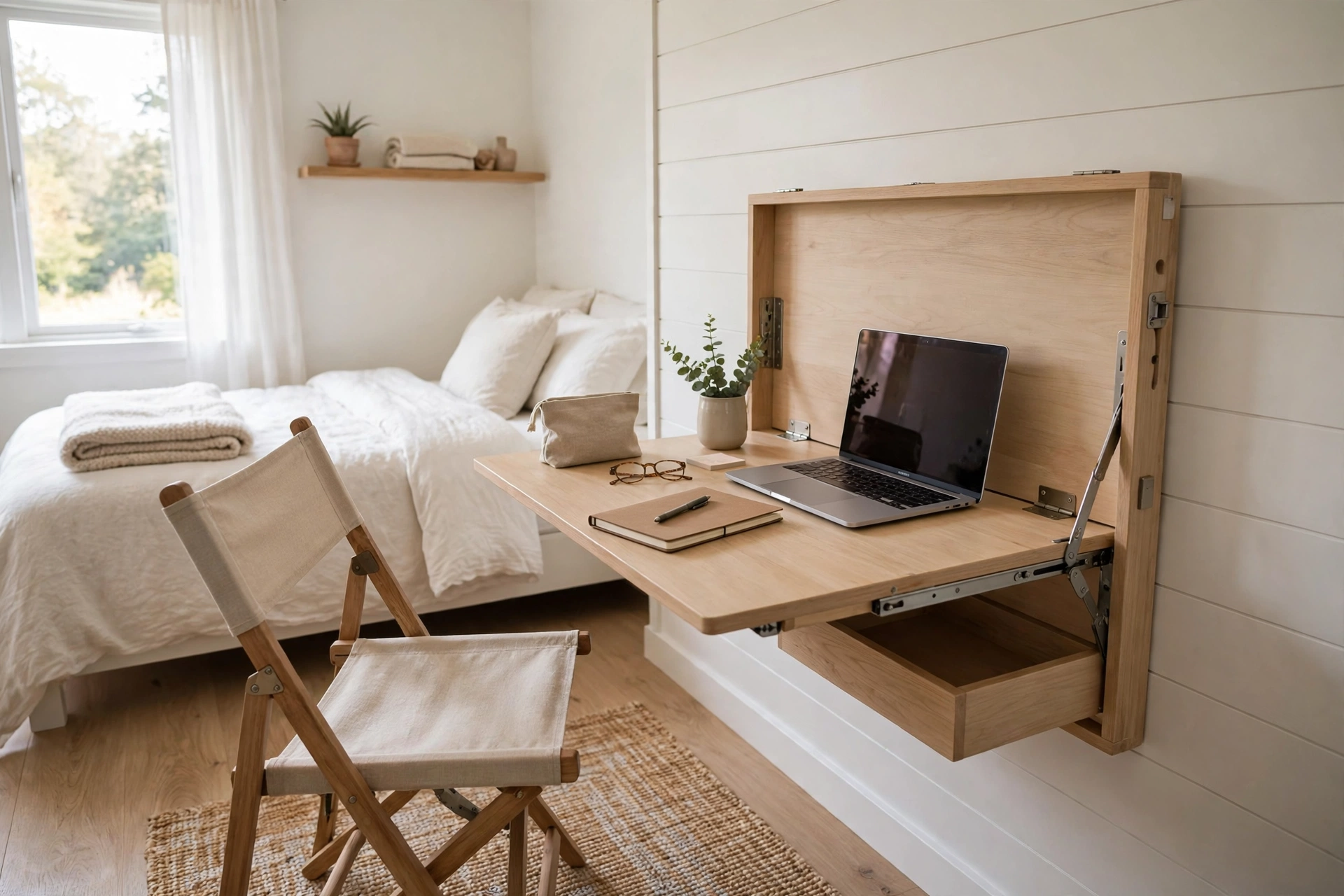
A fold-down wall desk gives a small bedroom a real workspace that disappears when the workday ends. Mounted on the wall, the desk folds down to a full writing surface and folds up to a slim cabinet or a picture frame, freeing the floor completely. It is ideal for bedrooms that double as a home office, because the room returns to being a bedroom the moment you close the desk.
Mount the desk at standard desk height — about 29 to 30 inches — and add a wall-mounted shelf above it for office supplies so nothing needs to live on the desk surface. A small folding chair that hangs on a wall hook nearby completes the setup. Keep only a laptop, a notebook and a pen on the desk while you work, and clear it completely before folding it up, so the closed desk stays flat against the wall.
19. Storage Headboard With Built-In Shelves
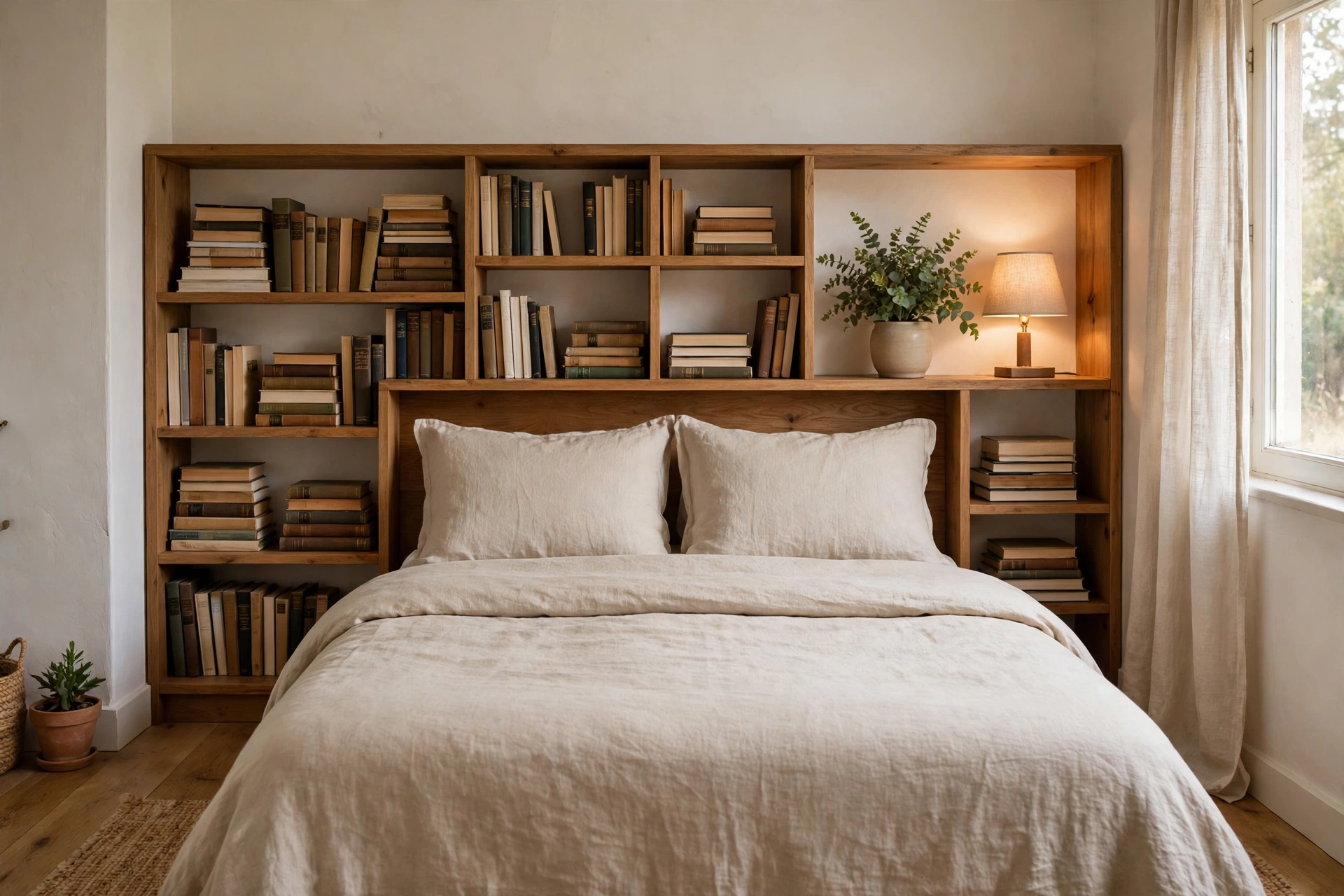
A storage headboard replaces a plain headboard with shelves, cubbies and small drawers built into the wall behind the bed. It holds books, glasses, a phone charger, a lamp and nighttime essentials, and it can eliminate the need for nightstands entirely in a very small room. A headboard with a wide top shelf also gives you a display ledge for photos and plants.
Choose a headboard that is the same width as your bed or a few inches wider, and check that the shelves are deep enough to hold a book without it falling — six to eight inches is right. Keep the shelves styled with intention: a few books, a small lamp and one decorative object per cubby, not a jumble. A storage headboard in the same finish as your bed frame looks built-in, while a contrasting wood tone can make it a feature piece.
20. Clear Stackable Bins Under the Bed
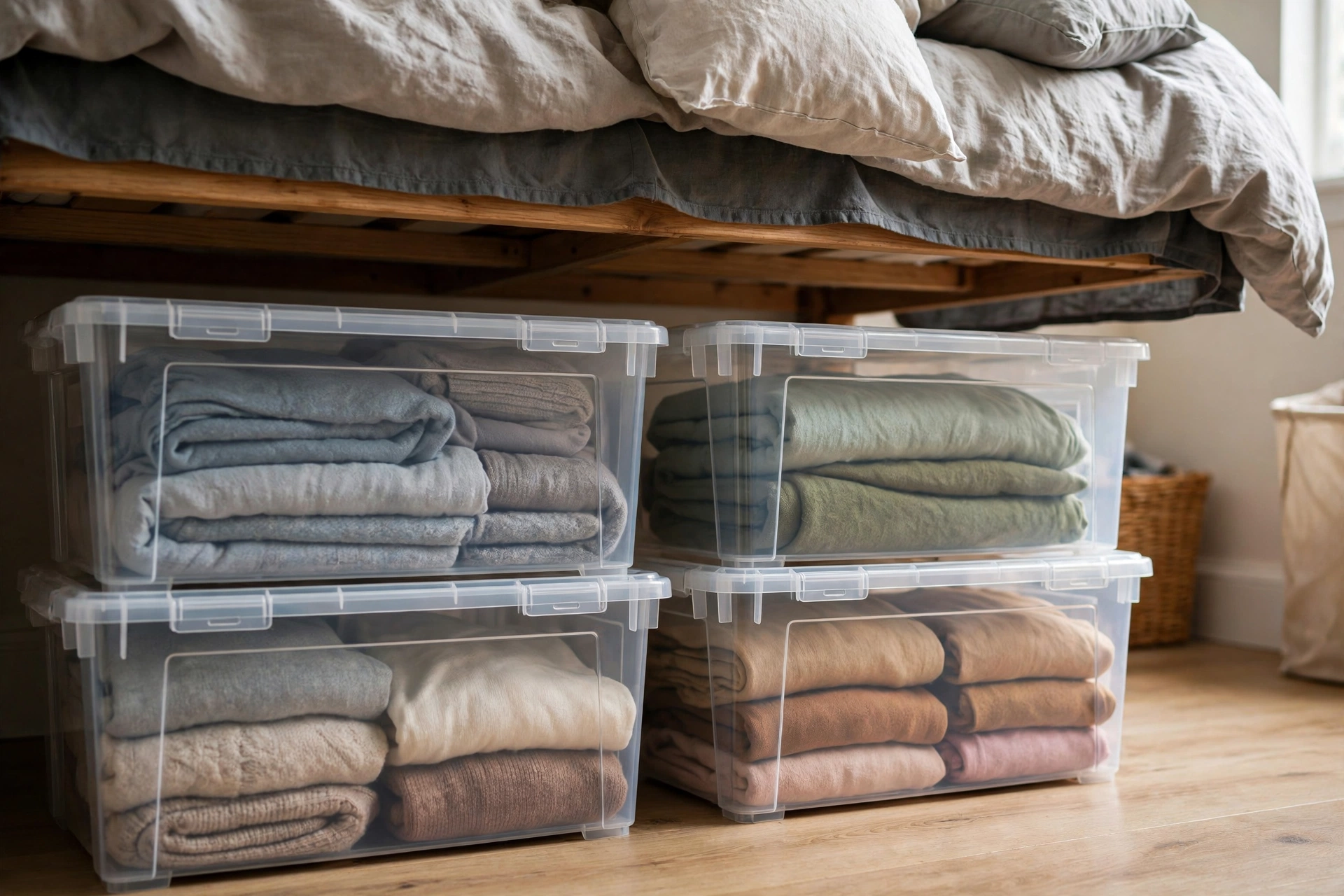
Clear stackable bins under the bed let you see exactly what is stored without pulling anything out, which is the difference between storage you use and storage you forget. Flat, lidded bins stack neatly under most bed frames, and the clear sides mean a quick glance tells you which bin holds the winter blankets and which holds the spare sheets. Labeling the short end of each bin makes the system even faster.
Use bins that are no taller than your bed clearance minus half an inch, and choose lids that snap on firmly so dust stays out. Group like items together — all bedding in one bin, all off-season clothes in another — and keep a simple inventory list taped inside the closet door if you have more than four bins. Clear bins also make the twice-yearly seasonal swap quick, because you can see at a glance what needs to move.
21. A Tall Narrow Armoire for Small Rooms
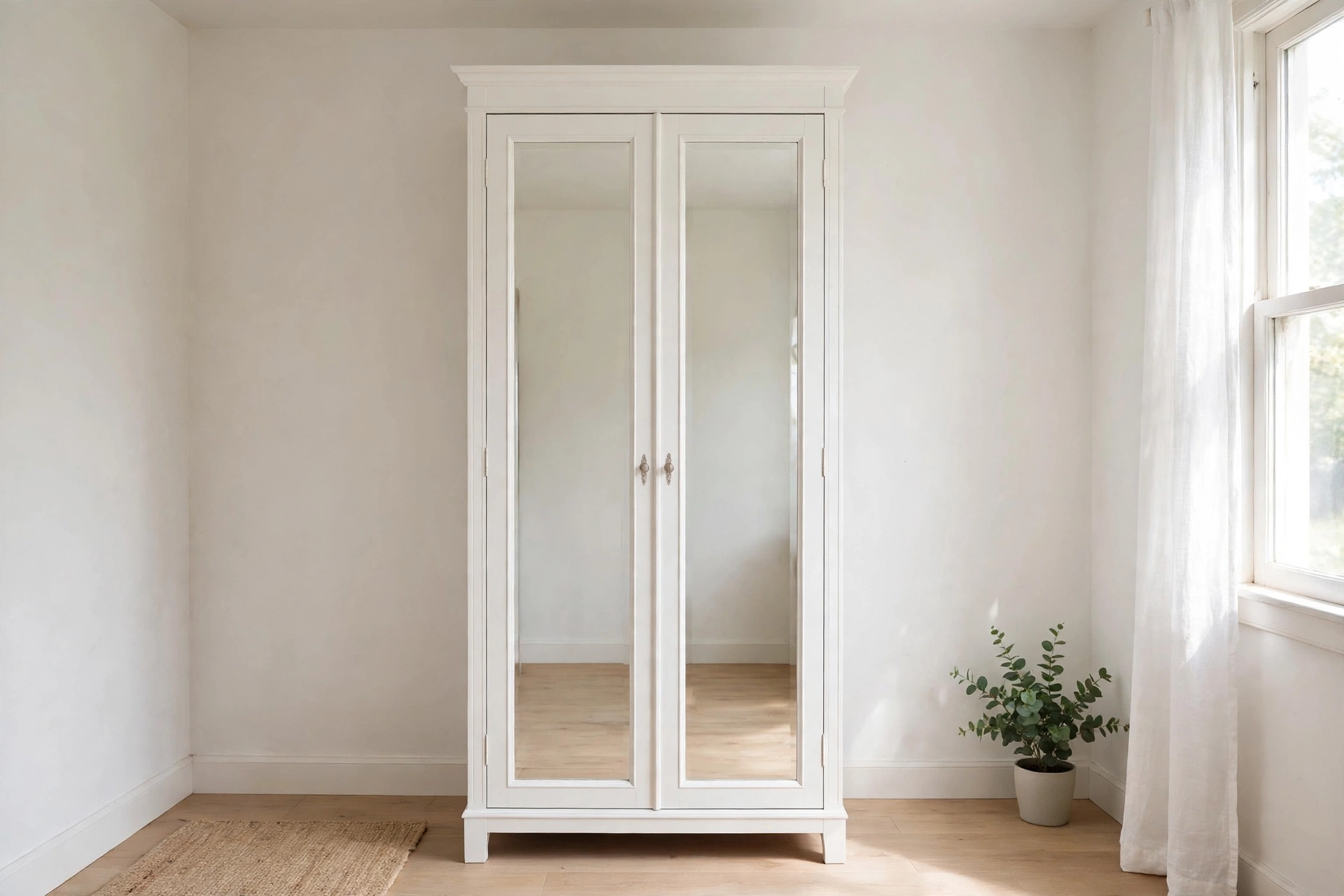
A tall, narrow armoire adds a full wardrobe’s worth of storage in the footprint of a nightstand, which makes it perfect for bedrooms with no closet or a closet that is too small. Look for an armoire no wider than 36 inches with a hanging rod on top and drawers or shelves below, so it holds hanging clothes, folded clothes and accessories in one piece. A mirrored door makes the room feel larger while it stores your clothes.
Before you buy, measure the ceiling height and the door swing, because a tall armoire needs clearance to open fully in a small room. Sliding doors or a curtain front can solve a tight door swing. Keep the armoire’s interior organized with a rod, two shelves and a small basket for accessories, and resist the urge to overfill it — an armoire packed to bursting is no better than a messy closet.
22. Wall Hooks and Rails for Bags and Hats
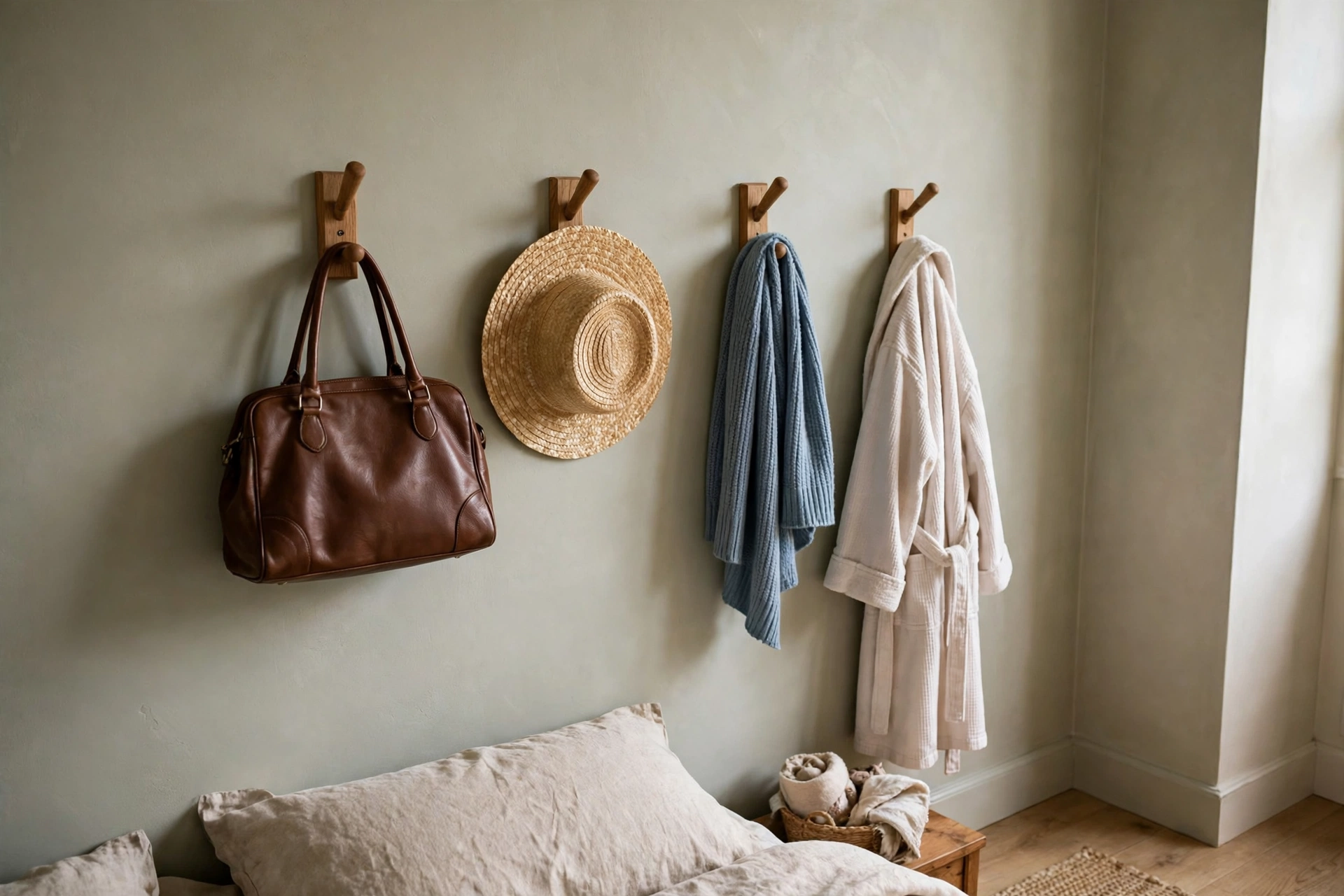
A row of wall hooks or a mounted rail gives bags, hats, scarves and robes a home that is not the floor, the bed or the back of a chair. Hooks use vertical wall space and keep items visible and easy to grab, which means they actually get put away instead of dropped. A rail with sliding hooks is even more flexible, because you can space the hooks to fit bulky bags or slim scarves as needed.
Mount the hooks at a height you can reach comfortably — about 60 to 66 inches from the floor for bags and hats — and space them at least six inches apart so items do not overlap and tangle. Limit each hook to one item, and keep the row to five or six hooks so it reads as an organized display rather than a crowded coat rack. Wooden pegs suit a warm, classic bedroom, while matte black metal hooks suit a modern one.
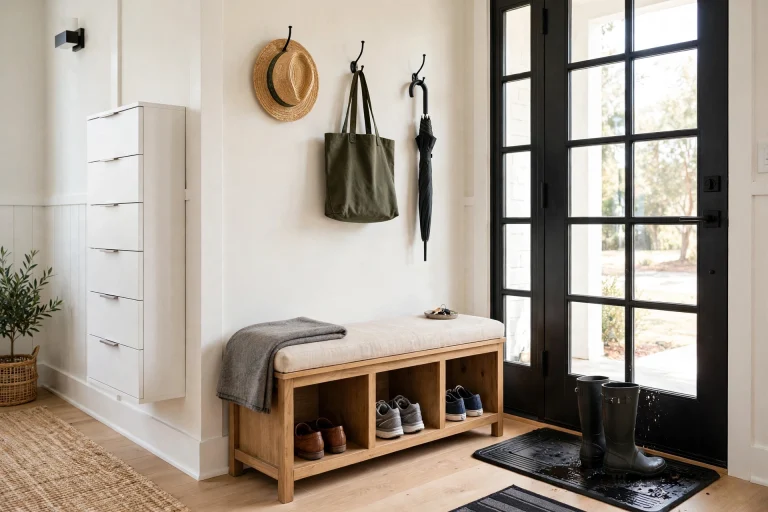
23. A Bench With Shoe Storage by the Door
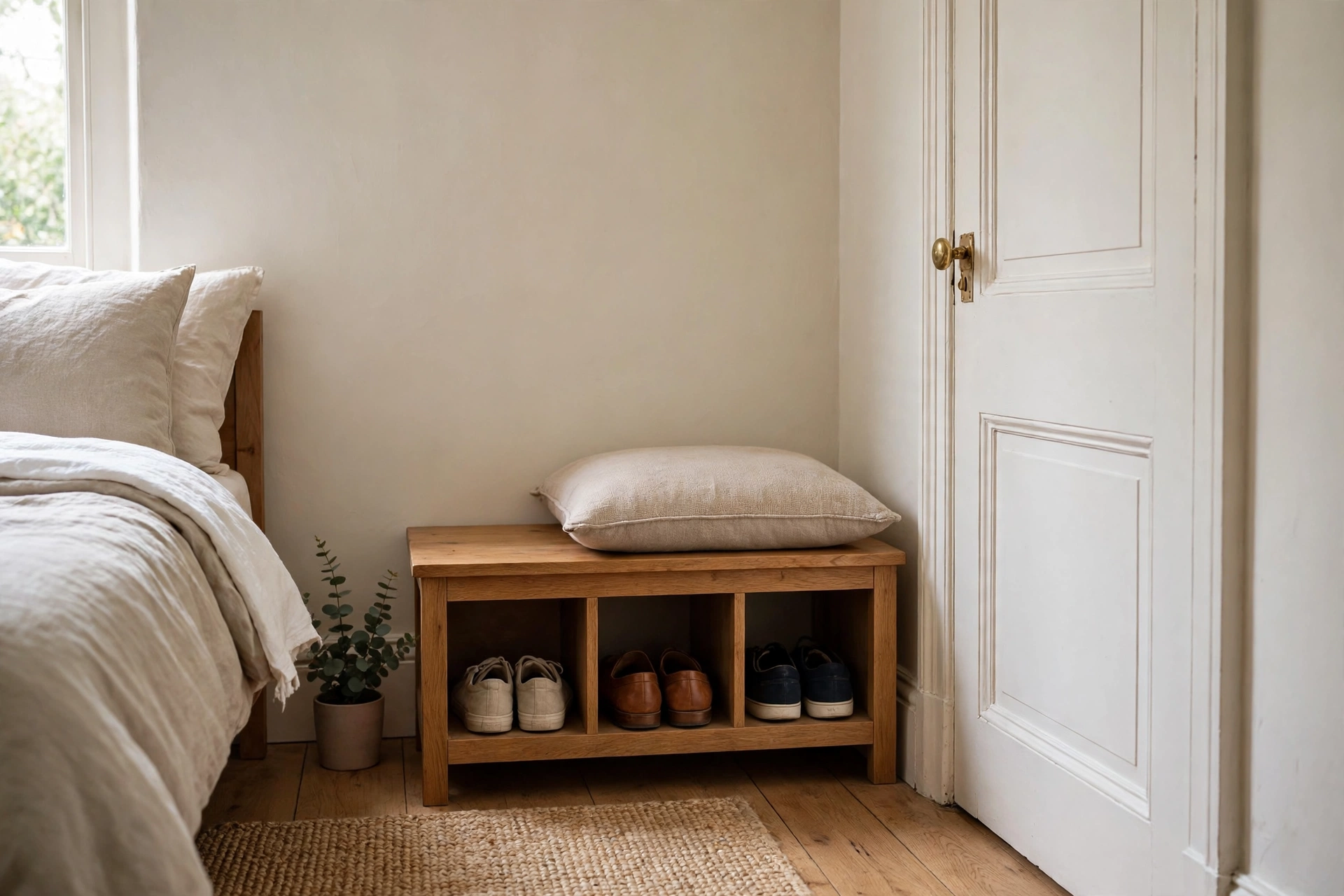
A bench with shoe storage by the bedroom door solves two problems at once: it gives you a seat for putting on shoes, and it hides the shoes themselves. A bench with open cubbies underneath holds several pairs in plain sight, while a bench with a lift-up seat hides them completely. Either way, shoes stop migrating across the bedroom floor, and the room’s entrance stays clear and welcoming.
Choose a bench that fits the wall beside the door without blocking the door swing, and keep the shoe count to the pairs you wear most often — the rest belong in the closet or under the bed. A bench cushion in a washable fabric makes the seat comfortable, and a small tray on top holds keys and sunglasses. If the bench is near the bedroom entrance, it also works as a landing spot for a bag when you come home.
24. Drawer Dividers Inside Every Dresser Drawer
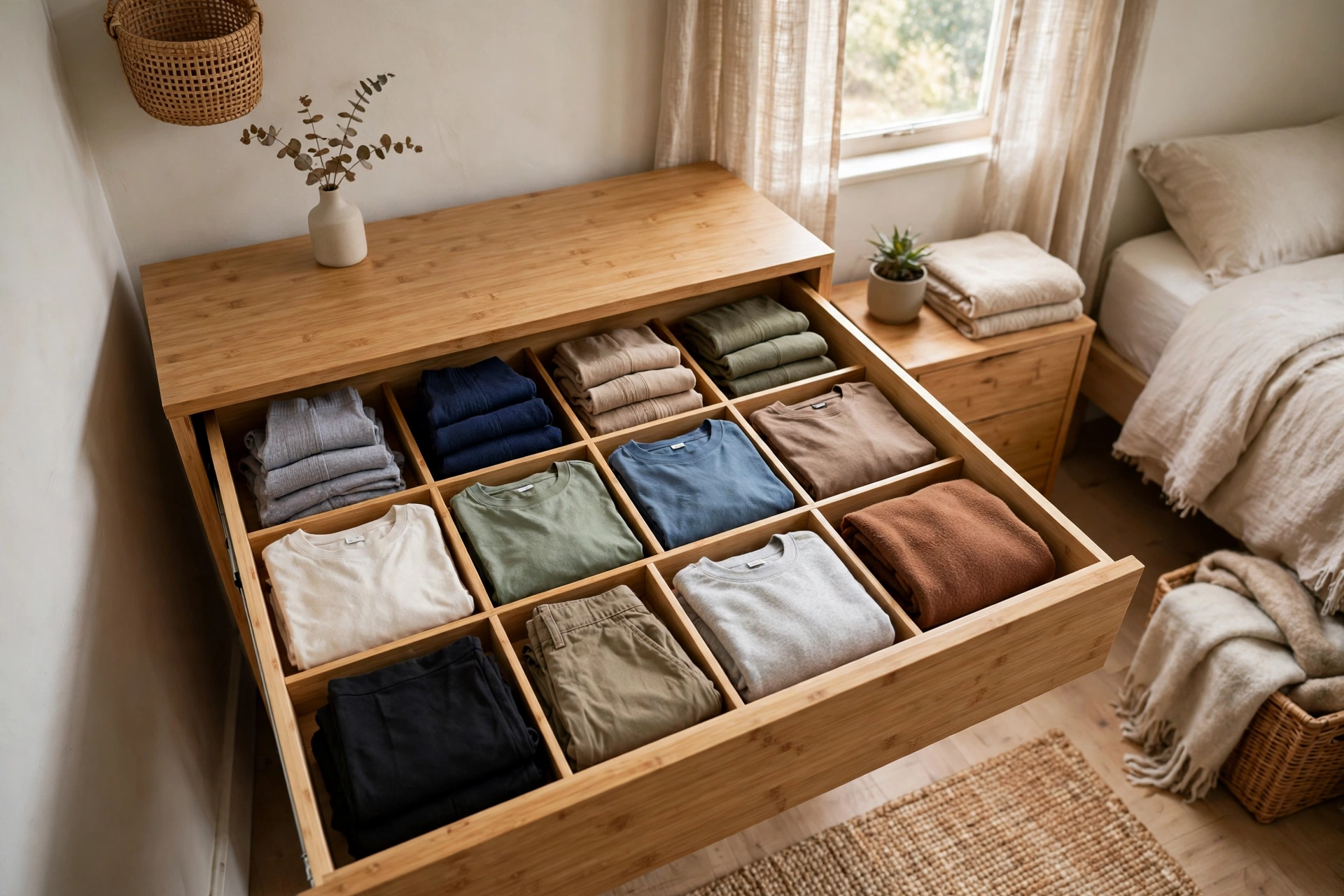
Drawer dividers are the cheapest storage upgrade in this guide, and they change how a dresser works. Without dividers, a drawer becomes a jumble where socks, underwear and T-shirts mix together; with dividers, every category has its own compartment, so you can see everything at a glance and nothing gets buried. Adjustable dividers fit any drawer, and fabric or bamboo organizers are easy to rearrange as your wardrobe changes.
Start with the top drawer, which holds the smallest and most-mixed items, and give each category its own slot: socks in one, underwear in another, accessories in a third. Fold clothes using the file-fold method — standing upright in rows — so you can see every item without digging. A divided drawer also shows you at a glance when a category is overfull, which is the signal to declutter before you buy more storage.
25. A Rolling Cart Between Bed and Wall
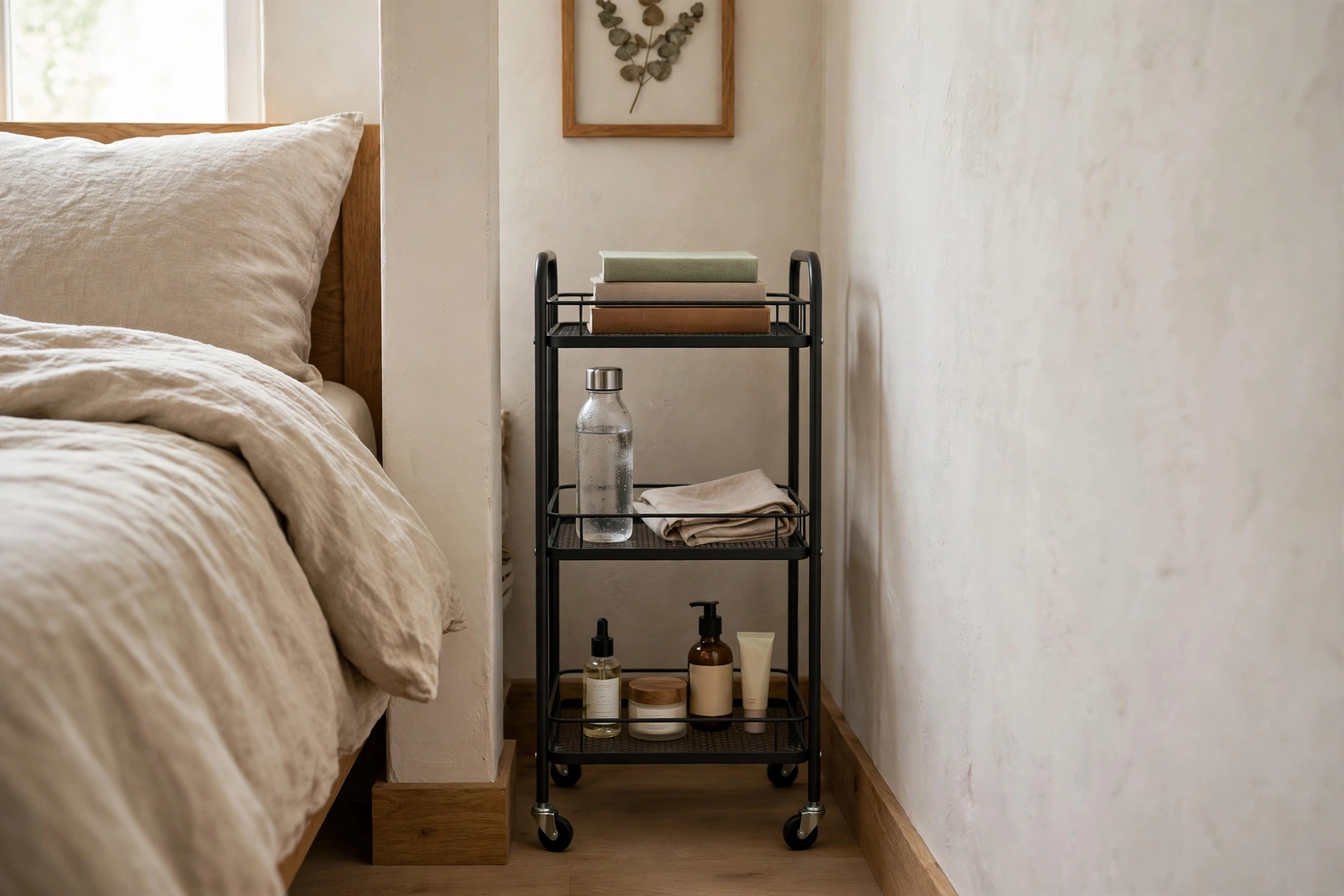
A slim rolling cart slides into the narrow gap between the bed and the wall — a space that is usually wasted — and holds books, chargers, skincare, water bottles and nighttime essentials on three tiers. Because it rolls, you can pull it out to reach the back tier and push it away when you need the floor space. It is a renter-friendly solution that needs no drilling and no assembly beyond snapping the shelves together.
Measure the gap before you buy, because rolling carts come in widths from four to eight inches, and a cart that is even a quarter inch too wide will not fit. Choose a cart with a top tray that has a raised edge so items do not slide off when you roll it, and keep the heaviest items on the bottom tier so it does not tip. A white or clear cart blends into the room, while a metal cart adds an industrial accent.
26. Overhead Storage Above the Door Frame
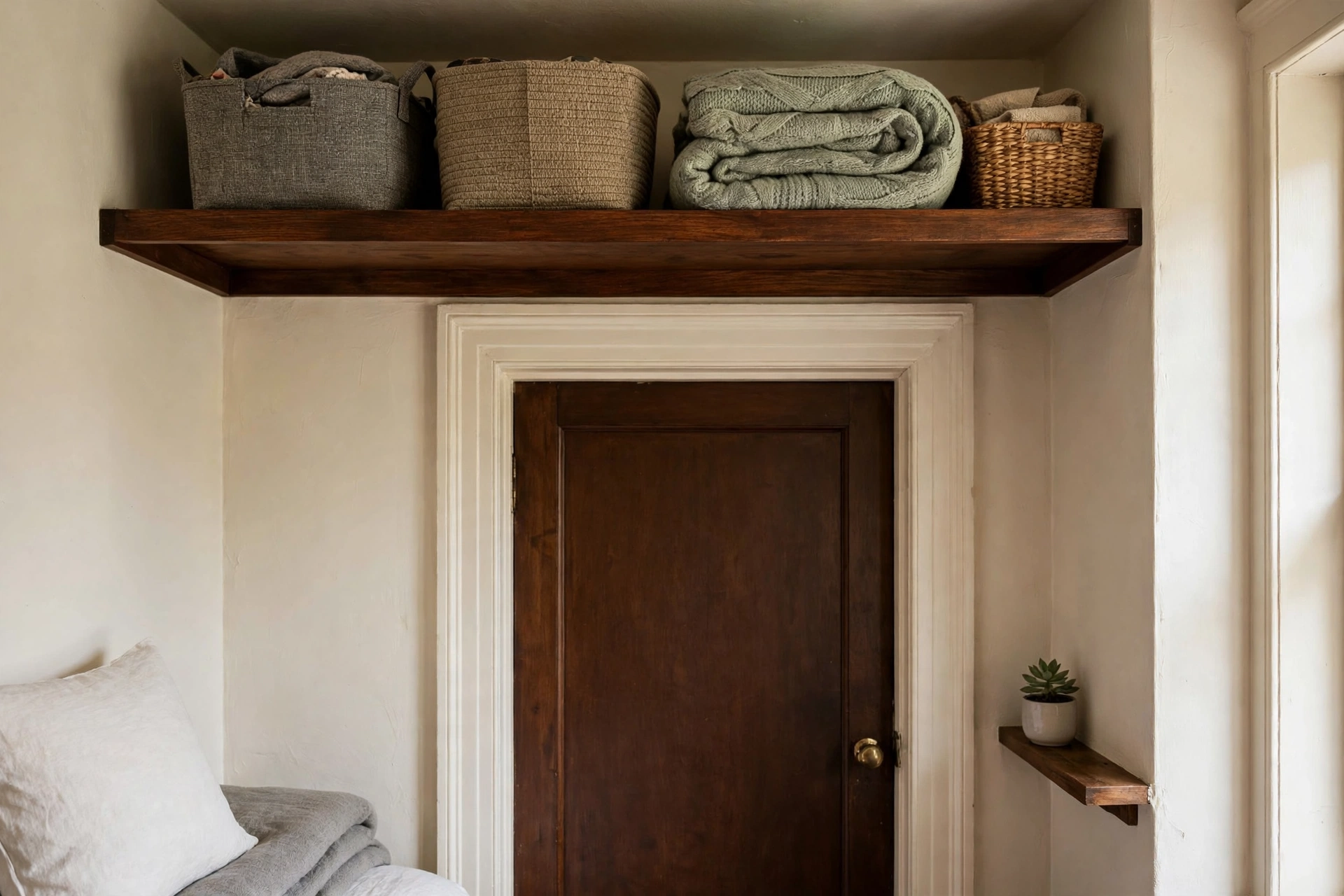
The space above a door frame is one of the most overlooked storage spots in a bedroom, and a shelf mounted there holds items you need only occasionally — extra blankets, luggage, keepsake boxes — without taking any floor or closet space. A single deep shelf above the bedroom door, or a shelf that runs above the closet door, can hold two or three labeled bins out of sight but within reach with a step stool.
Mount the shelf with heavy-duty brackets and wall anchors rated for the weight, and keep the bins light — under ten pounds each — so the shelf stays safe and the items stay easy to lift down. Label the bins on the side facing the room so you can identify them from the floor. This is a good spot for the things you want to keep but do not want to see every day, such as holiday decorations or childhood keepsakes.
27. A Mirror Cabinet That Hides Storage
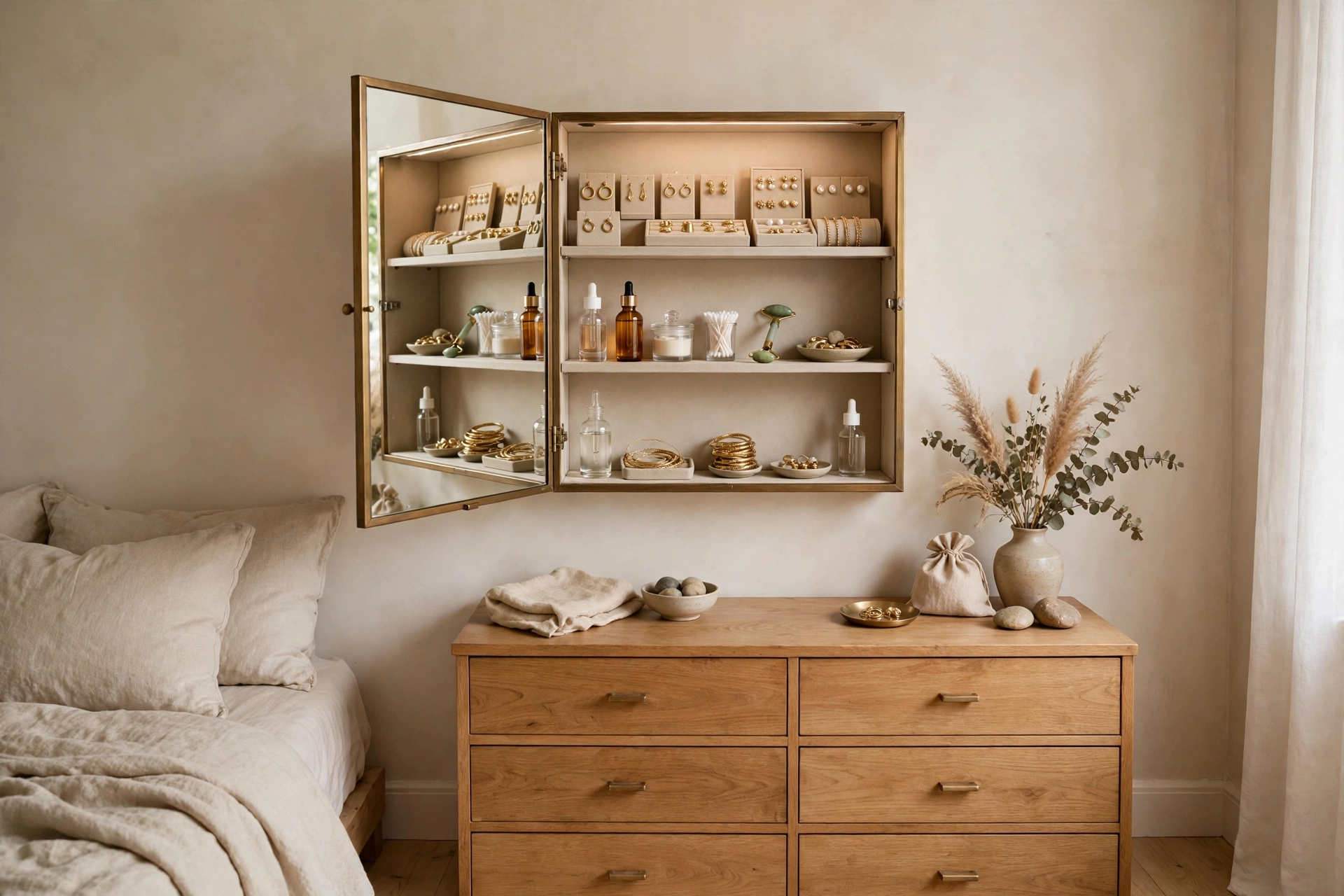
A mirror cabinet — a shallow wall cabinet with a mirrored front — hides storage behind a mirror, so it stores jewelry, medication, skincare and small accessories while making the room look larger. The mirror reflects light and doubles the sense of space, which is exactly what a small bedroom needs, and the cabinet behind it keeps the dresser top clear of clutter. Mount it above the dresser or near the closet for the most useful placement.
Choose a cabinet no deeper than four or five inches so it sits close to the wall and does not jut into the room. Organize the inside with small shelves and a few tiny baskets, and keep the items you reach for every morning at eye level. A mirror cabinet with a soft-close door and an interior light is a worthwhile upgrade if your budget allows, because it turns a storage box into a proper vanity station.
28. Vacuum Bags for Bulky Bedding
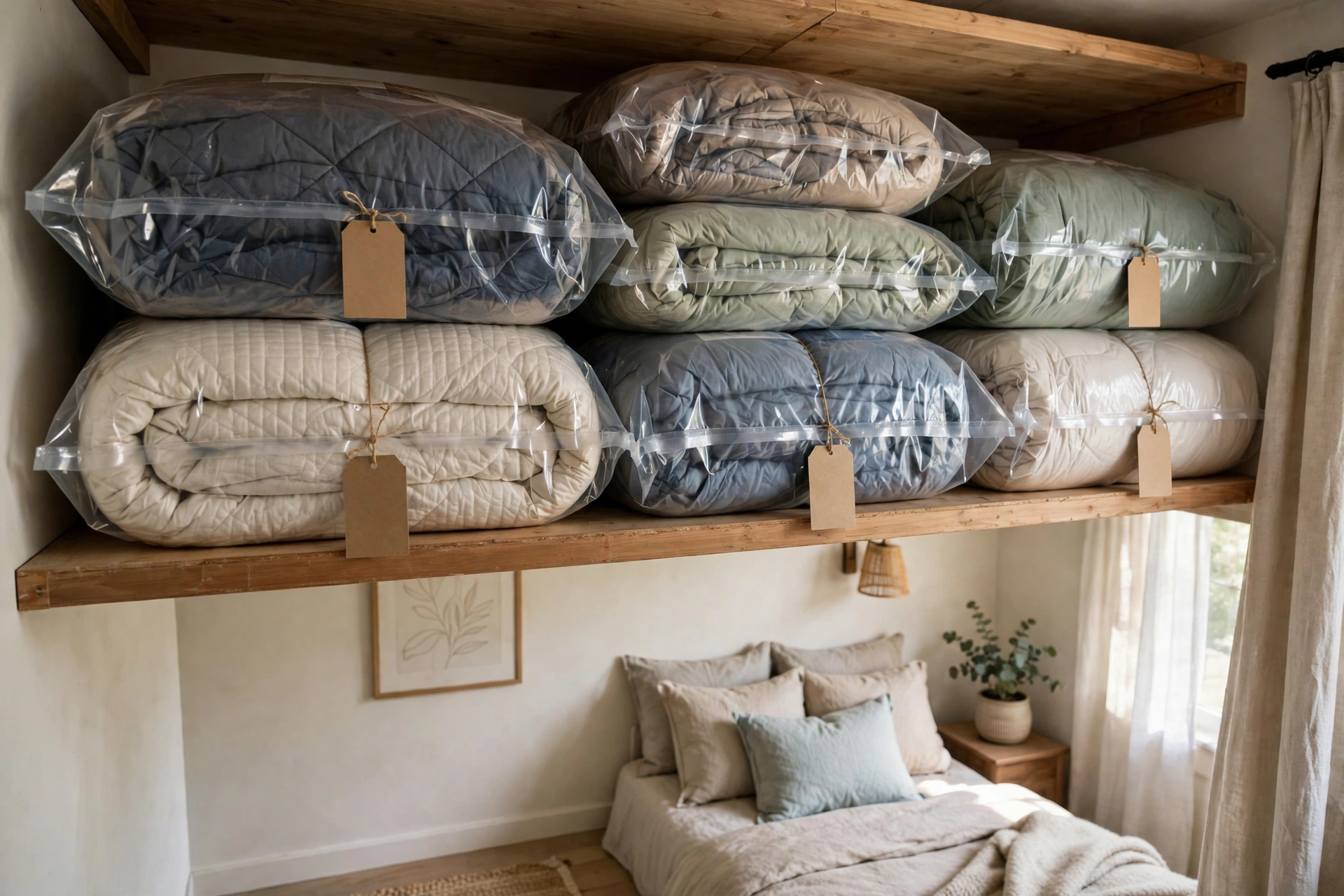
Bulky bedding — comforters, duvets, spare blankets and pillows — eats closet space fast, and vacuum bags shrink it to a third of its size. A king-size comforter that fills a whole shelf compresses flat enough to slide under the bed or onto a high closet shelf, freeing that shelf for clothes you actually wear. Vacuum bags are the simplest way to store the bedding you only need in one season.
Use a standard vacuum cleaner to remove the air, and seal the bag completely before storing it — a slow leak lets the bag re-inflate over weeks. Store the compressed bags flat, never standing on edge, so the seal stays intact, and keep them away from sharp objects. Do not vacuum-seal natural down or feather items for more than a few months at a time, because long compression can damage the fill; synthetic bedding handles it much better.
29. A Nightstand Charging Station Drawer
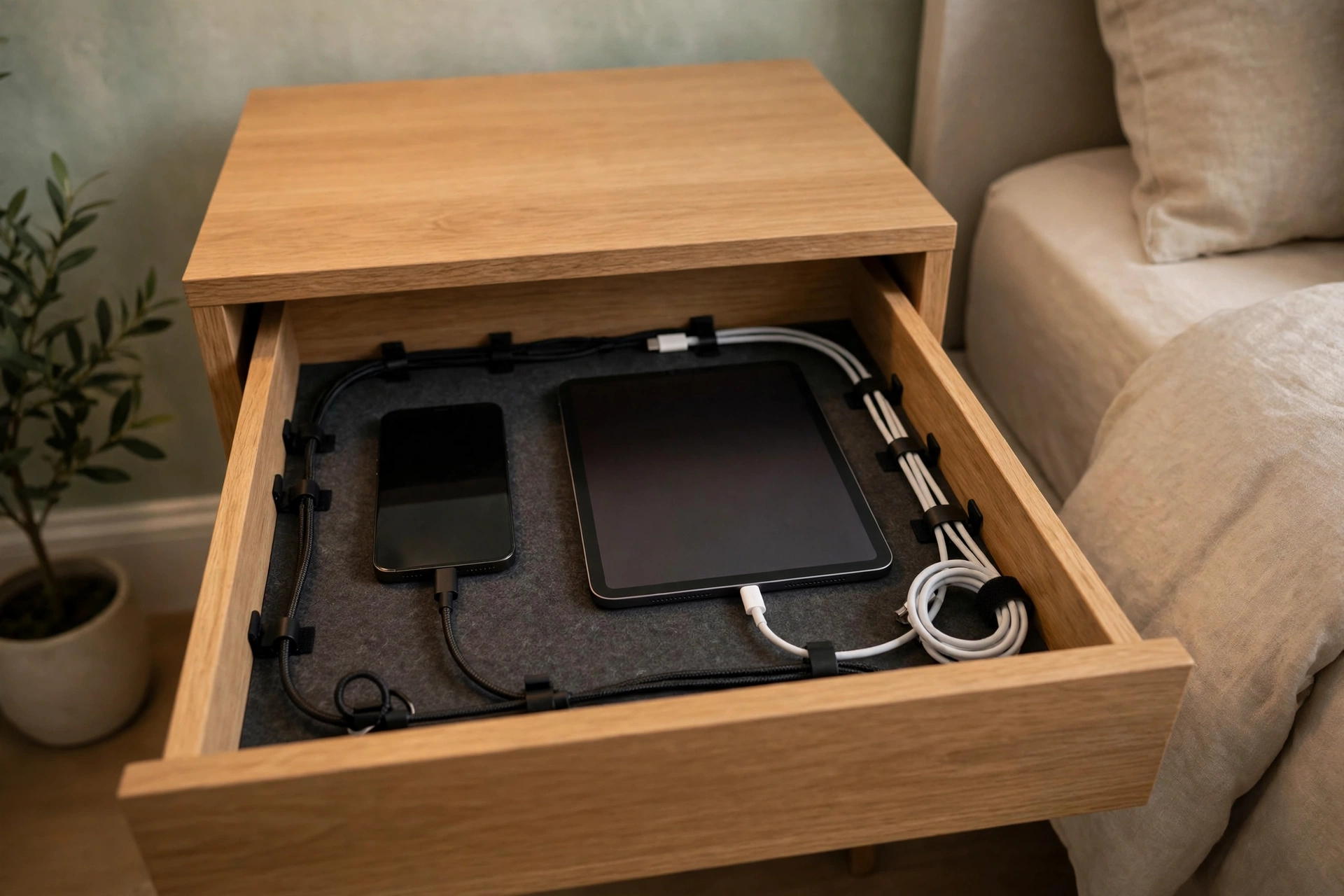
A nightstand drawer fitted as a charging station hides the tangle of cables that usually spreads across a small bedroom. A small power strip or a multi-port USB hub inside the drawer, with a cable hole drilled in the back, lets you charge a phone, tablet, watch and earbuds out of sight while you sleep. The nightstand top stays clear for a lamp and a book, and you never trip over a cable on the way to the bathroom at night.
Use a power strip with surge protection, and keep the drawer ventilated — do not pack it tight with fabric around the chargers, because chargers generate heat. Cable clips inside the drawer keep each cord in its own channel so they do not knot together. If you do not want to drill, a ready-made charging drawer insert with a built-in power strip is available at most home stores and fits a standard nightstand drawer.
30. Floating Desk Shelf for a Work Nook
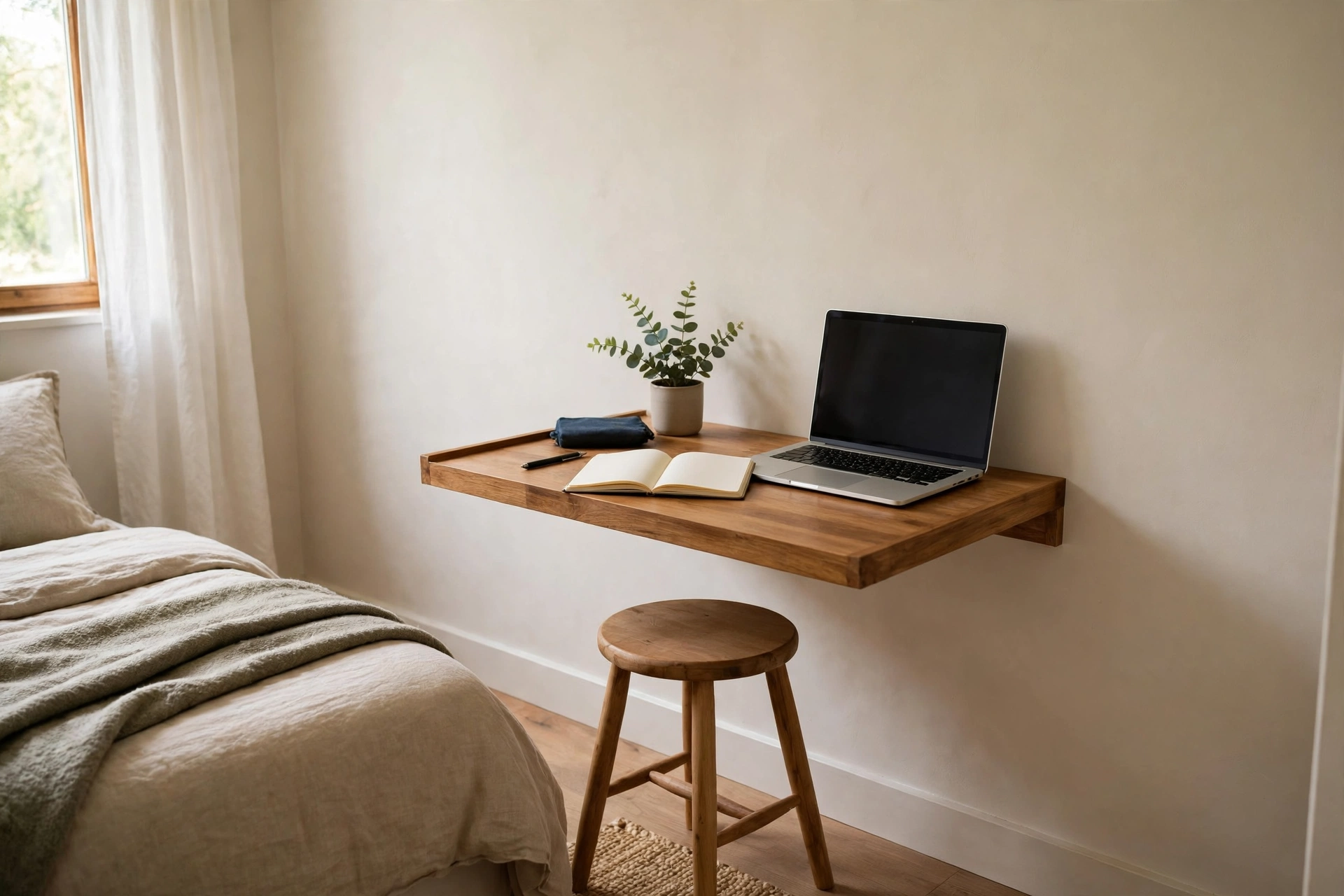
A floating desk shelf creates a work nook in a small bedroom without the footprint of a desk. A single deep shelf mounted at desk height, about 29 inches from the floor, holds a laptop and a notebook, and a wall-mounted shelf above it holds supplies. When the workday ends, the laptop closes and the shelf becomes a display ledge, so the bedroom never feels like an office.
Choose a shelf at least 20 inches deep so a laptop sits comfortably with room for your wrists, and mount it with brackets rated for at least 50 pounds so it stays solid while you type. A small stool or folding chair that tucks under the shelf completes the nook without taking floor space. Add a wall-mounted light above the shelf so you do not need a desk lamp, and keep the shelf clear of everything except work essentials during the day.
31. Storage Baskets on Top of the Wardrobe
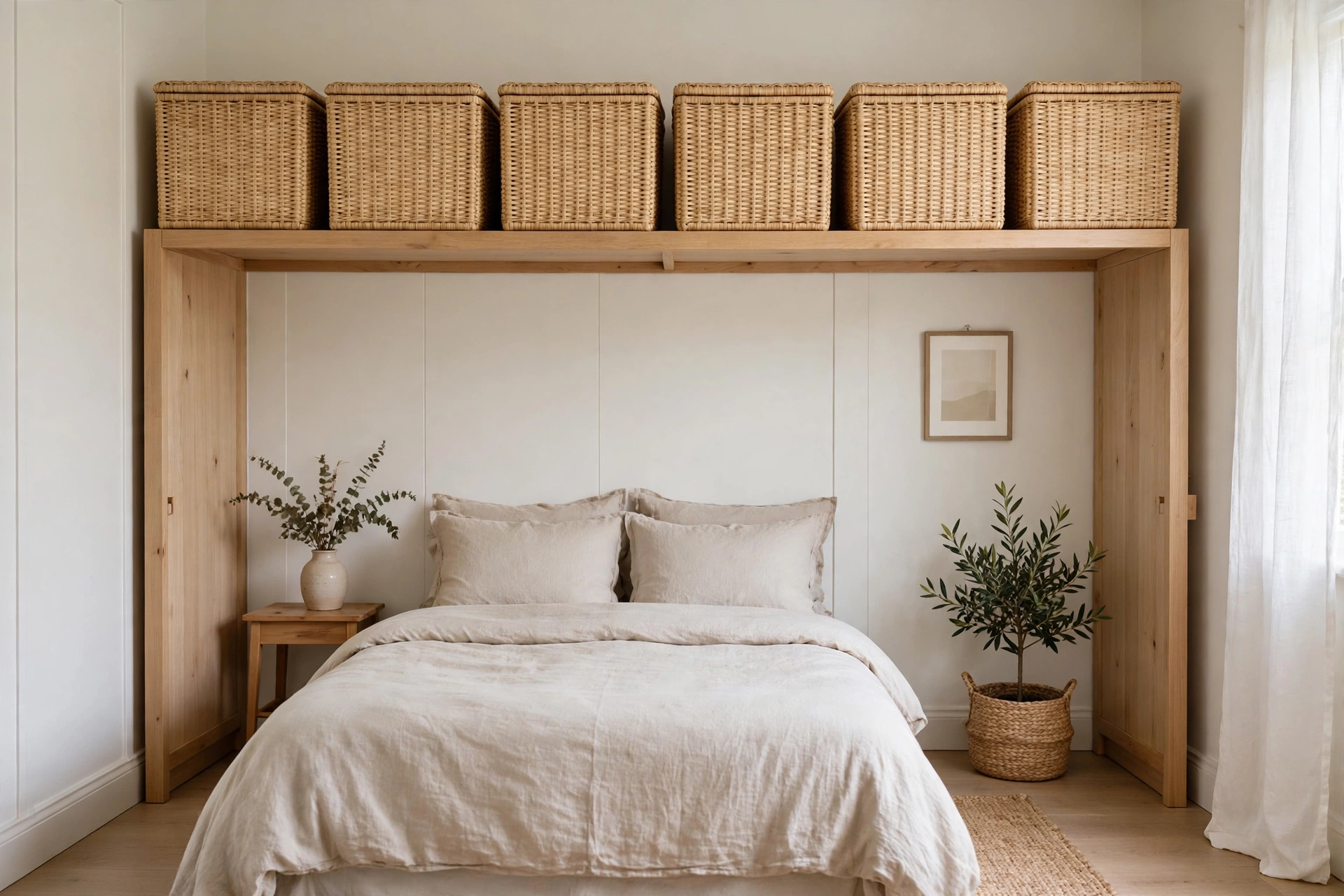
The top of a wardrobe is prime storage real estate that most people leave empty or pile with loose items, and matching storage baskets turn it into a tidy, intentional shelf. Baskets hold off-season clothes, spare bedding and rarely used items, and because they match, the top of the wardrobe looks styled rather than cluttered. Choose baskets that fit the wardrobe’s depth exactly so they do not overhang the front edge.
Label each basket on the front so you know what is inside without climbing up to check, and keep a small step stool nearby so the baskets are genuinely reachable. Woven baskets suit a warm, natural bedroom, while fabric bins in a solid color suit a modern one. Keep the basket count to three or four so the top of the wardrobe stays calm, and dust the baskets monthly so they do not become a dust trap.
32. A Bed Skirt That Hides Under-Bed Bins
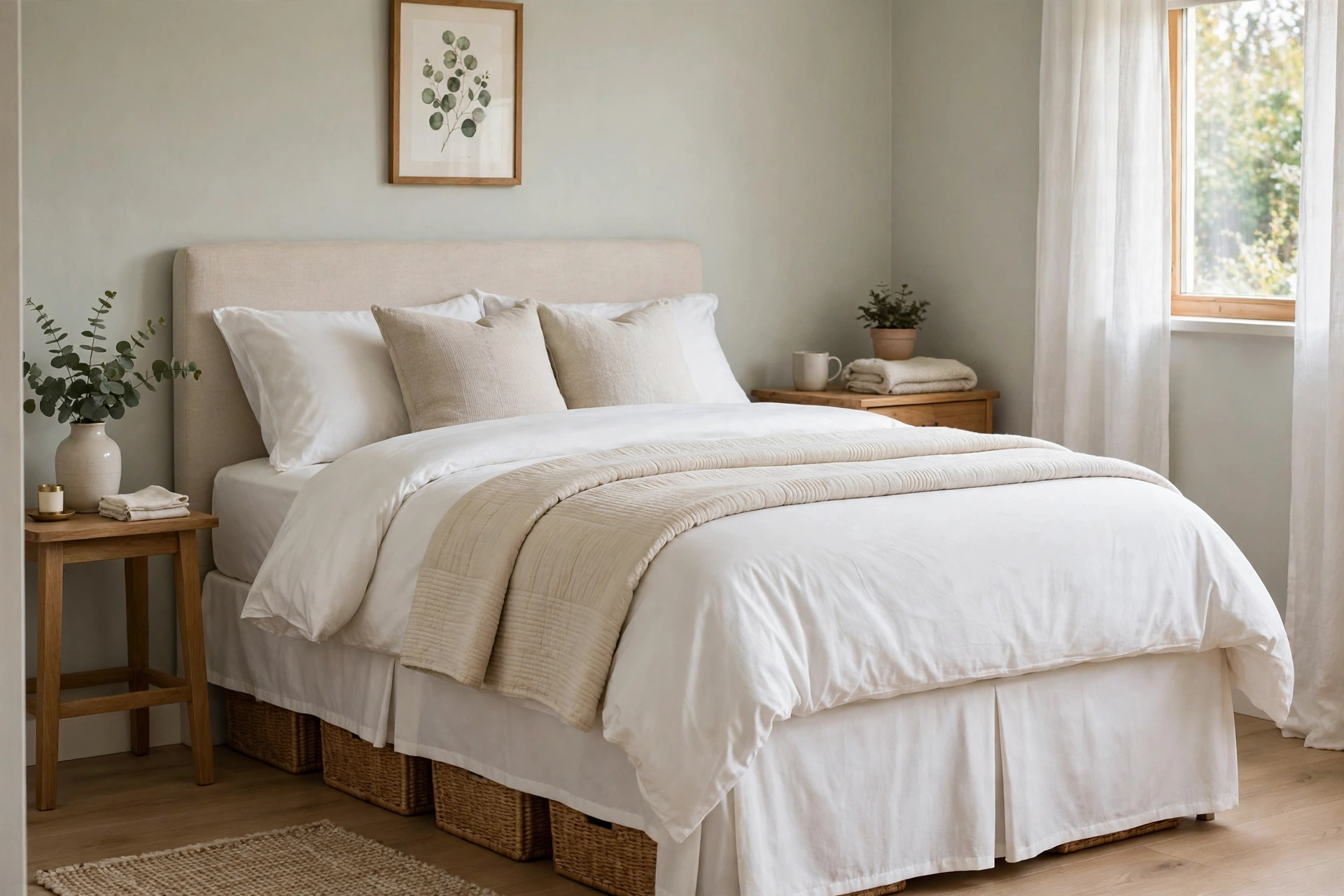
A bed skirt hides the under-bed storage completely, so the room looks calm and finished even when the space under the bed is fully loaded with bins. A tailored bed skirt in a color that matches the bedding makes the bed look like a solid, upholstered piece of furniture, and it keeps dust out of the bins at the same time. It is a simple, inexpensive way to make visible storage invisible.
Choose a bed skirt with a split at the corners if you need to reach the bins often, because a full skirt has to be lifted to slide a bin out. A pleated or tailored skirt suits a classic bedroom, while a flat panel skirt suits a modern one. Wash the skirt regularly, because it hangs close to the floor and collects dust, and make sure it is long enough to reach the floor without dragging.
33. Magnetic Strips for Jewelry and Small Items
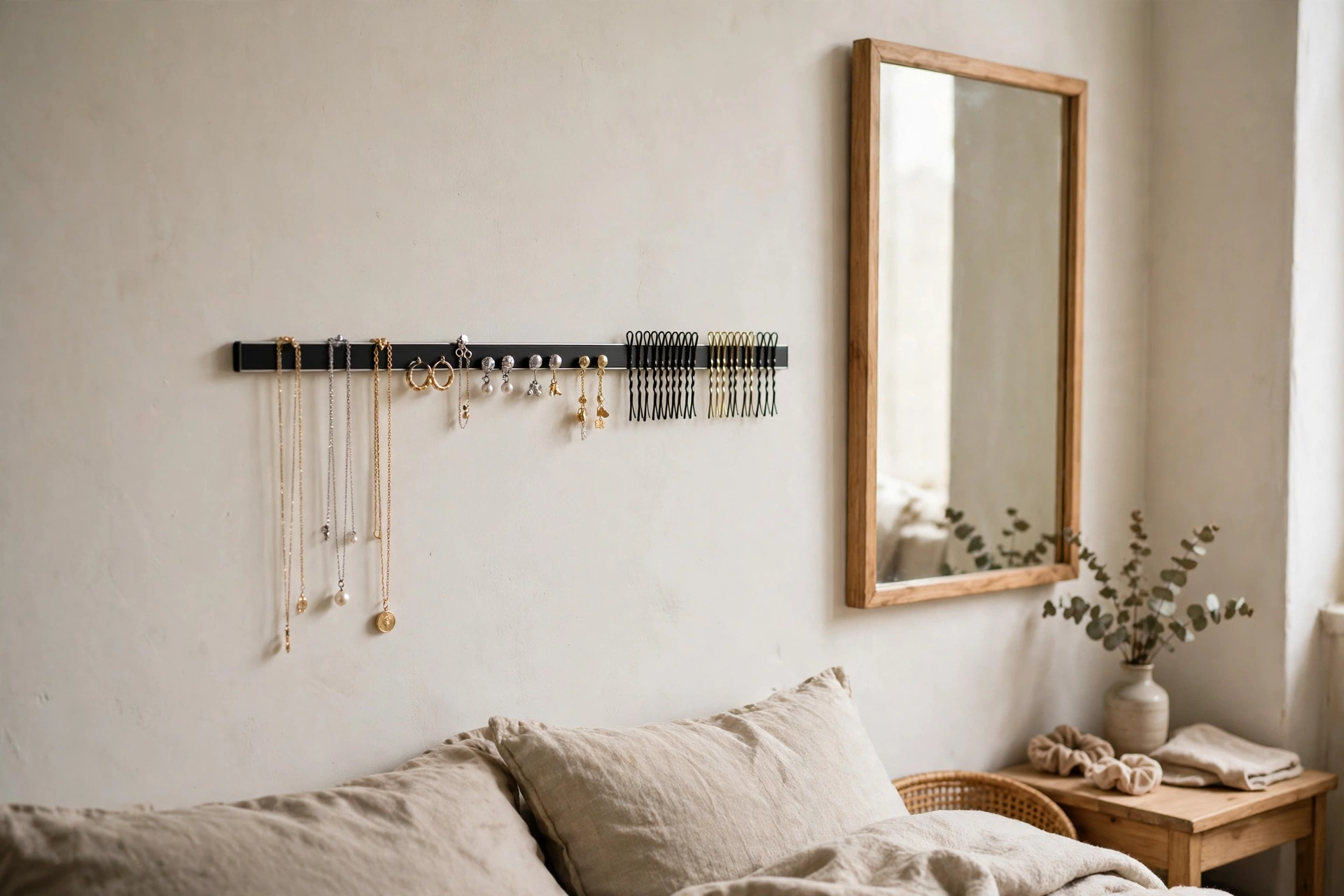
A magnetic strip mounted on the wall or inside a cabinet door holds metal jewelry, bobby pins, tweezers and small tools in plain sight, so tiny items stop disappearing into drawers. A strip inside the closet door or on the wall beside the mirror keeps necklaces untangled and earrings paired, and it takes up no shelf or drawer space at all. It is one of the smallest storage upgrades in this guide and one of the most satisfying.
Mount the strip at eye level where you get dressed, and use small magnetic hooks or clips for items that are not magnetic themselves. Keep the arrangement sparse — a strip crammed with jewelry looks cluttered and makes pieces hard to remove. A slim, brushed-metal strip blends into most bedrooms, and a strip mounted inside a cabinet door keeps the jewelry hidden when the door is closed.
34. A Slim Vertical Bookcase Beside the Bed
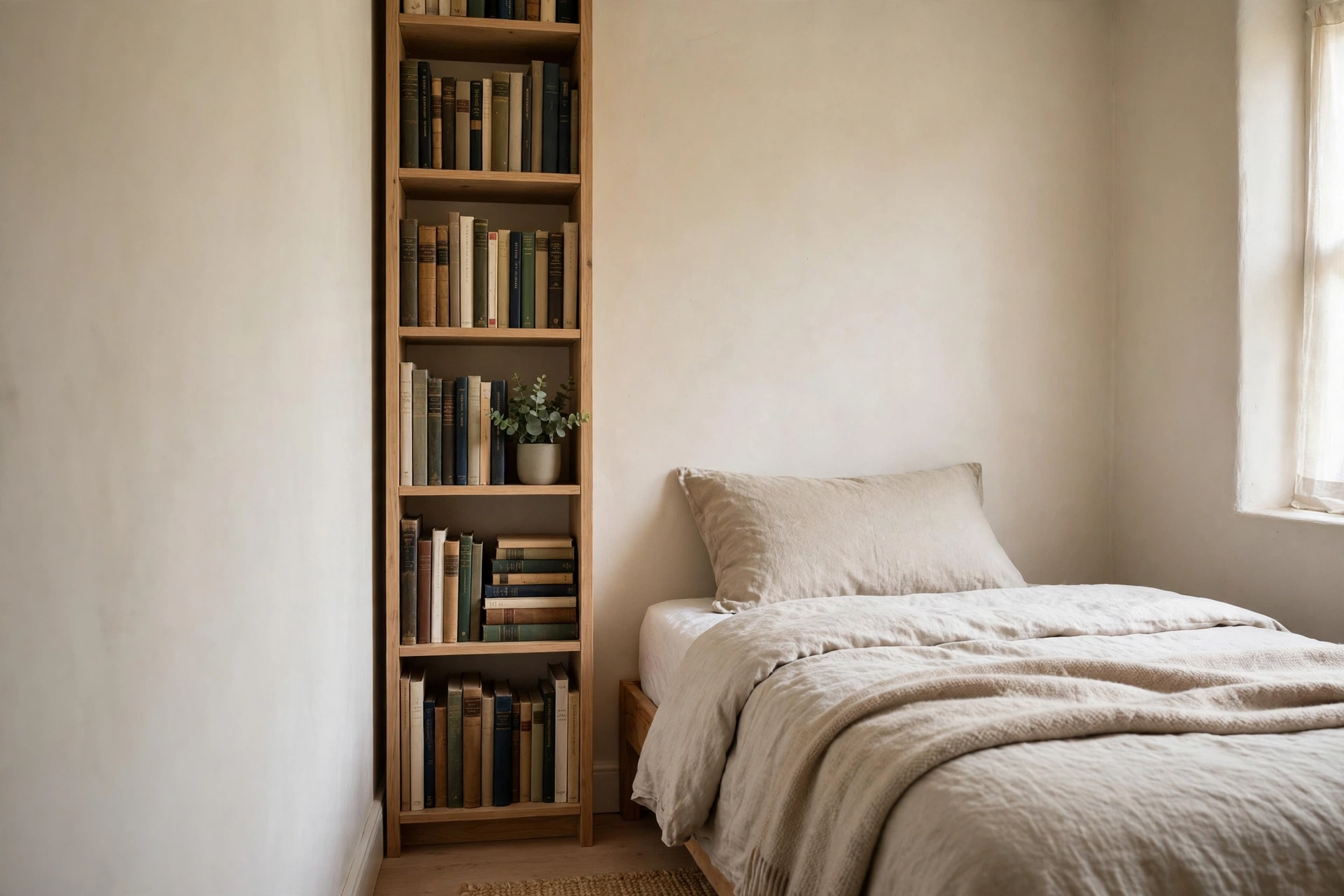
A slim vertical bookcase beside the bed stores books, plants and decorative objects in a footprint barely wider than a nightstand. A bookcase 12 to 16 inches wide and five or six feet tall holds a surprising amount, and because it is tall and narrow, it draws the eye upward and makes the room feel taller. It works in the gap between the bed and the wall that is too narrow for a dresser.
Anchor the bookcase to the wall with a furniture strap so it cannot tip, and put the heaviest books on the lowest shelves to keep it stable. Use the top shelves for display and the middle shelves for the books you are reading now, so the most-used items are at arm’s reach from the bed. A bookcase in the same finish as the bed frame ties the corner together visually.
35. Hidden Storage Inside a Platform Bed Base
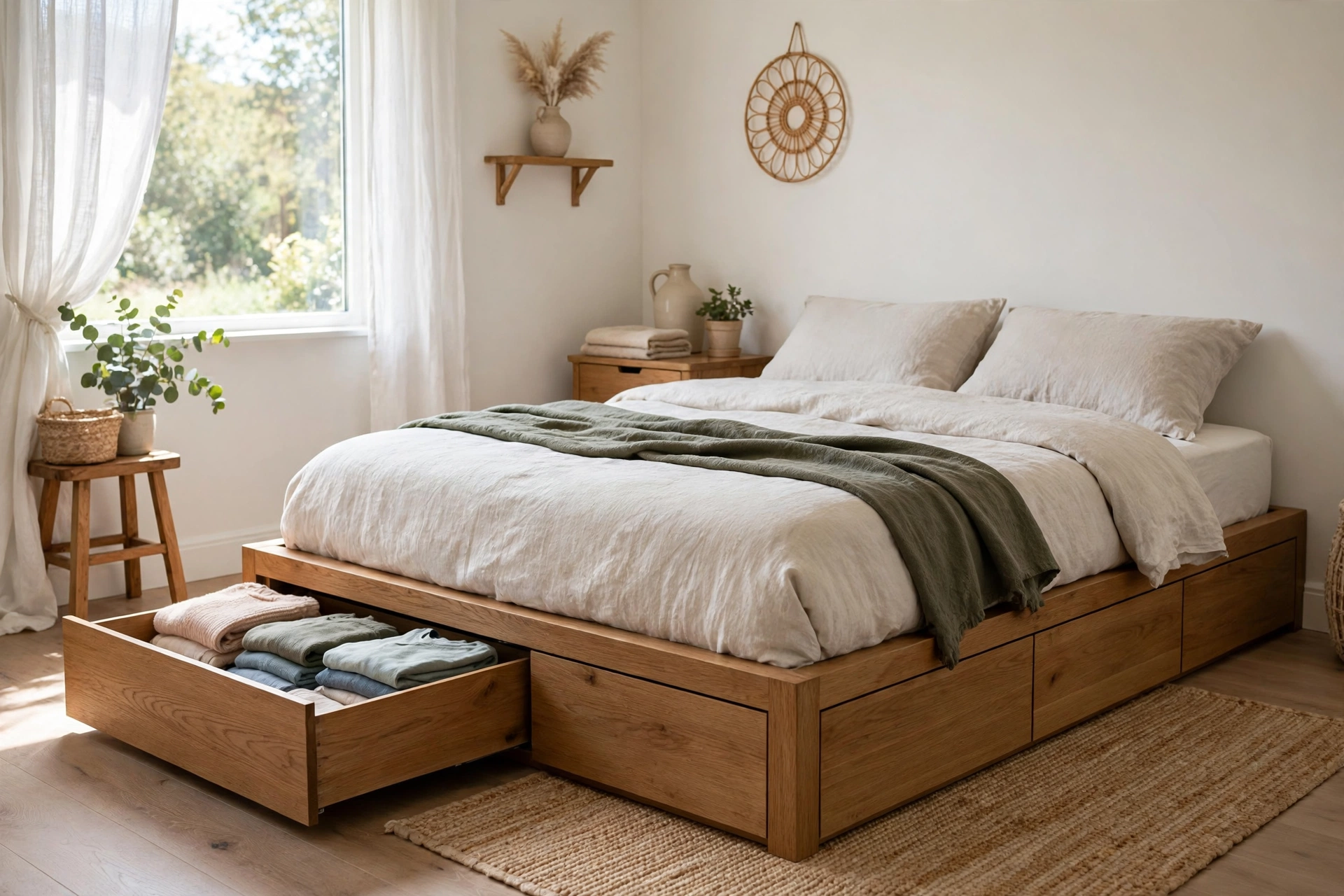
A platform bed base with hidden storage — drawers built into the sides or a lift-up top — hides a surprising amount of storage inside the bed itself. Side drawers hold clothes and bedding, while a lift-up base opens to a full compartment for suitcases and seasonal items. Because the storage is built into the bed, it adds no furniture to the room and no visual clutter at all.
Choose a platform bed with drawers on both sides if the room allows access from both sides, or drawers on one side only if the bed sits against a wall. Check that the drawers open fully without hitting the rug or the wall, and keep the drawer contents light enough to slide easily. A low platform bed with hidden storage also makes a small room feel larger, because the bed sits closer to the floor and leaves more wall visible above it.
36. A Wall-Mounted TV to Free the Dresser Top
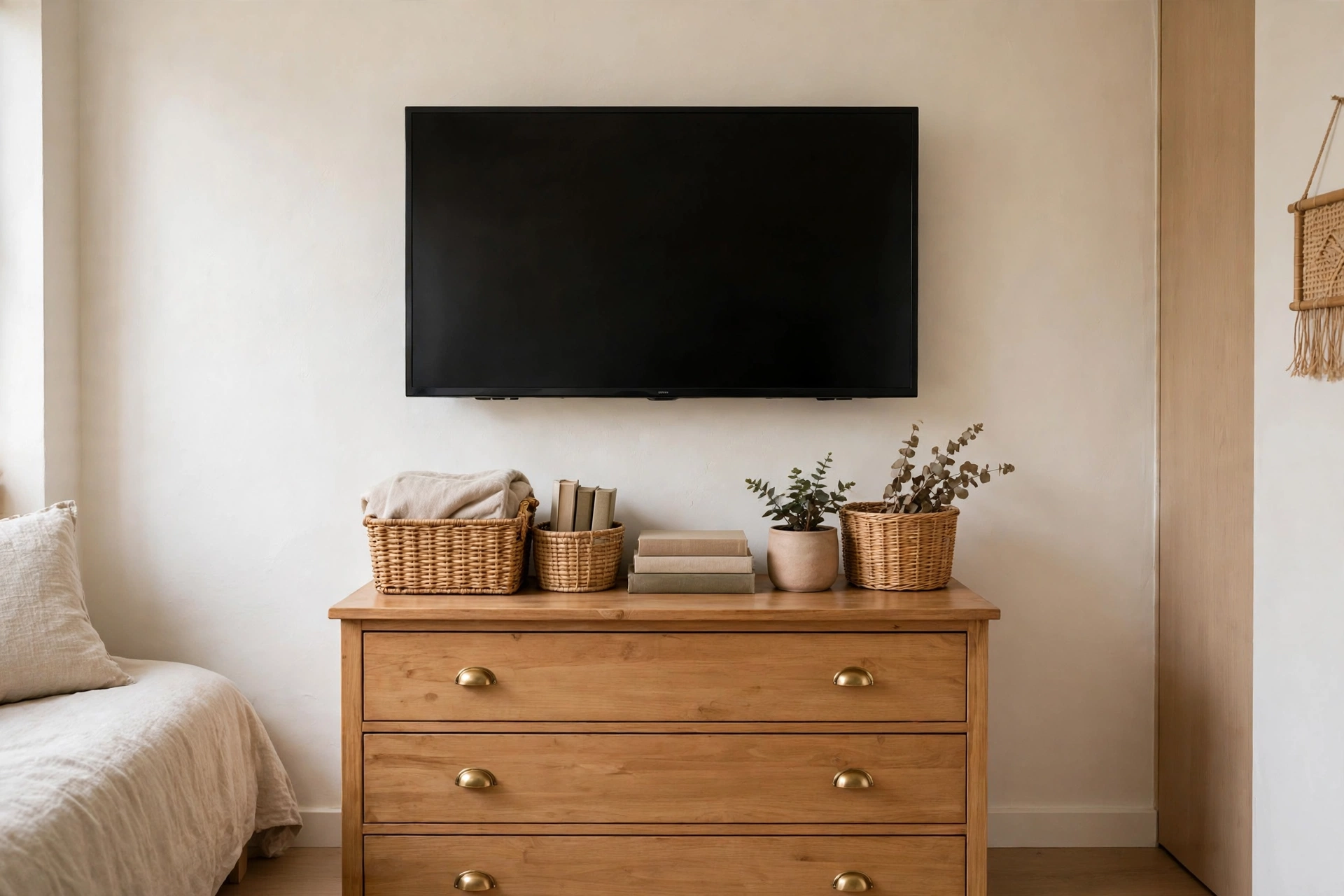
Mounting the TV on the wall frees the entire top of the dresser, which is often the largest flat surface in a small bedroom. That surface becomes storage — baskets, a jewelry tray, a stack of books — instead of a TV stand, and the room gains a cleaner sightline because the TV sits flat against the wall rather than jutting out on a stand. A wall-mounted TV also lets you place the dresser anywhere, not just where the TV fits.
Mount the TV at eye level from the bed — the center of the screen about 42 to 48 inches from the floor for most beds — and hide the cables in a paintable cord cover that runs down to the outlet. A small floating shelf below the TV holds a streaming device and remote without needing a console. Choose a TV size that fits the wall without overwhelming it; in a small bedroom, a 43-inch screen is usually plenty.
37. Seasonal Rotation System With Labeled Bins
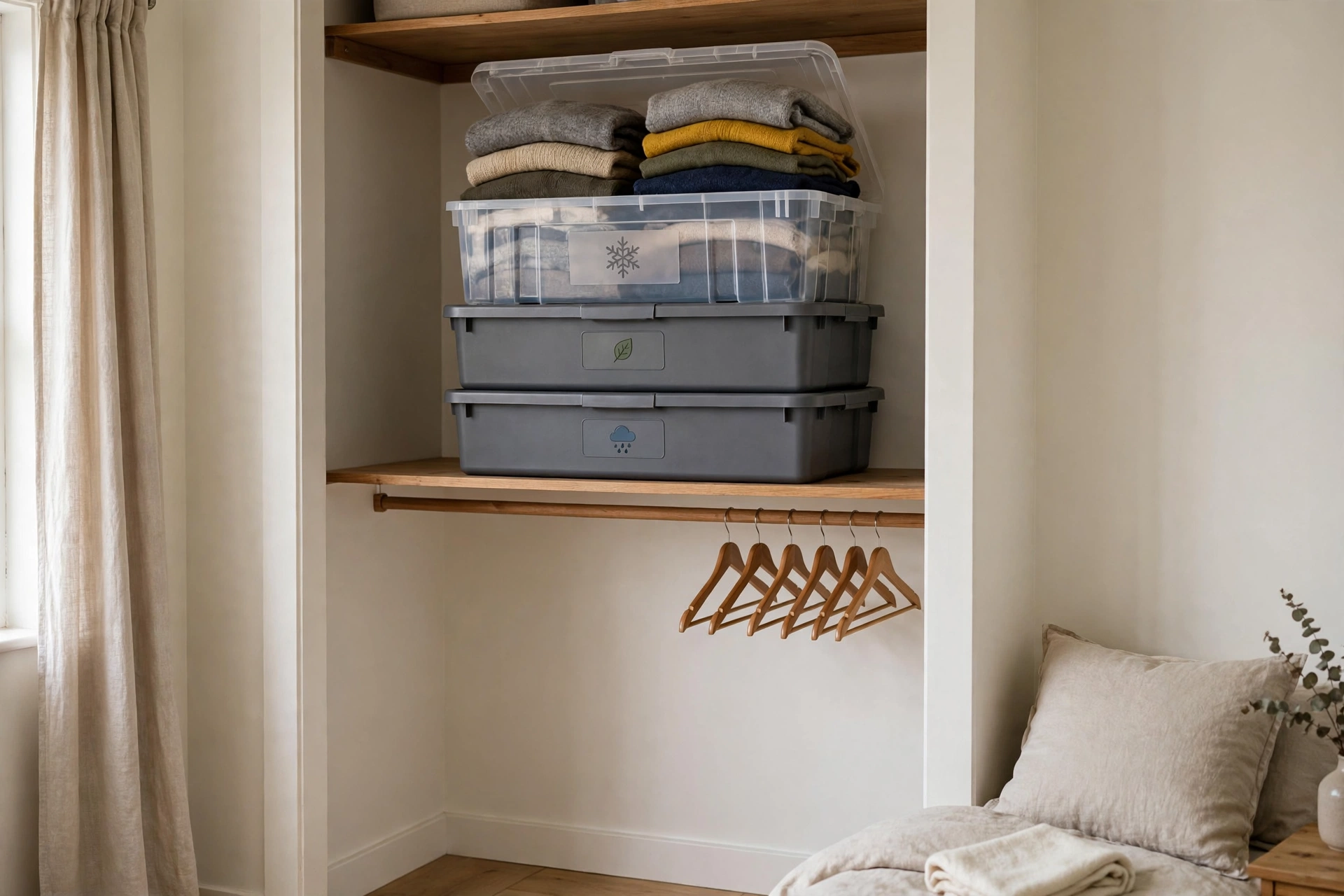
A seasonal rotation system keeps only the current season’s clothes in the bedroom and stores the rest elsewhere, which instantly frees a third of your closet and dresser space. Labeled bins — one for each season — hold the off-season clothes, and twice a year you swap the bins. The bedroom stays right-sized for what you actually wear now, instead of holding a full year’s wardrobe at once.
Use clear bins with big, readable labels, and keep the off-season bins on a high closet shelf, under the bed or in another room if space allows. Do the swap on the same weekends every year — early April and early October work well for most of the United States — so it becomes a habit rather than a chore. While you swap, try on anything you have not worn in a year and donate what no longer fits or flatters.
38. A Pull-Out Tray Under the Nightstand
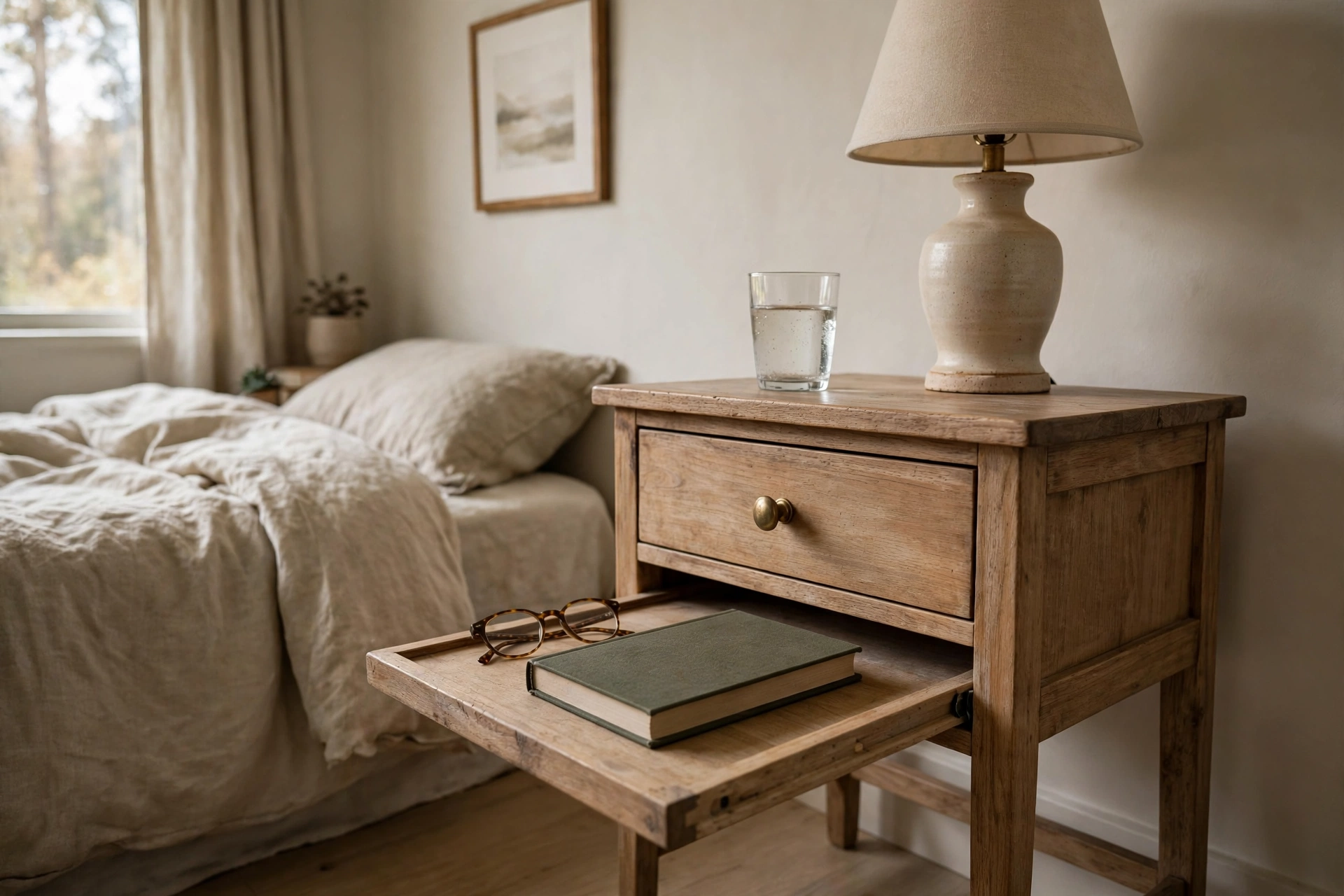
A pull-out tray mounted under a nightstand adds a hidden surface for a book, glasses or a phone without taking up any space on the nightstand top. The tray slides out when you need it and tucks away when you do not, which is ideal for small bedrooms where the nightstand top is already full with a lamp and a water glass. It is a small addition that makes the nightstand work twice as hard.
Install a shallow tray — no deeper than the nightstand itself — on smooth drawer slides so it glides easily, and keep only one or two items on it so it slides back in without catching. A tray with a raised lip stops a phone or glasses from sliding off the edge. If you read in bed, the tray is the perfect spot for your book and reading glasses, right at mattress height.
39. Hooks Inside Closet Doors for Accessories
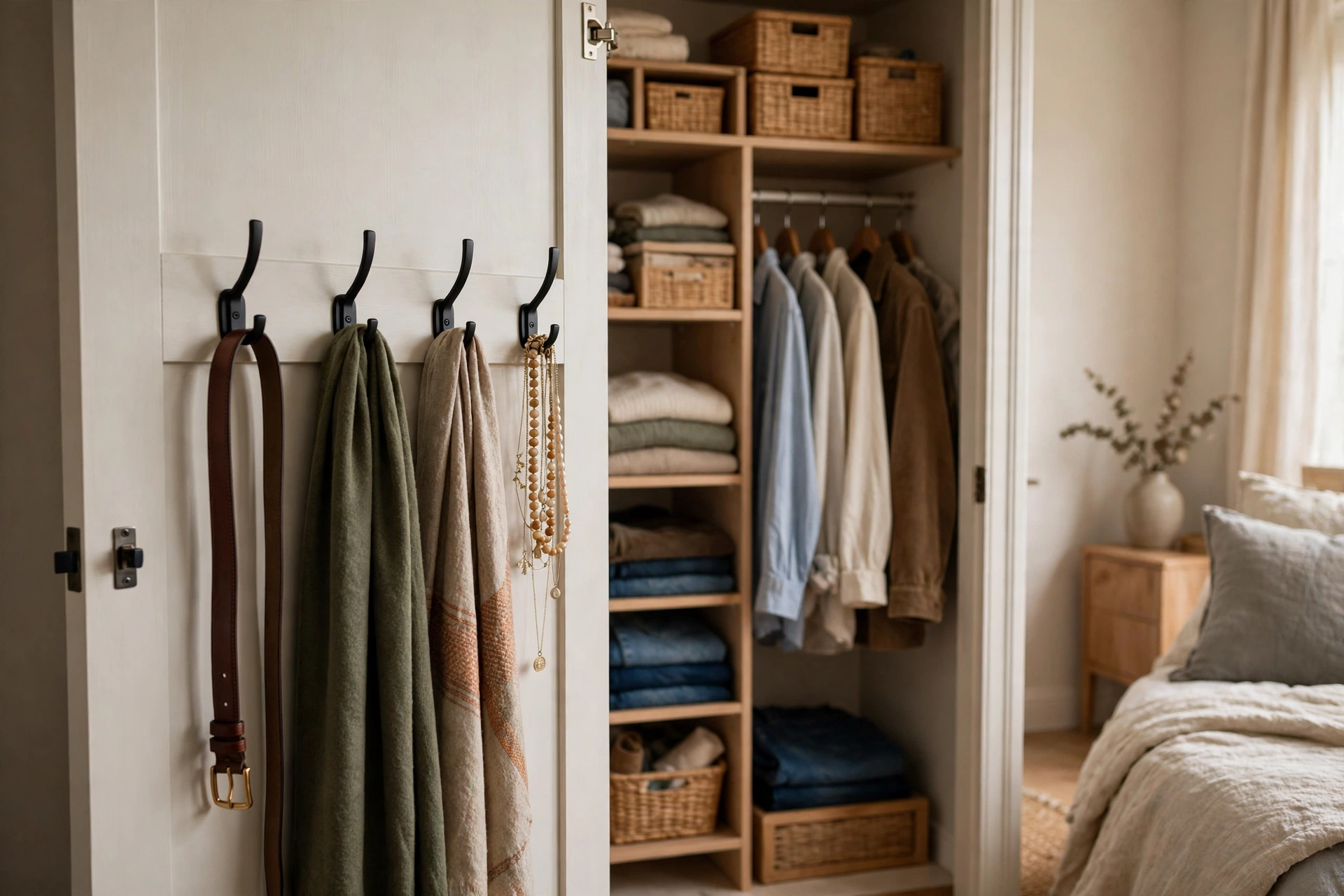
Hooks mounted inside the closet door turn the door itself into accessory storage for belts, ties, scarves, necklaces and bags. The hooks are invisible when the door is closed, so the closet looks tidy from the room, but everything is visible and reachable the moment you open it. This is a no-cost storage win in a room where every inch counts, and it works on any closet door with a flat interior surface.
Use adhesive hooks if you rent, or small screw-in hooks if you own the home, and space them so belts hang straight without tangling. Keep the heaviest bags on the lowest hooks so the door hinges are not strained, and limit the total to what the door can carry without sagging. A row of five or six hooks holds a full accessory collection for most people, and it frees a whole dresser drawer for clothes.
40. A Storage Bench Under the Window
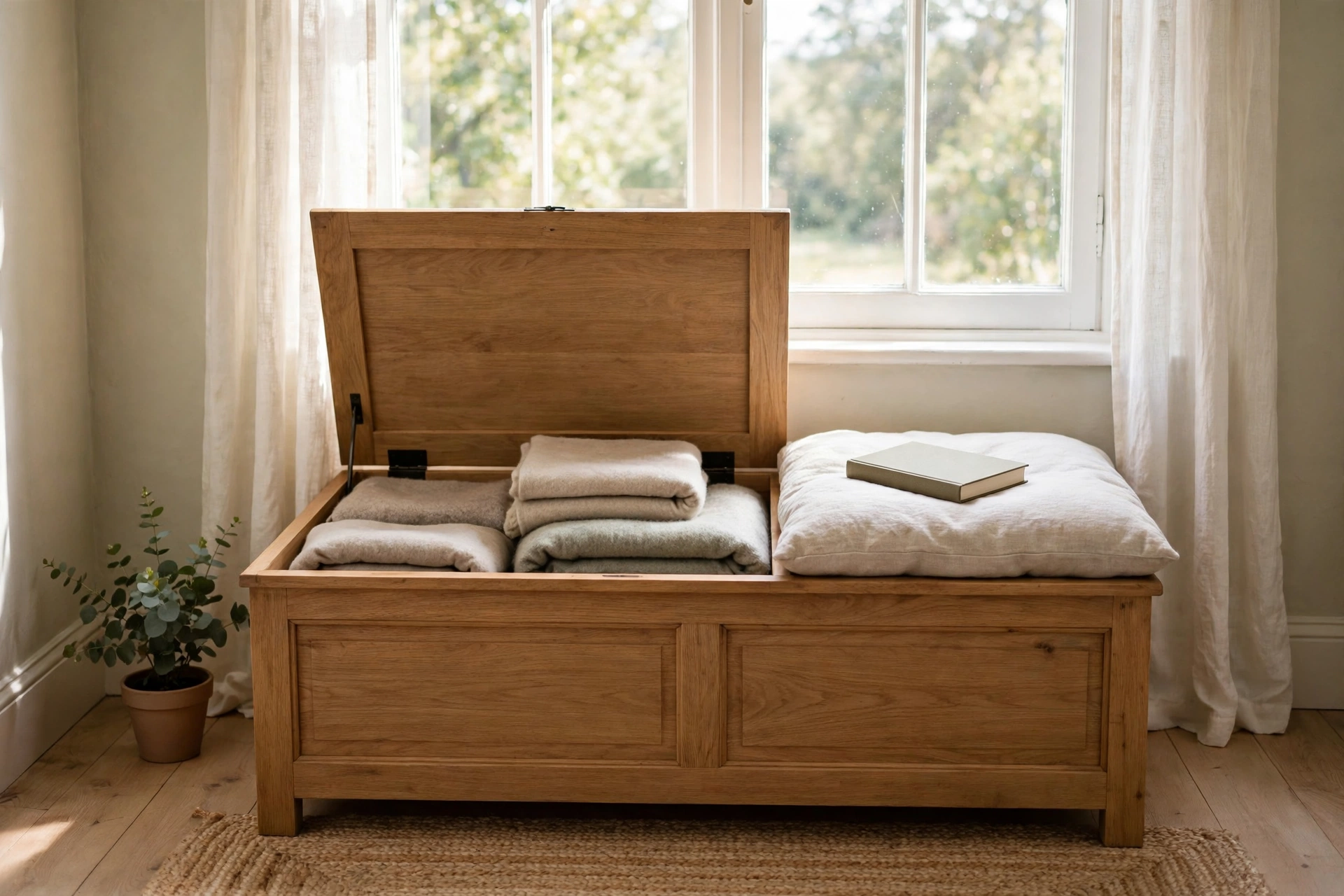
A storage bench under the window combines a seat, a display surface and a hidden storage box in a spot that is often empty. The bench holds extra blankets, books or off-season clothes inside, while the top serves as a reading seat or a place to lay out clothes. Placed under the window, it uses the natural light for reading and keeps the center of the room clear.
Choose a bench that fits the window’s width without blocking the radiator or the window’s opening mechanism, and pick a cushion in a washable fabric because window seats collect dust and sunlight. Keep the contents light and frequently used, so you open the bench often enough to remember what is inside. A bench with a lift-up lid is easier to use than one with doors, because you can see everything at once when it opens.
41. Foldable Storage Cubes in Open Shelving
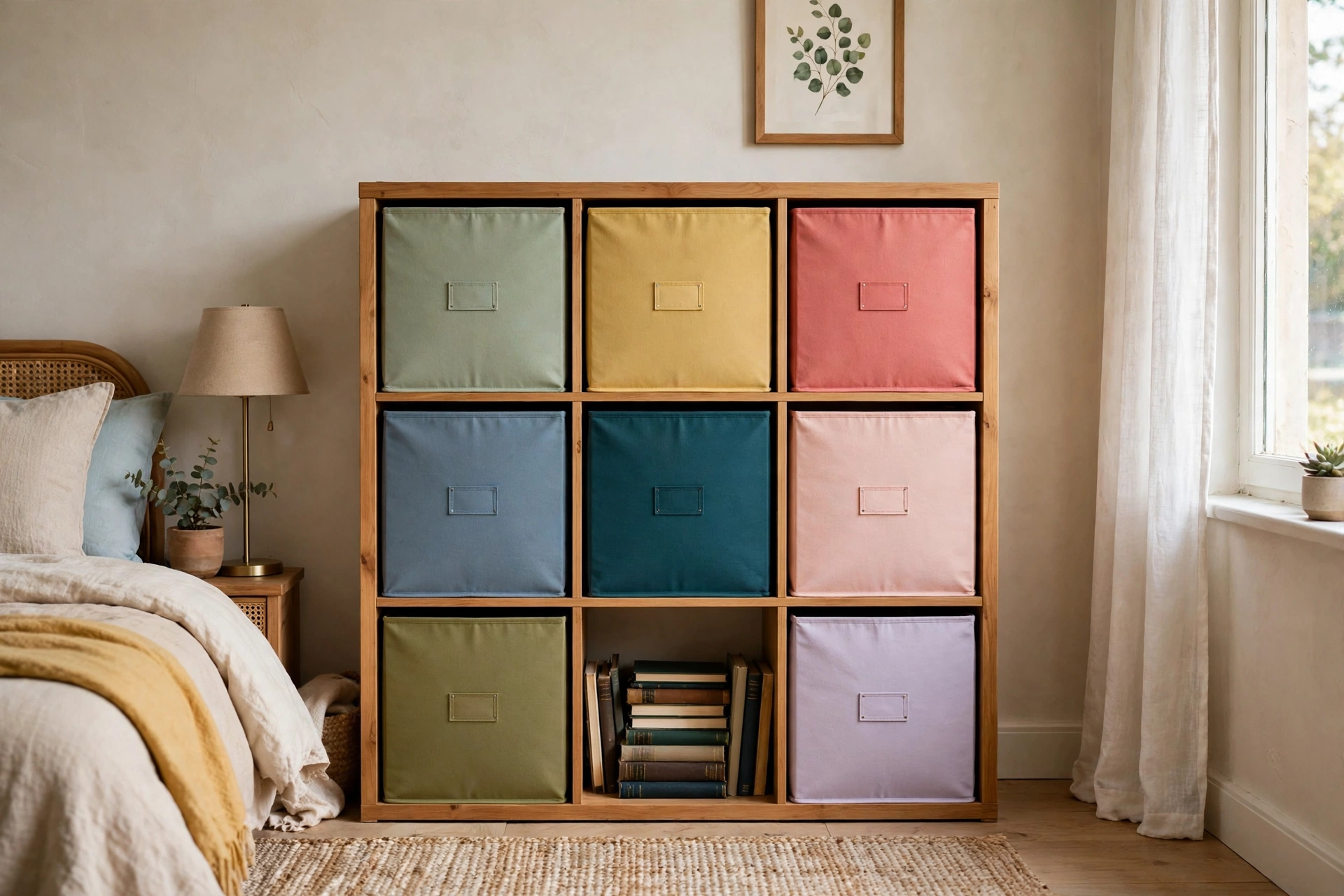
Foldable storage cubes turn open shelving into hidden storage, because each cube hides a category of clutter behind a neat fabric front. Cubes fit standard cube shelves and come in colors and patterns that match any bedroom, so the shelving looks styled rather than stuffed. When a cube is empty, it folds flat for storage, which makes the system easy to change as your needs change.
Label each cube on the front with a small tag or a clip-on label holder, and give each cube a single category — chargers in one, scarves in another, spare bedding in a third. Keep the heaviest cubes on the lowest shelf so the shelving unit stays stable, and leave one or two cubbies open with books or a plant so the unit does not look like a wall of fabric boxes. Fabric cubes are light and washable, while woven cubes look more substantial.
42. A Bedside Wall Pocket Organizer
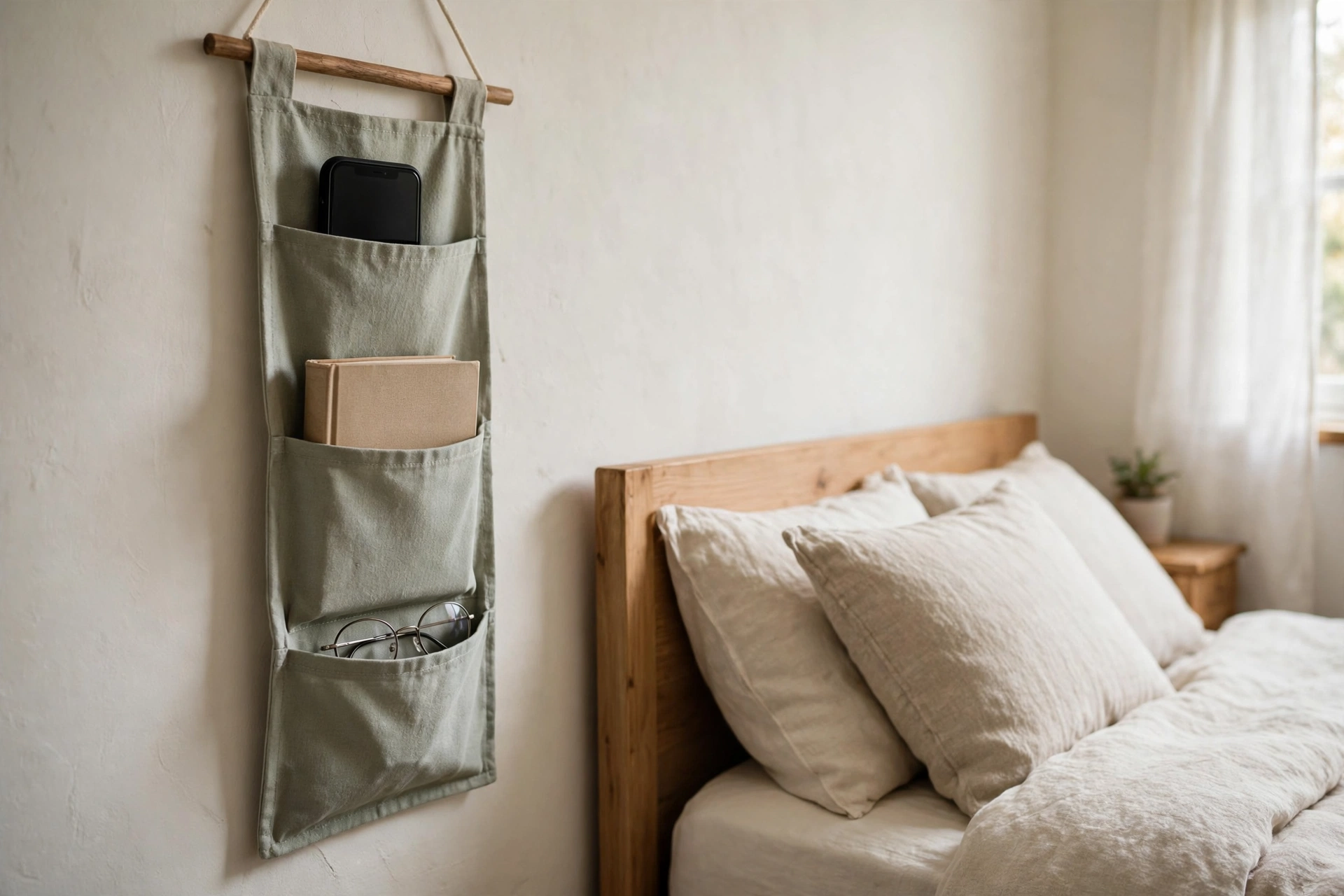
A bedside wall pocket organizer is a fabric panel with pockets that hangs on the wall beside the bed, holding a phone, charger, book, glasses and remote within arm’s reach. It replaces a nightstand entirely in the tightest bedrooms, and because it hangs flat on the wall, it takes up no floor space at all. The pockets keep small items sorted and visible, so nothing gets lost between the mattress and the wall.
Hang the organizer at mattress height on the wall beside the bed, using adhesive hooks or small nails depending on your walls. Choose an organizer with pockets of different sizes — a deep pocket for a book, a slim pocket for glasses — and keep the total weight light so the hooks hold. A fabric organizer in a color that matches your bedding looks intentional, while a clear organizer makes it easy to see every pocket’s contents at a glance.
43. A Full Storage Audit and Layout Plan
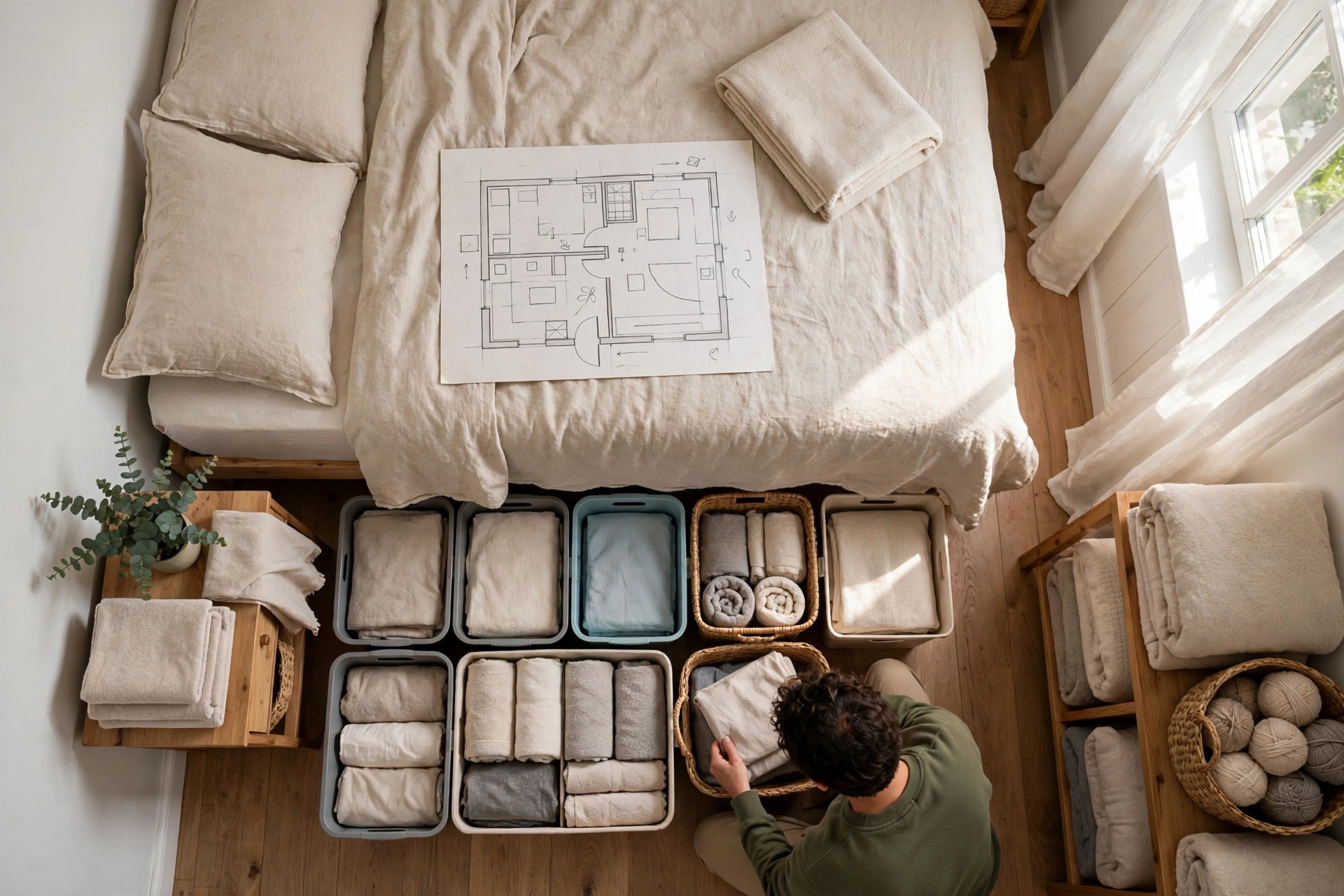
The final idea is not furniture — it is a plan. A full storage audit means emptying every drawer, shelf and closet in the bedroom, sorting everything into keep, donate and relocate piles, and then drawing a simple layout plan that assigns every kept item a specific home. Without a plan, new storage just fills up again; with one, every bin, hook and shelf has a purpose, and the room stays organized because everything has a place to return to.
Start the audit on a weekend morning, work one zone at a time, and measure each storage spot before you buy anything new — the plan should be based on your room’s real dimensions, not on a guess. Sketch the room on paper, mark the bed, dresser and closet, and note where each category will live: daily clothes in the dresser, off-season clothes under the bed, accessories on the wall. Revisit the plan every six months, because a small bedroom only stays organized when its storage keeps up with your life.
Frequently Asked Questions
How can I add storage to a small bedroom without making it feel crowded?
Start with hidden storage first — under the bed, inside the bed base, behind doors and above door frames — because it adds space without adding furniture. Then use vertical storage like floating shelves and tall narrow bookcases, which draw the eye upward and keep the floor clear. The small room storage bedroom design ideas in this guide are ordered from the biggest wins to the finishing touches, so begin with the storage bed or under-bed drawers before buying decorative pieces.
What is the best storage for a bedroom with no closet?
A tall narrow armoire or a wardrobe with a hanging rod and shelves is the best single piece for a bedroom with no closet, because it holds hanging clothes, folded clothes and accessories in one footprint. Pair it with under-bed storage for off-season items and wall hooks for bags and robes, and add a dresser if the room allows. A freestanding clothing rack works as a temporary fix, but an armoire keeps clothes dust-free and the room looking tidy.
How do I organize a small bedroom on a budget?
Start with the cheapest ideas in this guide: drawer dividers, over-the-door organizers, labeled bins and wall hooks cost little and make an immediate difference. Then add one bigger piece at a time, such as a storage ottoman or under-bed drawers, rather than buying everything at once. The most effective budget move is a seasonal rotation system, because it frees closet space without buying any furniture at all — it just takes an afternoon of sorting.
Where should I store off-season clothes in a small bedroom?
Vacuum-sealed bags under the bed are the best spot for off-season clothes, because they shrink bulky items to a third of their size and the bins slide out easily for the twice-yearly swap. A high closet shelf, the top of the wardrobe or a labeled bin above the door frame also work for lighter items. Keep the off-season bin labeled and in one place, so the swap takes an hour instead of a whole weekend.
How do I keep a small bedroom organized long-term?
Give every item a specific home and do a quick five-minute reset each evening — put clothes in the hamper or the closet, clear the nightstand and return items to their bins. A seasonal audit every six months keeps the storage honest, because a small room storage bedroom design only works when the amount you own matches the space you have. When something new comes in, let something old go, so the room never slowly refills.
Related Reading
- Under-Sink Organization Ideas
- Pantry Organization Ideas
- How to Declutter Your Home Room by Room
- New Year Bedroom Organization Ideas
- Toy Organization Ideas
- Garage Organization Ideas
Conclusion
A small bedroom stops feeling small the moment every inch has a job, and these 43 small room storage bedroom design ideas give you a place to start — whether that is a storage bed, a wall of floating shelves or simply a drawer full of dividers. Pick the three ideas that solve your biggest frustrations, do those first, and let the rest follow one weekend at a time. For a fresh-start reset of the whole bedroom, see New Year Bedroom Organization Ideas. Your bedroom should work as hard as you do, and with the right storage in the right places, even the tiniest room can feel calm, open and completely yours.