
15 Under-Sink Organization Ideas for Every Room in the House
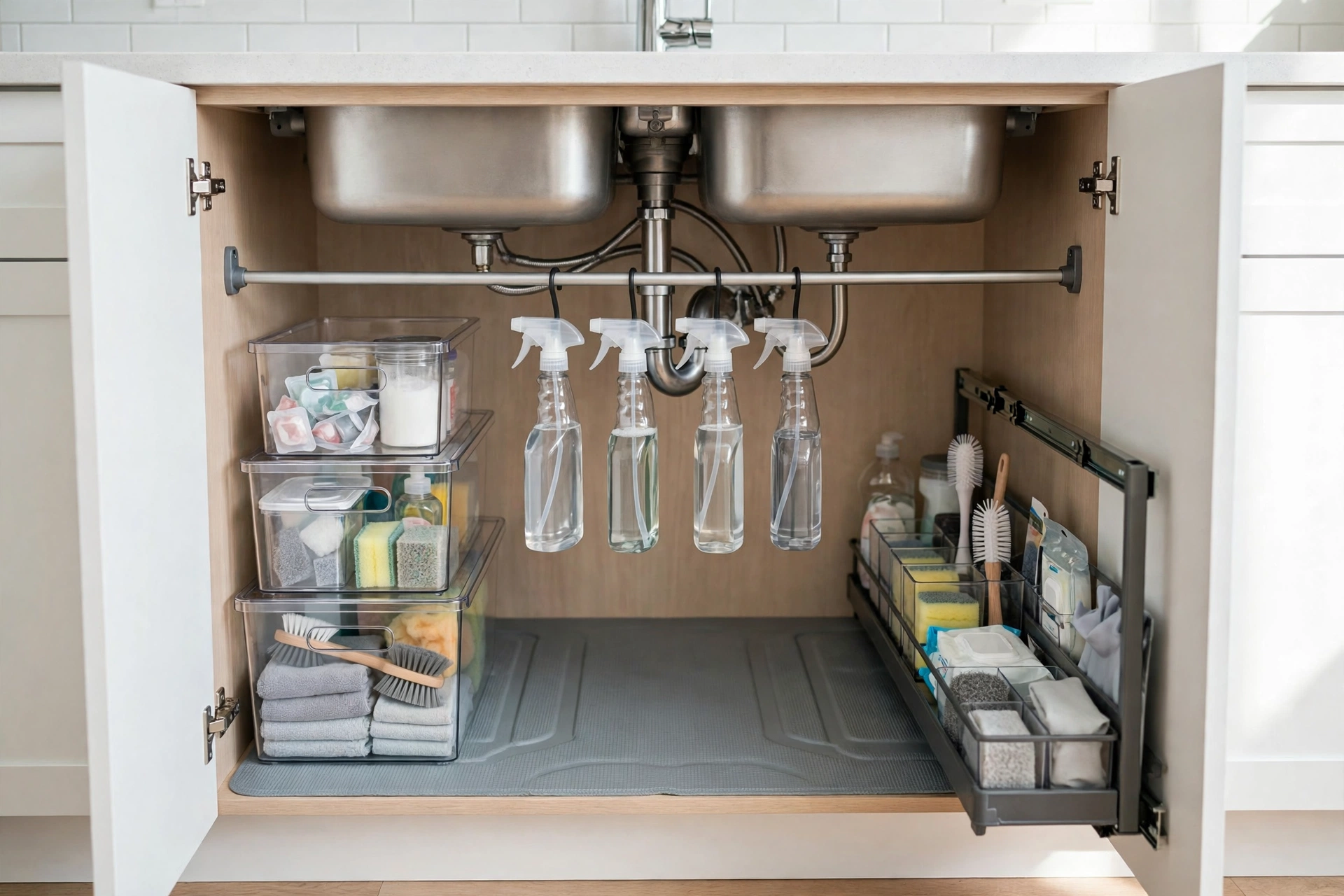
Open the cabinet under any sink in an American home and you will usually find the same thing: a jumble of half-empty spray bottles, a bag of trash bags, a sponge that has seen better days, and something leaking very slowly onto the cabinet floor. The under-sink cabinet is the hardest storage space in the house — pipes run through the middle of it, it is dark, it is deep, and everything in it gets shoved to the back and forgotten. The good news is that under-sink organization ideas do not need a remodel or a big budget. A few stackable bins, a tension rod, a pull-out caddy, and a leak-proof mat can turn that dark cabinet into a space that actually works. A sink is the one fixture every room shares, so the same ideas work in the kitchen, the bathroom, and the laundry room, with small changes for what each room stores. The fifteen ideas below cover all three rooms, in the order that makes sense: clear it out, protect the floor, then build a system you can actually keep. If the rest of your home needs the same treatment, our pantry organization ideas use the same bin-and-label system for food storage, and our laundry room organization ideas show how to sort detergents and supplies in a small space.
1. Start With a Full Clean-Out and a Leak Check
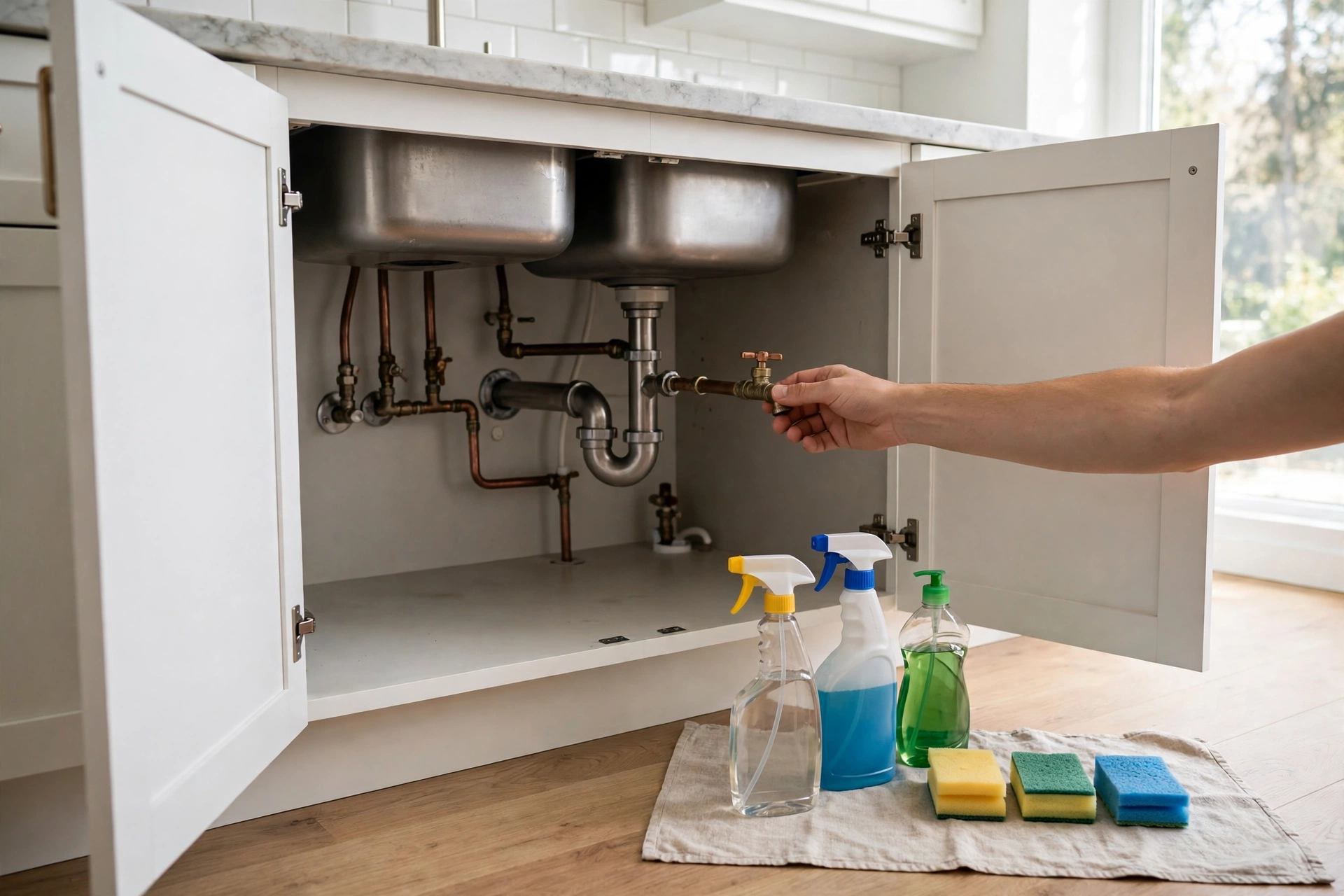
Every under-sink organization project starts the same way: take everything out. Every bottle, every sponge, every half-used box of trash bags — all of it, onto a towel on the floor. You cannot organize a cabinet you cannot see, and you will be surprised at what has been hiding in the back: duplicates, expired products, and at least one bottle that has been leaking. While the cabinet is empty, check the pipes for water stains, warped wood, or a musty smell. A slow drip is the number one reason these cabinets get ruined, and tightening a connection now is far cheaper than replacing a rotted cabinet floor later. Wipe the interior with hot soapy water, let it dry, and throw away anything expired, empty, or duplicated.
2. Stackable Bins for Every Zone
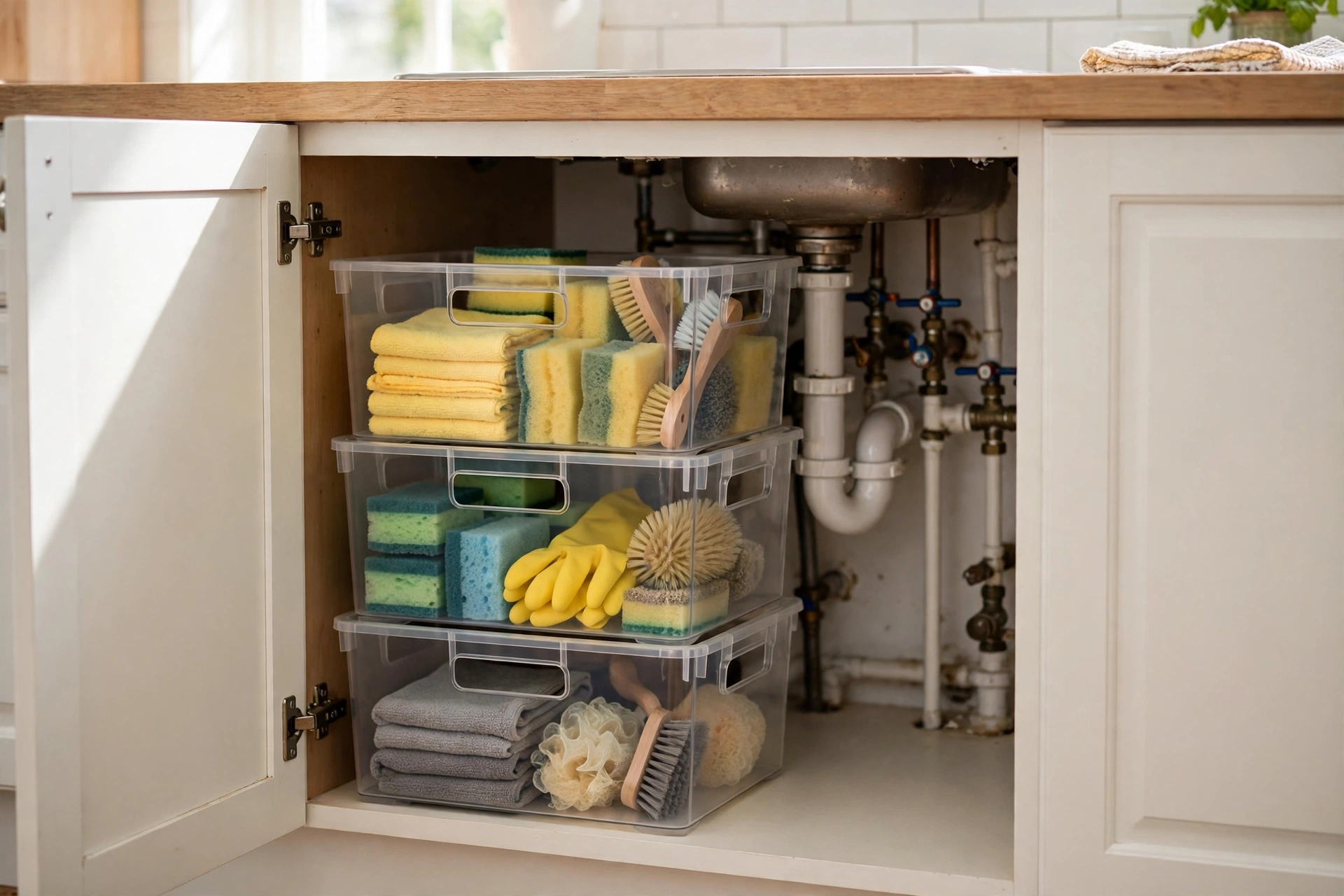
Stackable bins are the backbone of under-sink organization, because they turn one deep, dark cabinet into separate zones you can see at a glance. Measure the inside of your cabinet first — height, width, and depth, minus the space the pipes take up — and buy bins that fit those measurements. Clear bins work best because you can see what is inside without pulling the bin out, and a bin with a handle is worth the extra dollar because you will pull it out one-handed. Give each bin a job: one for dish soap and sponges, one for all-purpose cleaners, one for trash bags, one for extras like drain cleaner and rubber gloves. Stack a small bin on a larger one where the cabinet is tall enough, and keep the daily-use bin at the front.
3. Pull-Out Caddies That Bring the Back Forward
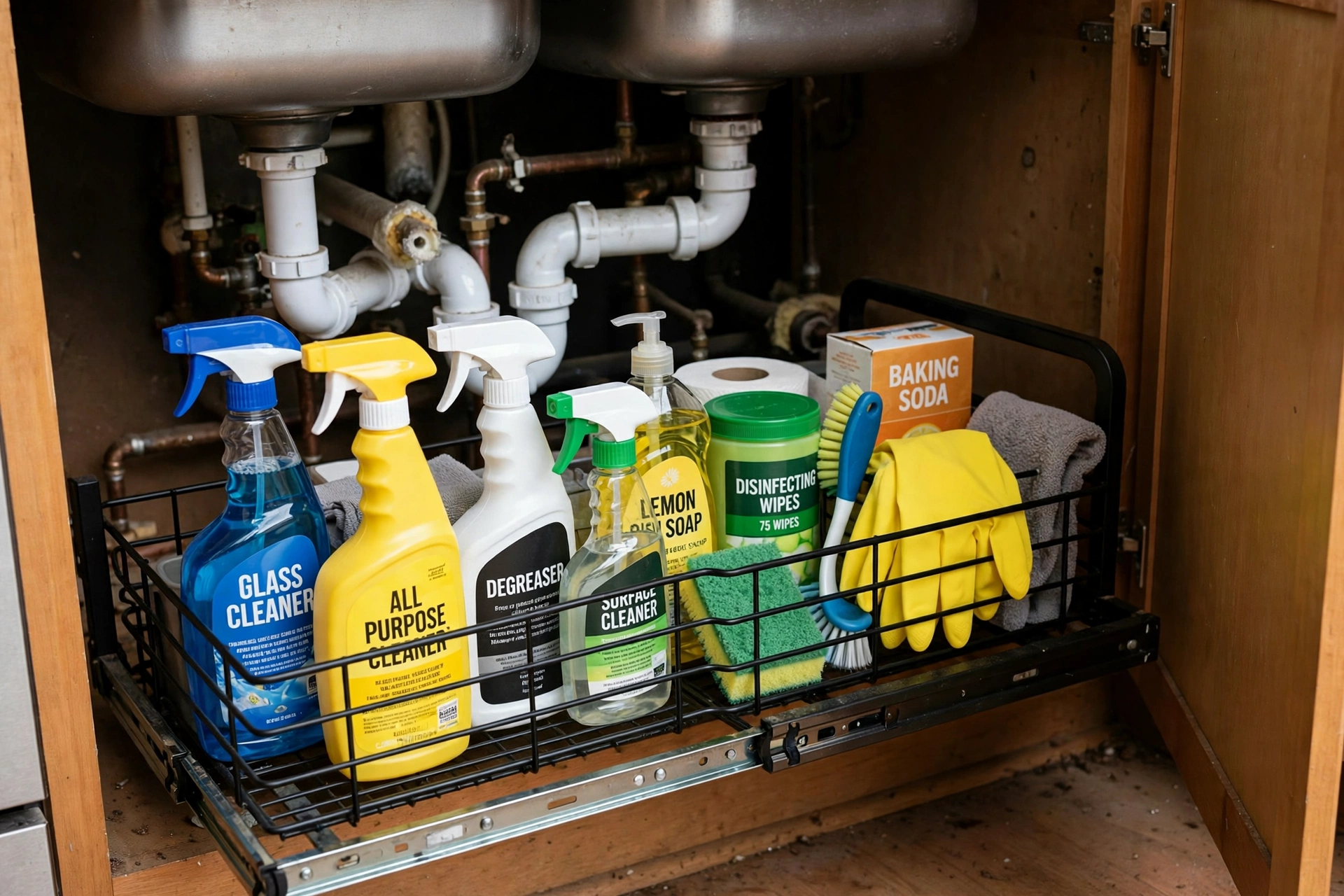
The back of an under-sink cabinet is where cleaning supplies go to disappear. A pull-out caddy — a sliding basket mounted to the cabinet floor — fixes that, because it brings the whole back of the cabinet out to you in one smooth pull. Look for a U-shaped or two-tier design that fits around the pipes, and check the weight rating: a caddy full of detergent and gallon jugs is heavy, and a cheap rail will sag within a month. Install it with the screws it comes with and load the heaviest bottles at the bottom. Daily-use items go in the front caddy, backups and rarely used products go in the back one.
4. Tension Rods for Spray Bottles
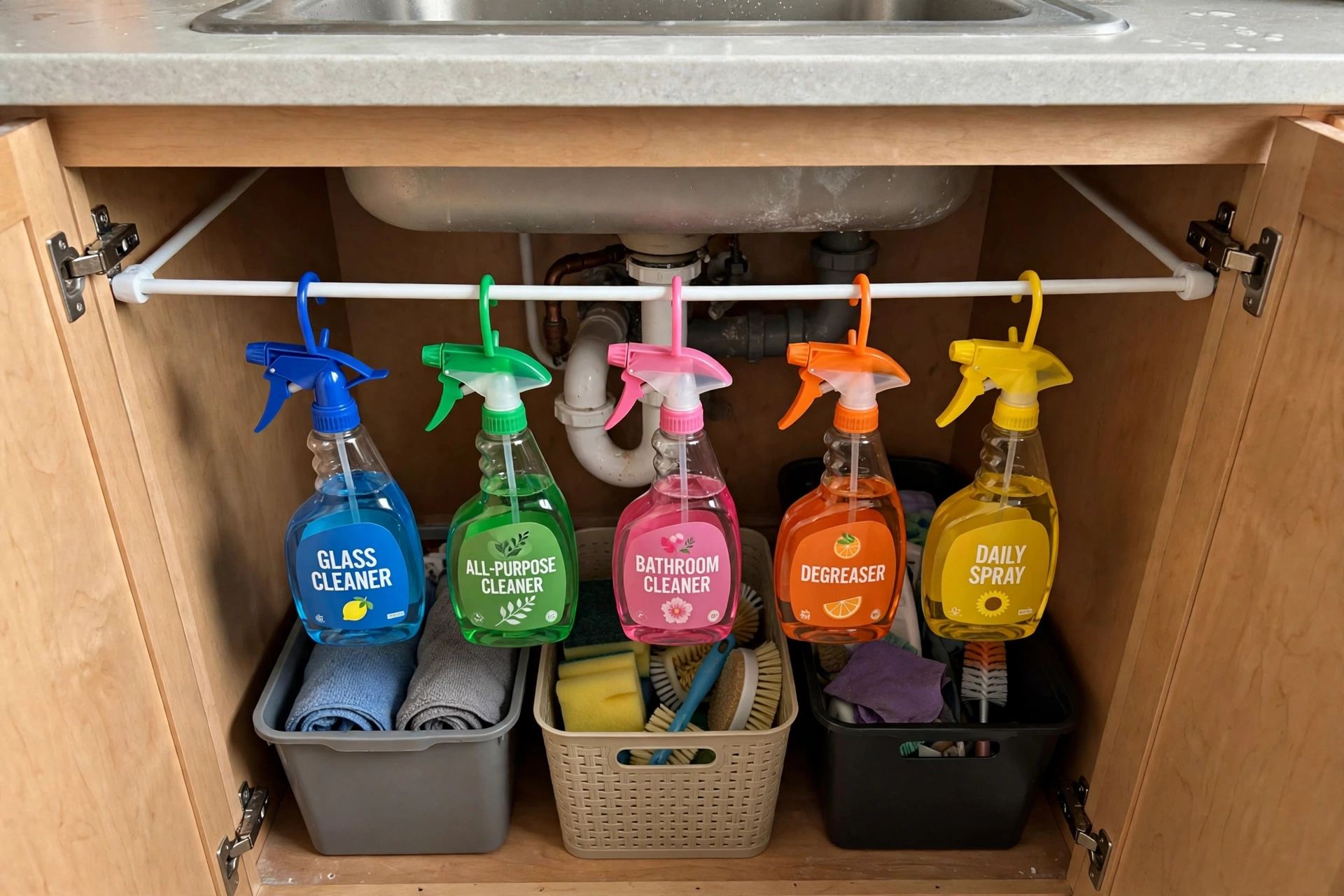
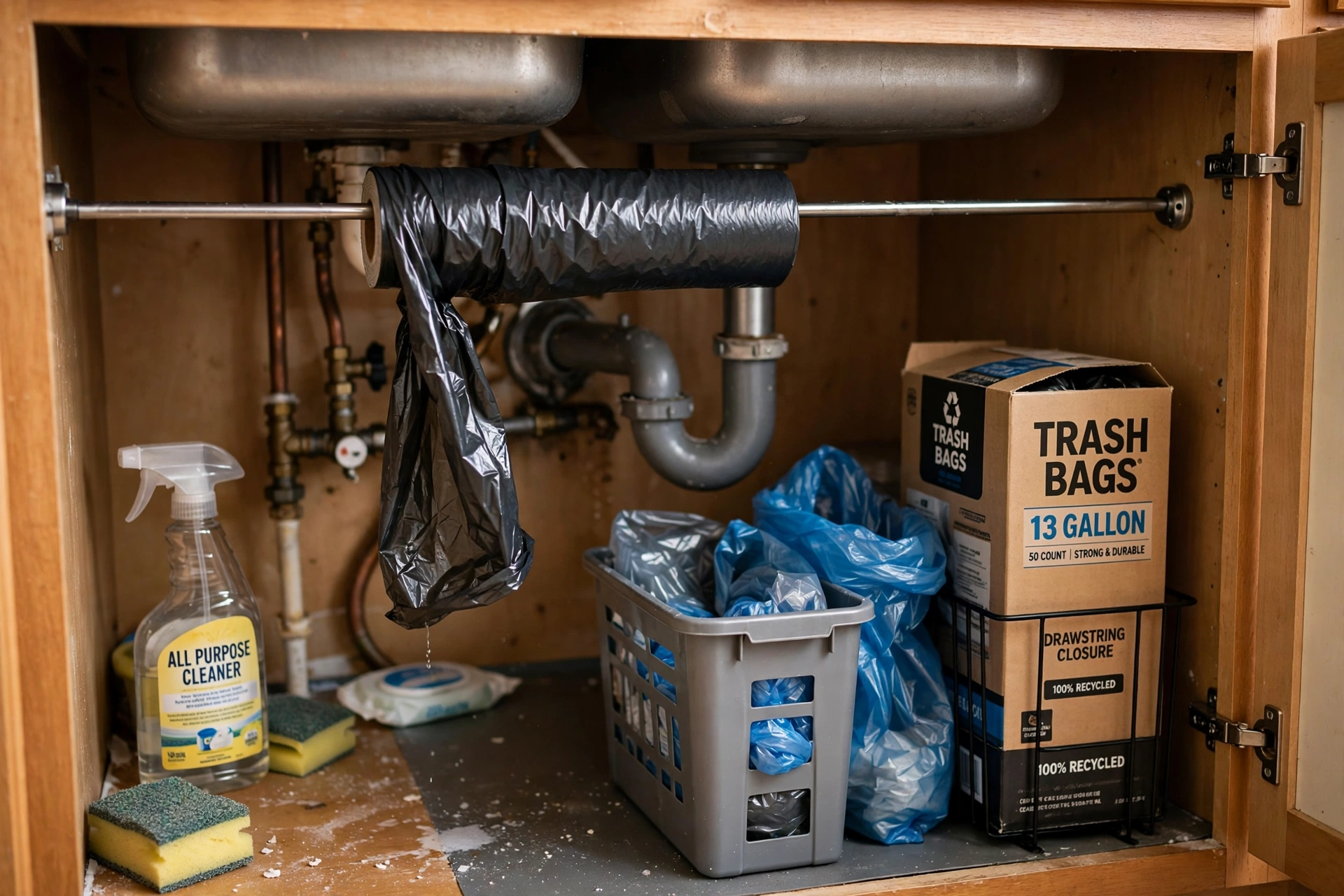
A tension rod is the cheapest under-sink organization trick there is, and it works because it uses space nothing else can: the empty air above the bottles. Mount a spring-loaded tension rod across the cabinet, high enough that spray bottles can hang from it by their trigger handles, and low enough that they do not hit the shelf above. The bottles hang in a neat row, labels facing out, and the cabinet floor stays clear for bins underneath. Measure the inside width of the cabinet and buy a rod that extends a little past it, so the spring holds it tight — a rod that is too short will slip the first time you pull a bottle off it. This works best in the kitchen, where most cleaners come in trigger-spray bottles, and it also works in the bathroom for hairspray and bathroom cleaners.
5. A Leak-Proof Mat Under Everything
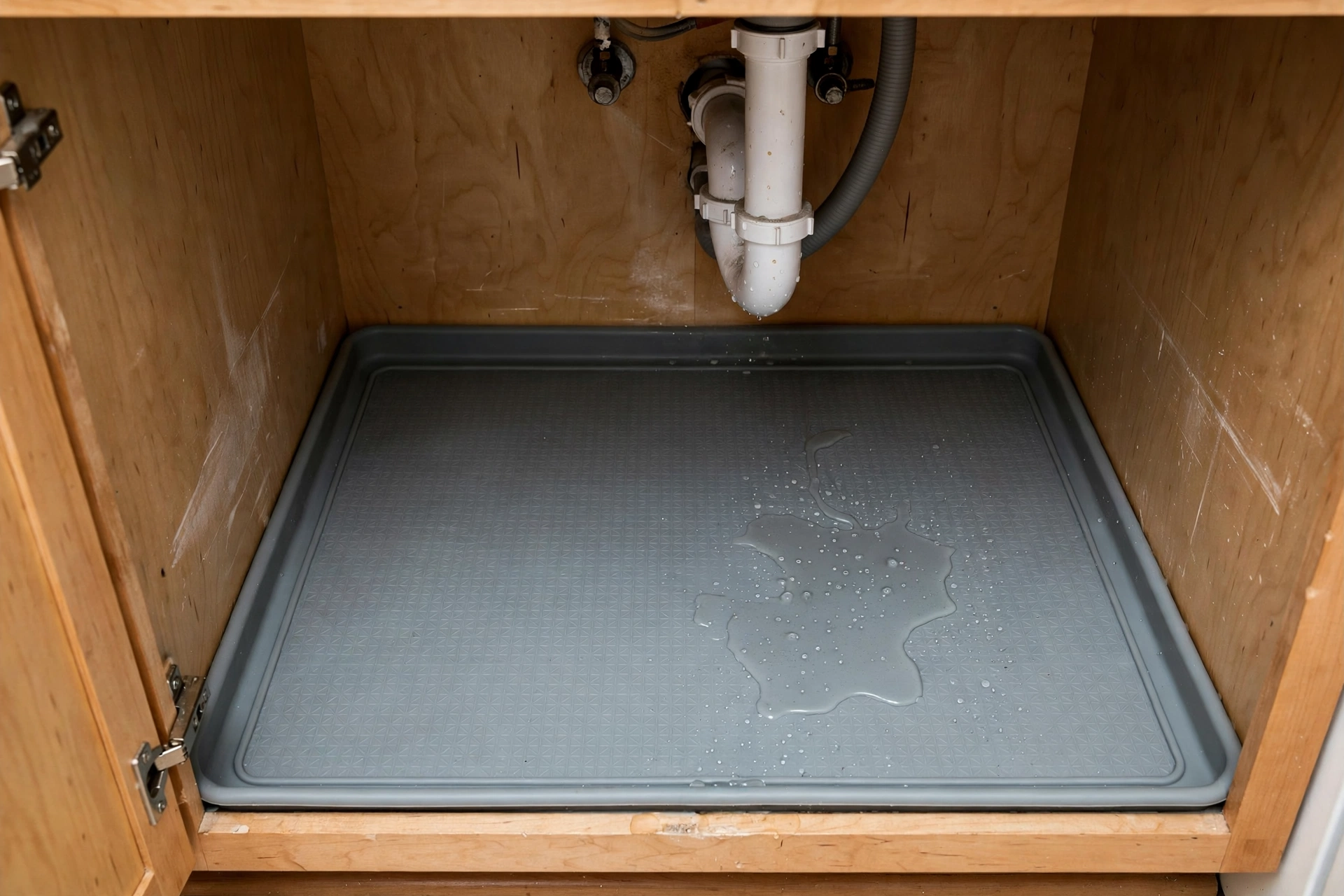
Before you put a single bottle back, lay a leak-proof mat across the floor of the cabinet. A good under-sink mat is a shallow tray with a raised edge — usually silicone or flexible plastic — that catches drips, spills, and slow leaks before they soak into the wood. It turns a disaster, a bottle of bleach leaking all night, into a five-second wipe-up, and it protects the cabinet floor from the stains and warping that make these cabinets look old before their time. Choose a mat that fits your cabinet with at least a half-inch lip around the edge, and cut it to fit around the pipes with a utility knife if you need to. Wipe it down once a month during your regular clean, and check underneath it for trapped moisture at the same time.
6. Door-Mounted Racks for Small Items
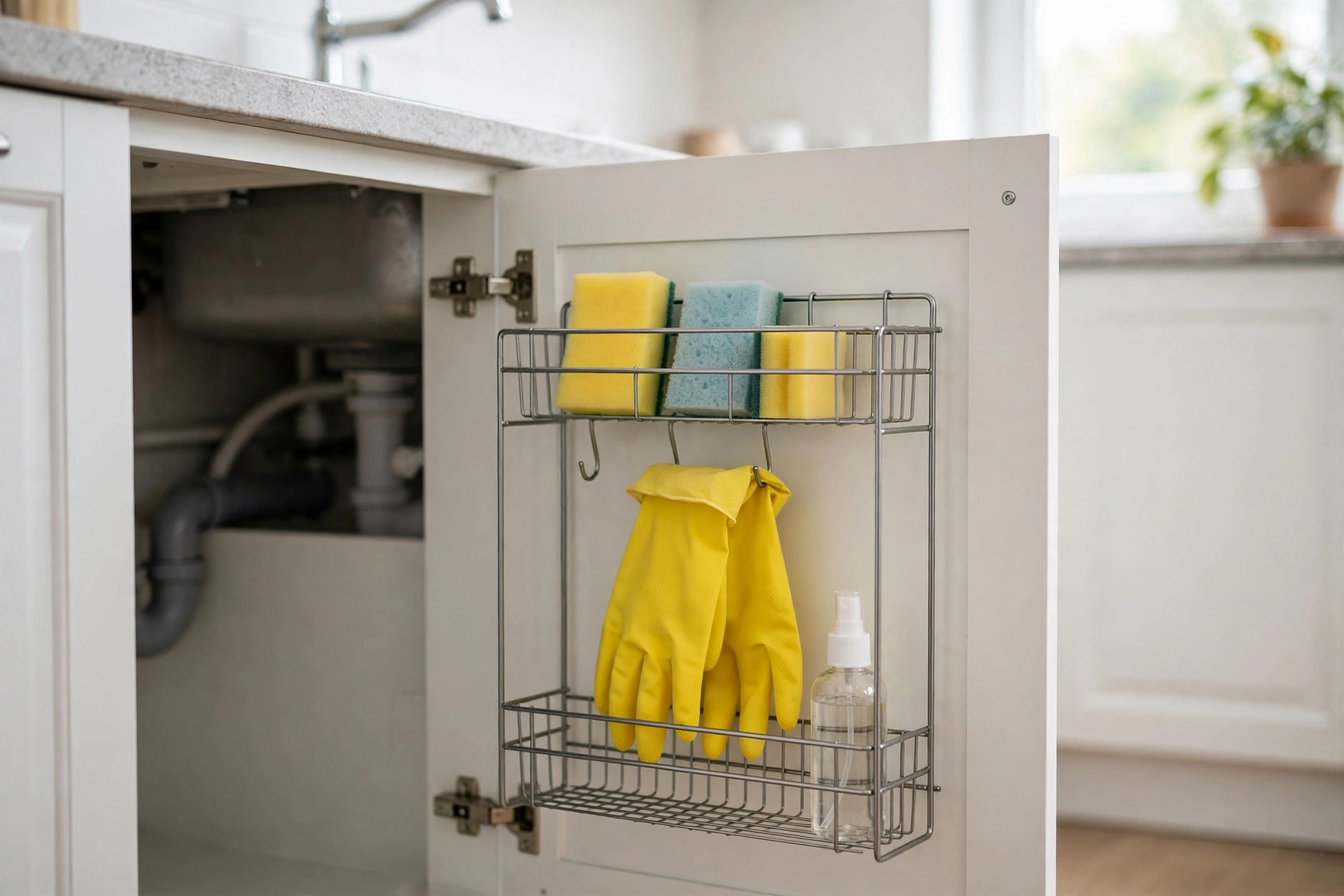
The inside of the cabinet door is free storage space, and a door-mounted rack puts it to work for the small things that otherwise vanish into the bottom of a bin: sponges, scrub brushes, rubber gloves, trash bags, and the little bottles you reach for every day. A rack that hooks over the top of the door needs no screws and comes off in seconds, while a screw-mounted rack holds more weight and stays put when you yank a sponge out in a hurry. Measure the door’s thickness and the clearance between the door and the shelf inside before you buy — a rack that is too deep will stop the door from closing, which defeats the purpose entirely. Keep the rack light: sponges, gloves, and a small spray bottle are perfect, but a gallon of detergent belongs on the cabinet floor, not hanging from the door.
7. Sort Cleaning Supplies by Job, Not by Bottle
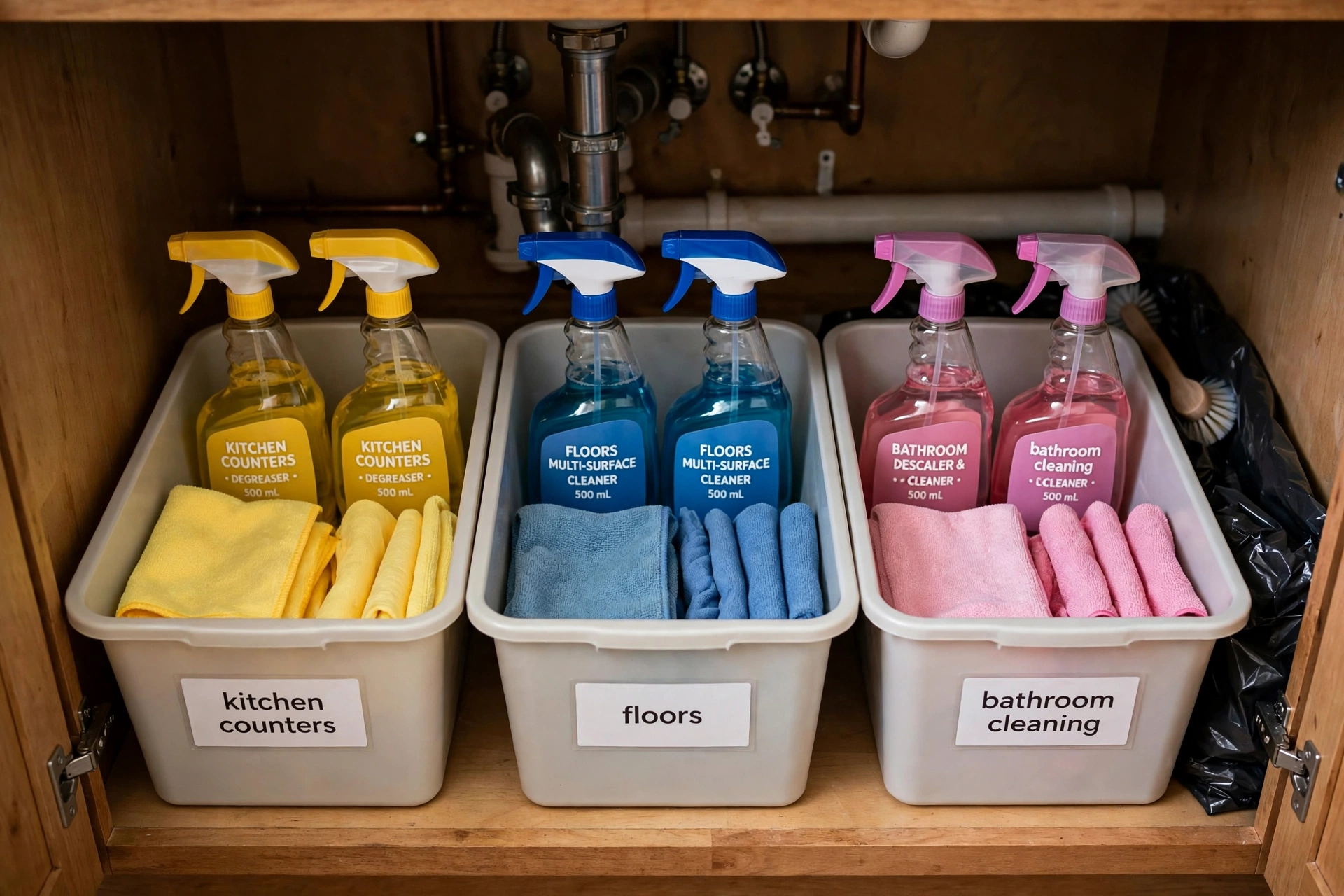
Most people organize cleaning supplies by where they bought them or by bottle size, which is why the cabinet ends up as a random pile. Sort by job instead: everything for the kitchen counters in one bin, everything for the floors in another, everything for the bathroom in a third. When you need to clean the bathroom, you grab the bathroom bin and carry it there — you do not dig through a pile of kitchen sprays to find the tub cleaner. Keep a small caddy for the daily jobs — dish soap, all-purpose spray, a sponge, and a cloth — at the very front of the cabinet, because those are the four things you reach for every day. Deep-clean supplies like oven cleaner, grout cleaner, and drain cleaner go in the back bin, because you use them once a month at most.
8. A Turntable for Deep Cabinets
A turntable — the lazy Susan of the cabinet world — is the answer for under-sink cabinets that are too deep to reach into comfortably. Put the bottles on the turntable, give it a spin, and the bottle you want comes to the front instead of you having to reach past five other bottles to get it. A turntable with a raised edge keeps bottles from sliding off when it spins, and a two-tier turntable doubles the storage in a tall cabinet without adding a shelf. Measure the depth of your cabinet before you buy, and leave at least an inch of clearance on every side so it spins freely without scraping the cabinet walls or the pipes. Turntables work best in the bathroom, where small bottles of cleaner, hair products, and toiletries pile up fast, and in the laundry room, where stain removers and fabric sprays come in a dozen similar-looking bottles.
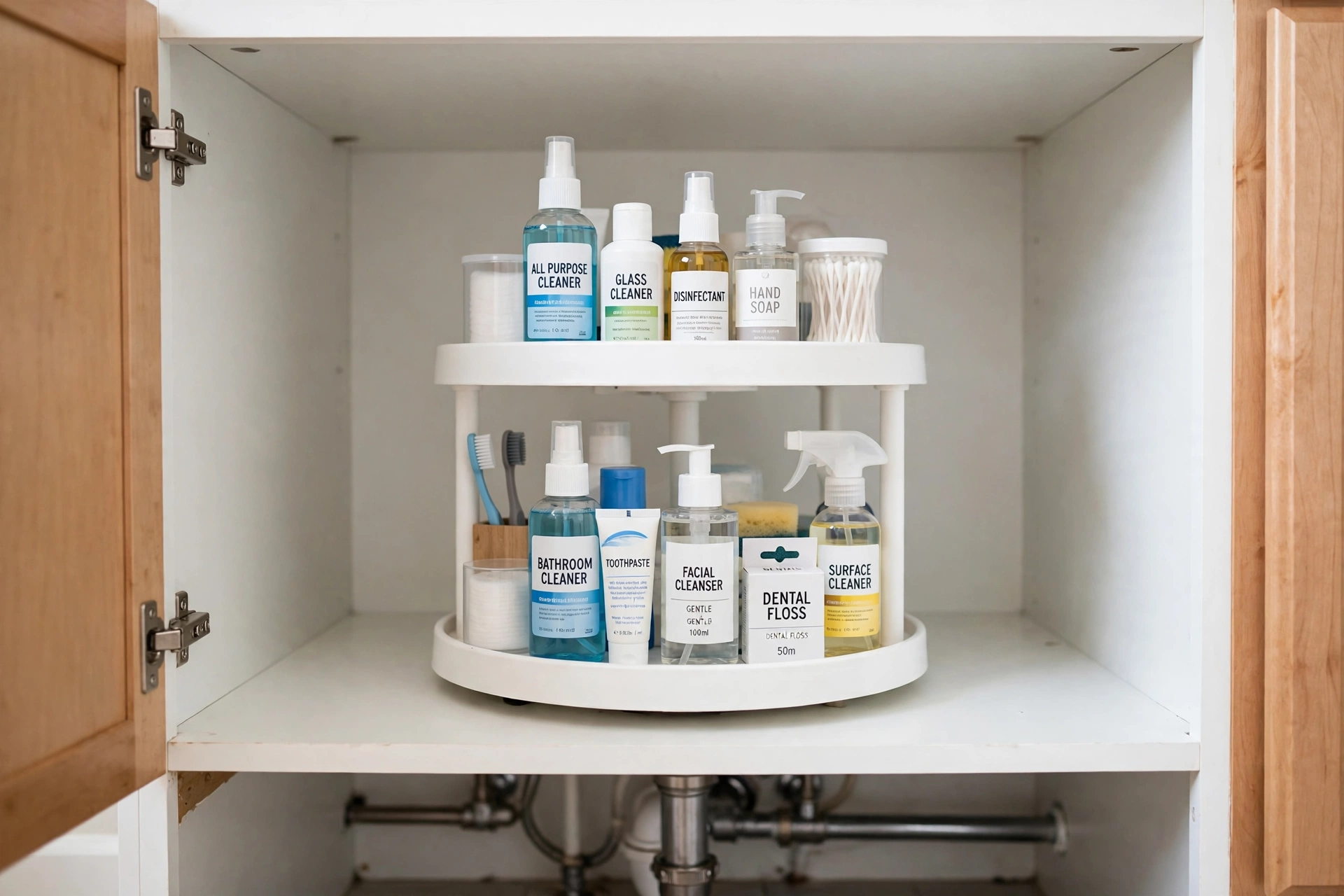
9. Label Every Bin So the System Sticks
An under-sink organization system without labels lasts about two weeks, because the first person who puts something back in the wrong bin breaks the system, and then everyone else follows. Label every bin, every caddy, and every shelf with what belongs there — a label maker gives the cleanest result, but masking tape and a marker work just as well and cost nothing. Put the label on the front of the bin, facing out, where you can read it without pulling the bin out. Keep the labels short and plain: “Dish Soap,” “Bathroom,” “Trash Bags,” “Sponges.” The goal is not a beautiful label, it is a system that a teenager, a partner, or a houseguest can follow without asking. In a shared house, labels are the difference between an organized cabinet and a cabinet that one person organizes and everyone else ignores.
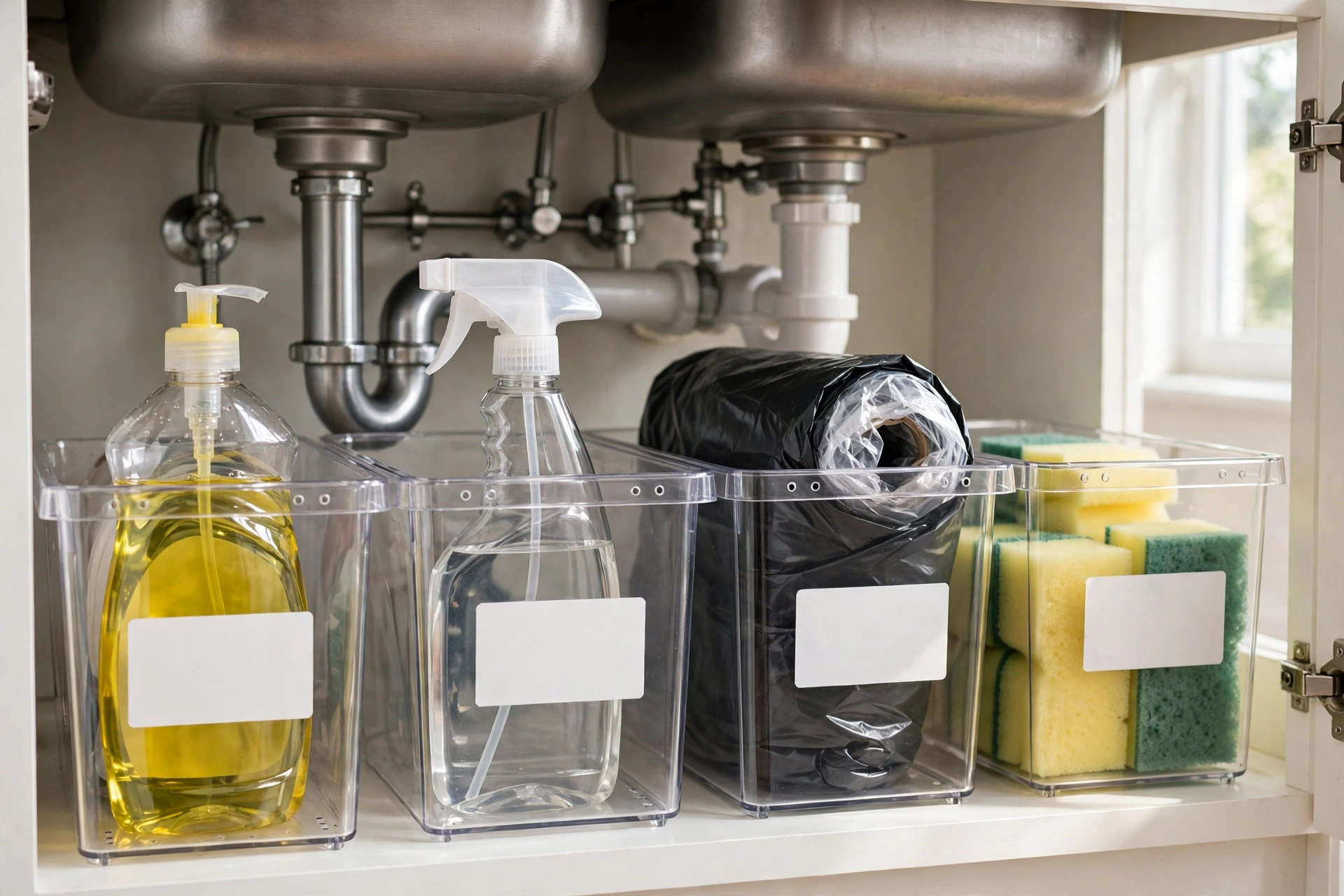
10. Use the Vertical Space With Shelf Risers
Under-sink cabinets are usually tall enough for two layers of storage, but most people use only the floor — which wastes half the space. A small shelf riser or stackable wire shelf creates a second level inside the cabinet, so short bottles live on top and tall bottles stand on the floor below. The riser also keeps the bottom layer from getting buried: you can see both levels at a glance instead of digging through a single deep pile. Measure the height of your tallest bottle before you buy a riser, and make sure it fits around the pipes — a riser that blocks the shut-off valves is one you will regret the first time a pipe leaks. In the bathroom, a riser is perfect for stacking small bottles of skincare and cleaning products; in the kitchen, it holds sponges and dish soap above the taller bottles of floor cleaner.
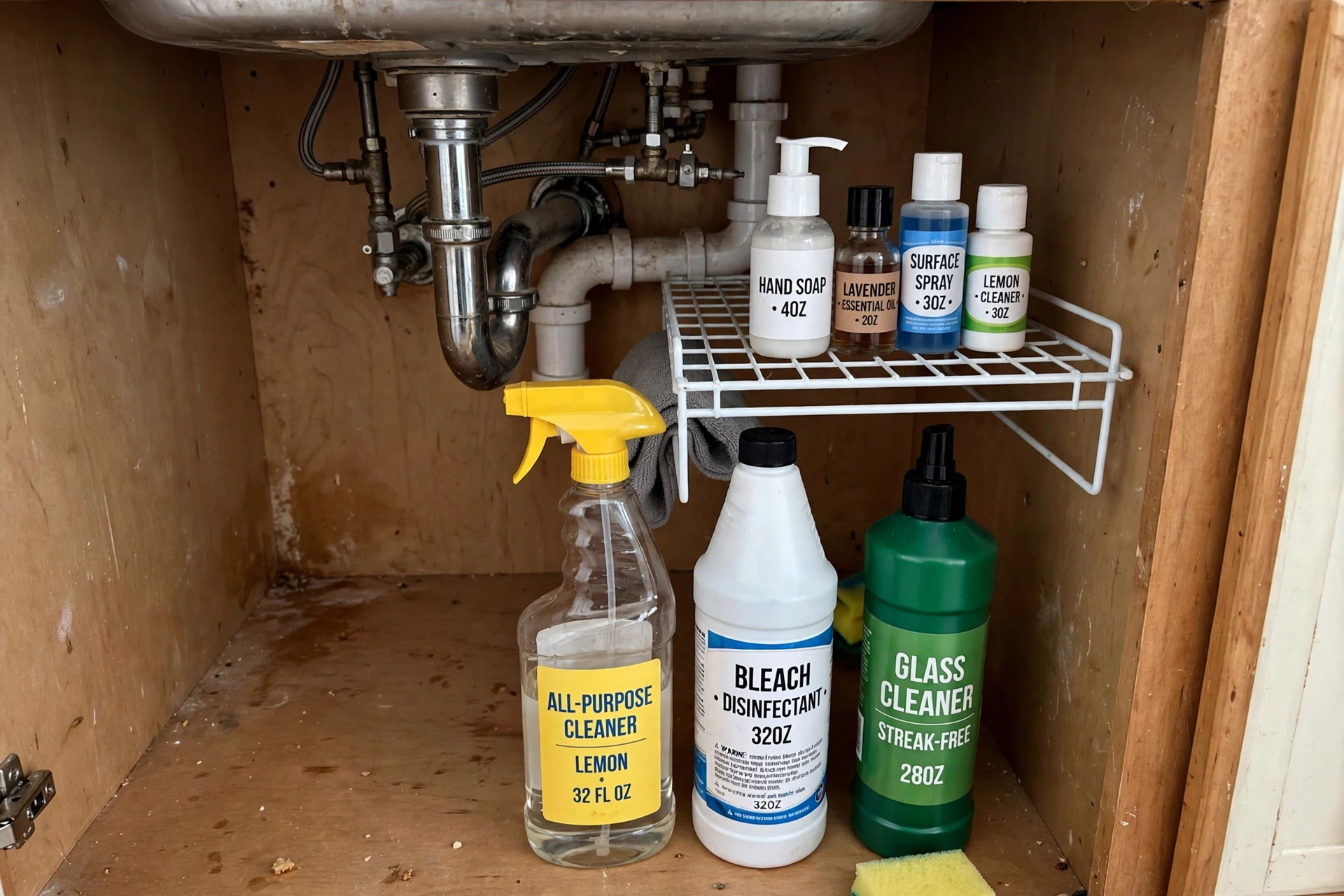
11. A Dedicated Caddy for Daily-Use Items
The four things you use every day — dish soap, all-purpose spray, a sponge, and a cleaning cloth — deserve their own caddy, separate from the rest of the cabinet. A small handled caddy keeps them together, so you can lift the whole thing out with one hand, carry it to the counter or the stove, and put it back when you are done. No more opening the cabinet three times for one ten-minute cleanup. Keep the daily caddy at the very front of the cabinet, right behind the door, where you can grab it without moving anything else. Restock it once a week from the backups in the back of the cabinet, and replace the sponge every two weeks — a sponge that has been under a sink for a month is doing more harm than good.
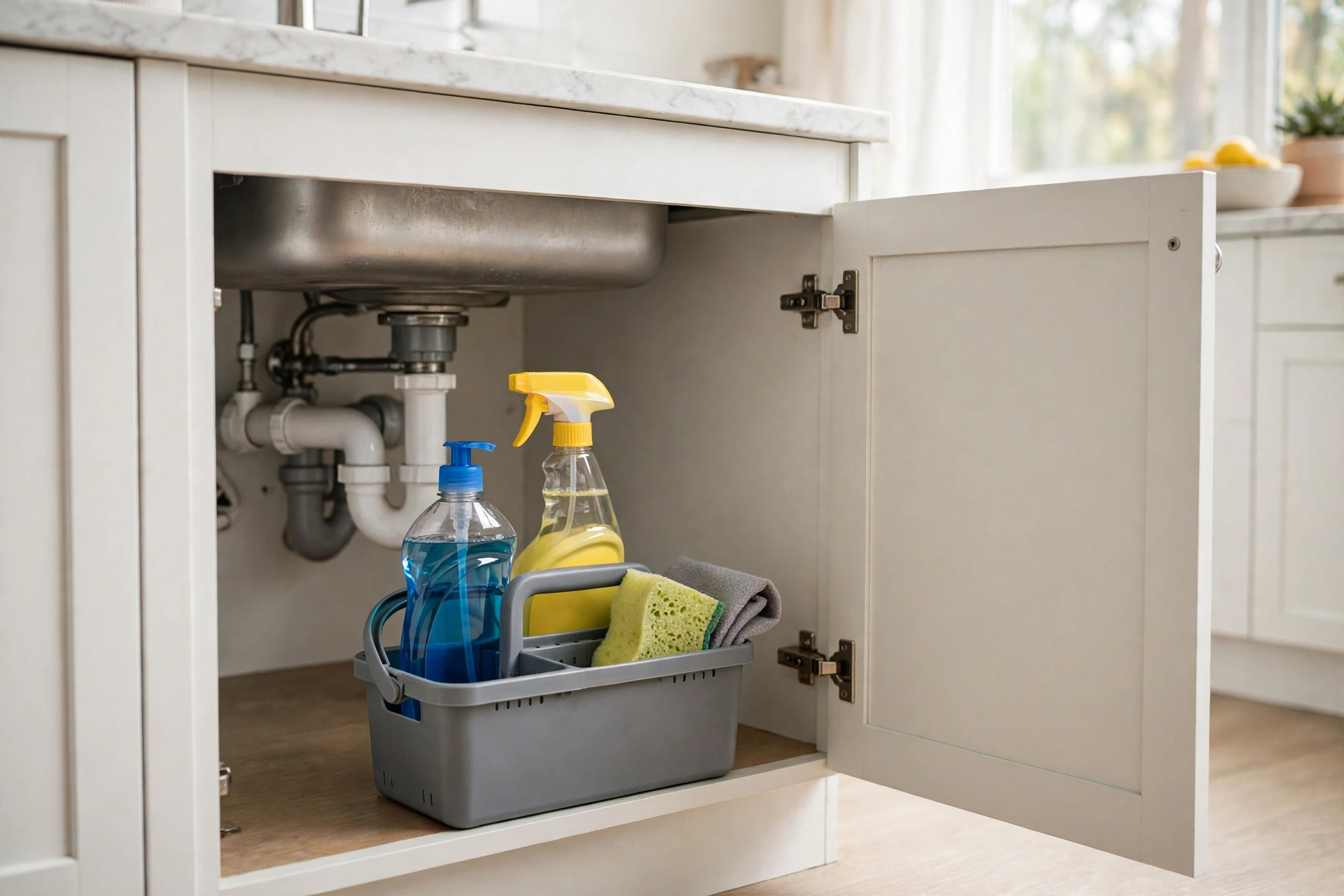
12. Keep Trash Bags and Recycling Within Reach
Trash bags are the most-used item under most kitchen sinks, and they are usually stored in the worst way possible: a crumpled box shoved behind the cleaning bottles, or a loose roll that unspools every time you pull one out. Give them a proper home — a small bin or a mounted dispenser that holds the box upright, or a tension rod with the roll of bags threaded onto it so you can tear one off with one hand. Store the recycling bags in the same spot, in a second bin or a second roll on the same rod. Keep the bags at the front of the cabinet, next to the daily caddy, because you reach for a trash bag more often than any cleaner in the house. If you keep a small compost bag or a recycling bin under the sink too, give each its own labeled spot so nobody has to guess.
13. Bathroom Under-Sink: Hair Tools and Toiletries Sorted
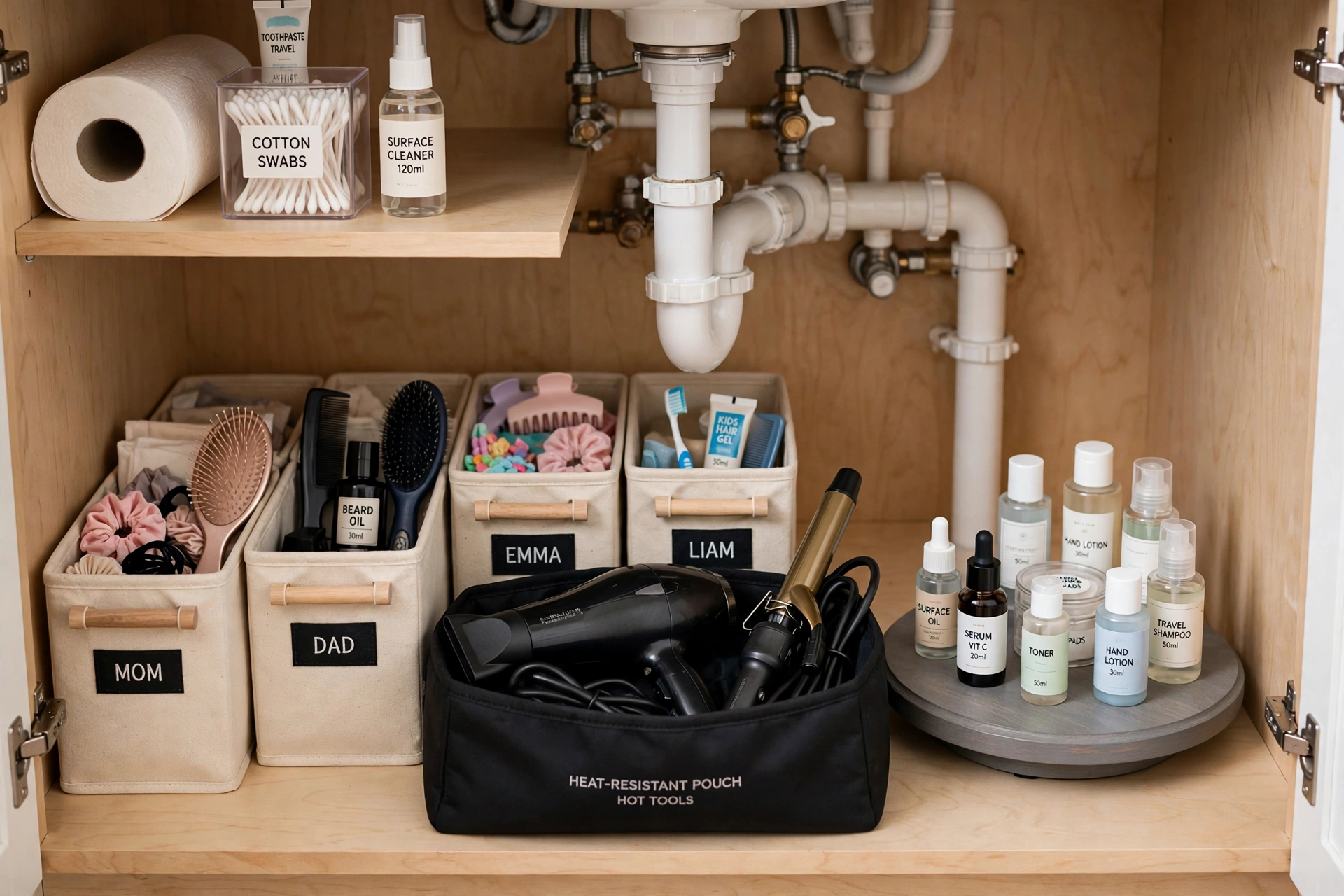
The bathroom under-sink cabinet holds hair tools, toiletries, and medicines — all small, all used every day, and all likely to end up in one tangled pile. Start by giving hair tools their own heat-resistant pouch or a tall bin: a curling iron or hair dryer needs a spot where it cannot melt a plastic bottle or burn a towel. A small hanging organizer on the cabinet door holds brushes, combs, and hair ties where you can see them. Sort toiletries by person if the bathroom is shared — one bin per person, labeled with a name — and keep medicines and first-aid supplies in a separate lidded bin at the back, out of reach of small children. A turntable works wonders here for the small bottles, and a leak-proof mat matters even more in the bathroom, where a spilled bottle of nail polish remover or hair dye can stain the cabinet floor permanently.
14. Laundry Room Under-Sink: Detergent and Stain Kit Station
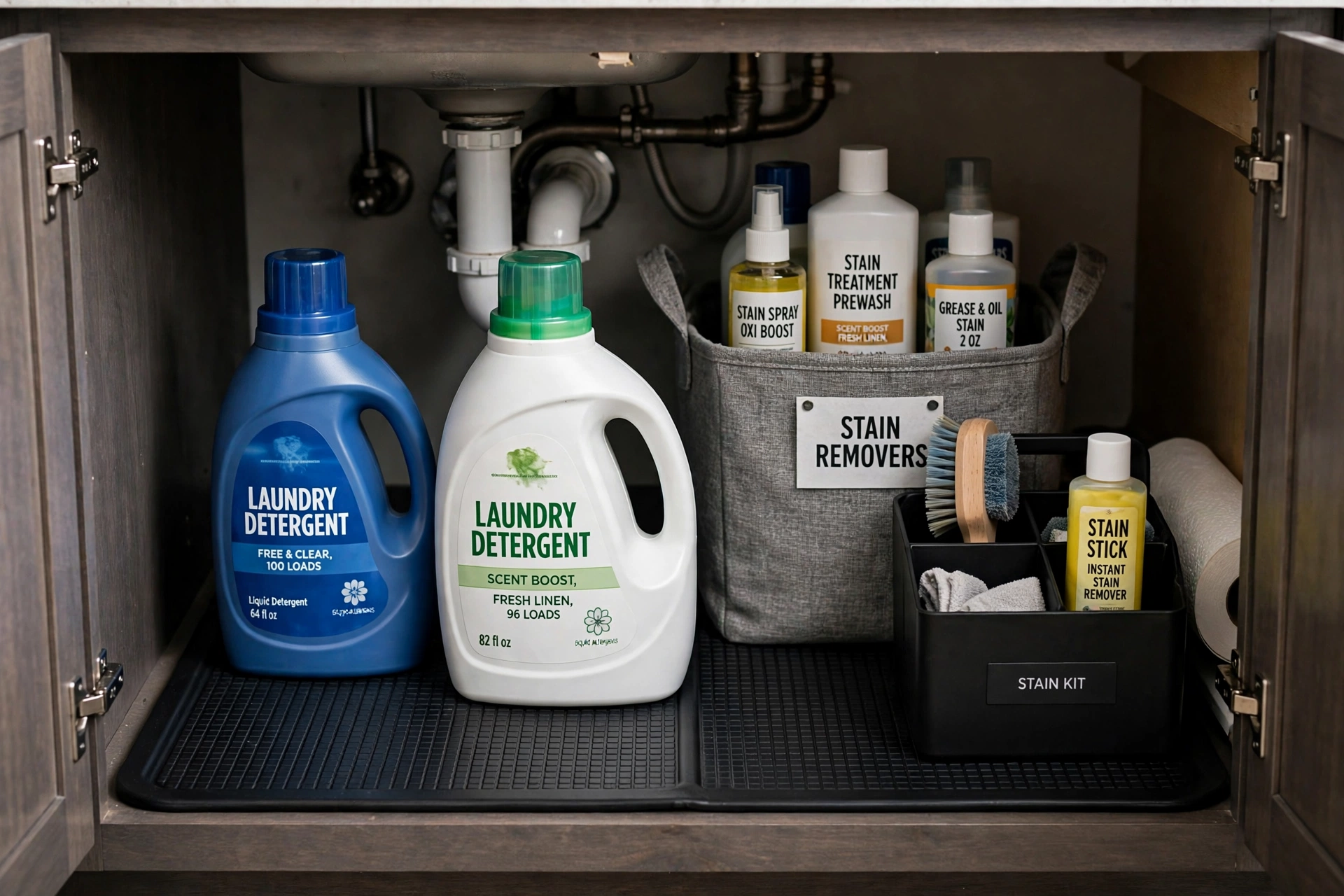
The laundry room under-sink cabinet holds detergent, stain removers, fabric softener, and the cleaning supplies for the washer itself. It works best as a station: detergent and softener in the front, because you use them every load; stain removers, bleach, and specialty products in a labeled bin behind them; and a small stain kit — a stain stick, a scrub brush, and a clean cloth — in a caddy you can carry to the washer when a shirt needs treating before it goes in. Our laundry room organization ideas build on this station idea for the whole laundry room, from the folding shelf to the drying rack. Keep heavy detergent jugs on the cabinet floor, never on a high shelf, because a gallon of detergent dropped from shoulder height is a mess nobody wants to clean up. Put a leak-proof mat under the detergent, because detergent leaks are sticky, and sticky is the hardest kind of mess to clean out of a cabinet.
15. A Monthly 10-Minute Reset Routine
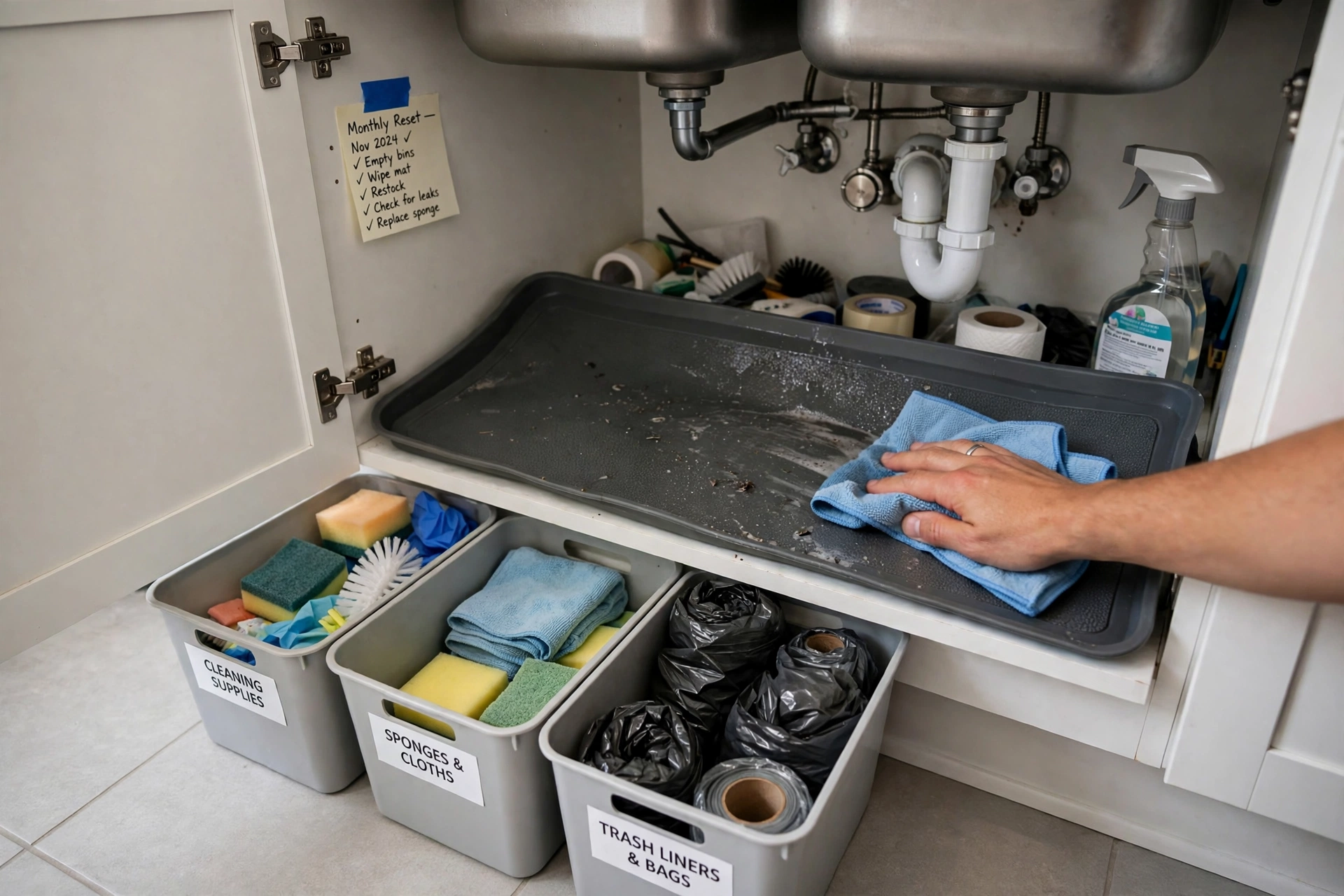
No under-sink organization system maintains itself, and the one that fails is the one nobody checks. Put a ten-minute reset on the calendar for the first Saturday of every month: pull out every bin, wipe the mat and the cabinet floor, throw away anything empty or expired, and put everything back in its labeled spot. Ten minutes a month is all it takes, and it is the difference between a system that lasts for years and a cabinet that slides back into a mess within a season. During the reset, check the pipes for drips one more time, replace the sponge in the daily caddy, and restock anything that is running low from the backups in the back. If a bin is overflowing, that is the cabinet telling you that you own too much of something — use it up before you buy more.
Frequently Asked Questions
How do I organize under the kitchen sink with pipes in the way?
Work around the pipes, not against them. Use a U-shaped pull-out caddy that fits around the plumbing, stackable bins sized to the space on each side of the pipes, and a tension rod above the bottles for spray bottles. Measure the cabinet first and buy storage that fits those measurements. These under-sink organization ideas are built for real cabinets with real plumbing, so nothing here needs you to move a pipe.
What is the best way to store cleaning supplies under the sink?
Sort them by job into labeled bins — kitchen counters, floors, bathroom — and keep the four daily-use items (dish soap, all-purpose spray, sponge, cloth) in a handled caddy at the front. Put a leak-proof mat under everything, hang spray bottles from a tension rod, and keep backups and rarely used products in the back. A labeled bin per job means you grab one bin and go, instead of digging through a pile every time you clean. That is the core of these under-sink organization ideas: one bin per job, everything labeled, daily items at the front.
How do I keep the cabinet under the sink from smelling?
The smell usually comes from a slow leak, a damp sponge, or an old bottle that has been leaking. Start with a full clean-out and a leak check, then lay a leak-proof mat on the cabinet floor and replace sponges every two weeks. Leave the door open for an hour after cleaning so the inside dries, and throw away any product that smells off or has expired. If the smell stays, check the drain connections — a loose slip nut is a common culprit.
What should you not store under the sink?
Do not store anything that a leak would ruin: paper towels, spare light bulbs, pet food, or anything in a cardboard box. Keep chemicals out of reach of small children — use a childproof latch if kids can reach the cabinet — and never store flammable products like aerosol sprays next to the garbage disposal or a hot water heater. Keep medicines in a lidded bin at the back, and anything you use daily at the front where you can reach it safely.
How often should I reorganize under the sink?
Do a full clean-out once, then a ten-minute reset on the first Saturday of every month: wipe the mat, toss empties and expired products, and put everything back in its labeled spot. That monthly reset is the whole secret — under-sink organization ideas only work if the system gets a quick check, and ten minutes a month keeps the cabinet tidy for years instead of weeks.
Related Reading
- Pantry Organization Ideas
- Laundry Room Organization Ideas
- Small Closet Organization Ideas
- How to Declutter Your Home Room by Room
- How to Clean a Dishwasher
- How to Get Rid of Pet Odor in Your House
Conclusion
The cabinet under the sink is the hardest storage space in the house, but it does not have to be the messiest. With these under-sink organization ideas — a full clean-out, a leak-proof mat, stackable bins, a tension rod, a pull-out caddy, and labels on everything — the kitchen, bathroom, and laundry cabinets all become spaces that work instead of spaces you avoid. Start with the clean-out this weekend, add one idea at a time, and keep the monthly ten-minute reset on the calendar. A tidy under-sink cabinet saves you time every day, and once you can actually find the dish soap, you will wonder why you waited so long.