15 Garage Organization Ideas for a Tidy, Usable Space
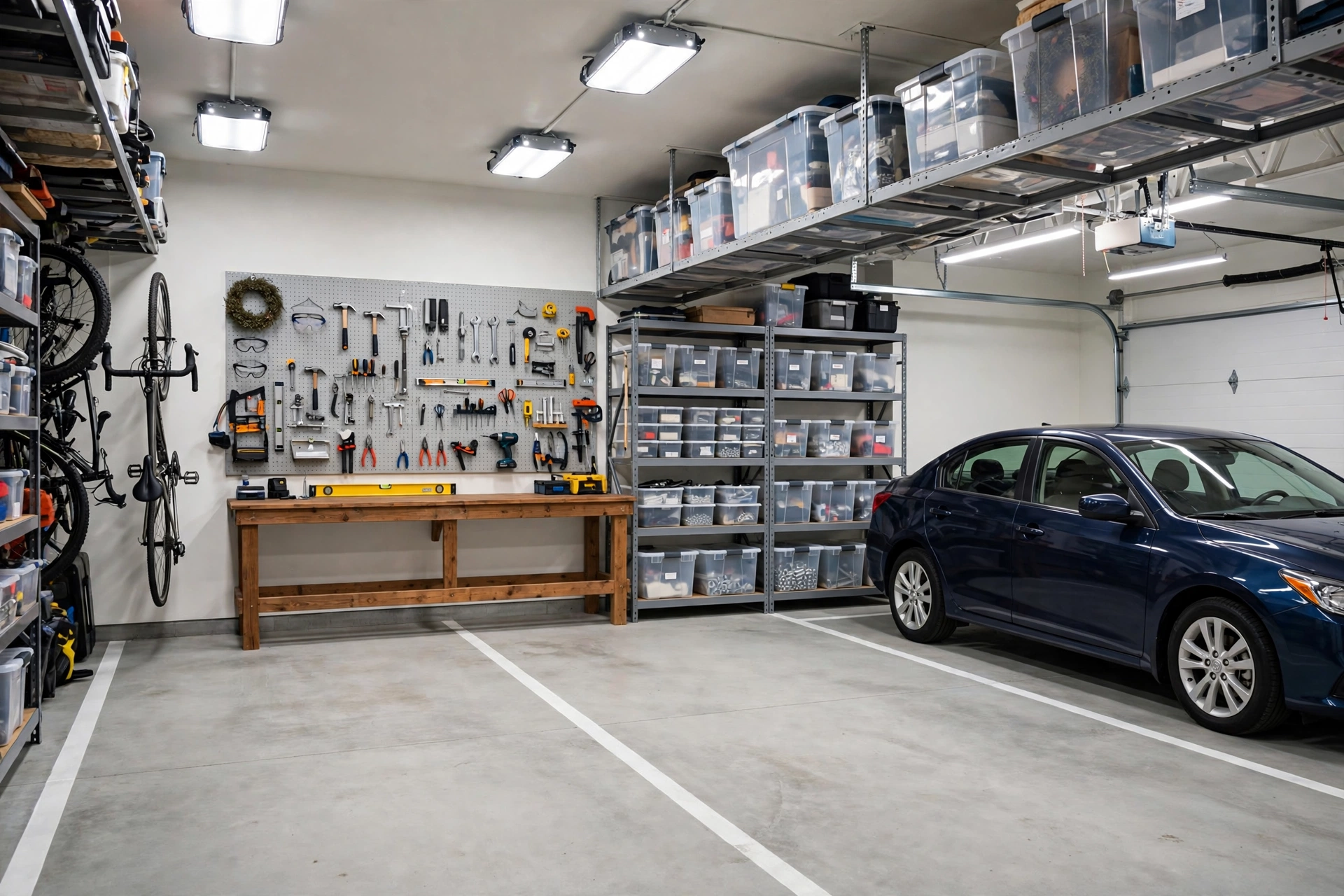
In most American homes, the garage is the biggest room in the house — and the one that gets used the least like a room. It starts as a place to park the car, then becomes the home for everything that does not fit anywhere else: the holiday decorations, the sports gear, the tools, the old paint cans, the boxes nobody has opened since the move. One day the car does not fit anymore, and the garage has quietly become a storage unit you pay a mortgage on. The good news is that garage organization ideas do not need a remodel or a contractor. Zones, wall storage, overhead racks, and labeled bins can turn a packed garage into a space where you can find the screwdriver, park the car, and actually use the workbench. A garage is a building or part of a building for storing a vehicle, but in practice it is also the workshop, the sports closet, and the seasonal storage room — so the fifteen ideas below treat it as all four, in the order that makes sense: clear it out, map your zones, get things off the floor, then build the systems that keep it tidy. If the rest of your home needs the same treatment, our shoe storage ideas sort the shoes that pile up by the door, and our laundry room organization ideas show how the same zone system works in a small space.
1. Map Your Zones Before You Move Anything
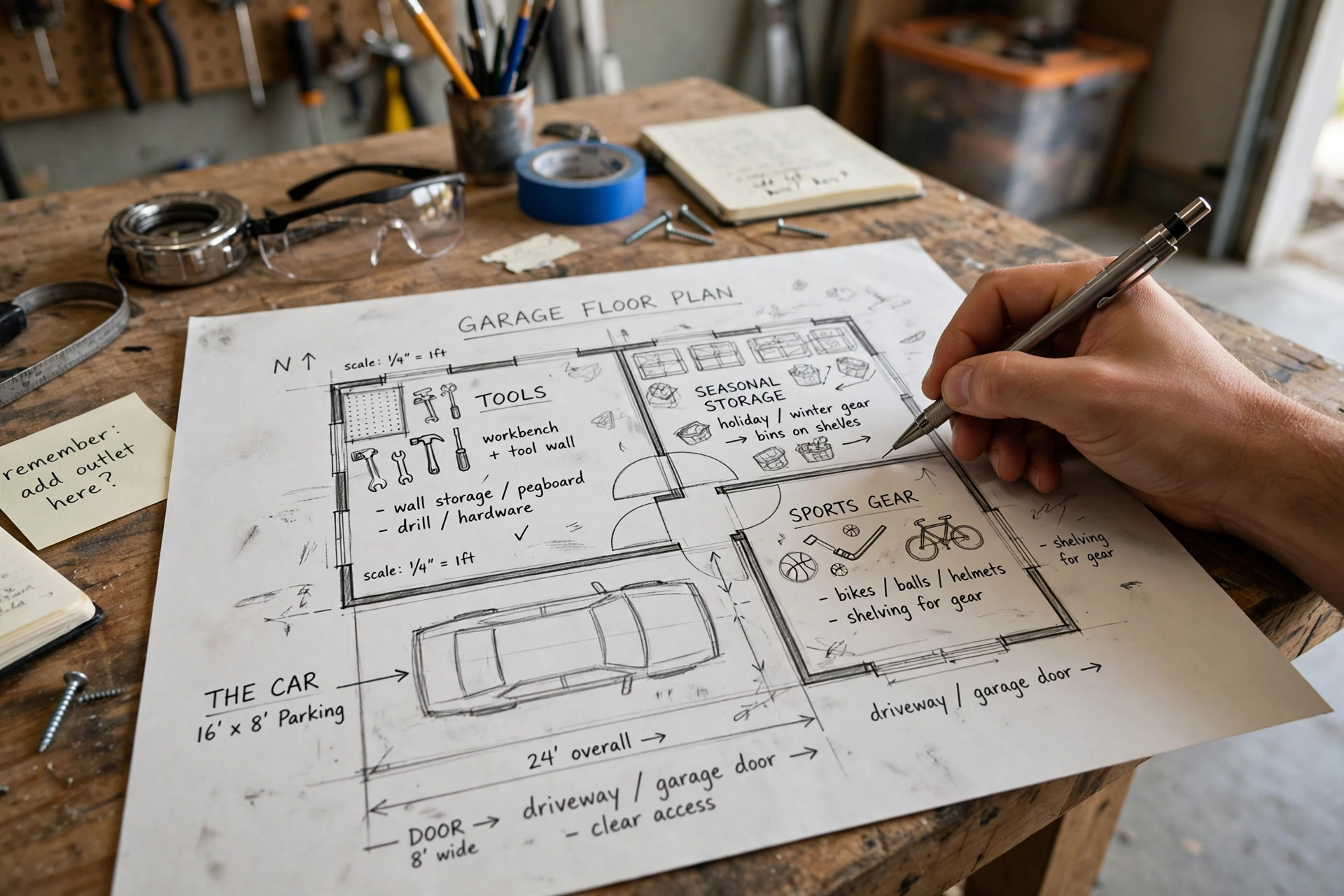
Before you buy a single bin or hook, map the garage into zones on paper. Draw a rough floor plan — the walls, the doors, the car, the workbench spot — and mark a zone for each job the garage does: tools, sports gear, seasonal storage, car care, garden tools, and the things that belong in the house but live in the garage anyway. A zone is a promise: everything for one job lives in one place, and nothing else lives there. Measure the zones as you draw them, and be honest about what fits. The car needs its full footprint plus room to open the doors; the workbench needs light and a power outlet; the seasonal bins need a spot you can reach twice a year without moving five other things. A map made in twenty minutes saves a weekend of moving heavy shelves twice, and it is the step most people skip — which is why most garages get reorganized every year and stay messy anyway.
2. Wall Storage: Pegboard for Tools
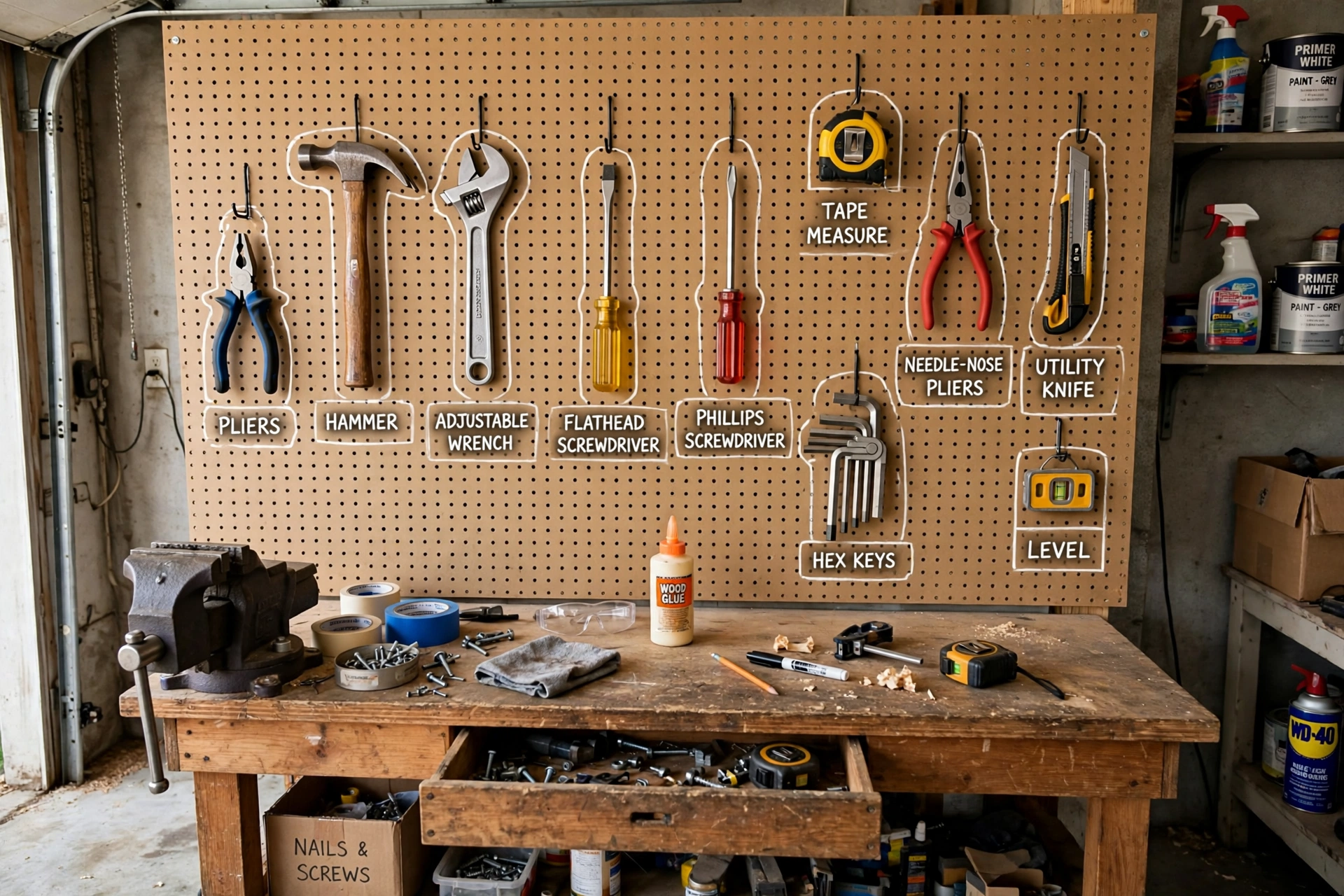
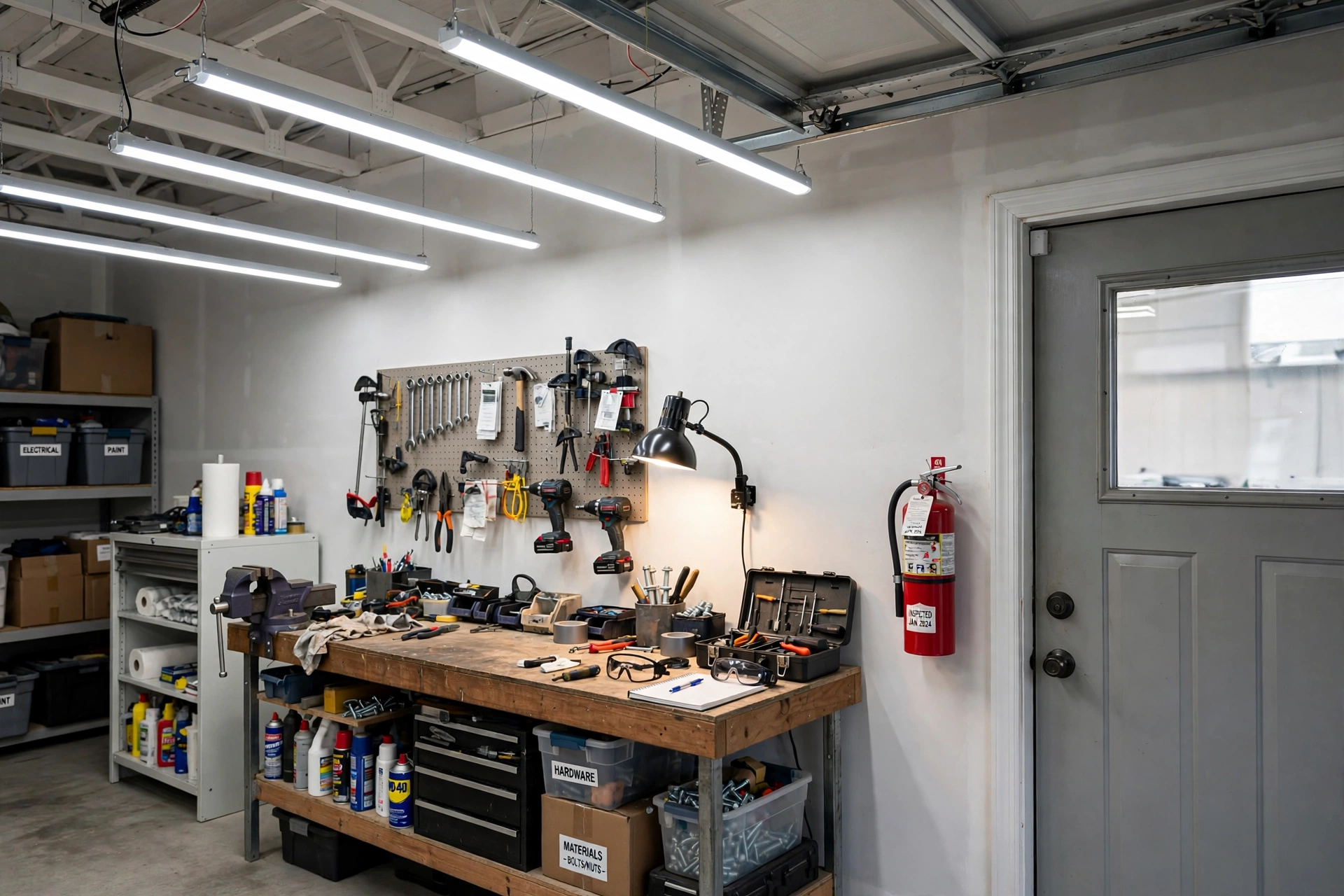
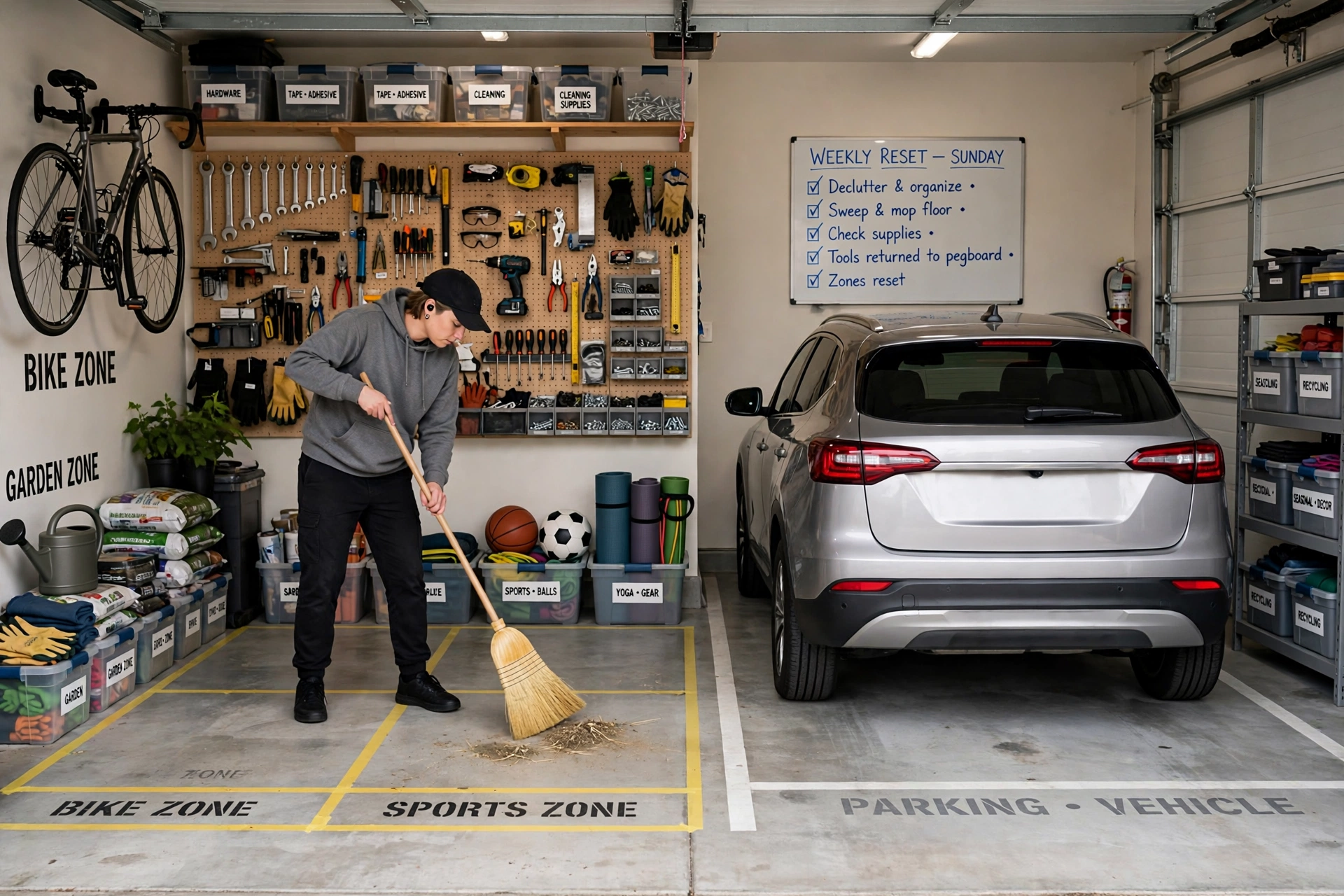
Pegboard is the cheapest wall storage there is, and it is perfect for tools because it keeps every tool visible, reachable, and off the workbench. Mount a sheet of pegboard on the wall above the workbench, add a set of hooks and small baskets, and hang the tools you use most: hammers, screwdrivers, wrenches, pliers, tape measures. Trace each tool’s outline on the pegboard with a marker when you hang it, so you can see at a glance which tool is missing and where it goes back. Mount the pegboard into the wall studs with screws and spacers so there is a gap behind it for the hooks — a sheet screwed flat to the wall will not hold a hook. Keep the heavy tools low, where they are easy to lift off, and the light, sharp tools high, out of reach of small hands. A pegboard wall turns a drawer full of tangled tools into a display you can read like a menu.
3. Overhead Racks for Seasonal Gear
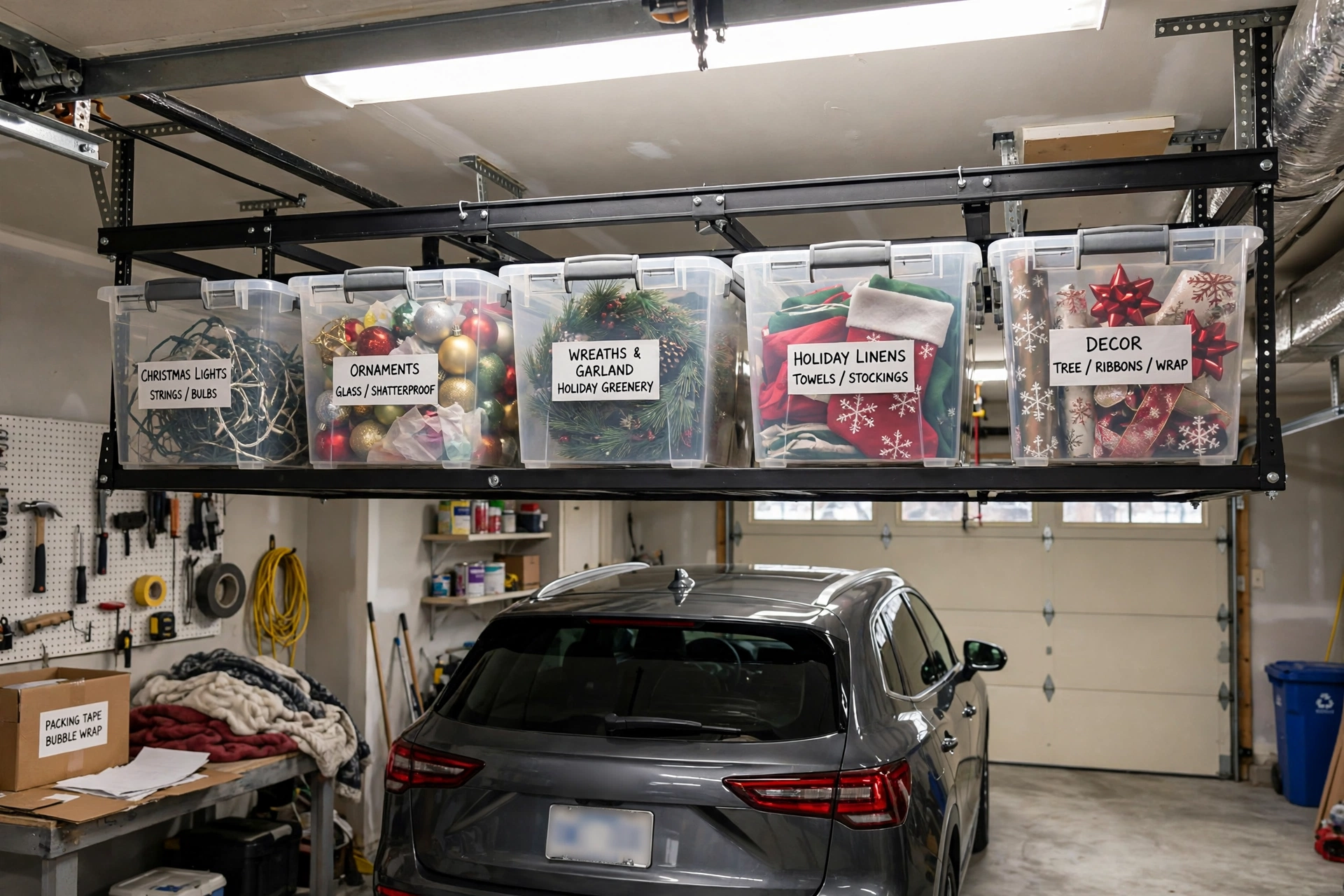
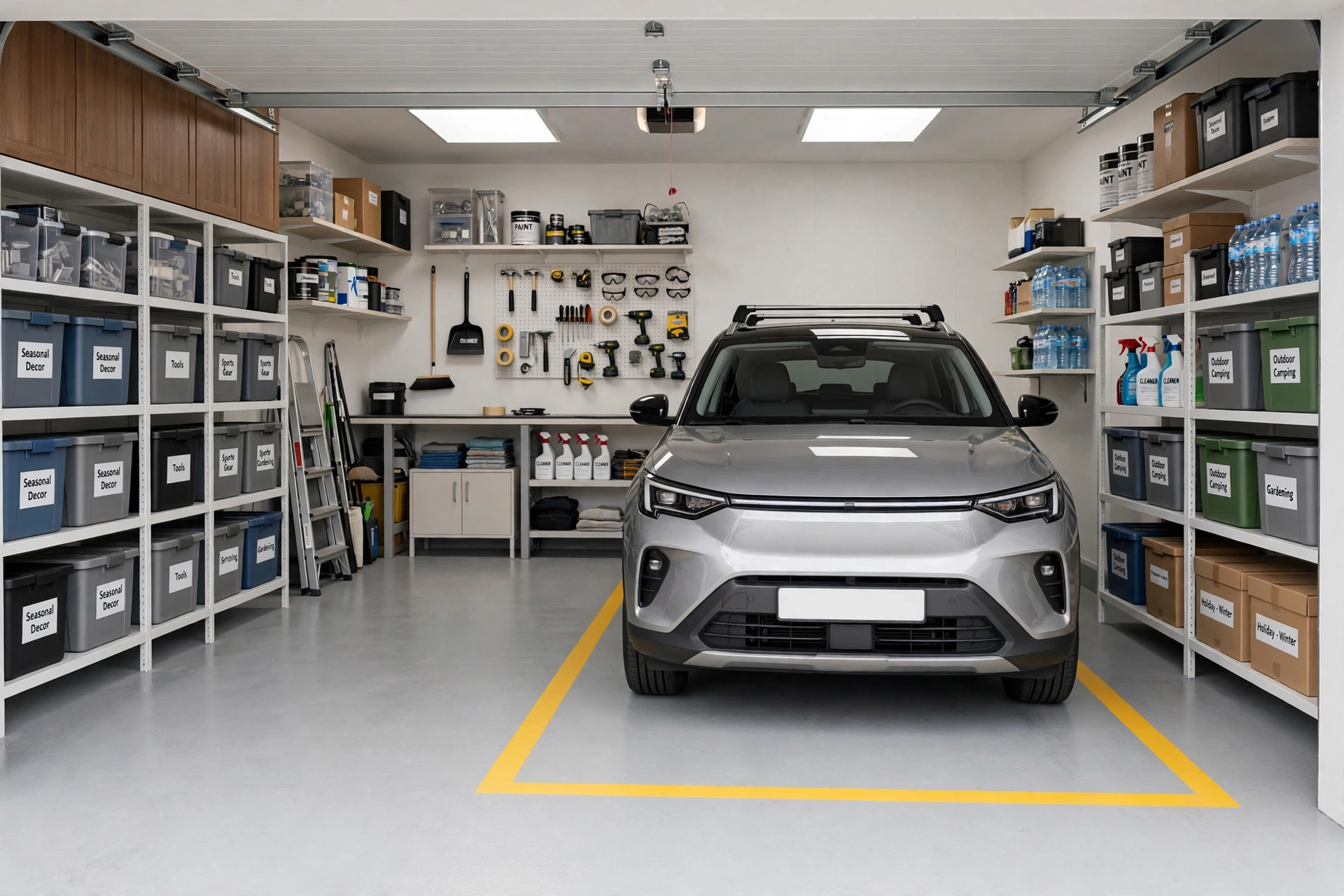
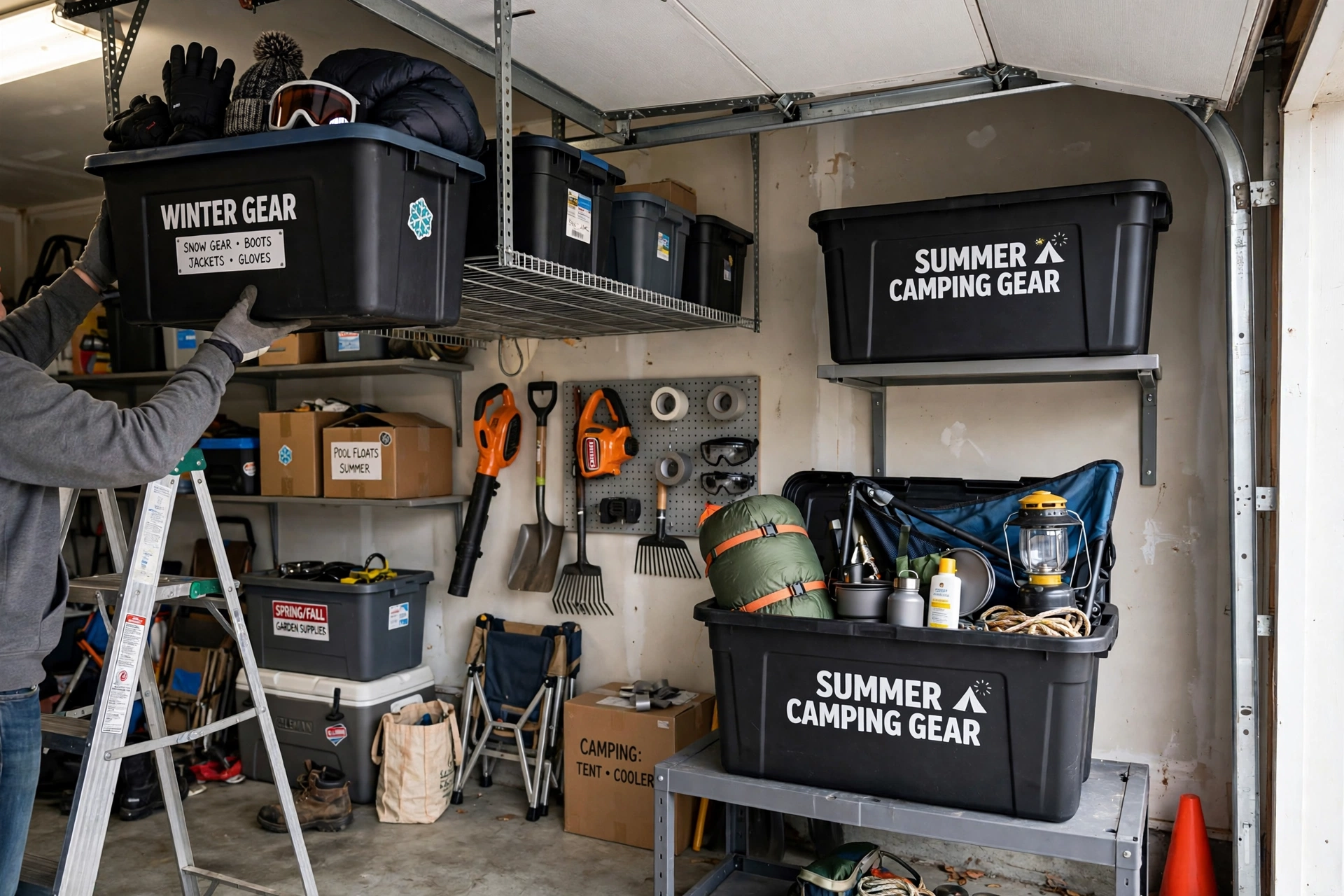
The ceiling is the most wasted space in a garage, and overhead racks put it to work for the things you only need twice a year: holiday decorations, camping gear, off-season sports equipment, and the boxes of clothes the kids have outgrown. A ceiling-mounted rack — a steel frame bolted into the ceiling joists with a wire deck — holds hundreds of pounds and keeps bulky bins off the floor and off the shelves. Measure the height of your car and the clearance you need to open the garage door before you buy a rack, and install it where it will never hang over the car’s path. Use clear, labeled bins on the rack so you can see what is up there from the floor, and never store anything heavy enough to hurt someone if it fell. Overhead storage is the single biggest space win in a garage, because it frees the floor without costing a square foot of wall.
4. Labeled Bins on Heavy-Duty Shelving
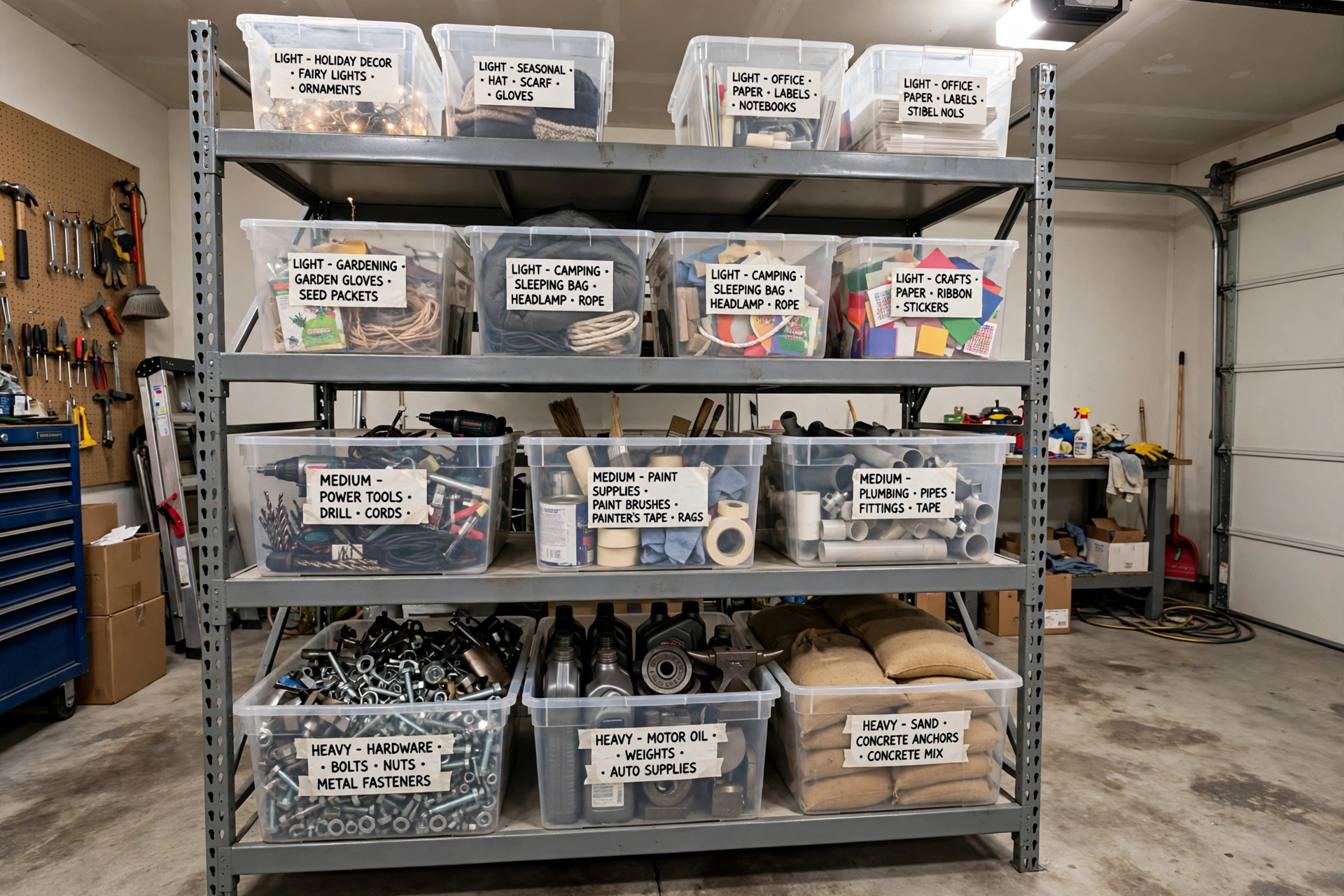
Shelving is the workhorse of garage organization, but only if the shelves are strong enough and the bins are labeled. Buy heavy-duty steel shelving rated for the weight you will put on it — a shelf full of paint cans, toolboxes, and car parts is heavy — and bolt the shelving unit to the wall so it cannot tip. Use clear bins with lids, one category per bin, and label the front of every bin in big, readable letters you can read from across the garage. Keep the heavy bins on the lower shelves and the light ones up high, and never store anything on the top shelf that you need more than twice a year — a ladder trip for a light bulb is a system that will not last. One bin per category is the rule: “Holiday Lights,” “Camping,” “Car Wash,” “Paint.” If a bin holds two categories, split it — mixed bins are where organization goes to die.
5. A Workbench With a Home for Every Tool
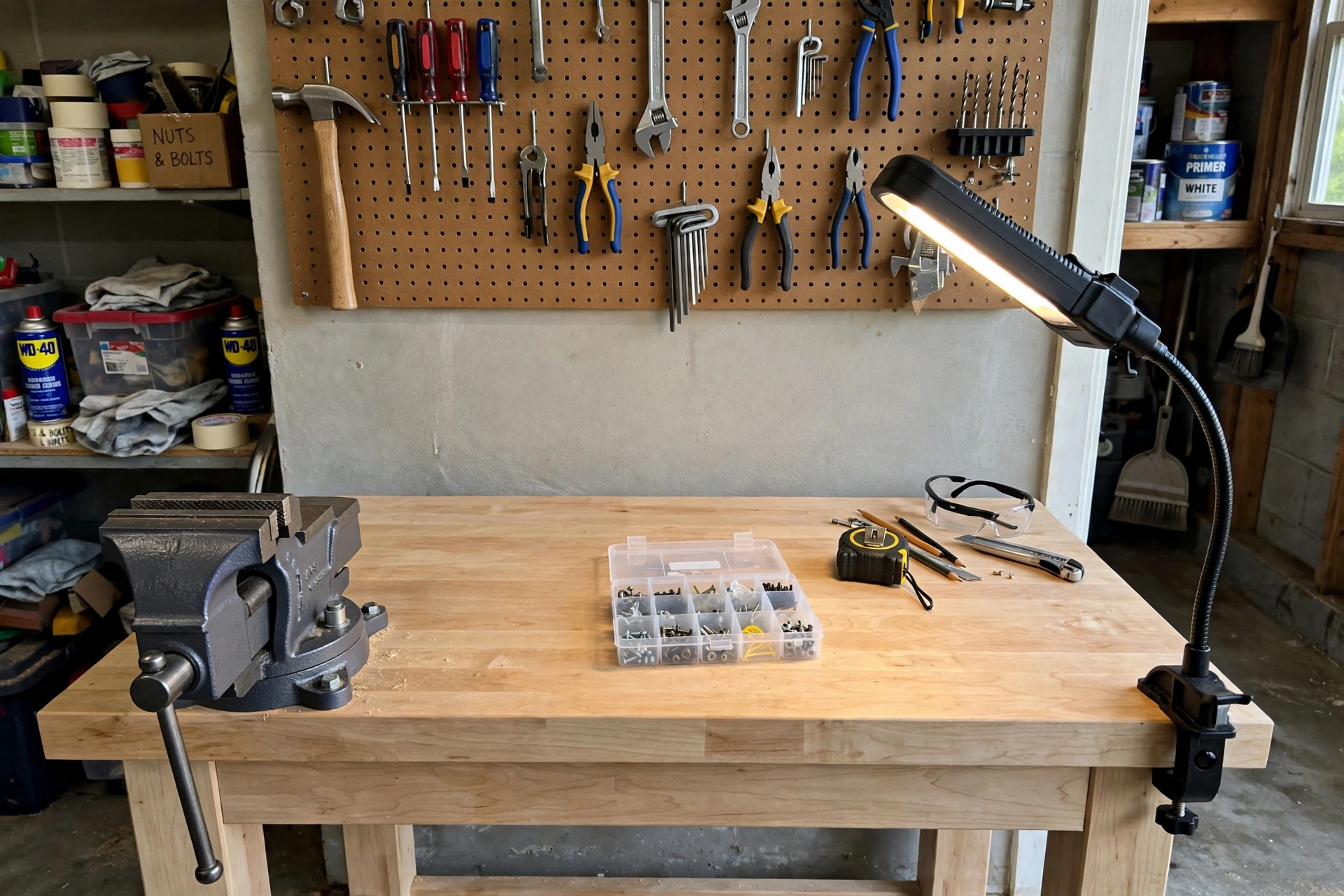
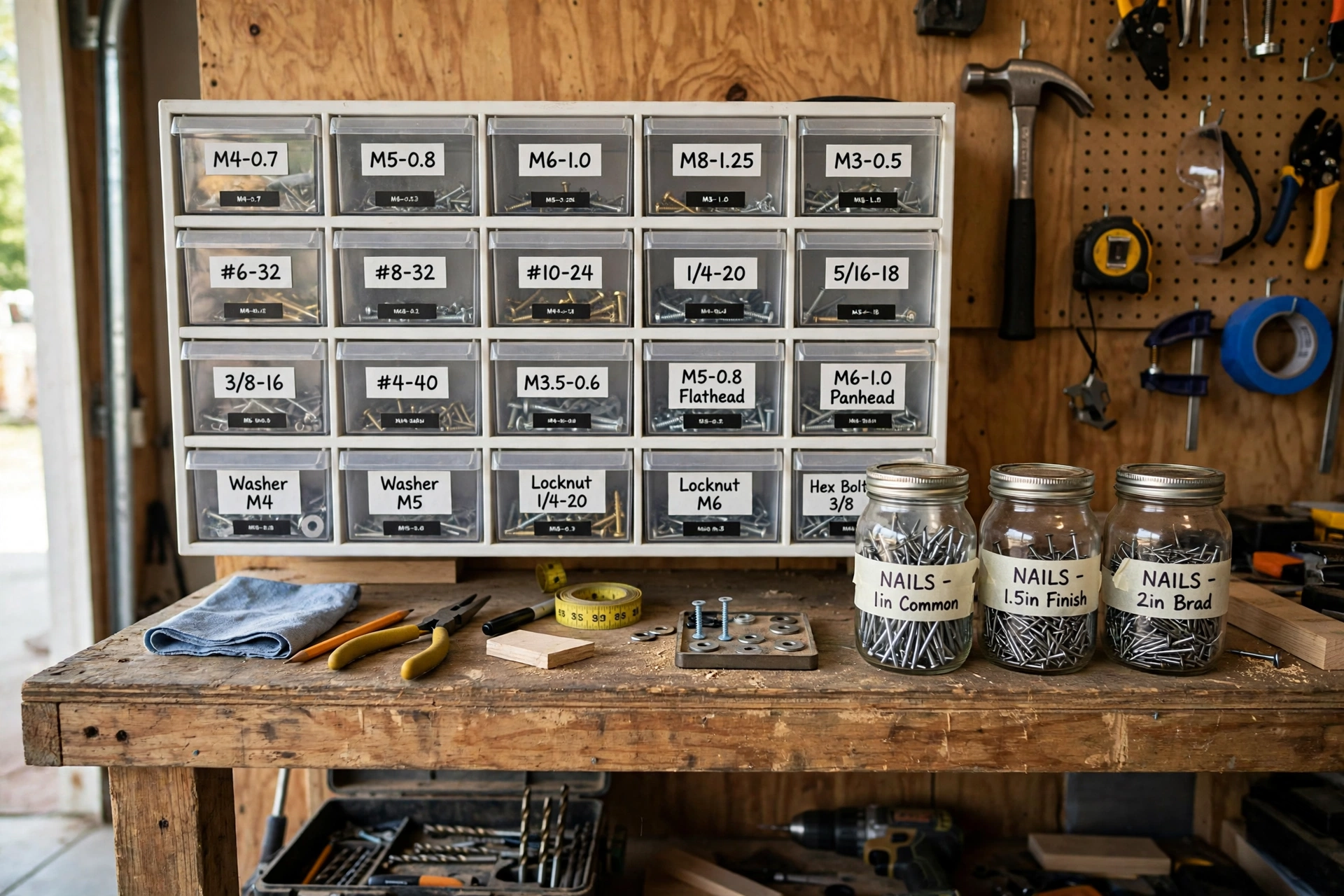
A workbench only works if it has a clear top and a home for every tool, and most garage workbenches have neither: the top is a landing strip for everything that comes through the door, and the tools live in a drawer where they cannot be found. Start by clearing the bench completely, then decide what actually belongs on it — the vise, the task light, the tools you use every week — and give everything else a home on the pegboard, in a drawer, or on a shelf. Build the bench at a height that fits you: elbow height is the rule for standing work, and a bench that is too low will hurt your back within an hour. Add a small parts organizer on the bench for screws, nails, and bolts, and a power strip mounted to the side so chargers and tools have a place to plug in. A clear workbench is an invitation to actually use it, and a cluttered one is a shelf with a fancy name.
6. Sports Gear Wall: Hooks, Bins, and a Ball Corral
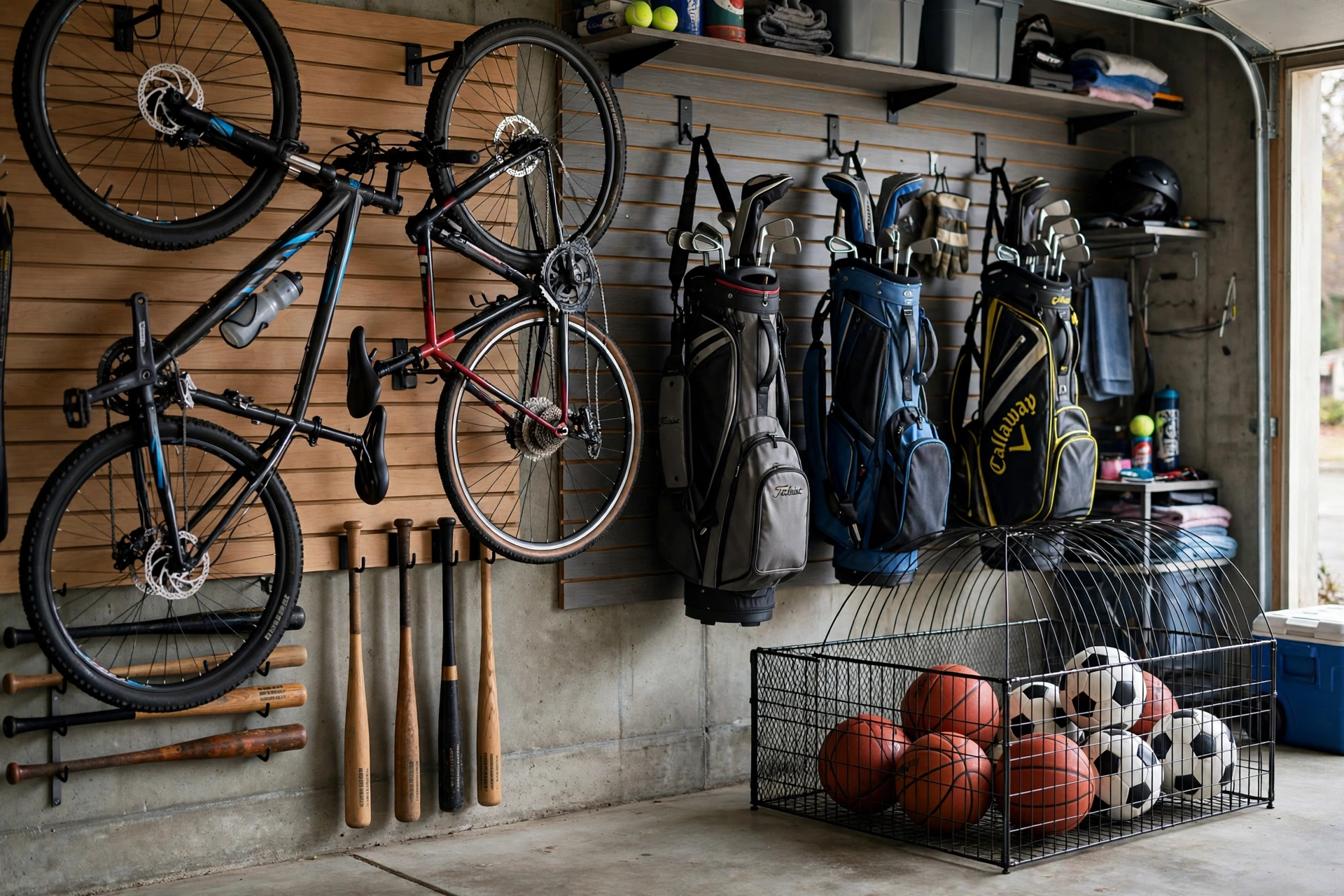
Sports gear is the messiest category in most garages because it is big, oddly shaped, and used by everyone in the house. Give it its own wall: heavy hooks for bikes, bats, and golf bags; a tall bin for balls and outdoor toys; and a low shelf for helmets, gloves, and shin guards. A ball corral — a simple frame of bungee cords or dowels that holds balls in a stack — keeps a dozen balls in one neat column instead of rolling around the floor. Assign each person in the house a hook or a bin for their gear, and label it with their name. When the gear has a labeled home, the kids put it back — most of the time — and when they do not, you can see in one glance whose gear is on the floor. Keep the sports wall near the garage door, so gear goes straight from the car to the wall and back again without crossing the whole garage.
7. Keep the Floor Clear for the Car
The floor is the most expensive real estate in the garage, because it is the only place the car can go. The rule is simple: nothing lives on the floor that can live on a wall, a shelf, or a ceiling rack. Walk through the garage and ask of everything on the floor, “Could this hang, stack, or go on a shelf?” If the answer is yes, move it. What stays on the floor is the car, the workbench, and the shelving units — everything else goes up. Mark the car’s parking spot on the floor with tape or paint, so everyone in the house can see where the car goes and nothing creeps into that space. A clear floor is also a safety issue: a garage floor with boxes and cords on it is a tripping hazard in a room where you carry heavy things and where the lighting is often poor. The car fits, the floor is clear, and you can walk from the door to the workbench without stepping over anything — that is what a finished garage feels like.
8. A Car-Care Station by the Door
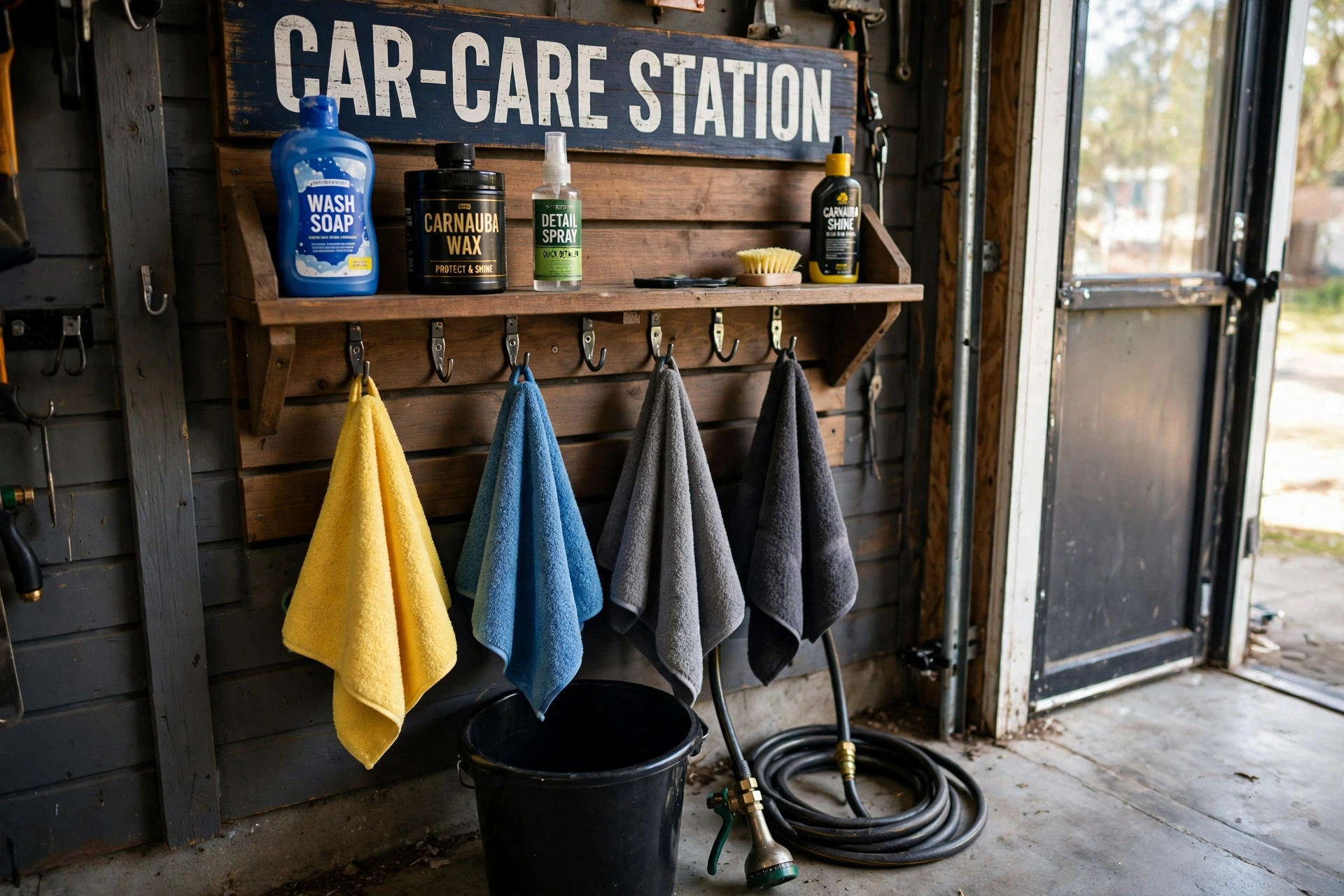
Car care supplies — wash soap, wax, microfiber towels, tire cleaner, glass cleaner — belong in one station, not scattered across three shelves. Put a small cabinet or a shelf near the garage door, at the spot where you wash the car, and keep everything for the car in it: the bucket, the hose nozzle, the drying towels, and the products. A labeled bin for each type of product keeps the station tidy, and a hook for the hose keeps it off the floor. Keep the car-care station near the driveway side of the garage so you can grab the bucket and go, and restock it when you buy car products instead of leaving the new bottle in a shopping bag on the workbench. The same station can hold the emergency kit — jumper cables, a flashlight, a tire gauge, and a first-aid kit — because the car is where you need those things, and the garage is where they live. If your shoes pile up by the door that leads into the house, our shoe storage ideas sort that spot too, so the whole entry works as one system.
9. Vertical Storage for Bikes and Bulky Gear
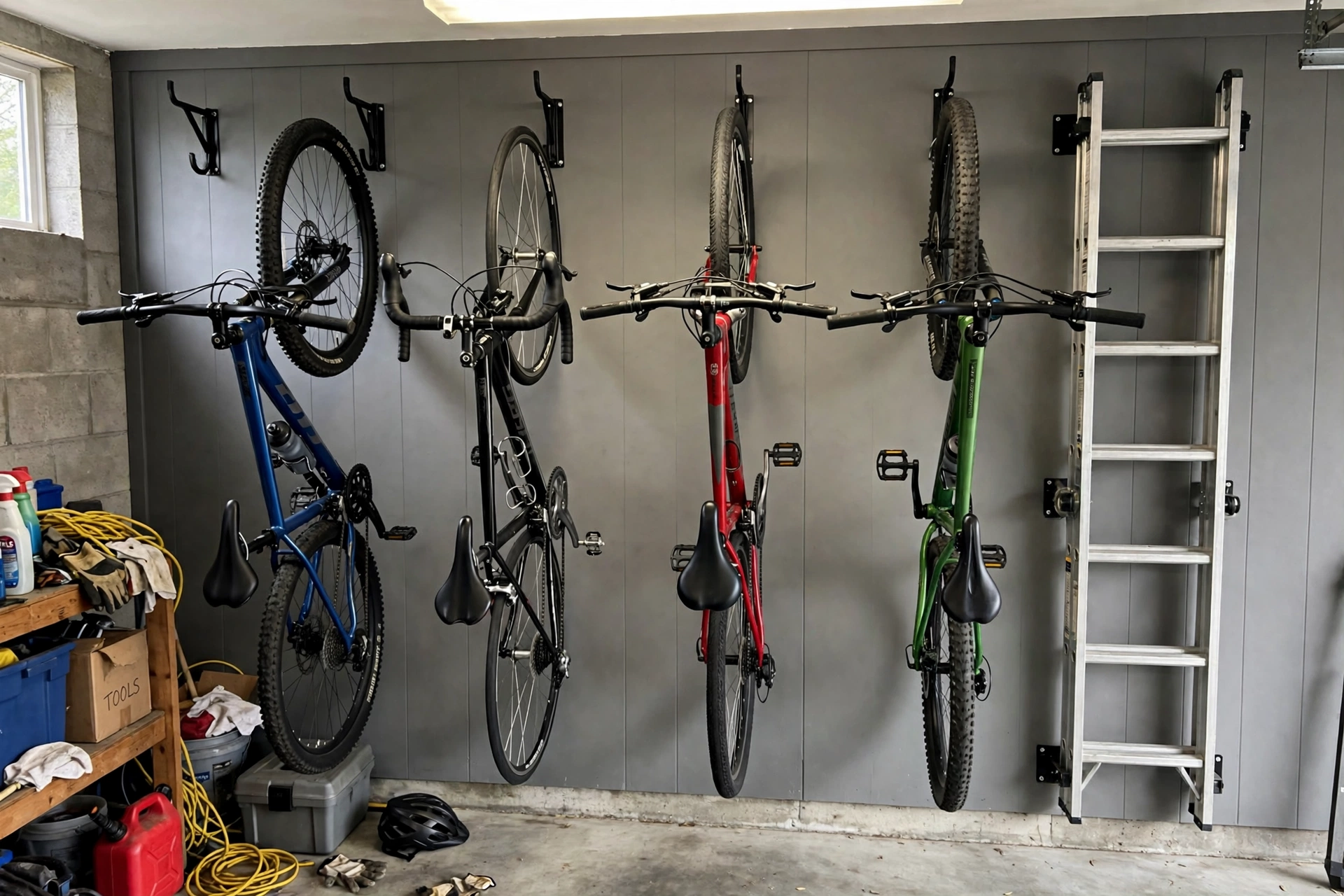
Bikes take up more floor space than almost anything else in a garage, and a family can easily have four of them. Get them off the floor with vertical storage: a wall hook that holds a bike by its front wheel, a ceiling hoist that lifts it flat against the ceiling, or a freestanding rack that holds two bikes upright in the space of one. Wall hooks are the cheapest option and work for most bikes, as long as the hook is screwed into a stud. Store the bikes in the order you use them — the daily riders where you can reach them easily, the kids’ outgrown bikes up high or on the ceiling hoist. The same vertical thinking works for ladders, kayaks, and skis: a pair of heavy-duty hooks on the wall holds a ladder flat against the wall, and a kayak hangs from straps on the ceiling. Bulky gear is only bulky when it lies on the floor; on a wall, it is just a shape on the wall.
10. A Small-Parts System: Jars and Drawer Dividers
Screws, nails, bolts, washers, and wall anchors are the smallest things in a garage and the hardest to find when you need one. Give them a system: clear jars or a parts organizer with small drawers, one compartment per type and size, labeled on the front. Mount the organizer on the wall above the workbench or on the bench itself, where you can reach it without leaving the project you are working on. Sort the parts by size as well as type — a drawer of mixed screws is barely better than a coffee can of mixed screws — and keep a small magnet dish on the bench for the screws you take out during a job, so they do not roll off and vanish into the garage floor. The rule for small parts is the same as for everything else in the garage: one home, one label, and nothing loose in a drawer. Our laundry room organization ideas use the same one-home-one-label rule for small supplies, and it works just as well in a garage as it does in a laundry room.
11. Seasonal Rotation: Swap Gear Twice a Year
A garage that holds summer gear and winter gear at the same time is a garage that holds twice as much as it needs to. Rotate seasonally: in the spring, the snow shovels, sleds, and holiday decorations go up onto the overhead rack or the high shelves, and the bikes, camping gear, and garden tools come down. In the fall, swap them back. Each rotation takes about an hour, and it keeps the gear you need now within reach and the gear you do not need out of the way. Label the seasonal bins by season, not by contents alone — “Winter” is easier to find than “Snow Shovel, Sled, Ice Melt” when you are standing on a ladder in November. The rotation is also the moment to get rid of things: if a piece of seasonal gear did not get used all season, it probably does not need to come back down next year. Two rotations a year keep the garage honest about what you actually use.
12. Garden and Yard Tools on One Wall
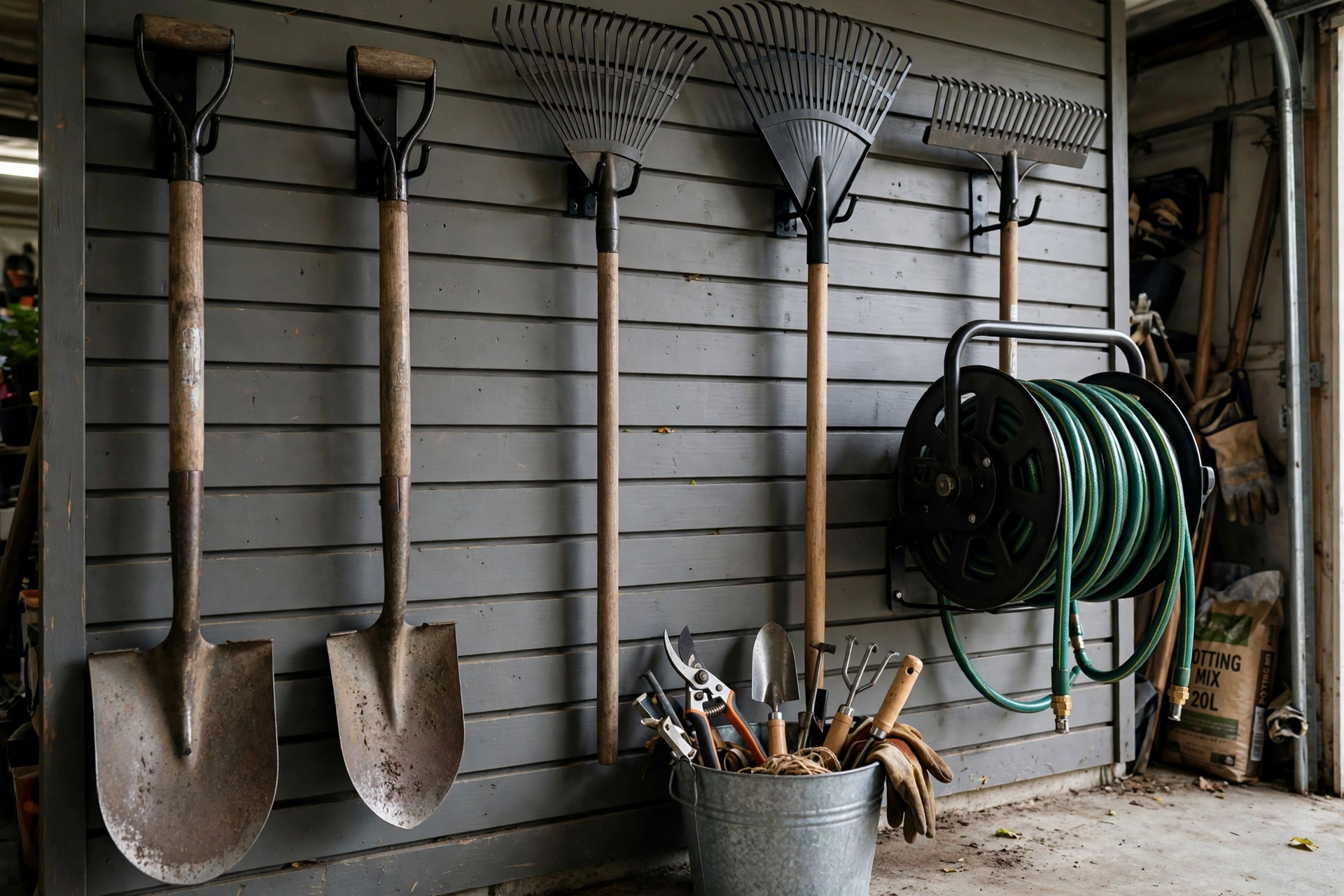
Garden tools — shovels, rakes, hoes, pruners, the hose, the leaf blower — belong on one wall, near the door to the yard. Heavy-duty hooks hold the long-handled tools upright, a small shelf holds the hand tools and the gloves, and a hose reel keeps the hose coiled instead of snaked across the floor. A five-gallon bucket with a tool roll inside holds the small tools and the seed packets, and it carries to the garden in one hand. Keep the sharp edges up and the handles down, so nobody grabs a rake by the teeth, and keep the chemicals — weed killer, fertilizer, pest spray — on a high shelf in a labeled bin, away from children and pets. The garden wall is also the best home for the lawn mower, parked at the end of the wall where it can roll straight out the door. One wall for the yard means the yard work starts at the wall, not with a search through the garage.
13. A Mudroom-Style Drop Zone Inside the Garage Door
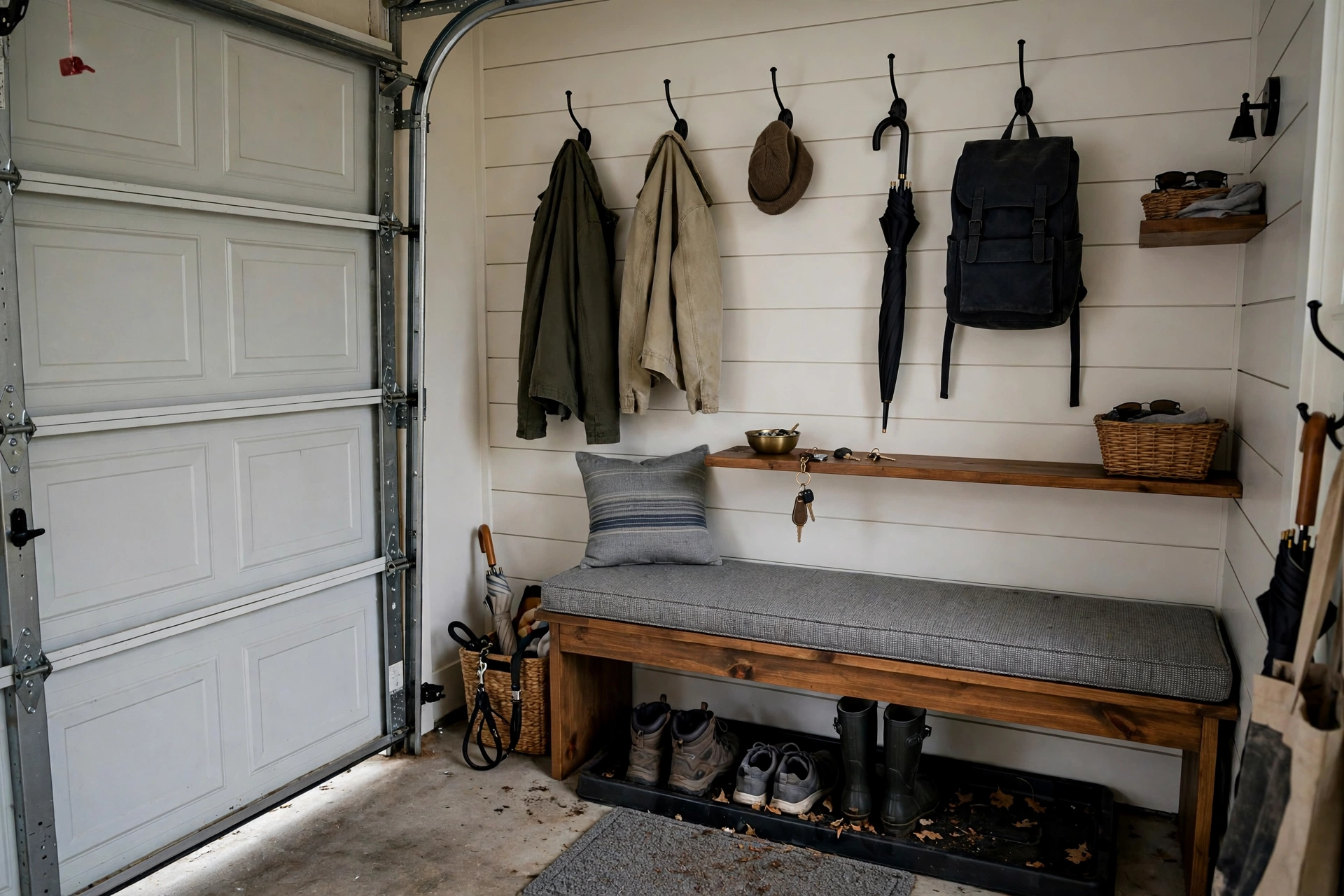
The door from the garage into the house is the busiest door in the home, and it needs a drop zone: a bench to sit on while you take off shoes, hooks for coats and bags, a shoe rack or a boot tray, and a small shelf for keys, mail, and the things that come in with you. A boot tray catches the mud and snow that would otherwise walk straight into the house, and a shoe rack keeps the pile of shoes from spreading across the garage floor. Build the drop zone on the wall beside the door, not in front of it, so the path through the door stays clear. Label a hook per person if the house is big enough to need it, and keep a small basket for the things that need to go back out to the car — the library books, the returns, the bag for the gym. A drop zone turns the garage door from a mess that walks into the house into a system that stops the mess at the door.
14. Lighting and Safety: See Everything, Trip Over Nothing
A garage that is hard to see is a garage that is hard to keep tidy, because you cannot organize what you cannot find. Replace the single bare bulb with bright LED shop lights — two or three across the ceiling, plus a task light over the workbench — and the whole garage becomes easier to use at night and in winter. Add a motion-sensor light over the door into the house, so you are never carrying groceries into a dark garage. Safety is part of organization: keep a fire extinguisher mounted by the door, keep flammable liquids like gasoline and paint thinner in a metal cabinet away from the water heater, and keep the floor clear of cords and clutter so nobody trips while carrying something heavy. Good light and a clear floor are the two cheapest safety upgrades in a garage, and they make every other organization idea work better.
15. The 15-Minute Weekly Garage Reset
No garage organization system maintains itself, and the one that fails is the one nobody checks. Put a fifteen-minute reset on the calendar for the same day every week: walk the zones, put back anything that has drifted, sweep the floor, and take out anything that belongs in the house or the trash. Fifteen minutes a week is all it takes, and it is the difference between a garage that stays organized and a garage that slides back into a storage unit within a season. During the reset, check the overhead rack and the high shelves for anything that has shifted, and check the car-care station and the workbench for supplies that need restocking. If a zone keeps getting messy, the zone is wrong — move the bin, the hook, or the shelf, and the mess usually follows the fix. The reset is also the moment to notice what you no longer need: if something has sat untouched for a year, it is time to donate it, sell it, or throw it away.
Frequently Asked Questions
How do I organize a garage on a budget? Start with zones and a floor plan, then use the cheapest storage first: pegboard for tools, heavy-duty hooks for bikes and garden tools, and clear labeled bins on steel shelving. Overhead racks and a workbench can come later. These garage organization ideas are built to work in order — clear it out, map the zones, get things off the floor — so you can do one step a month and spread the cost out over a season.
What is the best way to store things in a garage? Use zones, one per job, and get everything off the floor onto walls, shelves, and ceiling racks. Store heavy items low, light items high, and seasonal items on the overhead rack. Use clear labeled bins, one category per bin, so you can see what is inside and find it without opening five boxes. The floor stays clear for the car. That is the heart of these garage organization ideas: zones on the walls, shelves, and ceiling, and a floor kept clear for the car.
How do I keep my garage organized long term? Do a fifteen-minute reset every week: walk the zones, put back anything that has drifted, sweep the floor, and remove anything that belongs elsewhere. Rotate seasonal gear twice a year, and check the zones during the reset — if a zone keeps getting messy, the zone is wrong, not you. A weekly reset is the whole secret to a garage that stays tidy for years.
How can I organize a small garage? Use the walls and the ceiling, because the floor is the smallest part of a small garage. Pegboard, wall hooks for bikes and tools, and an overhead rack give you storage without taking floor space. Keep only one car, or no car, in a small garage if you need the room for storage — and be ruthless about what earns a spot: if it did not get used in the last year, it does not live in a small garage.
What should you not store in a garage? Do not store anything that heat, cold, or damp will ruin: photographs, important papers, electronics, or anything in a cardboard box on the floor. Keep paint, gasoline, and chemicals in a metal cabinet away from the water heater, and keep food — including pet food — out of the garage, because it attracts pests. Anything valuable or irreplaceable belongs inside the house, not in the garage.
Related Reading
- Shoe Storage Ideas
- Laundry Room Organization Ideas
- Small Closet Organization Ideas
- Pantry Organization Ideas
- How to Declutter Your Home Room by Room
- How to Clean a Dishwasher
Conclusion
A packed garage is not a lost cause — it is a room waiting for zones, walls, and a weekly reset. With these garage organization ideas — a floor plan, pegboard for tools, overhead racks for seasonal gear, labeled bins on strong shelving, and a floor kept clear for the car — the biggest room in the house becomes a space you can actually use. Start with the clean-out this weekend, map your zones, get one thing off the floor at a time, and keep the fifteen-minute reset on the calendar. A tidy garage saves you time every day, and once the car fits again, you will wonder why you waited so long.