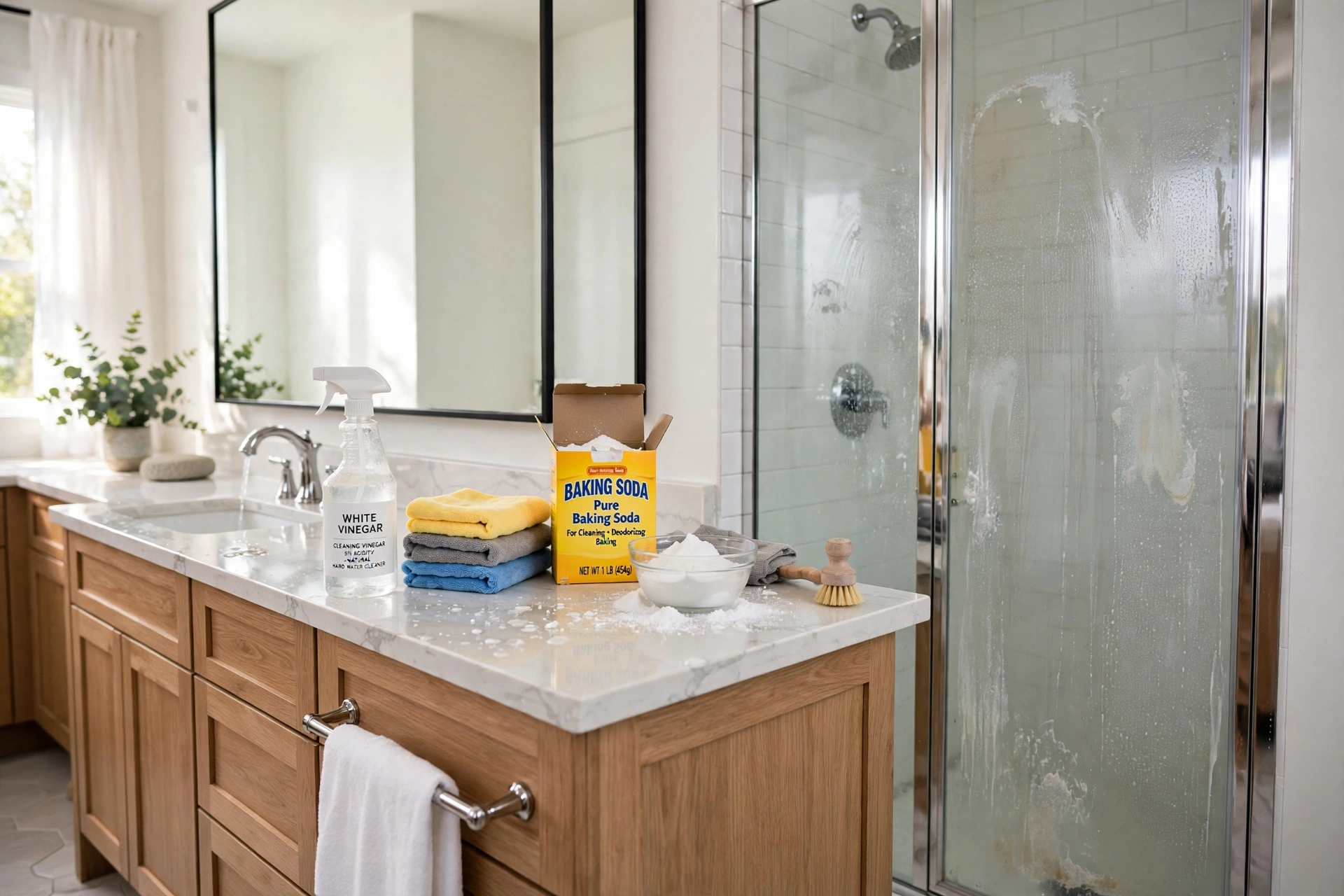
How to Remove Hard Water Stains: 15 Fixes by Surface
Introduction
Those cloudy white spots on the shower door, the chalky ring around the faucet, and the crusty white line inside the toilet bowl are not dirt, and no amount of ordinary scrubbing will make them go away. They are mineral deposits — mostly calcium and magnesium left behind when hard water evaporates — and learning how to remove hard water stains starts with that one fact: you are dissolving minerals, not washing away grime, so the fix is acid, patience, and the right tool for each surface.
The method that works on glass will etch marble, and the tool that saves a toilet bowl will scratch chrome, which is why this guide is organized surface by surface. The fifteen fixes below work through the house — glass, chrome, tile, toilet, dishes, sinks, and appliances — and finish with the heavy-duty options, the never-do list, and a severity guide. The same scale that clouds your shower door also slows your appliances: our how to clean a dishwasher guide covers the limescale inside the dishwasher, our how to clean a coffee maker guide walks through descaling, and our companion guide covers how to clean a shower head.
1. What Hard Water Stains Are (Mineral Deposits, Not Dirt)
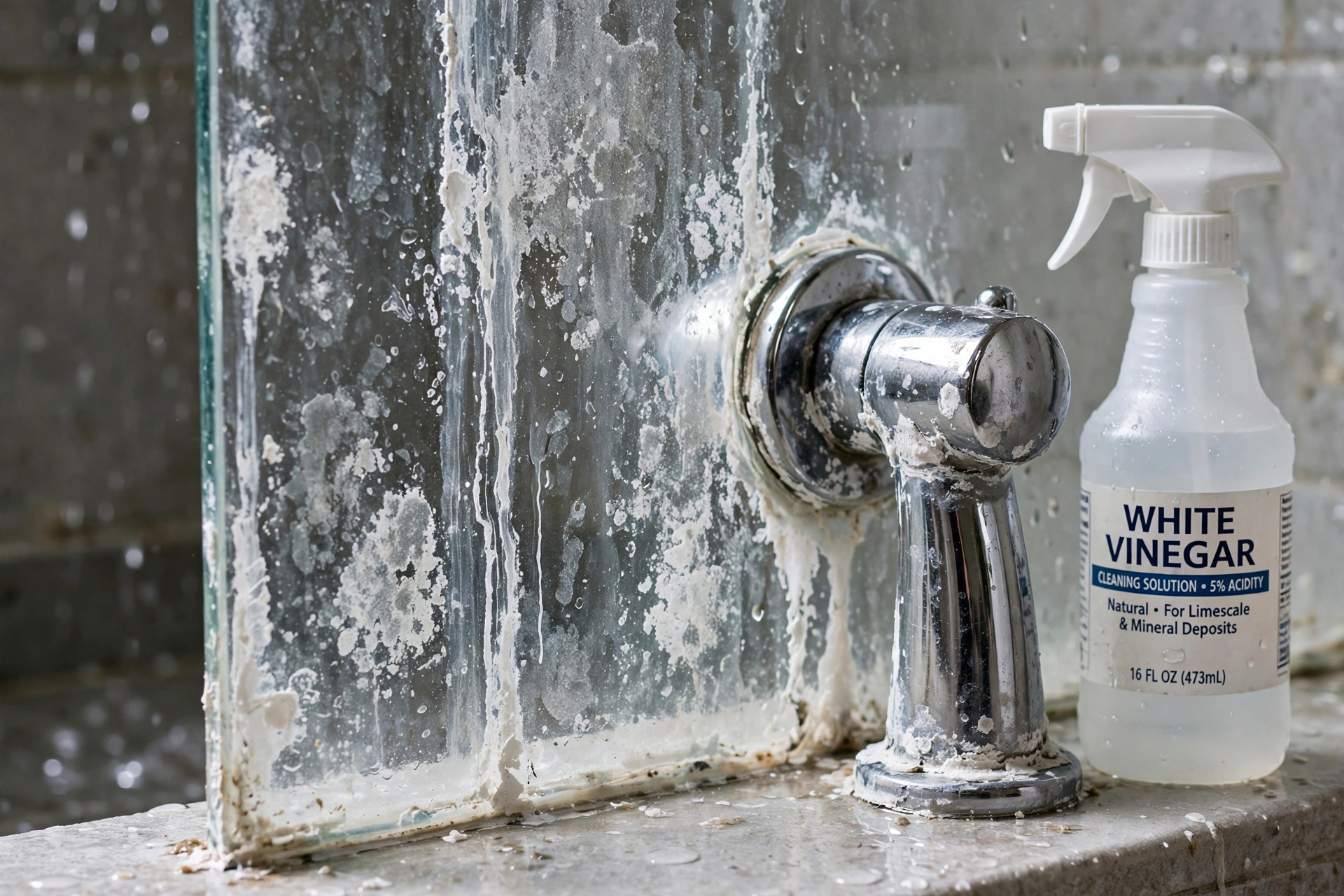
Hard water stains are mineral deposits, not dirt, and that distinction decides everything about how to remove hard water stains. When tap water evaporates, it leaves behind the dissolved minerals it was carrying — mainly calcium carbonate and magnesium. The white, cloudy, or crusty marks are those minerals crystallized on the surface, bonded more firmly the longer they sit.
This is why soap and water do almost nothing, and why the real fix is always a mild acid: vinegar, citric acid, or a commercial descaler. Acid dissolves the calcium carbonate, turning hard crust back into something you can wipe away, while scrubbing alone just polishes the minerals. First check whether the surface tolerates acid: glass, ceramic, porcelain, chrome, and stainless steel do; natural stone does not. Test any new solution on a small hidden spot first.
2. Glass Shower Doors: Vinegar Soak
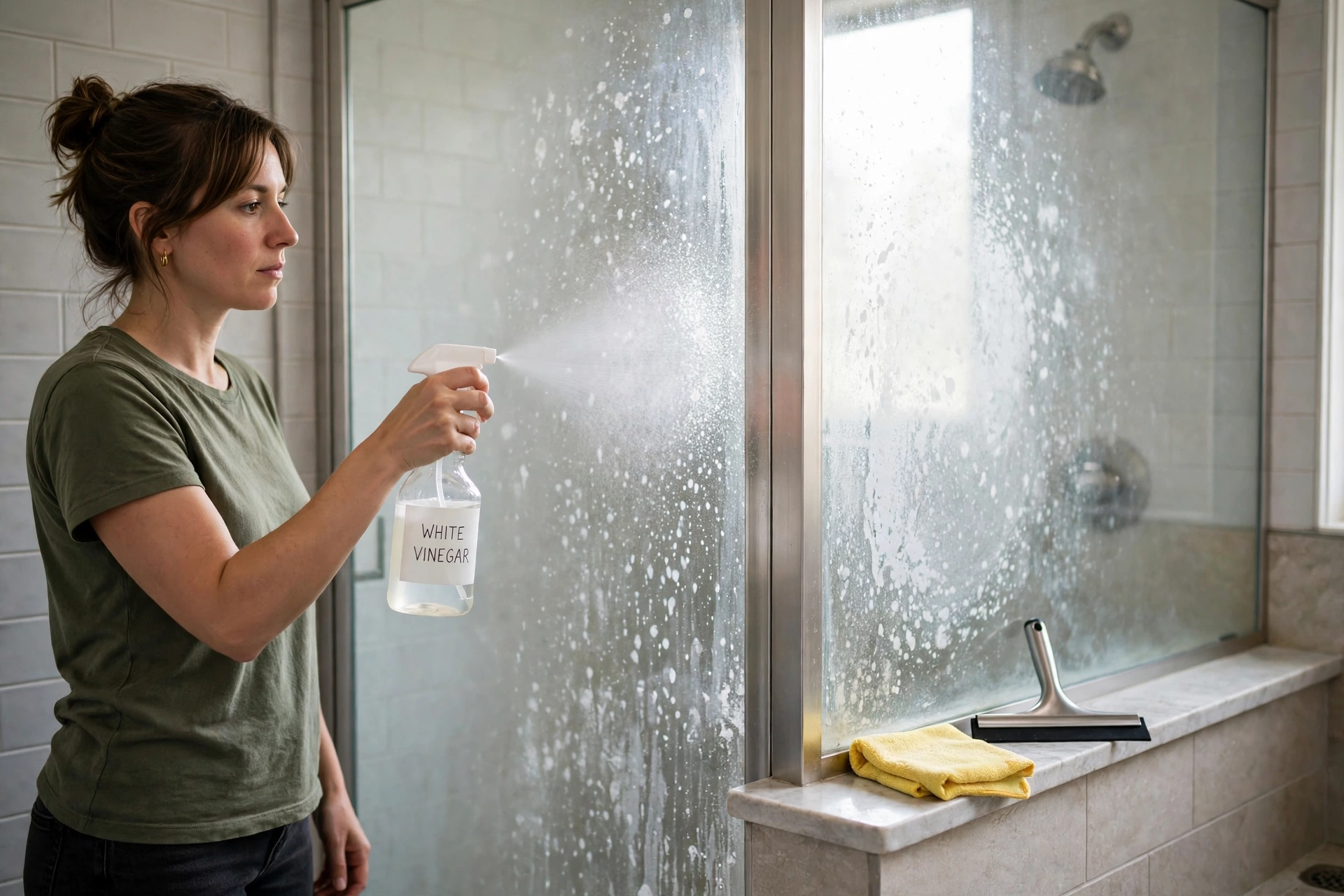
Glass shower doors show hard water stains more than any other surface, because every shower leaves mineral-rich water that dries into cloudy spots. The fix for how to remove hard water stains from glass shower doors is a vinegar soak: fill a spray bottle with undiluted white vinegar, spray the door generously, and let it sit for 15 to 30 minutes. For heavy buildup, warm the vinegar first and lay vinegar-soaked paper towels against the glass so it stays in contact.
After the soak, wipe with a microfiber cloth. Most light and medium stains will wipe away with the cloth alone. If a faint haze remains, rub a baking soda paste gently over it and rinse. Finish by squeegeeing the door dry, because every drop you leave behind is the next stain.
3. Chrome Faucets: Vinegar and Microfiber
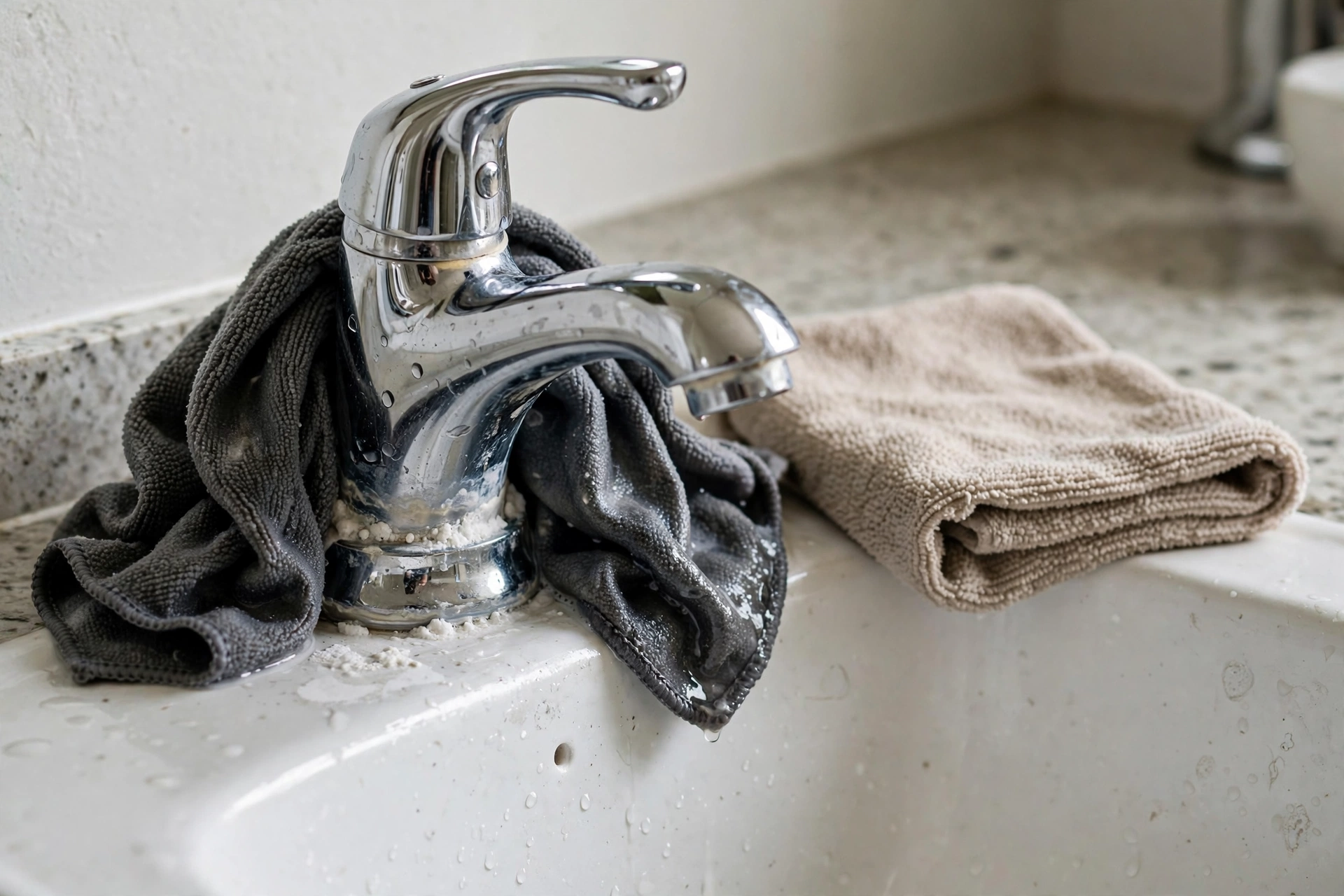
Chrome faucets collect hard water stains around the base and spout, and on chrome the tool matters as much as the cleaner. To learn how to remove hard water stains from chrome, soak a microfiber cloth in white vinegar, wrap it around the faucet or lay it over the stained area, and leave it for 15 to 20 minutes. Then wipe it clean and buff it dry with a second microfiber cloth for a streak-free shine.
Never use an abrasive pad, a scouring sponge, or a powdered cleanser on chrome. Chrome plating is thin, and one harsh scrub leaves scratches that catch minerals faster. If the vinegar cloth does not lift a stain, repeat the soak rather than scrubbing harder. Also check the aerator at the tip of the spout: unscrew it, soak it in vinegar for 30 minutes, brush it gently, and screw it back on.
4. Tile: Vinegar Spray and Scrub
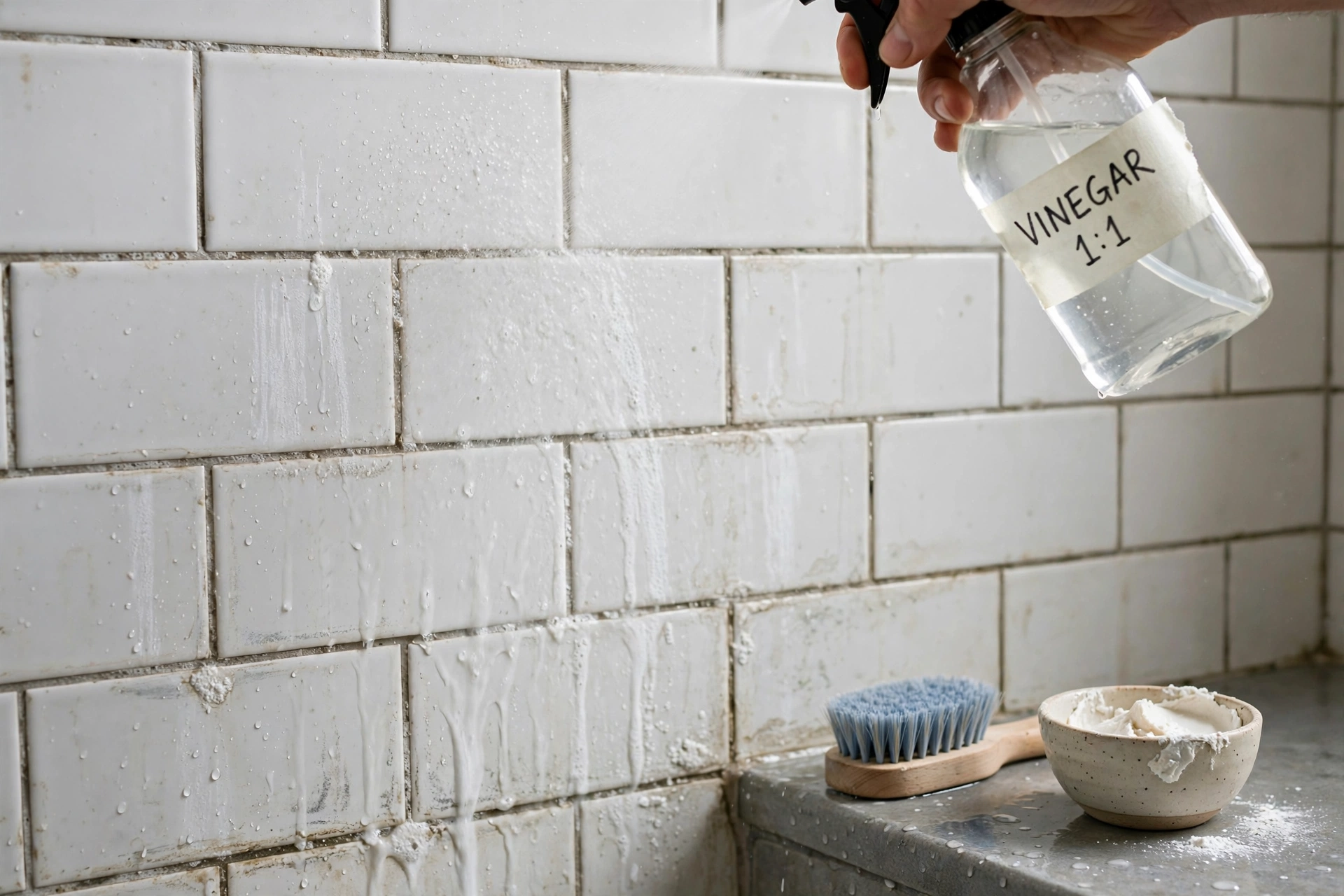
Ceramic and porcelain tile handle vinegar well, which makes tile one of the easiest surfaces for how to remove hard water stains. Spray the stained tiles with undiluted white vinegar, let it sit for 10 to 15 minutes, then scrub with a soft brush or a non-scratch scrub pad and rinse with clean water. Work in small sections on a shower wall so the vinegar does not dry before you scrub it.
For the grout lines, spread a baking soda paste along the grout, spray it with vinegar, and let it fizz for a few minutes before scrubbing with an old toothbrush. The fizzing lifts stains out of porous grout far better than either product alone. Do not use this method on natural stone tile — marble, granite, travertine, or slate — because vinegar etches stone. If you are unsure what your tile is, test the vinegar on a hidden tile first.
5. Toilet Bowl: Pumice Stone (Wet)
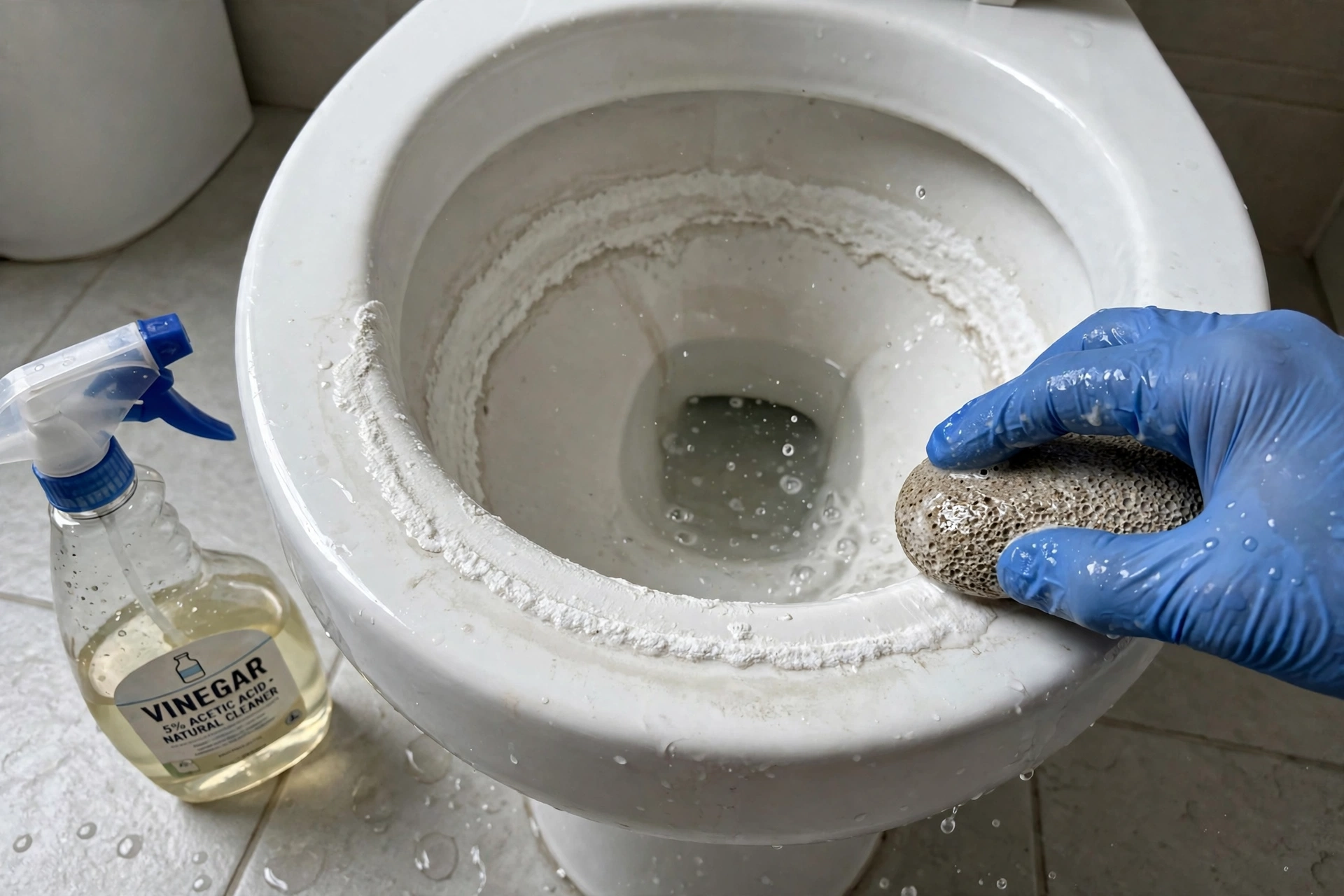
The ring inside the toilet bowl is hard water scale at its most stubborn. The tool that removes it is a pumice stone — but only a wet one, used on a wet surface. To learn how to remove hard water stains from a toilet bowl, lower the water level by turning off the supply valve and flushing once, then wet the pumice stone and rub it gently over the ring, keeping both stone and porcelain wet the whole time.
A wet pumice stone is softer than porcelain, so it grinds away the mineral ring without scratching the glaze — as long as it stays wet. A dry stone on dry porcelain will scratch, so re-wet the stone every few strokes. Flush to rinse, and repeat on any remaining patches. Wear gloves, and do not use a pumice stone on any other bathroom surface — it is too abrasive for chrome, fiberglass, or acrylic tubs.
6. Toilet Tank: Vinegar Flush
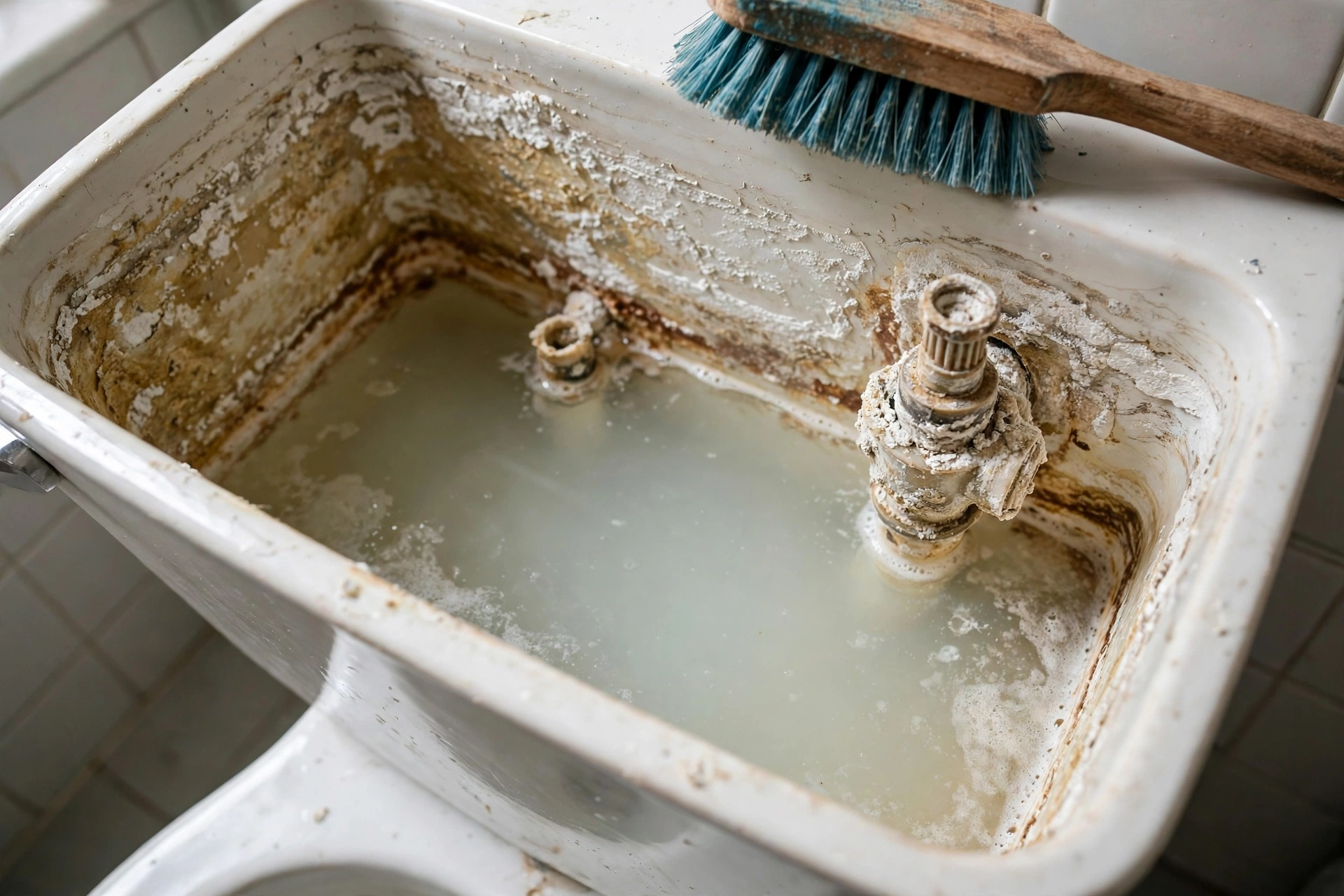
The toilet tank hides the same scale that rings the bowl, coating the fill valve, the flapper, and the tank walls — and a scaled-up tank is a toilet that fills slowly and runs longer than it should. Learning how to remove hard water stains from the toilet tank is a simple vinegar flush: turn off the water supply, flush to empty the tank, and pour in enough white vinegar to cover the stained areas, usually about a gallon for a standard tank. Let it sit for several hours, or overnight for heavy buildup, then scrub the walls and parts with a brush and flush to rinse.
While it works, check the rubber flapper and fill valve for stiffness or white crust. Scale makes rubber parts stiff and leaky, and a running toilet wastes far more water than the vinegar costs. If the flapper is crusty and warped, replace it — it is a five-dollar part and takes five minutes. Never put bleach and vinegar in the tank together, or pour descaler in while bowl cleaner is sitting in the bowl.
7. Dishes and Glassware: Vinegar Rinse
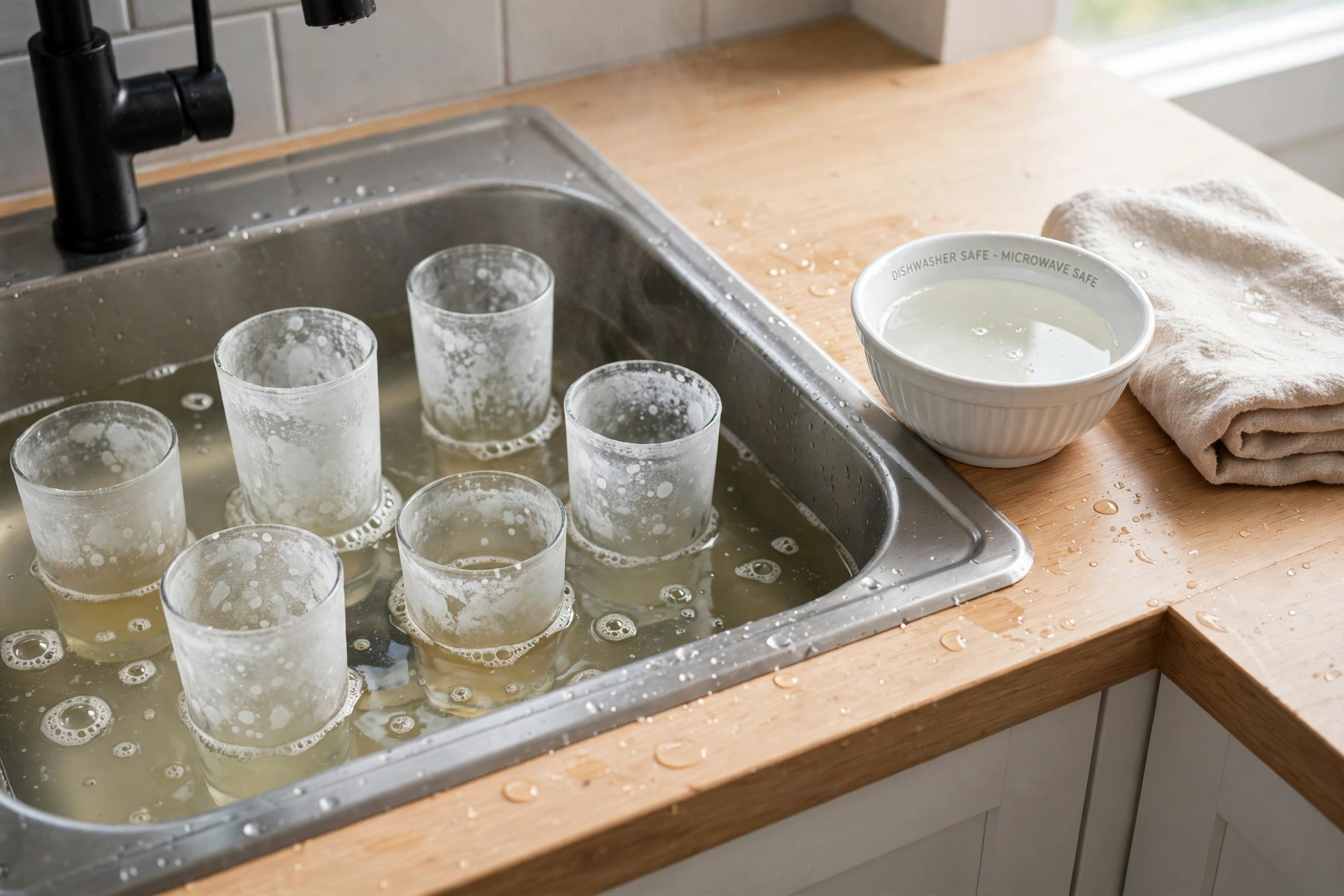
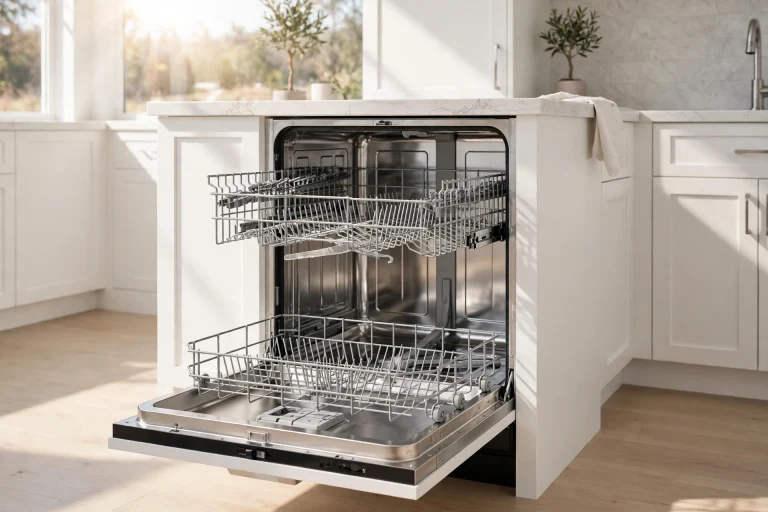
Cloudy glasses and white spots on dishes are the most visible sign of hard water in the kitchen, and they are also the easiest to fix. The trick for how to remove hard water stains from dishes and glassware is a vinegar rinse: add a cup of white vinegar to the rinse-aid dispenser, or place a bowl of vinegar on the top rack and run a normal cycle with no detergent. The hot water and the vinegar dissolve the mineral film as the cycle runs, and the glasses come out clear.
For glasses that are already badly clouded, soak them in a sink of warm water with a cup of vinegar for 30 minutes, then wash them by hand with dish soap and dry them immediately with a soft towel. Air-drying is what puts the spots back, so drying by hand is half the fix. If a glass stays cloudy after a vinegar soak, it may be etched rather than stained — years of hard water and heat can permanently cloud glass, and etched glass cannot be restored.
8. Sinks: Baking Soda Paste
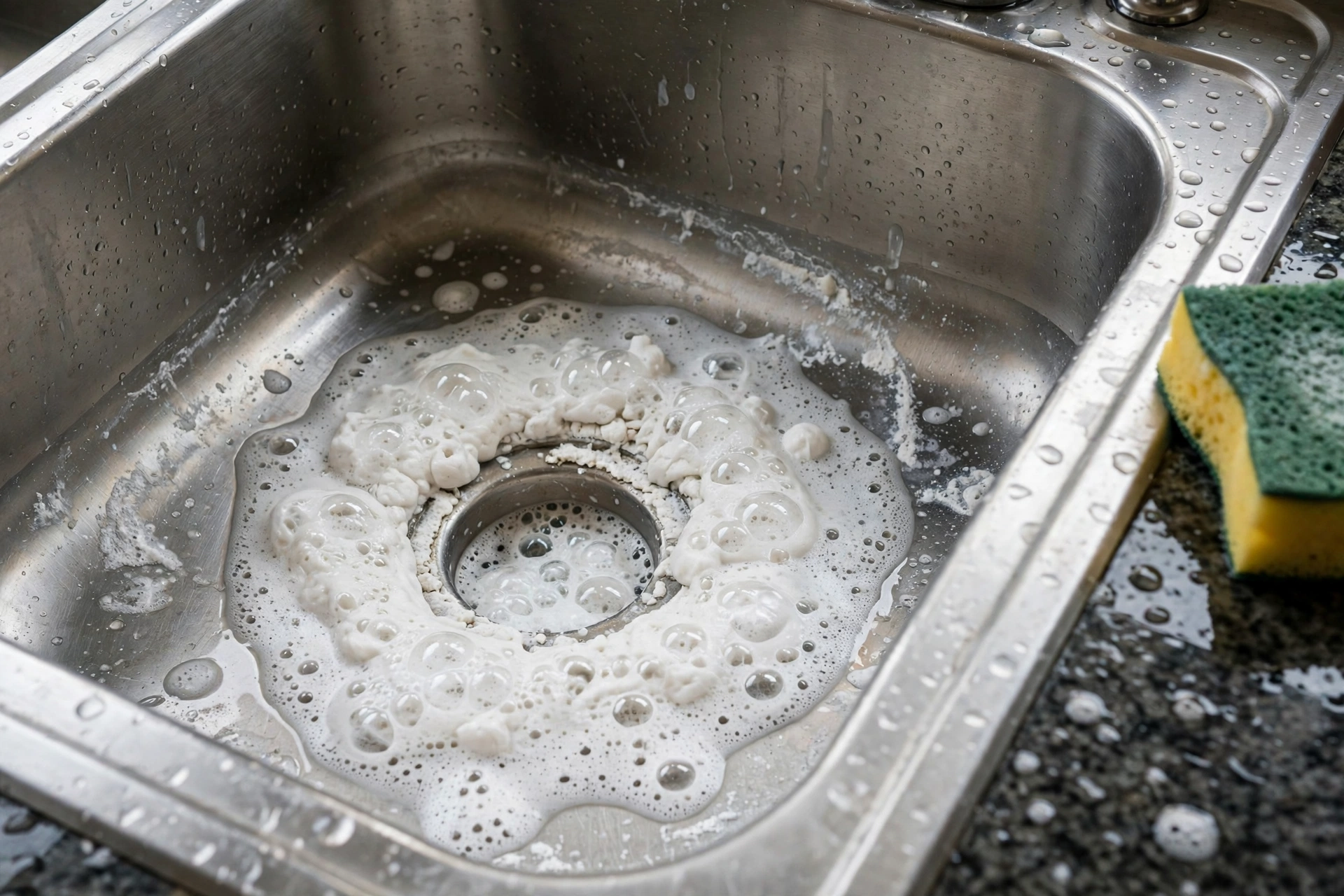
Kitchen and bathroom sinks collect hard water stains around the drain, along the waterline, and anywhere the faucet drips, and the safest everyday fix is a baking soda paste. For how to remove hard water stains from a sink, mix baking soda with just enough water to make a thick paste, spread it over the stained areas, and let it sit for 15 minutes. Then spray the paste with white vinegar, let it fizz, and scrub gently with a soft sponge or an old toothbrush around the drain and the faucet base. Rinse with clean water and dry the sink with a towel.
This method works on stainless steel, porcelain, and ceramic sinks. On stainless steel, always scrub in the direction of the grain — the faint lines you can see in the metal — so you do not leave visible scratches. On porcelain, the paste is gentle enough for regular use; skip the vinegar step on any sink you are not sure about — baking soda alone lifts light stains without any acid.
9. Kettles and Coffee Makers: Descale
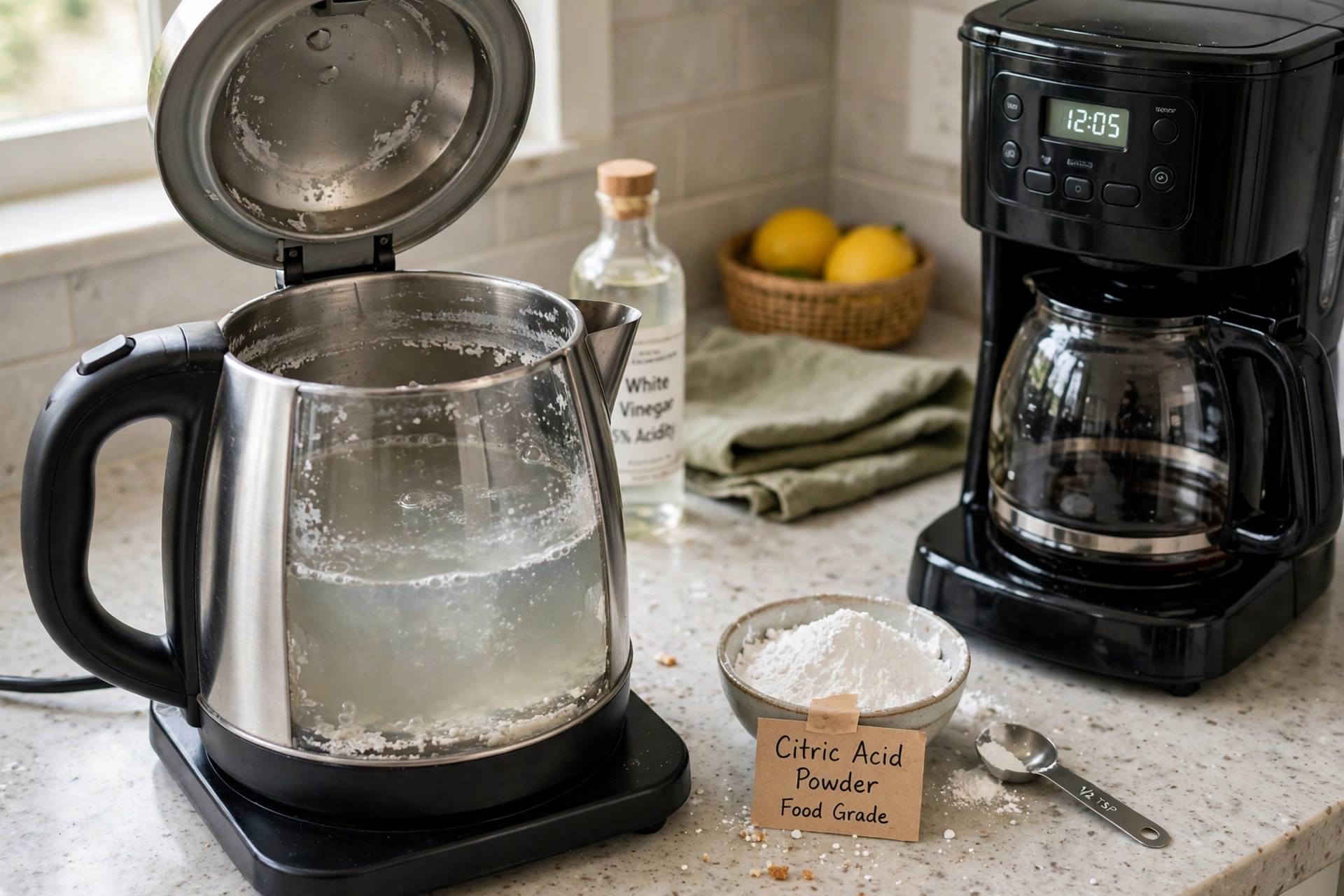
Kettles and coffee makers do not just show hard water stains — they suffer from them. Scale coats the heating element, so the machine heats slowly, brews cooler, and eventually stops working. Learning how to remove hard water stains from a kettle or coffee maker means descaling: for a kettle, boil a mix of equal parts white vinegar and water, let it sit for 30 minutes, then rinse and boil plain water once to clear the smell. For a coffee maker, run the same vinegar-and-water mix through a brew cycle, then run two full cycles of plain water to rinse it out.
Citric acid is the odorless alternative — one to two tablespoons per quart of water, run through the machine the same way. Our how to clean a coffee maker guide covers the full descaling routine for drip, pod, French press, and espresso machines. Descale once a month if you brew daily, and every two months for lighter use. Never descale with bleach, and never run a descaling solution through a machine that still has its charcoal water filter installed — the acid ruins the filter.
10. Shower Head: Vinegar Bag Method
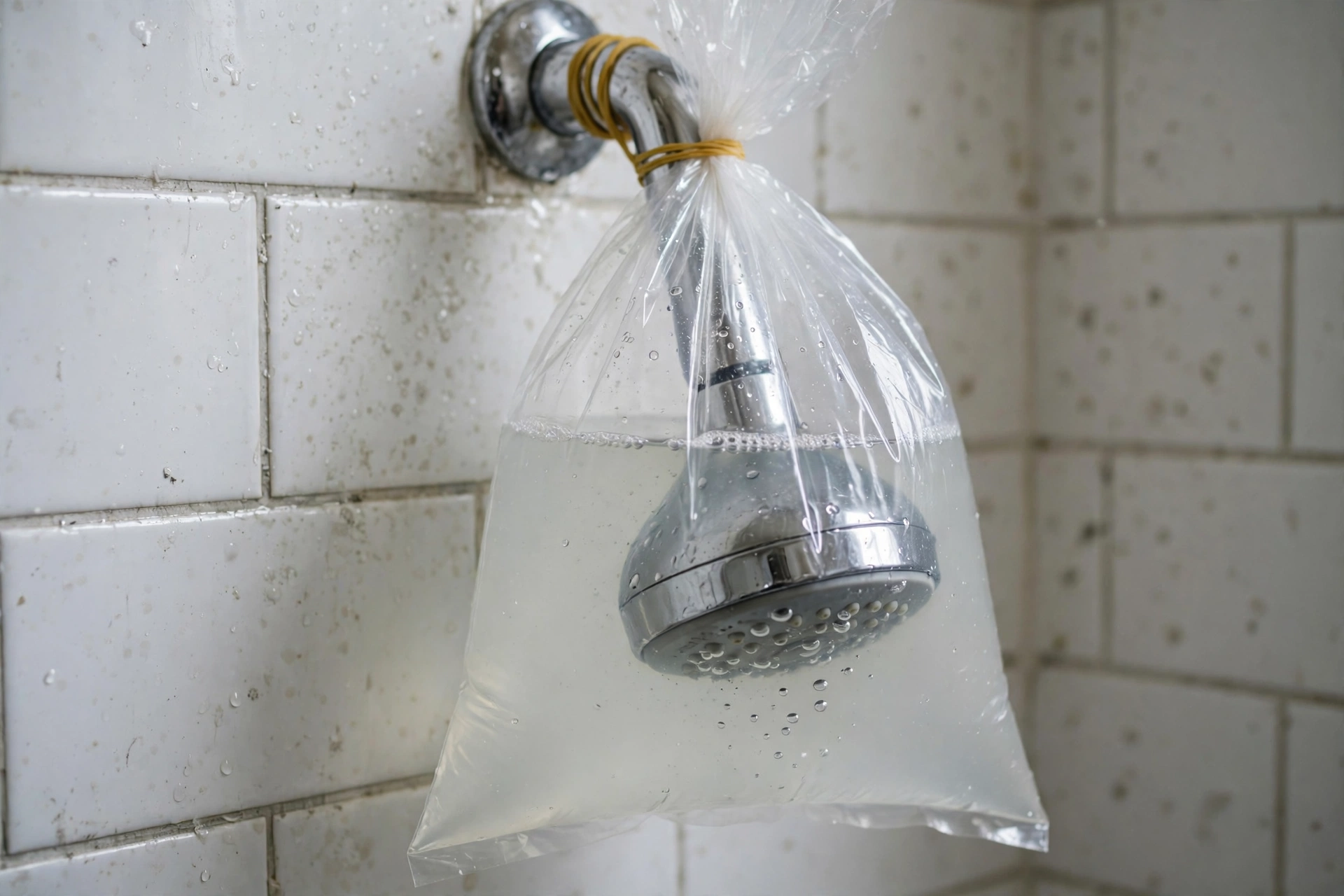
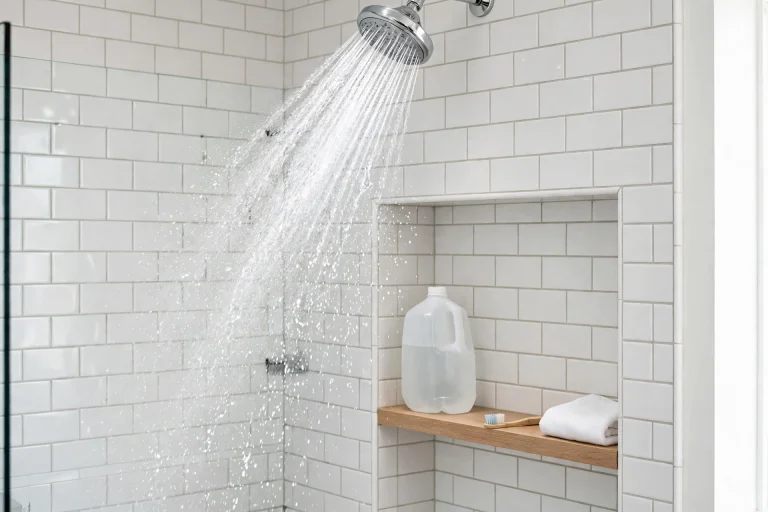
A shower head clogged with hard water scale sprays unevenly, loses pressure, and eventually clogs completely — and the fix does not require removing it. The vinegar bag method is the classic way to learn how to remove hard water stains from a shower head: fill a sturdy plastic bag with enough white vinegar to cover the shower head, tie or rubber-band the bag around the head so it is fully submerged, and leave it for 30 to 60 minutes. For heavy buildup, leave it overnight. Then remove the bag, run the shower for a minute or two to flush the loosened scale, and poke any still-clogged nozzles gently with a toothpick — never a pin or wire, which can damage the outlets.
Rub the rubber nozzles with your thumb first — many modern heads have flexible silicone nozzles that shed loose scale with a quick rub. If the head is removable, unscrew it and soak it in a bowl of vinegar instead — faster, and you can clean the inlet mesh filter too. For the full step-by-step, including finish safety for brass, gold, and nickel heads, see our companion guide on how to clean a shower head.
11. Citric Acid for Heavy Buildup
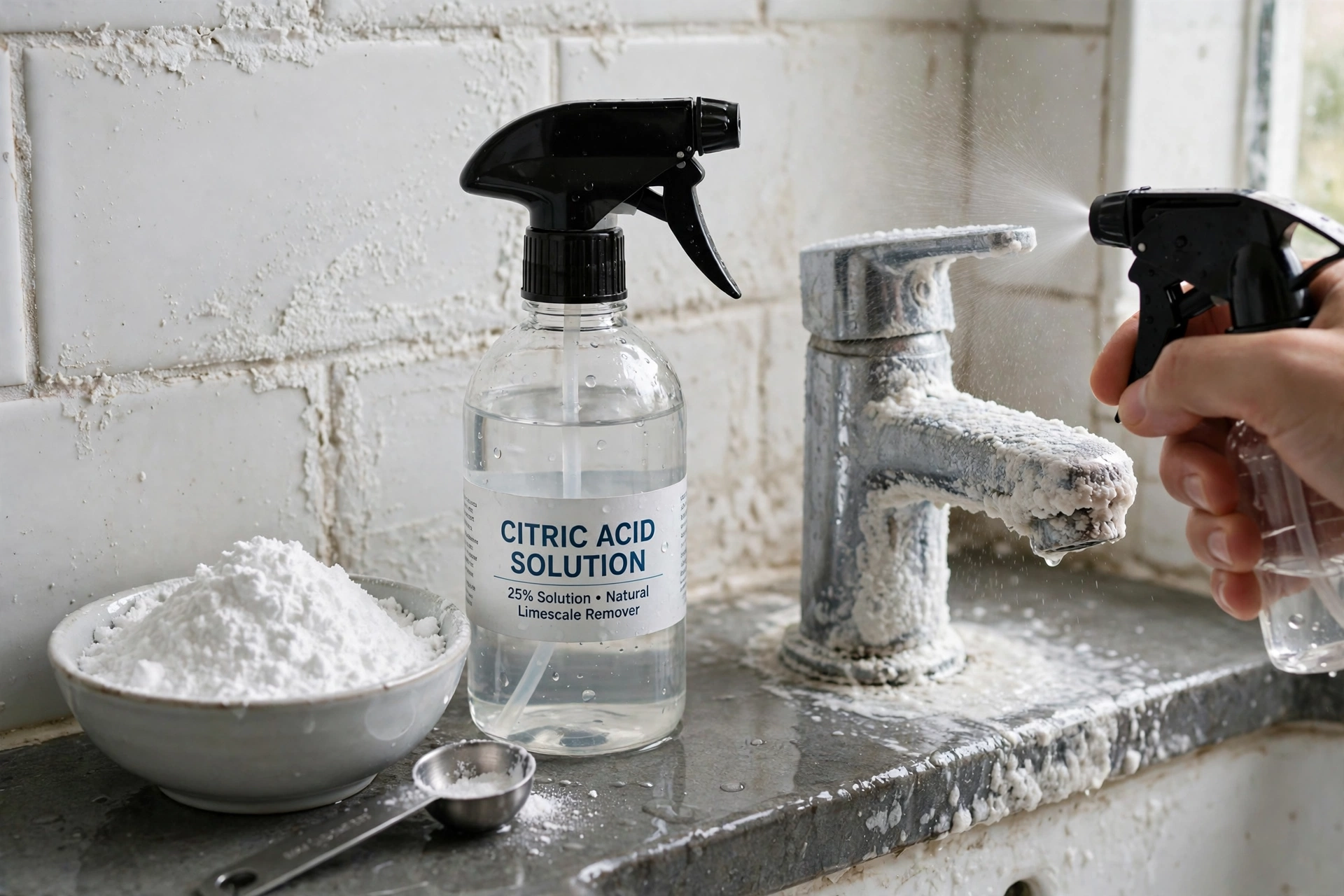
When vinegar soaks are not enough — the stains are thick, crusty, and months or years old — citric acid is the next step up. Citric acid is a stronger descaler than vinegar, it is odorless, and it dissolves heavy limescale faster, which is why it is the active ingredient in many commercial descaling solutions. To use it for how to remove hard water stains on heavy buildup, dissolve one to two tablespoons of food-grade citric acid powder per quart of warm water, apply it to the stained surface with a cloth or spray bottle, and let it sit for 15 to 30 minutes before scrubbing and rinsing.
Citric acid works well on glass, ceramic, porcelain, chrome, and stainless steel, and it is the best choice inside a kettle or coffee maker when vinegar leaves a smell behind. Buy it in the canning aisle or online in a small bag — a little goes a long way, and it keeps for years in a dry jar. Do not use citric acid on natural stone either: it is still an acid, and the same etching rule applies as with vinegar.
12. Commercial Descalers (When DIY Is Not Enough)
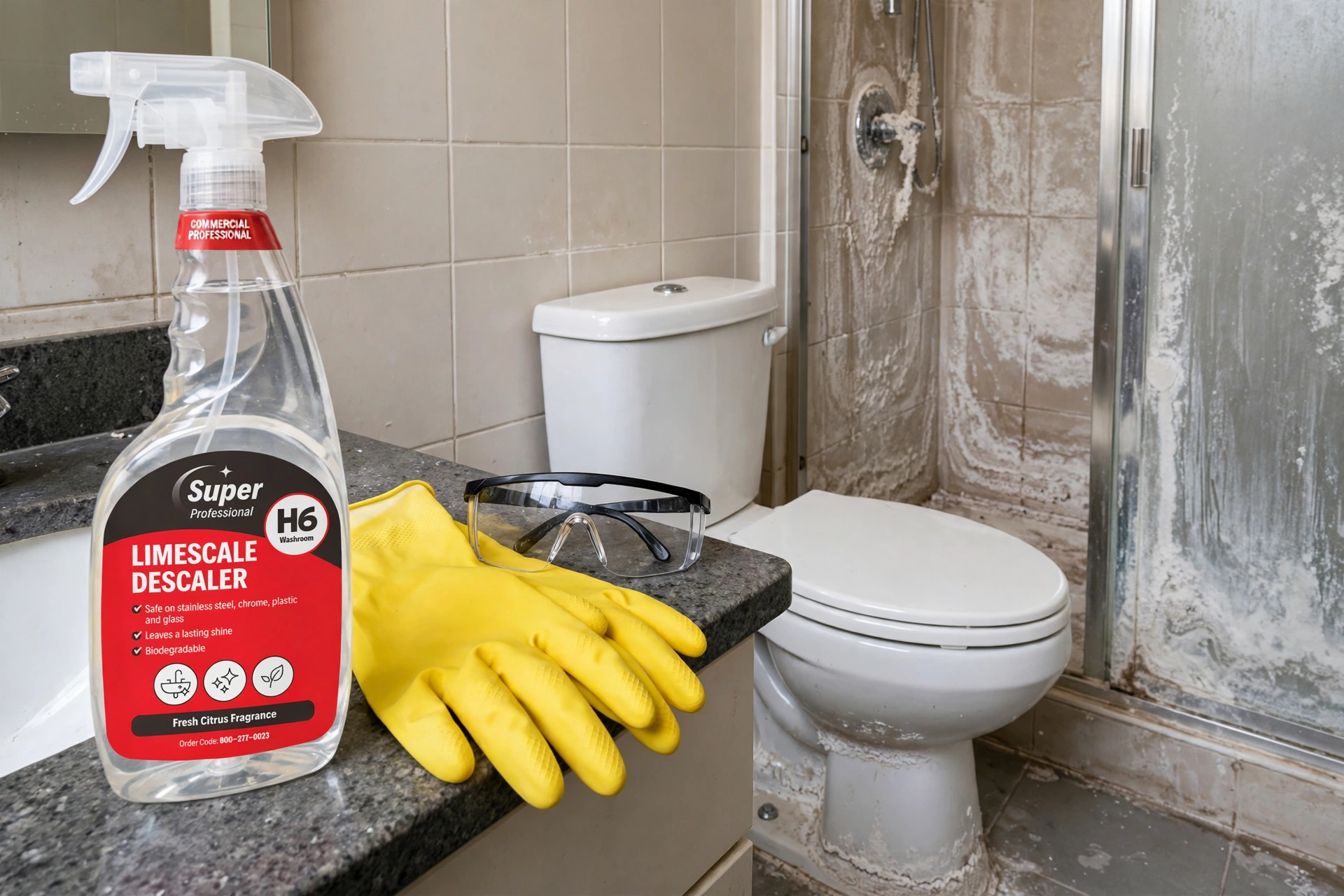
Sometimes the buildup is too thick, too old, or too widespread for vinegar and citric acid to handle in a reasonable time, and that is when a commercial descaler earns its place. Commercial descalers use stronger acids in a controlled formula, plus surfactants that keep the acid in contact with the scale, and they can dissolve in minutes what vinegar takes hours to soften. For how to remove hard water stains that DIY methods cannot shift, a commercial descaler is the right tool, not a failure of the DIY approach.
Read the label before you buy, and match the product to the surface. Some descalers are safe for glass, ceramic, and porcelain but not for chrome or stone; others are made specifically for toilets or for shower glass. Follow the dilution and contact-time instructions exactly — more product does not clean better, it damages the surface faster. Ventilate the room, wear gloves and eye protection, and rinse thoroughly. Never mix a commercial descaler with bleach, with another cleaner, or with vinegar: mixing acids and bleach creates chlorine gas, which is dangerous even in small amounts.
13. What Never to Do: Acid on Marble and Granite, Abrasives on Chrome
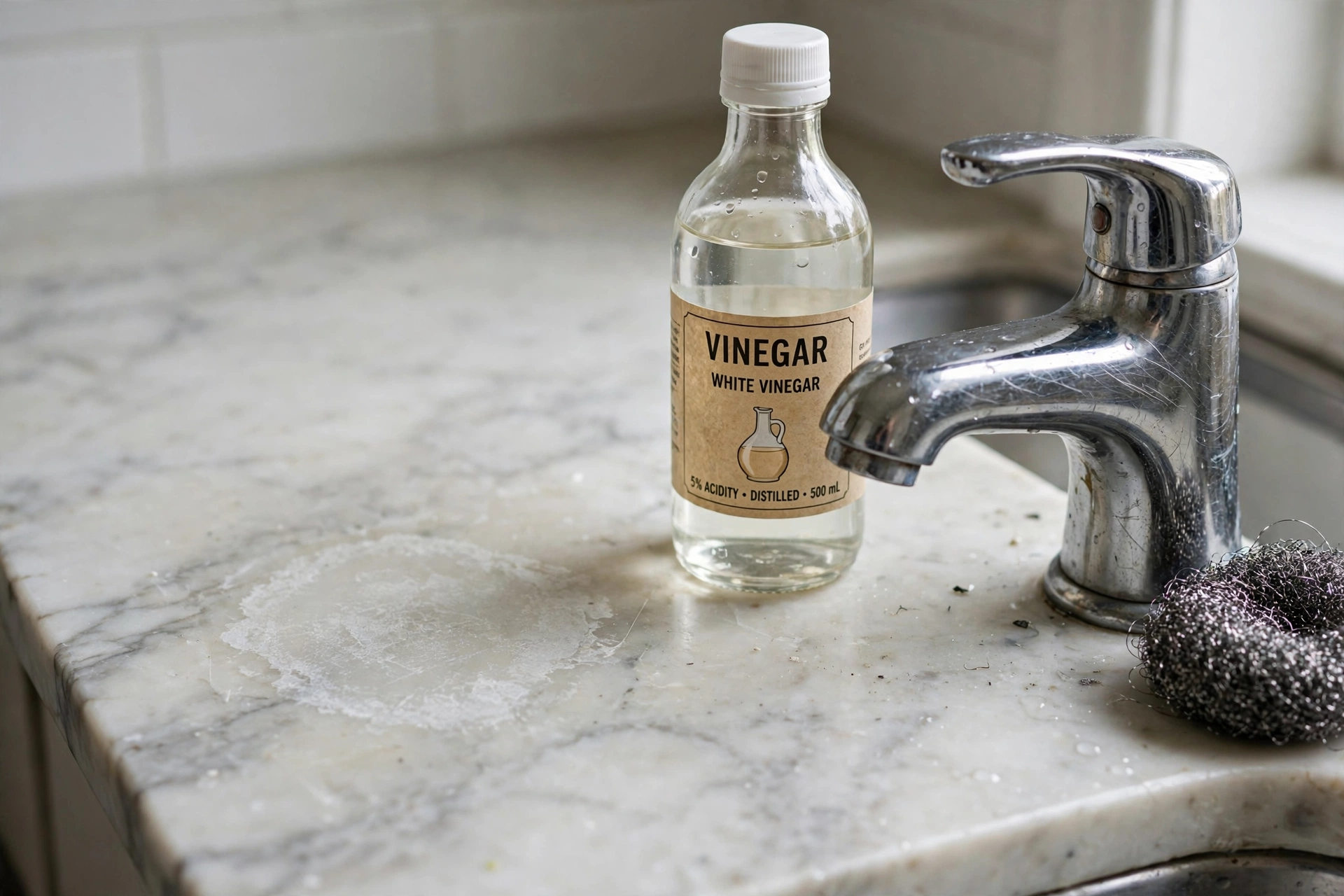
The fastest way to make hard water stains worse is to use the right cleaner on the wrong surface, so this is the rule that protects every other fix in this guide. Never use acid — vinegar, citric acid, lemon juice, or a commercial descaler — on natural stone. Marble, granite, travertine, limestone, and slate are all calcium-based or acid-sensitive, and acid etches them: it eats into the polished surface and leaves a dull, rough spot that no cleaner can undo. For stone, use a pH-neutral stone cleaner and a soft cloth only, and wipe up water promptly so it never dries into a stain.
Never use abrasives on chrome, either. Steel wool, scouring pads, powdered cleansers, and the green scrubbing side of a kitchen sponge all scratch chrome plating, and scratched chrome catches minerals faster and rusts sooner. The same rule applies to brushed nickel, oil-rubbed bronze, and gold finishes — treat coated finishes gently. Two more never-do items: never mix vinegar or any acid with bleach, which creates dangerous chlorine gas, and never use a dry pumice stone on any surface — pumice is only safe when it is wet and the surface is wet, and only on porcelain.
14. Prevention: Wipe Dry, Water Softener
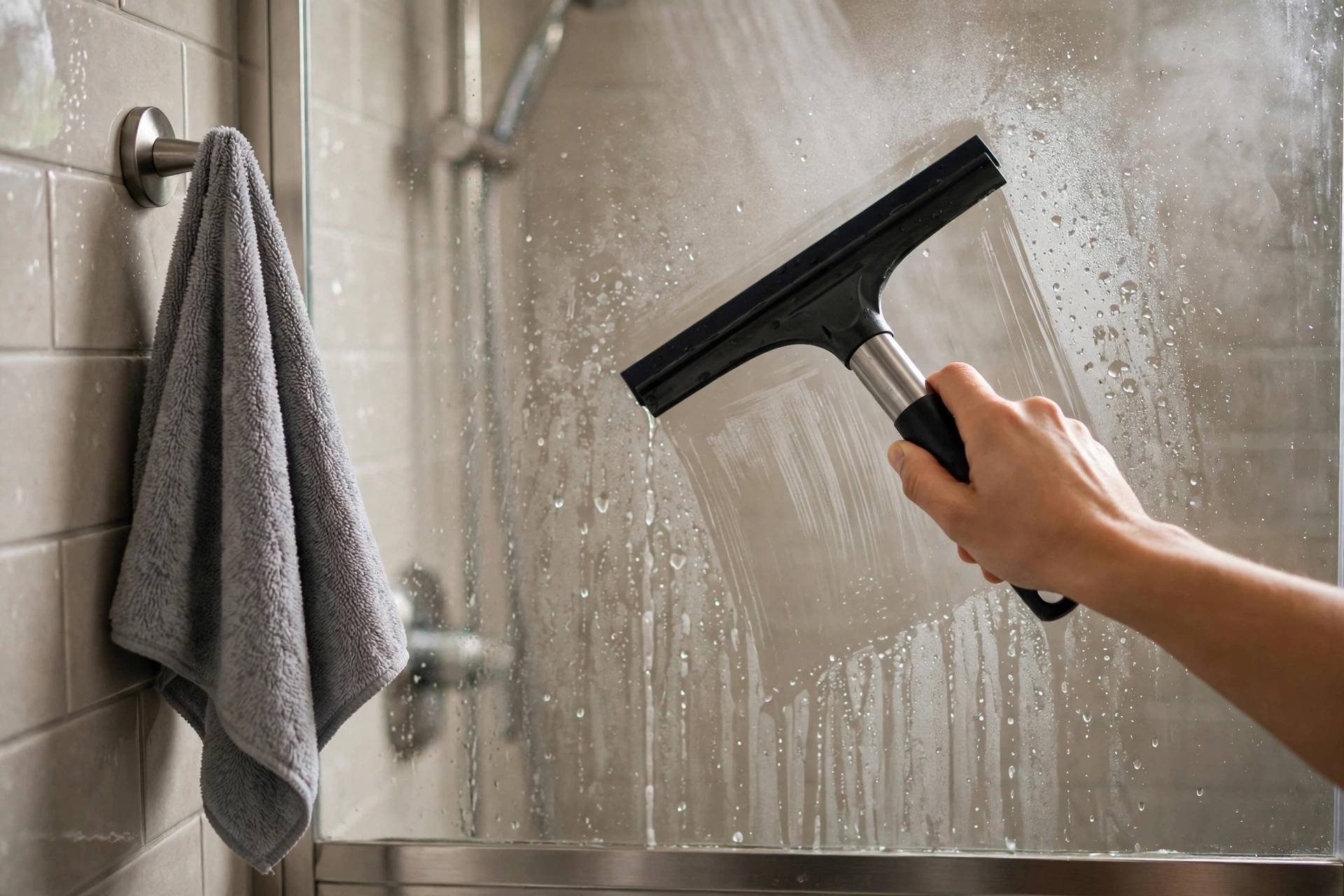
The cheapest way to learn how to remove hard water stains is to never let them form. Prevention takes seconds a day and saves hours of descaling: wipe the shower door, the faucet, and the sink dry after every use with a squeegee or a microfiber cloth. Every drop you wipe away is minerals that never get the chance to crystallize, and a shower door that is squeegeed daily stays clear for months while an unwiped one clouds in a week. Keep a squeegee on a hook inside the shower, and dry the faucet base after washing up.
For the whole house, the real fix is a water softener. A softener removes the calcium and magnesium from the water before it reaches your taps, which stops new stains from forming anywhere — shower doors, toilets, dishes, kettles, and appliances all at once. It costs more than a bottle of vinegar and needs salt and occasional maintenance, but in a very hard-water area it pays for itself in longer appliance life. If a full softener is not an option, a shower-head filter or a small under-sink filter for the kitchen can reduce scale in the worst spots.
15. Severity Matrix (Light, Medium, Heavy — Pick the Method by Severity)
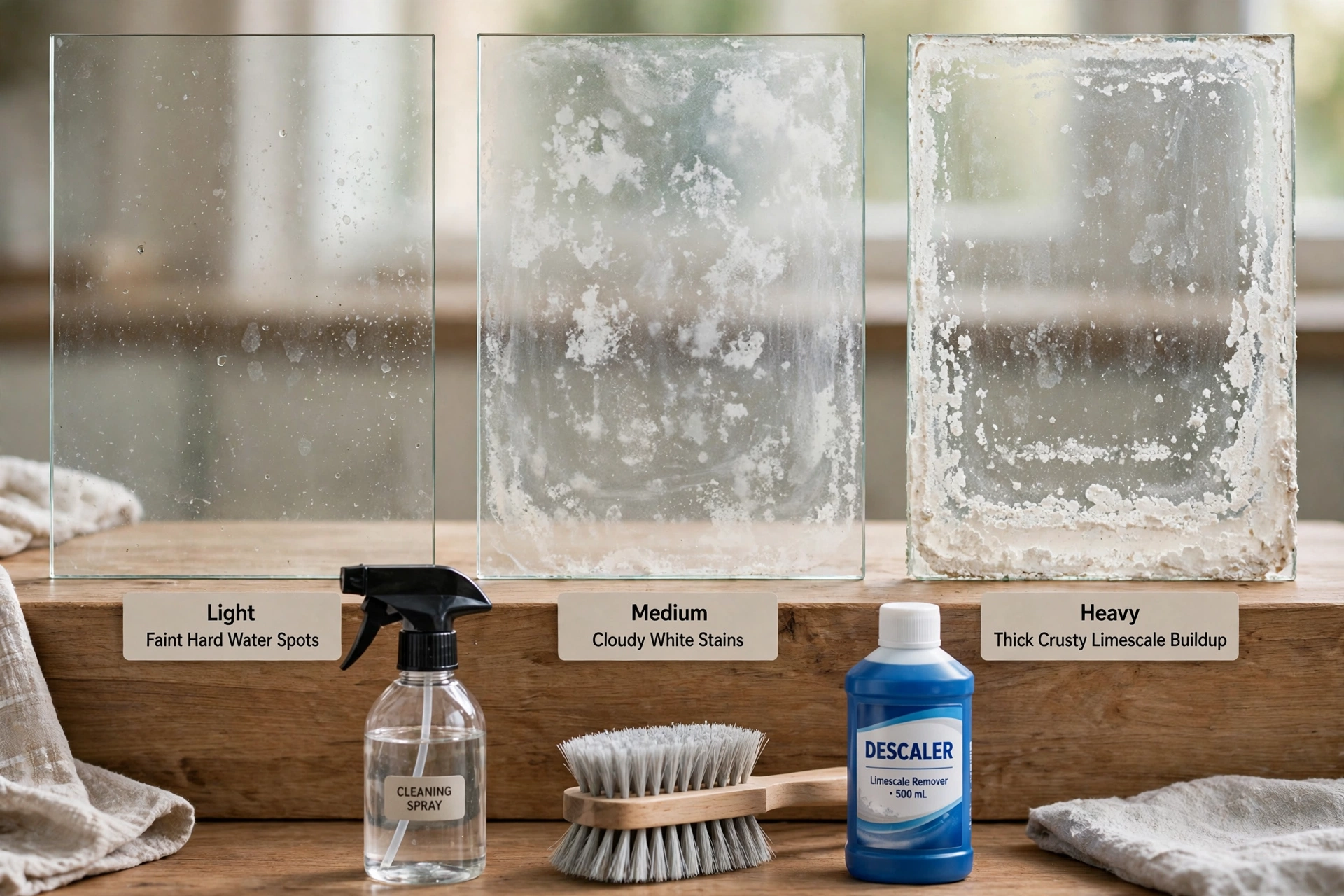
The last step in learning how to remove hard water stains is knowing which method matches the stain you actually have, because the wrong method wastes time, risks the surface, or wastes effort. Light stains are faint white spots or a light haze you can see only in certain light, usually less than a month old. For light stains, a vinegar spray and a microfiber wipe is enough — 10 to 15 minutes of contact time, no scrubbing, no special tools.
Medium stains are clearly visible white spots, a cloudy film, or a ring you can feel with your fingertip, usually one to six months old. For medium stains, use a longer vinegar soak with a vinegar-soaked cloth held against the surface, 30 to 60 minutes, followed by a gentle scrub with a soft brush or a baking soda paste. Heavy stains are thick, crusty, or brownish buildup that has been there for six months or more. For heavy stains, start with citric acid or a commercial descaler, give it the full recommended contact time, and use the right tool for the surface — a wet pumice stone for the toilet bowl only, a soft brush everywhere else.
Frequently Asked Questions
What is the fastest way to remove hard water stains?
The fastest way to learn how to remove hard water stains is a vinegar spray and a microfiber wipe for light stains — spray undiluted white vinegar, wait 10 to 15 minutes, and wipe. For medium stains, use a vinegar-soaked cloth held against the surface for 30 to 60 minutes. Heavy buildup needs citric acid or a commercial descaler and a longer soak.
Can vinegar damage my shower door or faucet?
Vinegar is safe on glass shower doors, chrome faucets, ceramic tile, porcelain, and stainless steel, which is why it is the first step in how to remove hard water stains. It is not safe on natural stone — marble, granite, travertine, or limestone — because acid etches stone permanently. Always test on a hidden spot first if you are unsure about the surface.
How do I remove hard water stains from a toilet bowl that will not come off?
To remove hard water stains from a toilet bowl that resist vinegar, lower the water level, soak the ring with a vinegar-soaked rag for an hour, then rub it with a wet pumice stone, keeping both the stone and the porcelain wet at all times. That is the standard answer for how to remove hard water stains from a toilet bowl, and it works because wet pumice is softer than porcelain. Never use a dry pumice stone, which scratches the glaze.
Why do hard water stains keep coming back?
Hard water stains keep coming back because the cause is still in the water: every drop that evaporates leaves minerals behind, so learning how to remove hard water stains is only half the job. Wipe surfaces dry after every use, squeegee the shower door daily, fix dripping faucets, and use rinse aid in the dishwasher. For a permanent fix, a water softener removes the minerals before they reach your taps.
Can I use lemon juice instead of vinegar to remove hard water stains?
Yes — lemon juice is a mild acid and works the same way vinegar does, so it is a valid option when you are learning how to remove hard water stains. Cut a lemon in half and rub it directly on a faucet or a glass stain, let the juice sit for 10 to 15 minutes, then rinse and dry. It smells better than vinegar, but it is weaker on heavy buildup, so save it for light stains. Never use lemon juice on natural stone, for the same etching reason as vinegar.
Related Reading
- How to Clean a Dishwasher
- How to Clean a Coffee Maker
- How to Clean a Shower Head
- How to Clean Stainless Steel
- How to Clean a Washing Machine
- How to Clean Hardwood Floors
Conclusion
Learning how to remove hard water stains comes down to three things: match the method to the surface, let the acid do the work instead of scrubbing harder, and never use acid on natural stone. Start with vinegar and a microfiber cloth for light stains, step up to citric acid or a commercial descaler for heavy buildup, and keep a wet pumice stone for the toilet bowl only. Then prevent the next round — squeegee the shower door, wipe the faucet dry, and consider a water softener if your water is very hard. The stains took months to build up; with the right method by surface, they take less than an hour to remove.